WARCOMMONS IS NOW ON ANDROID
Explore WWII history and stay connected with the community on the go.
GET THE APP →

The Nuremberg Laws never ordered a single murder. That was exactly the point, and exactly what made the Holocaust possible.
It’s hard to imagine, but with one signature more than half a million German citizens lost their full citizenship rights. This actually happened on September 15, 1935, when the so-called Reich Citizenship Law (Reichsbürgergesetz) was signed. It was a part of the Nuremberg Laws. Needless to say, all of these citizens were Jewish people, and the law turned them into ‘subjects’ without political rights.
The Nuremberg Laws
There have been a few discussions on the exact moment that Hitler revealed his real plan, to exterminate all Jewish people in Europe. But what can’t be denied is that the signs were already clear by 1935. This was the year that the Nuremberg Laws were signed. There are some misconceptions about this Law sometimes, because it wasn’t just one Law.
The Nuremberg Laws were in fact racist and antisemitic decrees that were introduced by Nazi Germany on September 15, 1935. They institutionalized state-sponsored discrimination and stripped Jewish people of their basic rights. The two core laws were the Reich Citizenship Law and the Law for the Protection of German Blood and German Honor. Both were exactly as menacing as they sound. The Reich Citizenship Law declared that only people of ‘German or kindred blood’ could be citizens of Germany. The Law for the Protection of German Blood and German Honor, meanwhile, banned marriages and sexual relations between Jews and German citizens. It also prohibited Jewish families from employing German female domestic workers under the age of 45.
But how do you decide who is Jewish according to the Nuremberg Laws?
Contrary to popular belief, the laws did not rely on religious beliefs at all. The Nazis defined who was Jewish according to ancestry, not religious belief. This rule stems from a series of supplementary decrees and executive ordinances, such as the First Supplementary Decree of November 14, 1935. The latter legally defined who counted as Jewish or who was seen as a Mischling (mixed-race). Over the following years, these foundational laws were expanded by dozens of additional discriminatory decrees that completely barred Jews from public life, professions, and the economy.
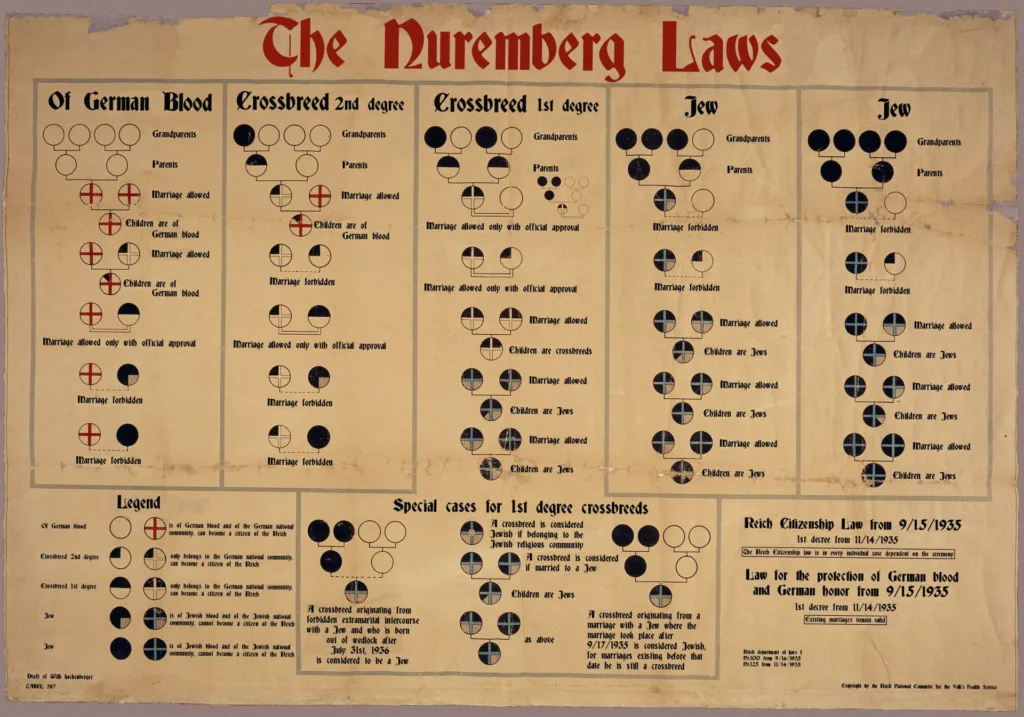
Legalization of Discrimination
The Nuremberg Laws foreshadowed what was still to come. Their main objective was to translate false Nazi racial ideology into official government policy. It was in fact just Hitler giving substance to what he had set out in his book Mein Kampf.
By stripping Jews of their basic rights as German citizens, the Nazi regime turned them into so-called stateless subjects. They no longer had political rights. They no longer had voting capabilities. They no longer had any legal protections. Jewish people became legally differentiated from their non-Jewish neighbors. This was all because of Hitler’s antisemitism and his belief that the German ‘Aryan’ race was superior and threatened by the presence of Jews. With the Nuremberg Laws Hitler sought to stop what the Nazis called Rassenschande, meaning race defilement. The laws were also signed to prevent the birth of mixed-race children, as the Nazi regime believed that these children undermined the genetic purity of the German population.
As crazy as it may seem, these laws were not just symbolic. These laws were not just symbolically signed as a politician’s promise and left to die. They were brought to life to establish a bureaucratic framework for future persecutions and to normalize racism and dehumanization.
Prior to September 1935, the Nazi anti-Jewish actions were often uncoordinated, localized, or economically focused. In 1933, the SA played the most prominent role in this at the time. They primarily engaged in physical attacks, beatings, and harassment against Jewish individuals, lawyers, judges, and left-wing opponents. Because there were no laws defining who was seen as a Jewish person, the attacks and boycotts were mostly random. They relied on a patchwork of criteria, such as whether a person practiced Judaism or had parents who did.
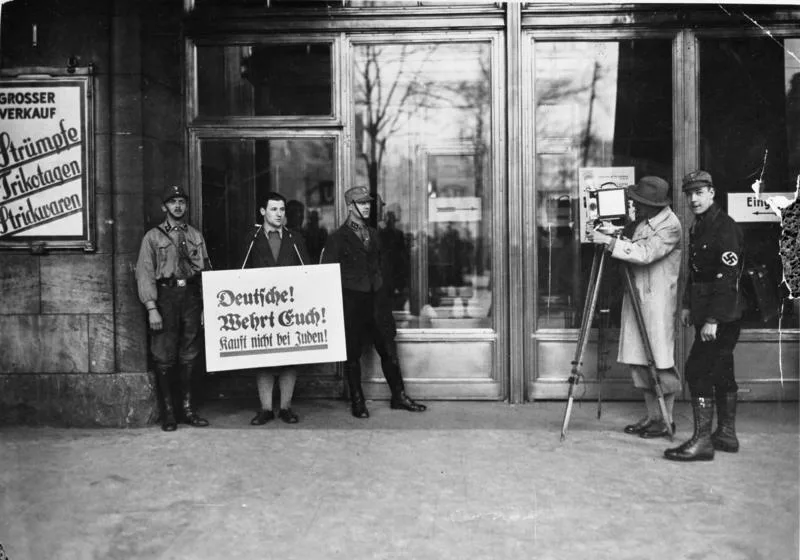
On April 1, 1933, the Nazi regime started organizing a nationwide one-day boycott of Jewish-owned shops, banks, doctor’s offices, and law offices. These businesses were marked by placing SA (Sturmabteilung) guards at the entrances to turn customers away. But marginalization on paper wasn’t enough; it extended to burning the ideas themselves. It was a proven tactic to destroy any ideas that were different from those of the Nazi ideology. Nazi-led student groups and authorities publicly engaged in burning books that were written by Jewish, Marxist, and pacifist authors across German university towns.
No Mandate for Violence
The laws were the first step to make the Holocaust possible. Still, it’s surprising to read that the laws themselves did not explicitly mandate violence. It’s hard to imagine this, just because of the sheer amount of violence that was in fact used against Jewish people, not only after the laws, but from March 1933 onwards. Racism was institutionalized and it created an environment that encouraged ordinary citizens to turn against their Jewish neighbors, business partners, and friends. It removed the moral and legal barriers to persecution.
And so it’s safe to say: people did know what happened to their fellow citizens, what happened to their neighbors.
Even if the laws did not mandate violence, they achieved the critical precondition for the Holocaust. It dehumanized Jewish people and it stripped a targeted population of the so-called right to have rights.
With Jewish people now reduced to objects under the law, without rights, the path toward systematic mass extermination was paved. However, ‘I was just following the law’ would not ultimately save the guilty parties.
Continue the discussion
The Nuremberg Laws never explicitly ordered violence; they stripped Jews of the legal protections that stood in its way. Do you think that makes the people who enforced them, quietly, on paper, any less responsible than the ones who committed violence directly?
Join Field Reserve for free and make your case inside the WarCommons community at our Field Headquarters.
WarCommons publishes long-form, source-driven World War II analysis without ads or sponsored content. If you found this article valuable, consider supporting independent research by joining Field Command.
By Nick Ravenshade — Founder & Editorial Director, WarCommons
Header image: Berlin, boycott of Jewish shops. 1933. Source: Wikimedia Commons / Bundesarchiv, Bild 183-R70355 / Unknown. CC-BY-SA 3.0.