WARCOMMONS IS NOW ON ANDROID
Explore WWII history and stay connected with the community on the go.
GET THE APP →

In just eighteen months, propaganda and terror turned a fragile coalition government into an unchallenged one-party state, and made it look like democracy the whole way through.
Propaganda played a pivotal role in Hitler’s rise to power. As we established in Part I of this series, the propaganda during the early years was revolutionary, but it needed refinement. The goal of his propaganda during those early years was also different; it was to build his power. On January 30, 1933, Hitler succeeded, and propaganda was a big part of his success. He became the Reich Chancellor, but in his cabinet he only had three nazi ministers. Now Hitler had his power, but the propaganda wouldn’t go away. He maybe even needed it more now than ever. He needed it to consolidate his power.
A Fragile Government
Even though Hitler became Reich Chancellor on January 30, 1933, it was far from certain whether he would remain in power. He was also not an absolute dictator, yet. What he was, was the head of a fragile, multi-part coalition government. Remember, in his cabinet he only had three out of eleven seats that were held by the Nazis. He did have conservative coalition partners who were led by Vice-Chancellor Franz von Papen; who naively believed that he would be the one capable of controlling and containing Hitler.
It took only one day after Hitler’s appointment as Reich Chancellor that he asked President Paul Von Hindenburg to dissolve the Reichstag and call a quick election for March 5, 1933. Hitler was very aware of the fact that he simply lacked a parliamentary majority. President Hindenburg gladly obliged. He signed the official decree on February 1, 1933, to dissolve the Reichstag. And no, propaganda didn’t have anything to do with it, yet.
Hitler had deliberately sabotaged the coalition talks with the centrist parties to claim that the parliament was deadlocked without any hope. President Hindenburg accepted Hitler’s explanation at face value, even explicitly stating in his formal dissolution order that a stable parliamentary majority could not be formed under the current circumstances. Franz von Papen would also give Hitler a helping hand by strongly supporting the dissolution. President Hindenburg wouldn’t be so quick to dismiss the advice of his closest advisor. Franz von Papen was absolutely sure of what would happen in a new election. He and the conservative cabinet members believed that a quick election would sweep in a massive conservative-nationalist majority, which would firmly anchor Hitler under their control while permanently crushing the left.
However, they failed to recognize that Hitler was now in a position of power, unlike the first election that had ultimately made him the Reich Chancellor. Of course Hitler would make sure that the elections would be ‘fair’. He even thought of maintaining election law and order by giving weapons to the Sturmabteilung (SA) and the Schutzstaffel (SS).
Still, Hitler wasn’t able to just shut down opposition newspapers to aid his cause. His own propaganda newspaper machine was still facing competition. It’s mind boggling that Hitler managed to convince Hindenburg to sign the ‘Decree for the Protection of the German People’ on February 4, 1933. This gave the police authority to ban political meetings and marches and censor publications.
It was probably frightening to see that on February 17, 1933, Göring (who was already Hitler’s right-hand man and the Interior Minister of Prussia) had issued the so-called ‘Shooting Decree’. This was a formal order issued to the Prussian police force. The policemen were instructed to use their firearms ruthlessly against political enemies. He explicitly stated that any officer who shot an opponent would be protected. But officers who failed to shoot out of ‘false consideration’ would face disciplinary action. On February 22, 1933, Hermann Göring officially deputized 50,000 SA and SS members as ‘auxiliary police’. The Nazi thugs now wore official white armbands, carried state-issued weapons, and had the legal authority to arrest anyone.
This all meant that from late February, anti-Nazi campaign rallies were frequently broken up by the newly deputized auxiliary police. The mainstream socialist and Catholic newspapers were also banned or heavily censored by Hitler’s newly-found power. It meant that Hitler’s Nazi propaganda could finally flood the public increasingly unchecked.
Reichstag Fire
There was not much to it; Hitler needed the Nazi propaganda to secure another win at the upcoming elections. His luck changed on February 27, 1933. The election was already less than a week away, when the Reichstag was engulfed in flames.
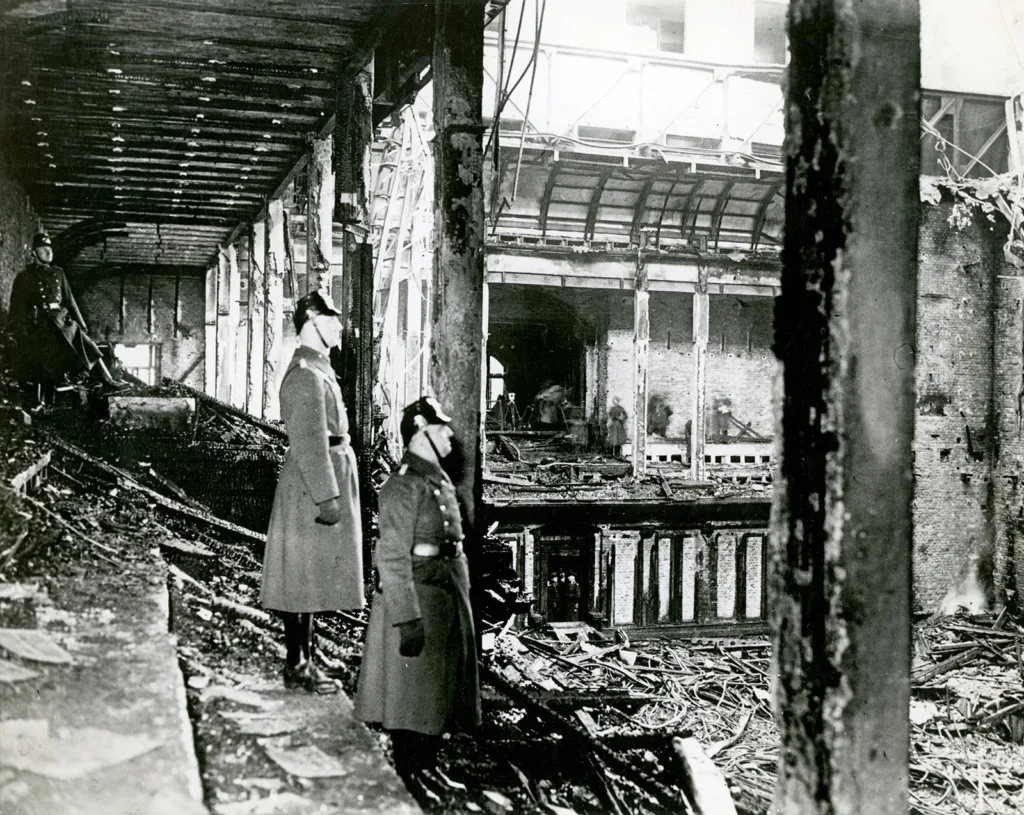
It was the lucky break Hitler needed, and it didn’t take much to get Hindenburg fully on his side. Hindenburg had already bought into Hitler’s ideas that this specific election was a battle for ‘national survival’. Therefore Hindenburg didn’t hesitate and he readily signed the Reichstagsbrandverordnung (Reichstag Fire Decree, sometimes better known as: Decree of the Reich President for the Protection of the People and the State), the morning after the fire. It should be clarified that Hindenburg didn’t help Hitler out because he had some kind of personal loyalty to Hitler. Hindenburg was an ageing, deeply conservative military man who despised communism and feared a civil war in the ever so unstable Weimar Republic. He therefore decided to sign the decree because he was convinced by Hitler and his small Nazi cabinet that a communist uprising was actively starting with the Reichstag fire.
This was a pivotal moment, as the decree suspended the core civil rights guaranteed by the Weimar Constitution and allowed the Nazis to mass-arrest thousands of leftist leaders just days before people went to the ballot box. Citizens no longer had any freedom of speech, freedom of press, and right to assemble. To put it bluntly, Hitler actually cheated the elections. Hitler was no longer just a lance corporal running in the elections. He was the Reich Chancellor, and he made sure to use all of his executive authority to secure the electoral win.
Hitler couldn’t do this on his own. After the fire, Joseph Goebbels held all the cards as he immediately launched a massive propaganda blitz. The Reichstag fire was framed as the start of a violent ‘Communist uprising.’ This managed to successfully panic the middle class into voting for the NSDAP, because the party had profiled itself as the sole defender of public order.
The Death of Democracy
Framing the Reichstag fire wasn’t the only propaganda offensive that Hitler concocted with Goebbels. The tactics completely shifted from what people had seen during the 1919-1933 period. It wasn’t just one newspaper and multiple campaigns within a day anymore. Hitler now had the full power to use his propaganda virtually unopposed.
With the power that Hitler now held as Chancellor, the Nazis quickly brought public radio under their control. Hitler also banned opposition parties, specifically the Social Democrats (SPD) and the Communists (KPD), from using the radio. Hitler ensured that only Nazi speeches and nationalistic rallies dominated the airwaves.
One of the most iconic examples was the Aufruf an das deutsche Volk, or the Appeal to the German People. It was Hitler’s first major radio address that he delivered on February 1, 1933, just two days after he was appointed Chancellor by President Hindenburg. In this radio address Hitler framed the Nazi movement not as a political party, but as a transcendent national renewal movement that tasked itself with overcoming fourteen years of democratic ‘decay.’
But the newspapers also continued to be a vital part, just like in the previous years. Hitler therefore managed to systematically shut down hundreds of opposition newspapers. The Nazis confiscated printing presses and arrested journalists. It left voters with a heavily biased information ecosystem.
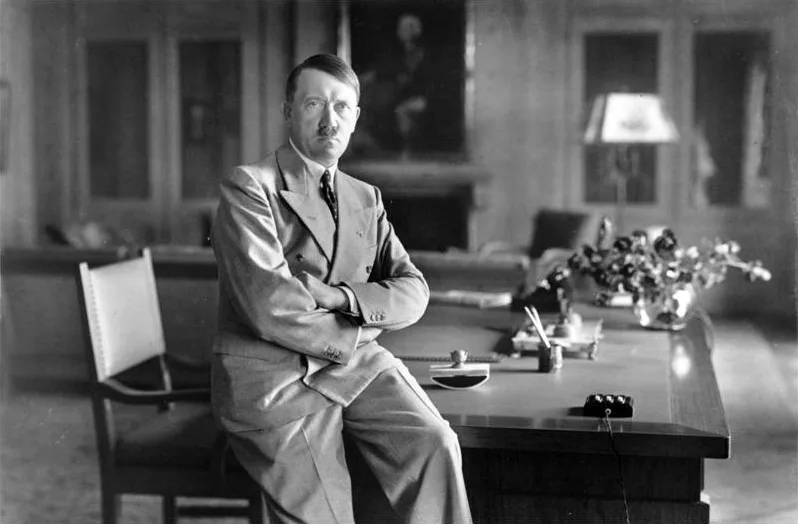
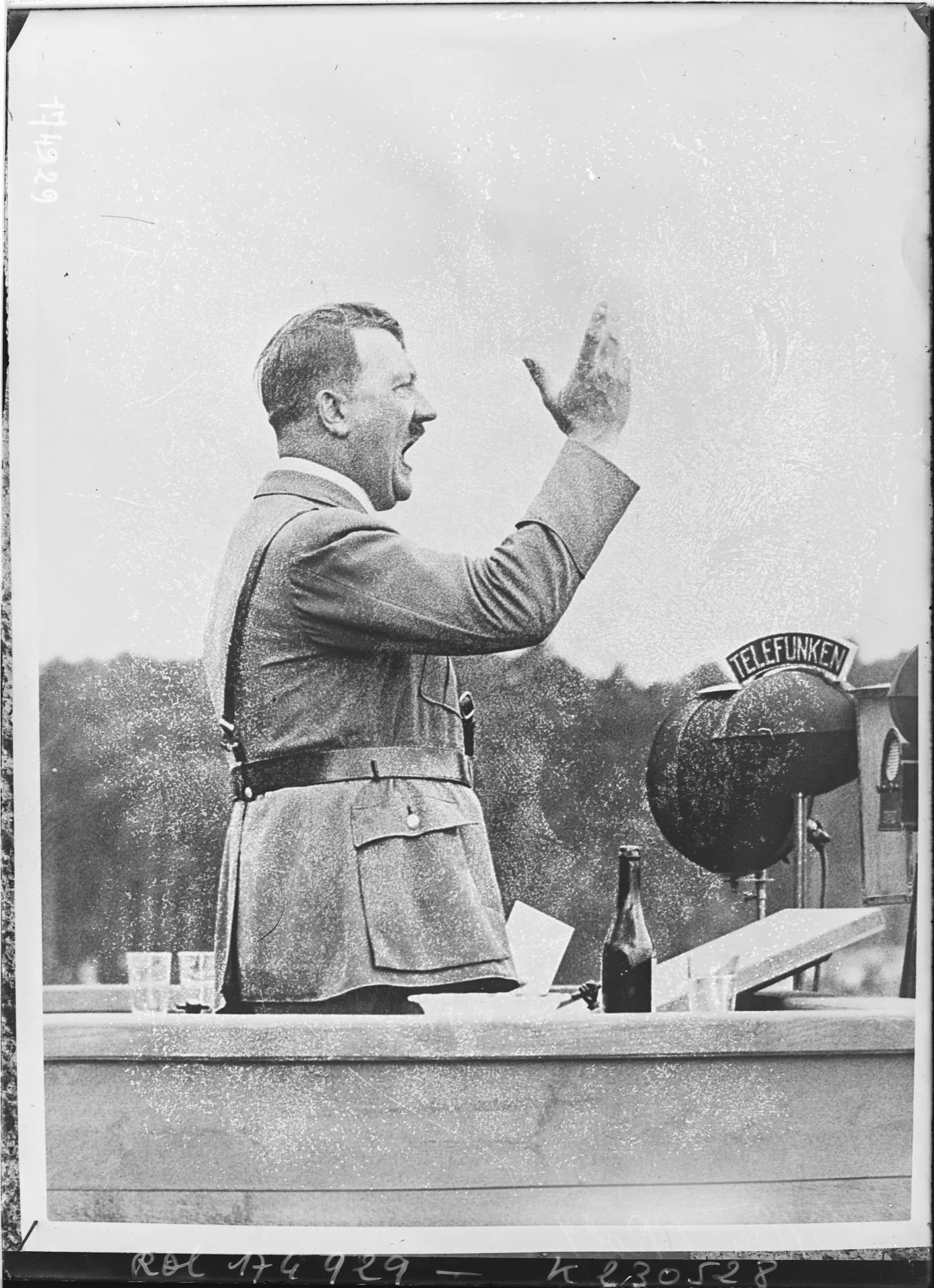
It wasn’t just the information ecosystem that was skewed; it was also about putting Hitler first. Nazi propaganda began to skew to creating the so-called cult of the Führer. They used propaganda to carefully decouple Hitler from the traditional and messy party politics. They made sure to present Hitler as an unassailable, selfless leader who stood above the political corruption. They portrayed him almost as the chosen one, the only one capable of restoring German pride. How Hitler was perceived was worked out in detail, from massive rallies to photos that were taken of him. Hitler spent countless hours perfecting his stances to use in his speeches and in photos.
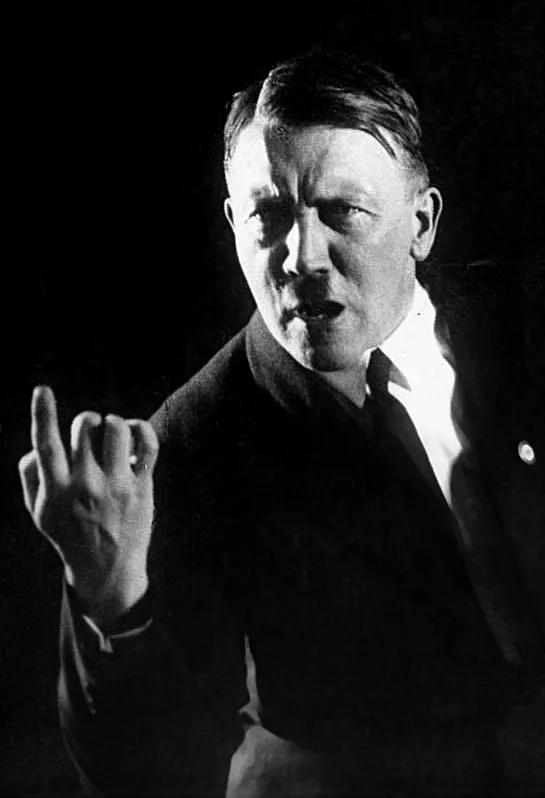
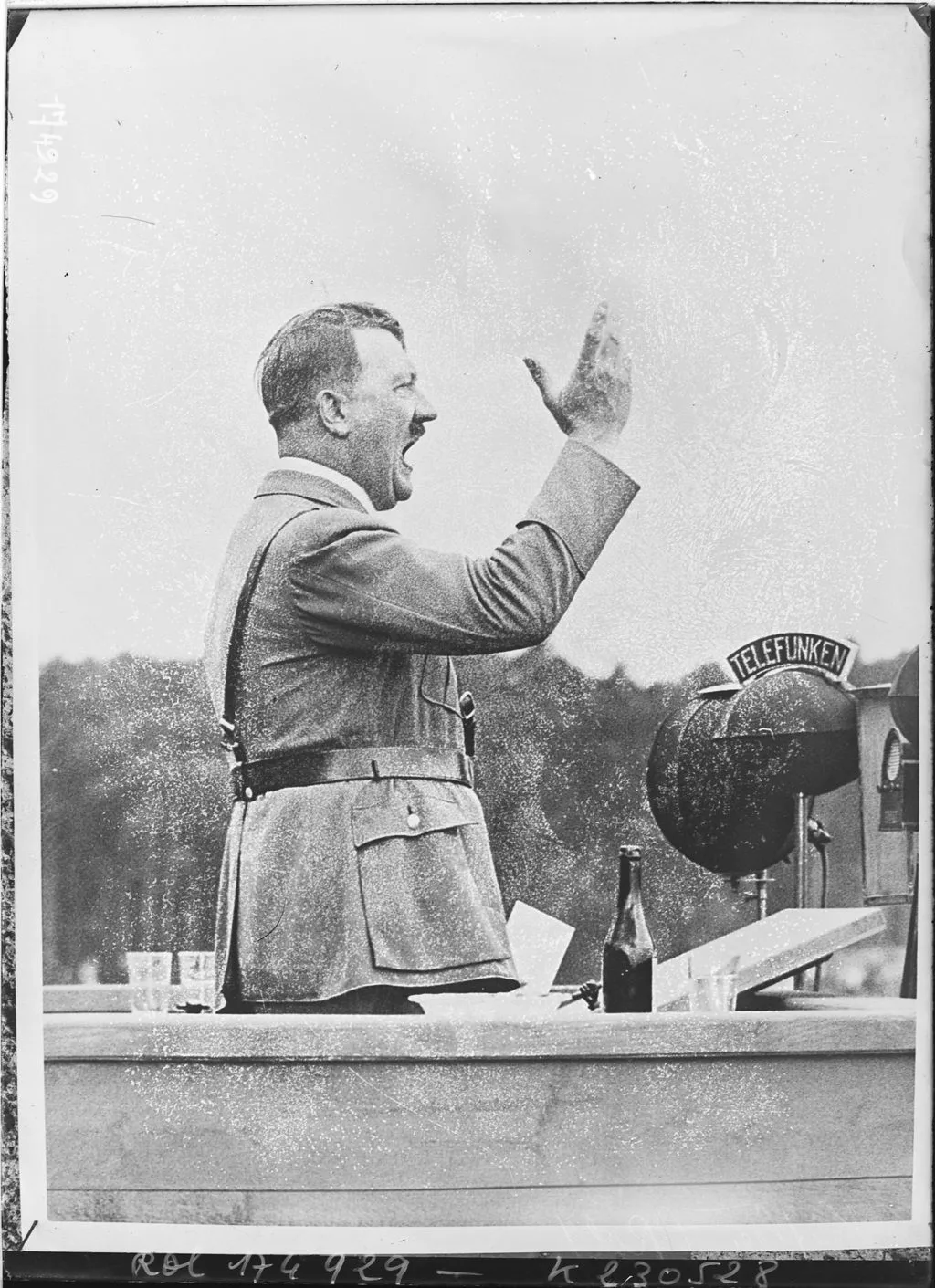
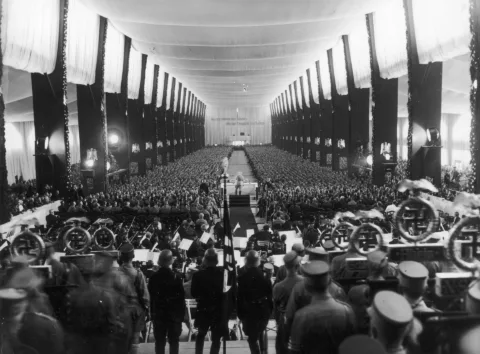
The mass rallies were therefore also not just random. They were carefully planned to extract maximum advantage for the Nazi propaganda campaigns. Everything, even the lighting was not random.
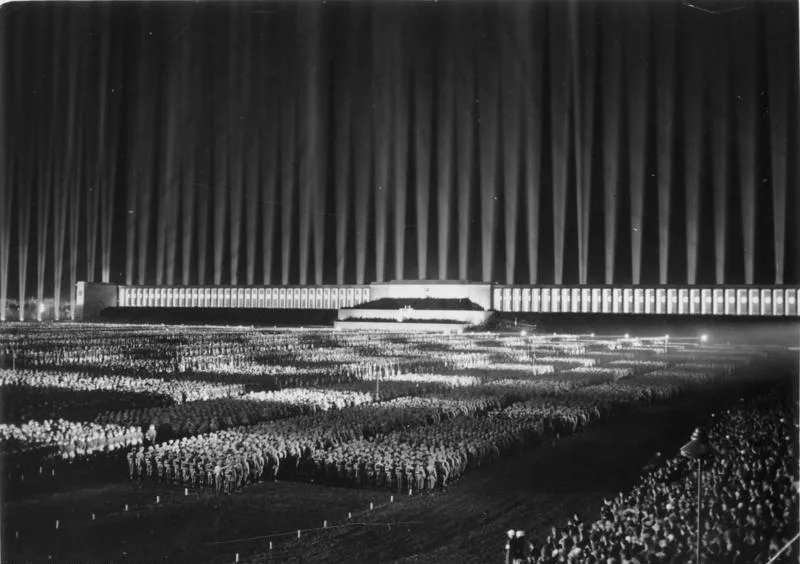
This was combined with Hitler delivering highly choreographed speeches in front of these massive audiences. It is safe to say that probably not a single aspect of these rallies would be successful on its own. But combining the dramatic use of searchlights, synchronized chanting, and vast displays of swastika flags simply overwhelmed the senses of the people. Together with Hitler’s speeches, it completed the propaganda picture for maximum effect. It aimed to create a collective feeling of inevitable victory and to induce psychological conformity among the attendees.
It was all carefully planned and executed to secure an overwhelming win at the ballot box. No matter the effort, it almost failed.
The March Election
State terror, SA violence, absolute indoctrination through radio broadcasts and massive Nazi rallies, and Hitler’s speeches. This was the reality for the German people leading up to the March 5, 1933, elections. The opposing media and political parties were heavily suppressed. The Nazis made it seem like the only thing the German people could vote for was the NSDAP or the NSDAP.
Despite all of the terror and effort to sway the public, the Nazi party failed to obtain an absolute majority once more. They ‘only’ secured 43.9% of the votes, which was good for 17,277,180 people that voted for the NSDAP. Contrary to popular belief, not even half of the votes cast went to the Nazi Party, while the turnout was remarkably high at 88.74%. Still, Hitler now needed the German National People’s Party (DNVP) to secure any legislative control, as the NSDAP would only hold 288 seats out of the 647 in the parliament.
Hitler succeeded in partnering with the DNVP of Alfred Hugenberg. Together they held 51.9% which gave them a working majority in the parliament. But the road to Hitler’s dictatorship was absolutely not set in stone. In fact, it was still very uncertain.
Enabling Act
The Enabling Act, or Ermächtigungsgesetz, aimed to alter the German constitution. This meant that Hitler needed a supermajority of 66.7% in the Reichstag to pass the act. The partnership between the NSDAP and the DNVP was therefore not sufficient. Hitler had to sway other parties into voting ‘Yes’, which would ultimately mean that the parties would vote to destroy the Reichstag’s power. Still, the important part was that the other political parties did not know this. They were absolutely convinced this was a temporary, desperate compromise that would preserve what was left of their institutions. They completely underestimated Hitler’s capacity to completely destroy them.
But first, Hitler had to make sure that the parties would be convinced it was temporary. And so something interesting happened with the Nazi propaganda that was primarily driven by Hitler and Goebbels.
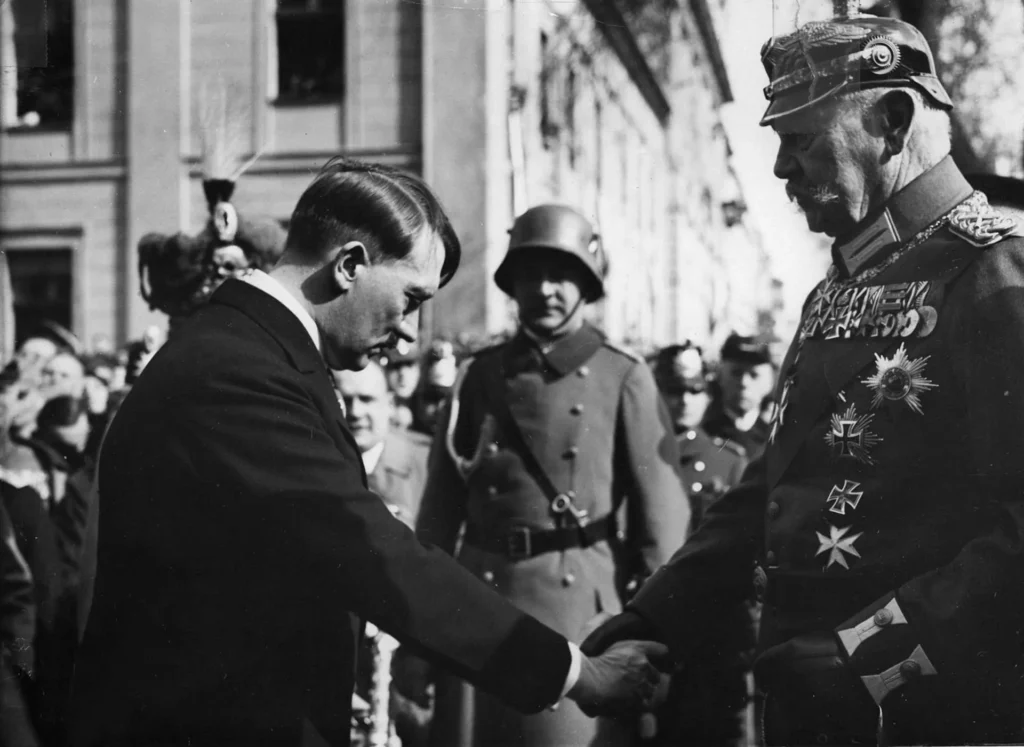
Hitler didn’t want to leave anything to chance, so the first major step was taken as soon as March 21, 1933. It was the so-called Day of the Potsdam spectacle. Hitler staged a highly publicized ceremony at the Garrison Church in Potsdam.
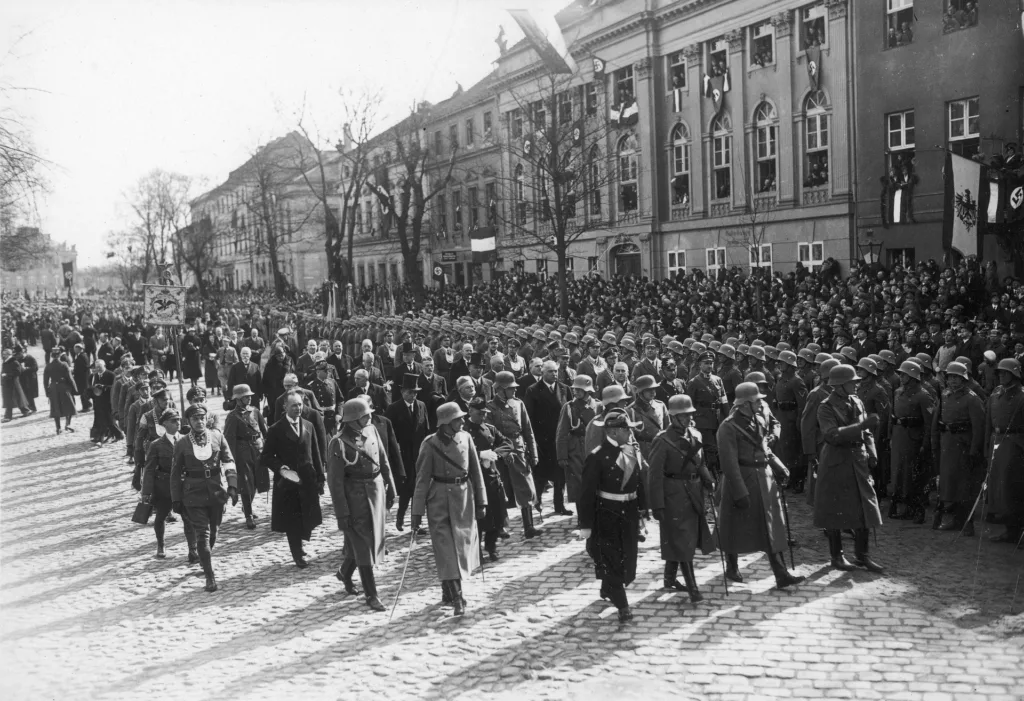
There was Hitler, center stage, bowing deeply to the conservative Reich President Hindenburg. The Nazis wanted to show the middle-class citizens, the conservative politicians, and the military that Hitler respected the traditional Prussian values and that he wasn’t a soon-to-be radical dictator.
Since the Reichstag fire brought the Nazis a previous win with highly effective propaganda, they turned to it again. It was once more framed as the starting point of a violent communist revolution that was absolutely imminent. The Nazis simply continued with their false narrative propaganda. During the speech, Hitler assured the public that the Enabling Act was only a temporary necessary emergency act to protect the state.
The Enabling Act was simply a coup? Nazi propaganda made sure you’d feel stupid for even thinking this. No, the act was absolutely a peaceful and lawful procedure rather than a violent coup, according to the Nazi propaganda. And Hitler would make sure everyone would continue to think this, even appealing to the Catholic Centre Party. He explicitly assured them that the Enabling Act would also protect their religious, cultural, and civil rights, but only if the Catholic Centre Party would support the act.
Maybe the most successful aspect of the Nazi propaganda during this episode was that it managed to create the so-called illusion of unity. It was framed as a national renewal in a positive way. The Nazi-controlled media targeted the German public with slogans of unity. They kept claiming passing the Enabling Act would finally end years of parliamentary gridlock, political instability, and economic ruin. And it’s safe to say that the German people were more than fed up with the violent instability the Weimar Republic brought them.
Old Habits Die Hard
It was, in this way, remarkably sophisticated how Hitler and Goebbels managed to utilize their propaganda. Still, Hitler had to rely on old methods at the actual vote as well. He simply couldn’t leave it to chance that the Enabling Act would be passed.
Hitler made sure that even if a politician wanted to vote against the act, it was made almost impossible. Once more the Nazi party defaulted to old habits of using the SS and the SA to intimidate the lawmakers. During the day of the vote on March 23, 1933, armed SS and SA troops surrounded and filled the corridors of the Kroll Opera House. They all chanted: ‘We want the Act, or there will be fire and murder!’ After days of false promises, anti-communist fear, and ultimately physical intimidation, 444 lawmakers voted in favor of the Enabling Act, while only 94 voted against. These 94 votes came from the Social Democrats, who refused to fold under the pressure and intimidation.
Through sophisticated Nazi propaganda and old habits of intimidation, Hitler achieved his ultimate goal. He got his supermajority vote in favor of the Enabling Act. And without realizing it yet, the other political parties had just voted to destroy the Reichstag’s power
Law to Remedy the Distress of the People and the Reich
Gesetz zur Behebung der Not von Volk und Reich. This was the official title of the Enabling Act. Hitler and his cabinet were now given the power to bypass the Reichstag entirely. Hitler could draft, pass, and implement laws by executive decree without any Reichstag votes. It also rendered President Hindenburg partially powerless, as the laws no longer required the signature or approval of the Reich President. It is still absolutely unbelievable how Hitler managed to acquire this amount of power through a heavily influenced democratic process.
Maybe the most shocking aspect of this new law was that it stated that any laws that were enacted by the cabinet could in fact violate and deviate from the Weimar Constitution. This amount of absolute power guaranteed the death of democracy. In the most simple terms it meant that the Weimar Constitution turned into nothing more than toilet paper in one single day.
The Reich government also gained the sole authority over the national budget and the authority to sign certain foreign treaties. Neither was dependent on Reichstag approval any longer.
In one day the Reichstag was no more.
Gleichschaltung
Hitler immediately executed a policy of Gleichschaltung, which translates to Synchronization. It was a rapid and aggressive Nazification of every pillar of German society. On May 2, 1933, Hitler banned every independent trade union that existed. Nazi troops raided the offices and the union leaders were sent to concentration camps. They were all replaced by the German Labour Front (Deutsche Arbeitsfront, DAF), which became the only state-controlled labor organization that was allowed to exist.
Naturally, it also didn’t take long before all other political parties were completely banned. On July 14, 1933, Hitler brought the ‘Law Against the Formation of Parties’ to life. The law made the NSDAP the only legally permitted political party in Germany. Hitler pressured the DNVP and the Centre Party to dissolve themselves, with the DNVP effectively absorbed into the NSDAP. Hitler’s enemies, the Communist party and the Social Democrats, fled or were arrested.
Through 1933 and 1934, Hitler continued to abolish federalism by stripping state parliaments of their authority. This happened in Prussia and Bavaria, where Hitler appointed Nazi governors (Reichsstatthalter) to rule them directly from Berlin. Hitler made himself the Reichsstatthalter of Prussia and delegated his powers in Prussia to Hermann Göring. Franz von Epp became the Reichsstatthalter in Bavaria.
One of the first major acts of state racism, discrimination, and antisemitism also took place with the April 1933 law named ‘Law for the Restoration of the Professional Civil Service.’ This law fired all anti-Nazis, democrats, and Jewish officials from schools, universities, courts, and government offices, with initial exemptions. If there were still any doubts as to what Hitler’s plans were, this should’ve made it very clear.
The Death of a President and a Republic
Reich President Hindenburg’s powers were already weakened. Yet he was the one person that unintentionally made the death of German democracy happen. He was one of the enablers whose miscalculation let him live to see Hitler put democracy to death. He could’ve stopped Hitler, but he underestimated him greatly. Even with the Enabling Act, President Hindenburg held the power to dissolve the Reichstag or to completely dismiss Hitler. The Enabling Act explicitly stated that the powers of the Reich President “remain unaffected.”
On August 2, 1934, President Hindenburg died. It paved the way for Hitler to acquire the total control over the country. Because the powers of the Reich President remained unaffected, he had to give himself those exact powers to prevent anyone being able to dismiss him or to dissolve the Reichstag.
And so, Hindenburg’s death meant that Hitler could now also finally abolish the office of the President, while merging its powers with the Chancellorship. From that moment on Hitler became Führer und Reichskanzler. The Reich Presidency was no more. On the same day a personal oath of loyalty from the entire German military was also demanded. Contrary to popular belief, Hitler in fact didn’t force this oath onto a reluctant military high command. The ‘Führer Oath’ was initiated and drafted by the Defense Minister Werner von Blomberg and General Walther von Reichenau. Together they offered this personal oath to Hitler on their own initiative as a political maneuver. They were convinced that by offering Hitler absolute personal loyalty, they could secure the military’s independence, guarantee massive funding, and ensure that Hitler would choose them over the SA.
Legitimizing Absolute Power and Permanent Propaganda
Still, Nazi Germany was a democracy. Wait, not really, but Hitler wanted to make it seem that way. He actually sought ‘democratic legitimacy’ within his illegal constitutional consolidation of powers. The Nazi propaganda machine was once more ramped up to achieve Hitler’s goals. Hitler held a plebiscite on August 19, 1934, but not before the German people were once more influenced by sophisticated Nazi propaganda and widespread voter intimidation by the SS and the SA. The vote was to approve Hitler’s consolidation of absolute power. It is said that approximately 90% of the German voters approved Hitler’s absolute power. It marked the official death of the Weimar Republic and the formal consolidation of Hitler’s position as absolute dictator.
From using propaganda to build his power, to consolidating his power. Hitler would continue to use propaganda to sustain his power and justify his road to an existential world war. The use of Nazi propaganda never stopped; it only continued to develop with the ever-changing goals it had to help accomplish. But now more than ever, it was organized and highly effective. Goebbels’ Reich Ministry of Public Enlightenment and Propaganda was already signed into law on March 13, 1933.
This marked the beginning of propaganda no longer used merely to secure votes, but rather as an arm of state coercion.
The Propaganda Front: Nazi Germany, Part III – Soon!
Continue the discussion
Hitler did not destroy German democracy overnight. Propaganda, intimidation, and legal manipulation worked together to make the destruction appear almost lawful. What do you think was the most important step in his consolidation of power?
Join Field Reserve for free and make your case inside the WarCommons community at our Field Headquarters.
Take WarCommons with you on Android.
WarCommons publishes long-form, source-driven World War II analysis without ads or sponsored content. If you found this article valuable, consider supporting independent research by joining Field Command.
By Nick Ravenshade — Founder & Editorial Director, WarCommons
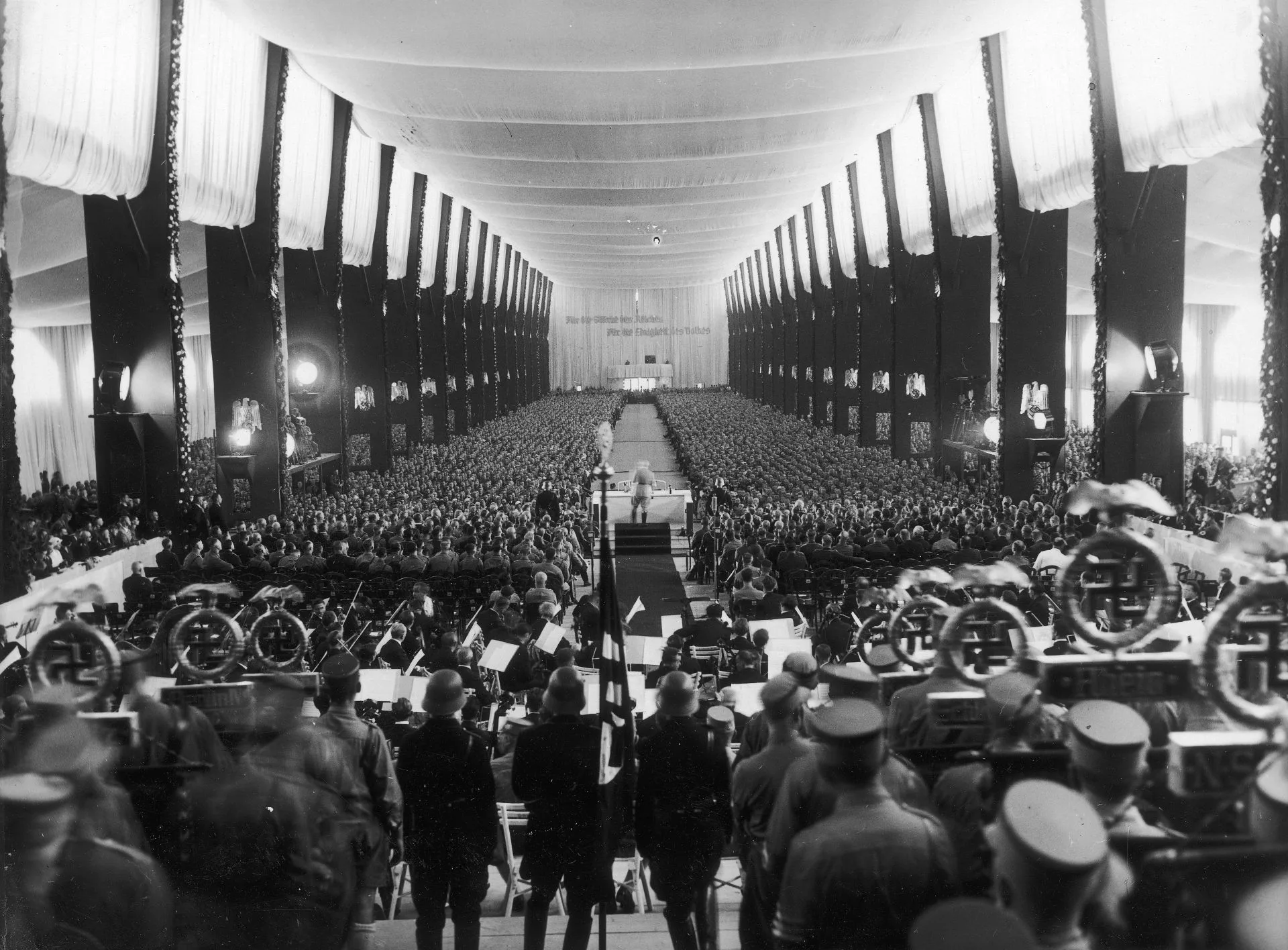
Header image: NSDAP Parteitag Nurnberg Germany Nazi Party Rally. August 30, 1933. Source: Wikimedia Commons. Public domain.




_Narodowe_Archiwum_Cyfrowe_Public.jpg)