WARCOMMONS IS NOW ON ANDROID
Explore WWII history and stay connected with the community on the go. GET THE APP →
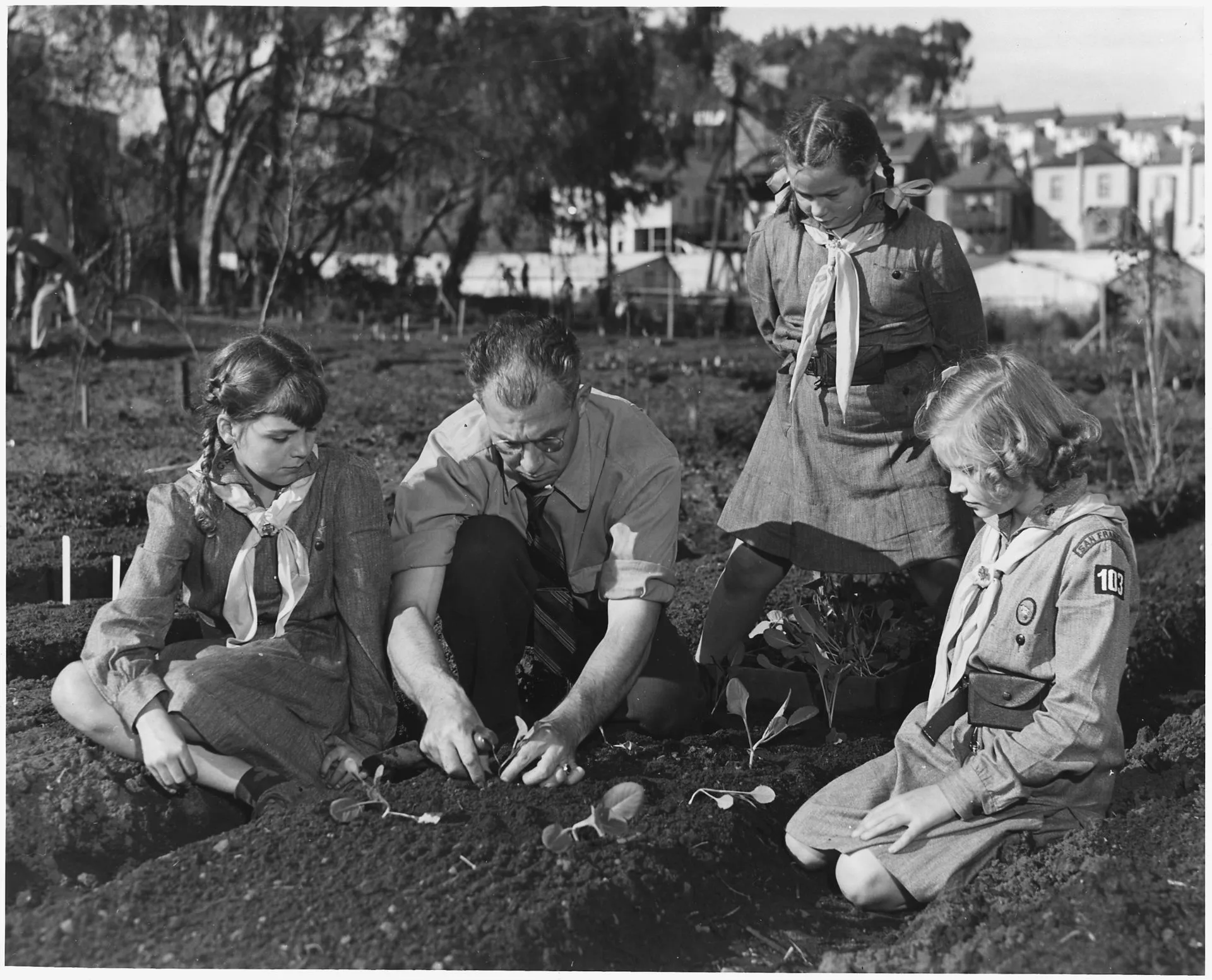

From a London bomb crater to the White House lawn, ordinary people grew a large share of the Allies’ vegetables. Nazi Germany ran its own version, too.
Victory gardens weren’t unique to World War II, but they played an important part in it, especially on the home front. Victory gardens, sometimes called food gardens for defense or war gardens, were not an exclusively Allied invention. These types of wartime collective initiatives raise the question of how important they actually were.
Morale Booster
Victory gardens were wartime initiatives that encouraged people to supplement their rations. People commonly grew fruit, vegetables, and herbs, improving their food security. By growing part of their own food, citizens collectively eased the pressure on the national food supply.
Victory gardens were a great way to indirectly aid the war effort. A pleasant side effect was that the gardens also boosted civilian morale. Part of the idea was that gardeners would feel satisfied or empowered by their personal contribution to the war effort. They were also rewarded with the produce grown in their own gardens. Needless to say, this collective effort brought a sense of purpose and community. It’s no surprise that the gardens became a major part of daily life on the home front.
The name, however, can be a bit misleading. The victory gardens weren’t only an Allied phenomenon: Germany used a similar concept.
Necessity, Not Luxury
It would’ve been somewhat ironic if Nazi Germany called them its victory gardens. But for Germany these gardens were a necessity, not a luxury. Especially from 1936 onwards, Nazi Germany strove for autarky, a self-sufficient economy. Hitler had written a confidential memorandum demanding that the German economy and military be fully ready for war within four years. Choosing this course meant that autarky was the policy to pursue, as Nazi Germany would surely become isolated. This memorandum is better known as the Four Year Plan Memorandum of August 1936.
Germany didn’t have to build this system of food gardens from scratch. Allotment gardening was actually a tradition dating back to the mid-19th century. Germany possessed a vast network of urban allotment gardens known as Schrebergärten or Kleingärten. These plots had already proven to be vital during World War I. Therefore, the German government had already passed a federal law protecting allotment gardens and fixing low rental rates as early as 1919. To no one’s surprise, in May 1933, the Nazi regime forcibly integrated all existing garden clubs into a single centralized, state-run organization called the Reichsbund Deutscher Kleingärtner (RDK). The RDK managed approximately 1.4 million rented plots at its peak.
Britain’s famous slogan was ‘Dig for Victory,’ later borrowed in Australia. But the Nazis, of course, had to frame it more dramatically: Blut und Boden, meaning Blood and Soil, as a general agrarian ideology. The gardens aligned with Germany’s economic goal of autarky, which also caused the gardens to be strictly regulated under the Nazi ideal of Blut und Boden. German citizens, as opposed to the citizens in Allied countries, had no say on what they wanted to plant in the gardens. Everything was explicitly dictated by the Nazi regime, from what to plant to how to lay out the plots.
It’s not clear if Germany’s Blut und Boden doctrine for its food gardens had any positive effect on civilian morale, as victory gardens did in the United States, Britain, Canada, and Australia. What is clear is that the Allied blockades and severe transportation disruptions had crippled Germany’s food supplies later in the war. Germany had also relied heavily on food taken from occupied Europe. German allotment owners were legally mandated to maximize food production for the war effort. What stands out is that a sense of community and doing good did not take center stage in Nazi Germany’s home-front doctrine. Maybe only if you were a die-hard Nazi.
Allied Victory Gardens
Obviously Allied countries didn’t strive for autarky, and they were also not isolated like Nazi Germany. The main goal of the food gardens in Allied countries was to prevent severe food shortages on the home front. This also meant that more of the commercial yields could be diverted to military use.
Although the Allied countries also used this system during World War I, it wasn’t a long-standing tradition like in Germany. The Allied initiative relied mostly on converting non-agricultural land. Across the Allied nations, private lawns, window boxes, apartment rooftops, schoolyards, and vacant commercial lots were re-purposed into functional plots. Some of these choices of location were absolutely ingenious, such as the victory garden in a London bomb crater.
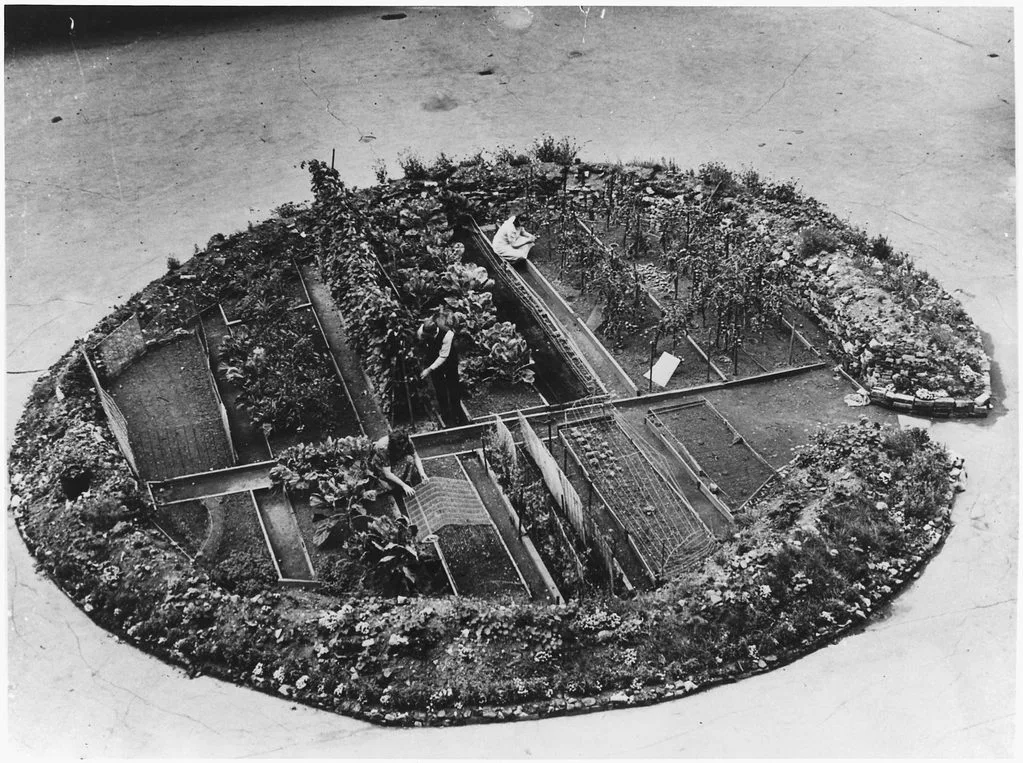
These victory gardens were very effective. In 1943-1944, America’s victory gardens were estimated to supply approximately 40% of the fresh vegetables consumed in the United States. Throughout the war, working on these victory gardens was not just done out of the goodness of people’s hearts. The Allied food supply also had to last through the winter months. Home food preservation became a formalized civil expectation and was presented as a patriotic duty. The government also tracked this expectation, notably through the January 1944 poll. In 1943, 75% of American homemakers preserved food at home, averaging 165 jars each.
Dig for Victory
The so-called Dig for Victory Campaign was perhaps the most iconic undertaking related to the victory gardens. The British Ministry of Agriculture came up with this campaign and slogan. The impact, however, was far greater than the catchy slogan might suggest. Even famous public spaces weren’t spared. Sections of lawn in Hyde Park were plowed and turned into allotments. Onions were grown in the shadow of the Albert Memorial, and vegetable gardens were planted at Buckingham Palace and Windsor Castle at the instigation of King George VI. Who knows, maybe Queen Wilhelmina of the Netherlands even lent a hand at Hyde Park. All jokes aside, Wilhelmina and the Dutch government spent much of the war in exile in London, while Princess Juliana and her children spent much of it in Canada.
Wartime shipping disruption had also complicated the cultivation. Traditional agricultural chemicals and fertilizers became virtually unavailable. British schools and urban gardeners proved to be very resourceful. To offset the loss of agricultural chemicals, they raised pigs on-site specifically to use the manure and collected soot from residential chimneys to alter soil composition.
United States Victory Gardens
We already touched on America’s victory garden effort a little. It also converted high-profile locations into victory gardens. Some of the most notable were gardens planted in San Francisco’s Golden Gate Park and at the Portland Zoo. And where Queen Wilhelmina probably didn’t lend a hand in Britain, the First Lady of the United States certainly did. A victory garden was planted on the White House lawn in 1943. Eleanor Roosevelt insisted on it despite objections from the Department of Agriculture. It was tended by eleven-year-old Diana Hopkins, the daughter of presidential adviser Harry Hopkins.
The United States is also known for Boston’s Fenway Victory Gardens, a massive network of gardens that spanned over 500 active civilian plots during World War II. It is one of two World War II victory garden sites in the United States that have remained in continuous operation since the war.
Even if we’re discussing Allied victory gardens, it’s not all free of controversy. Japanese Americans who were forcibly incarcerated at camps like Amache and Manzanar built and worked extensive, highly productive gardens there.
Canadian and Australian Victory Gardens
Canada introduced its first Official Food Rules in July 1942. The guide acknowledged wartime rationing and aimed to prevent nutritional deficiencies and improve the health of Canadians. This meant that Canada was able to fulfill its massive international food export commitments to Britain without triggering the starvation of its own citizens.
In January 1942, Prime Minister John Curtin launched Australia’s own “Dig for Victory” campaign as a result of severe food shortages caused by prolonged drought, labor shortages, and military enlistments. However, Australia’s campaign also differed in some ways. The financial cost of running the campaign was absorbed entirely by individual state governments rather than the federal government. In July 1942, the Young Women’s Christian Association (YWCA) launched the so-called Garden Army Week to boost neighborhood-level crop production by organizing civilian women and children into dedicated planting brigades.
By 1943, however, some areas were encountering problems. Home gardens and collective neighborhood plots were so prolific that a localized oversupply occurred. For example, in Brisbane the commercial farmers started complaining that their market produce was being dumped because local home growers had flooded the market.
No Drama, No Attention
The victory gardens, or food gardens, are a very underexplored World War II topic. The reason isn’t that the gardens were meaningless. On the contrary, these gardens were very important, and in countries like the United Kingdom the gardens were absolutely vital for survival. Yet, there is little drama surrounding the subject. There are no major battles, technological weapons breakthroughs, or tactical maneuvers. It’s also not glamorous or shocking. But that doesn’t mean we should forget it completely. Sometimes it’s the boring things, the things we take for granted, that add up to winning a war.
Continue the Discussion
Victory gardens asked ordinary people to fight a war with spades and seeds. Would people dig up their lawns today if a government asked? And did the volunteer spirit behind Allied gardens make them different from state-run allotments in Nazi Germany?
If your family kept a wartime garden, share their story.
Join Field Reserve for free and make your case inside the WarCommons community at our Field Headquarters.
Take WarCommons with you on Android
WarCommons publishes long-form, source-driven World War II analysis without ads or sponsored content. If you found this article valuable, consider supporting independent research by joining Field Command.
By Nick Ravenshade — Founder & Editorial Director, WarCommons
Header image: Victory Gardens. Professor Harry Nelson of San Fransico gives his daughter and her Girl Scout friends some pointers in transplanting young vegetables. Circa February 1943. Source: Wikimedia Commons. Public domain.