WARCOMMONS IS NOW ON ANDROID
Explore WWII history and stay connected with the community on the go. GET THE APP →
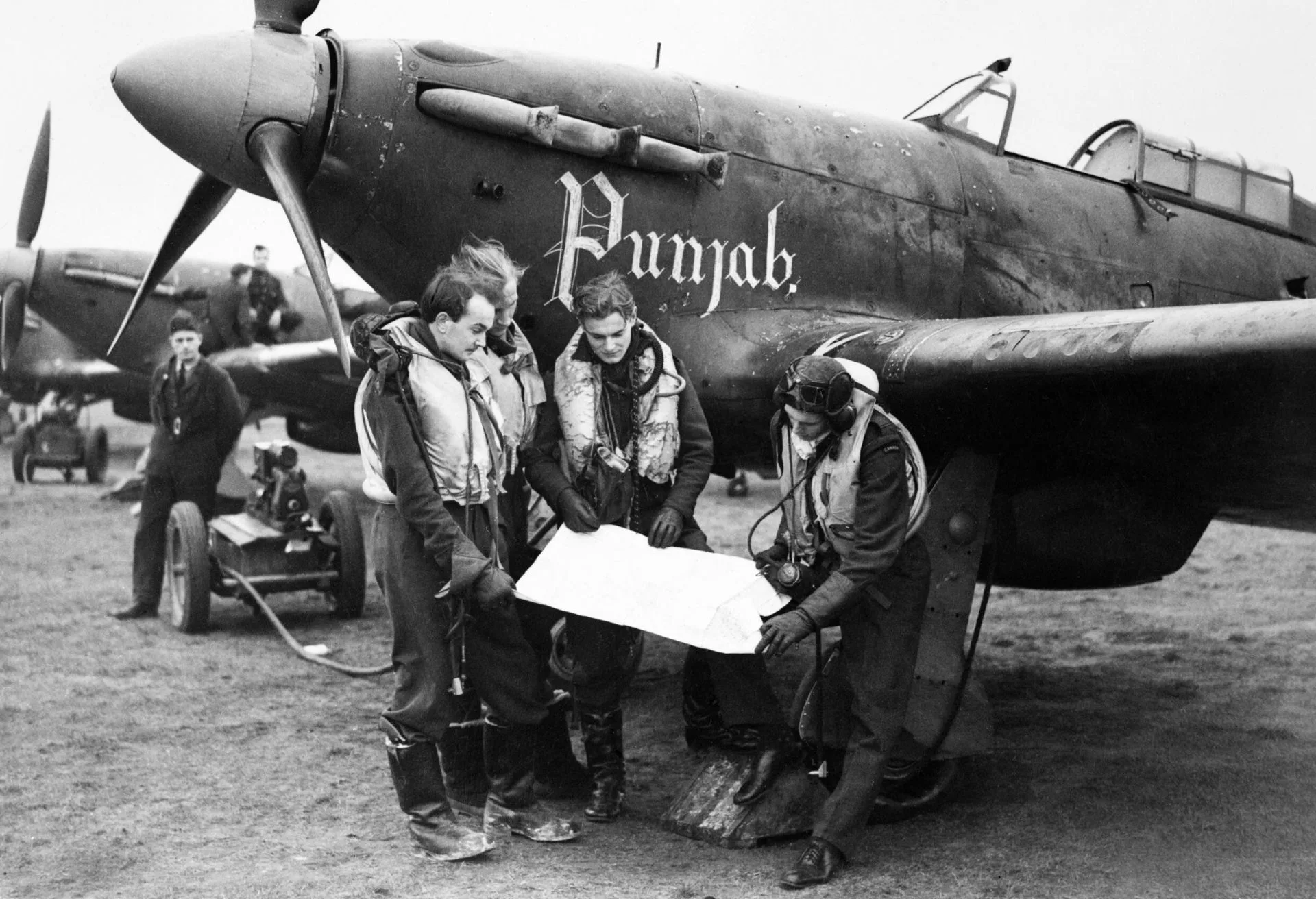

A radar failure, confused warnings and inexperienced pilots turned an early-war scramble into a fatal attack on two RAF Hurricanes.
Usually when discussing the first months of World War II, Nazi Germany takes center stage. While Hitler was making his moves and steaming ahead with the offensive on Poland, on September 3, 1939, Britain and France declared war on Nazi Germany. You’d expect guns blazing from the West to defend Poland as they promised. However, what the world got was what we now call the Phoney War, the Sitzkrieg or Sitting War in German, and Drôle de guerre in French. No matter how ‘phoney’ the war was at the time, it brought Britain’s first fighter pilot killed in World War II.
One Fatal Radar Flaw
Usually when a battle carries the name of a place, it’s where the battle took place. It’s like the Battle of Britain or the Battle of the Atlantic. However, the Battle of Barking Creek isn’t like that. Barking Creek is about 30 to 50 kilometers / 20 to 30 miles further west of where the actual battle took place.
Just three days after Britain declared war on Nazi Germany, the so-called Phoney War was not that phoney for some. On September 6, 1939, at around 6:15 am, a coastal searchlight crew on Mersea Island heard an unidentified aircraft overhead through thick fog. Soon after, a faulty British radar station began misreading friendly fighters flying inland as enemy aircraft approaching from the east toward the Essex coast. As the alarm sounded, the British had no inkling that the radar gave off a false alarm.
In early World War II a technical flaw in coastal radar stations caused them to mistake friendly planes flying inland for enemy planes flying toward England. What this is, in essence, is a so-called back-signal or reciprocal bearing. It’s a radar echo that is coming from the wrong direction, commonly 180 degrees backwards. However, everyone knew this phenomenon could occur. That’s why the radars had built-in blockers, commonly known as relay sensors or a back cut-off, that were implemented to ignore these backwards echoes. On that fateful day early in the war, this system had broken down, ultimately leading to false alarms about incoming air raids.
The Battle of Barking Creek
Nobody knew the relay sensors in the radar had actually failed on September 6, 1939. Britain and Nazi Germany were already three days at war. So, naturally, British troops concluded they were under attack with Luftwaffe aircraft approaching Great Britain. British troops were probably already on high alert and ready to go following this new state of war.
According to the squadron records, RAF Fighter Command relied on No. 11 Group to defend Great Britain against the imminent attack on September 6. At around 6:30 am, 12 Hawker Hurricane fighter aircraft from No. 151 Squadron at North Weald took off and flew towards the incoming threat. Each sector also had its own sector controller; in this area the sector controller was Group Captain David Lucking. Around ten minutes later, No. 56 Squadron followed by launching 12 aircraft from both flights. Two additional pilots, Pilot Officers Frank Rose and Montagu Hulton-Harrop, had also been ordered to fly. After Rose’s assigned Hurricane failed to start, the two took up a pair of reserve aircraft and patrolled north of the airfield, separated from the main formation.
The RAF also scrambled more aircraft: Hurricanes from No. 151 Squadron, which was also based at North Weald, and Spitfires from the No. 54 Squadron, the No. 65 Squadron, and the No. 74 Squadron, which were based at Hornchurch.
At this very early stage of the war, almost none of the RAF pilots had been in action. That also meant that almost none of them had ever seen a German aircraft in action. Other aspects of air combat were also underdeveloped at that point in time. The communication between ground control and the pilots in the air was lacking. Even though Britain knew where Europe was heading before September 1, 1939, and a state of war was imminent, there were still no reliable IFF (Identification Friend or Foe) sets installed in many RAF aircraft by September 6. Pilots had to rely entirely on visual-recognition procedures to tell friendly planes apart from the enemy. In the confusion that morning, Freeborn and Byrne believed they were following a direct order to attack, failing to properly identify their targets before opening fire.
Luftwaffe Aircraft, or Were They?
There is just one more aspect that made the Battle of Barking Creek a complete catastrophe, being confirmation bias. You see, the pilots in the air expected Luftwaffe aircraft. The radar set off the alarms because of incoming ‘enemy’ aircraft. All the pilots scrambled and took off to defend Britain against the imminent Nazi German threat. This is better known as expectancy bias, or even tactical confirmation bias, specifically amplified by high-stress conditions. They were in the air looking for Luftwaffe aircraft, and they had near-zero real-world fighting experience at that exact moment.
The RAF fighter planes in the air were divided into so-called flights, such as “A” Flight and “B” Flight. Each flight was commanded by a Flight Lieutenant. Six fighter planes from “A” Flight of the No. 74 Squadron were commanded by Adolf ‘Sailor’ Malan. They were the first flight to see what they thought to be Luftwaffe aircraft. It is believed that Flight Lieutenant Sailor Malan gave the order to engage the misidentified aircraft. There was no questioning a direct order: execute the order or get disciplinary action. That’s just how the military works. And so, Pilot Officer John Freeborn and Flying Officer Vincent ‘Paddy’ Byrne opened fire on the misidentified aircraft. Sailor Malan later said that he gave a last-minute call of ‘Friendly aircraft, break away!’ However, if that was actually true, both Pilot Officer John Freeborn and Flying Officer Vincent ‘Paddy’ Byrne never heard the last order.
In reality, there were no Luftwaffe aircraft in sight. They were probably nowhere near Great Britain, as Nazi Germany’s main focus was the ongoing invasion of Poland.
As the friendly-fire dogfight commenced, it is said that the squadron leader of the No. 151 Squadron, Edward “Teddy” Mortlock Donaldson (later a World War II flying ace and Air Commodore), alerted his pilots that the attacking aircraft were of the RAF and gave the order not to retaliate. With this call he prevented an even greater catastrophe by preventing further losses that would occur if the attacked RAF aircraft were to retaliate.
The Casualties and a Court Martial
Unfortunately no call of ‘Friendly aircraft, break away!’ was loud enough, or possibly even existent, to prevent casualties. Pilot Officer Montague Hulton-Harrop and Pilot Officer Frank Rose were shot down by their brothers-in-arms. Tragically, Montague Hulton-Harrop was killed in this case of friendly fire, after being struck in the head by the gunfire. His aircraft crashed at Manor Farm in Suffolk. Montague Hulton-Harrop was the first ever British fighter to be killed in action during World War II. Pilot Officer John Freeborn was actually the one who fired upon Hulton-Harrop’s aircraft, killing his fellow airman.
Frank Rose survived the incident by crash-landing his Hurricane into a sugar-beet field unscathed, although he was ultimately killed in action a few months later on May 18, 1940, over France.
Pilot Officer John Freeborn and Flying Officer Vincent ‘Paddy’ Byrne were subsequently court-martialed in private at the Bentley Priory headquarters of the RAF Fighter Command. There was nothing glamorous about the court martial; it turned into something you can almost call mud throwing and evading of one’s responsibilities. We have to keep in mind that most of the records are still sealed. It wasn’t until 2019 that some of the records were released by the National Archives, so the full extent and the full content of the trial is commonly unknown. Certain court documents and the Operations Records Books of the fighter squadrons released in 2019 give us a glimpse of what transpired, and maybe more importantly what was said during the court martial. Because the court martial transcript is still unreleased to this day, much of the trial’s contents are unknown. However, in 2009, Bill Nasson noted that it was widely known that Pilot Officer John Freeborn believed Sailor Malan had attempted to dodge blame for the incident.
It is said that Sailor Malan had given evidence against his two pilots. He is believed to have said that Pilot Officer John Freeborn was impetuous, irresponsible, and had failed to pay proper attention to critical communications during flight. Sir Patrick Hastings was Freeborn’s counsel during the trial. He is said to have called Sailor Malan a bare-faced liar. No matter what was said and done, the verdict was clear. Ultimately, both Pilot Officer John Freeborn and Flying Officer Vincent ‘Paddy’ Byrne were exonerated.
Distinguished Flying Cross
Pilot Officer John Freeborn even went on to become the one pilot who flew the most operational hours during the Battle of Britain. He continued serving in the RAF, eventually returning to operational flying in 1943. He served with No. 602 Squadron and later commanded No. 118 Squadron before becoming Wing Commander Flying of No. 286 Wing in Italy. However tragic September 6, 1939, was, it didn’t speak to Freeborn’s character. He turned out to be a remarkable airman, even being awarded the Distinguished Flying Cross and bar. His final rank within the RAF became Wing Commander.
It wasn’t until 2002 that Wing Commander John Freeborn decided to share his version of what transpired during the Battle of Barking Creek in his 2002 biography A Tiger’s Tale. He also co-authored the book Tiger Cub, in which he shared an even more complete account of the events of that fateful day.
This battle didn’t only cause Britain’s first fighter pilot death in World War II, it also brought about the first aircraft ever shot down by a Spitfire. Maybe even more striking is the fact that there were no Luftwaffe aircraft involved in the Battle of Barking Creek. No Luftwaffe aircraft were probably even close to Great Britain, as Nazi Germany was completely focused on its invasion of Poland.
“I think about him nearly every day. I always have done… I’ve had a good life, and he should have had a good life too” – Wing Commander John Freeborn, 2009.
Continue the Discussion
Who was responsible for the Battle of Barking Creek?
Was it primarily a failure of radar technology and communication, or should the pilots and their commanders have recognized what was happening before opening fire?
And did the subsequent court-martial really settle the questions surrounding that tragic morning?
Join Field Reserve for free and make your case inside the WarCommons community at our Field Headquarters.
Take WarCommons with You on Android
Give the Gift of WarCommons
Know someone who loves WWII history? Give them a year of WarCommons Field Command, with original articles, premium features, and a community dedicated to exploring World War II.
WarCommons publishes long-form, source-driven World War II analysis without ads or sponsored content. If you found this article valuable, consider supporting independent research by joining Field Command.
By Nick Ravenshade — Founder & Editorial Director, WarCommons
Header image: Pilots and Hawker Hurricanes of No. 56 ‘Punjab’ Squadron RAF at Duxford. January 2, 1942. Source: Wikimedia Commons. Public domain.