WARCOMMONS IS NOW ON ANDROID
Explore WWII history and stay connected with the community on the go. GET THE APP →
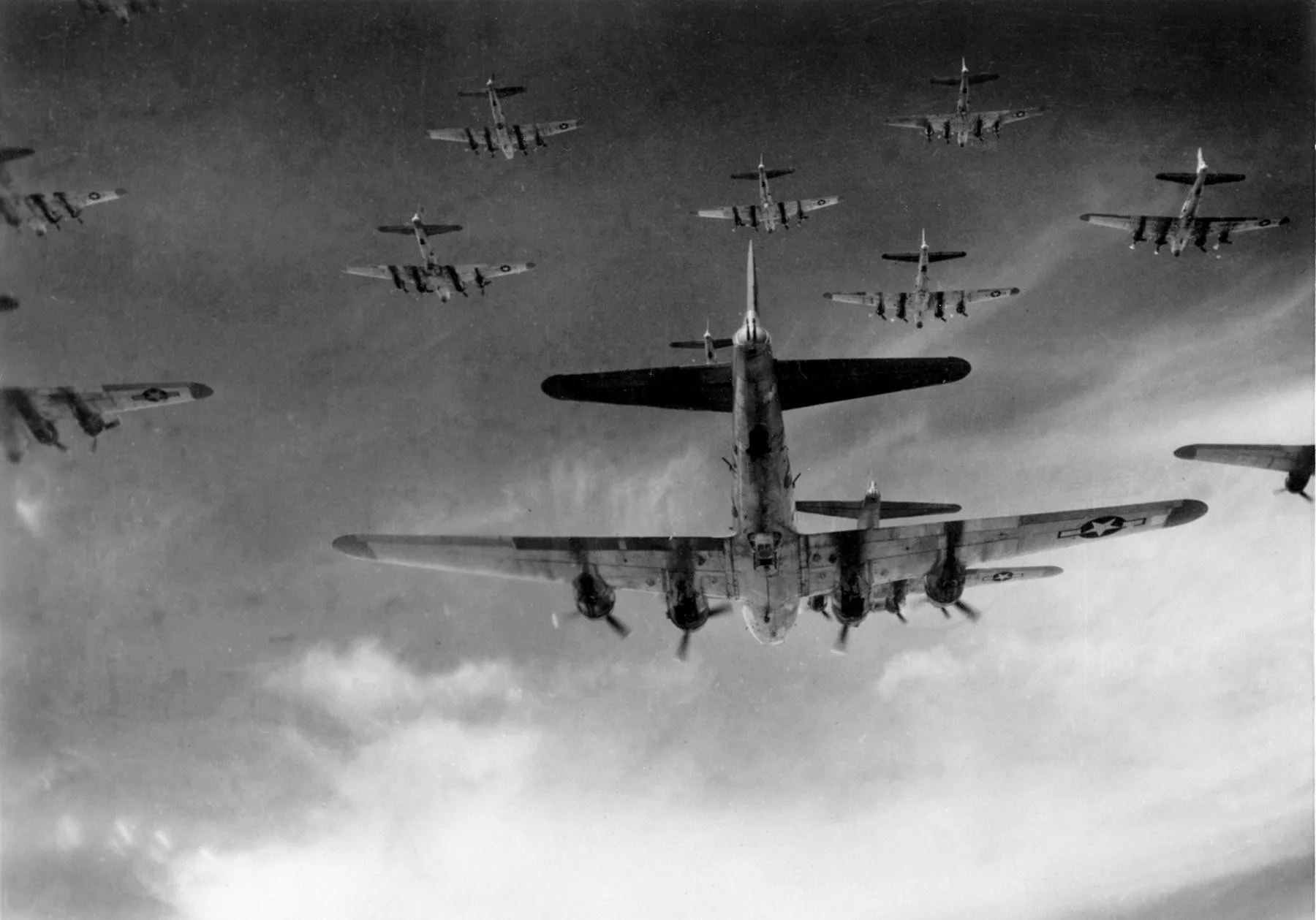

Four deep-penetration raids in October 1943 exposed the cost of daylight bombing without long-range fighter escort, and forced the USAAF to rethink its strategy.
October 14, 1943, the last day of the ‘Black Week’. It was a Thursday, so you might’ve also seen it being referred to as Black Thursday. And before you start thinking about deals and shopping, it had nothing to do with Black Friday. Actually, there wasn’t even anything funny about it. This day marked the last day of the so-called Black Week. It marked the day the United States Army Air Force (USAAF) nearly lost the war.
The Black Week
By 1943 the USAAF and Britain’s Royal Air Force (RAF) transitioned into the so-called round-the-clock bombing strategy. The RAF bombed Nazi Germany by night, while the USAAF bombed it by day. The fundamental difference in bombing doctrine surprisingly brought this combined doctrine that, by design, pummeled Nazi Germany from the air day in and day out.
In this particular week, from October 8, 1943, until October 14, 1943, the USAAF had four major missions to accomplish. No one could predict what the USAAF Eighth Air Force would come to face.
The Bremen Bombing Raids
The first mission, on October 8, was to execute bombing raids on the port city of Bremen, Germany. Inside of the port city, the Allies had marked a few primary targets that had to be destroyed. Mainly the aircraft manufacturing hubs of Focke-Wulf, the shipyards, and precision industry centers. The Eighth Air Force probably didn’t know what they were about to face. But the signs were absolutely there. The USAAF knew that the port city of Bremen was heavily defended. The USAAF also stayed with their doctrine they deemed superior to the RAF’s bombing doctrine, meaning daytime bombing raids. This was chosen by the Americans, because they were convinced that they could only achieve precision accuracy against specific targets by bombing during the day. It had to prevent hitting cities and their innocent citizens indiscriminately.
That noble thought, however, failed very often, making it seem like innocent citizens were legitimate targets as well.
The bombers took off for their destination, Bremen. Loaded up with heavy bombs to drop on their targets, the bombers encountered a surprise. They flew into a storm, not created by nature, but rather a storm created by swarms of Luftwaffe fighter defenses and a storm created by coordinated anti-aircraft flak. The bombers didn’t have any long-range escort fighters with them, meaning the B-17 bomber formations were sitting ducks as soon as the short-range P-47 escort fighters turned back due to a lack of fuel.
It was clear the B-17 bombers were defenseless, and the numbers show exactly this. The Eighth Air Force had dispatched 357 heavy bombers for this operation. The Allies lost 30 aircraft that were shot down, meaning these losses were unrecoverable. There was one group of the Eighth Air Force that endured particularly high losses. The so-called ‘Bloody Hundredth’, better known as the 100th Bomb Group, lost 7 out of 21 B-17s that were dispatched. That meant 72 Bloody Hundredth airmen were recorded as lost, while 13 airmen from this group were wounded. Among them was Major Gale ‘Buck’ Cleven, the Bloody Hundredth’s squadron leader who was frequently described as charismatic. He too was shot down during the attack and taken as a Prisoner of War by the Germans. He was actually a prisoner inside Stalag Luft III and Stalag VII-A. Eventually, he managed to escape to the American frontlines in March 1945. He survived the war and lived until his death in 2006.
No matter the tough Allied losses, a day later the Eighth Air Force had to perform a long-range strike on the German aircraft factories in Marienburg.
Bombing Marienburg
Marienburg, Germany, is now Malbork, Poland, and here the Germans had their Focke-Wulf Fw 190 aircraft assembly plant. This matters because it was farther from the Allied frontlines in western Europe. The Allies had to route their bombers with deep-penetration flights across the North Sea and East Prussia. Despite the location, the Allies were determined to bomb this factory on October 9, 1943. It was VIII Bomber Command Mission No. 113.
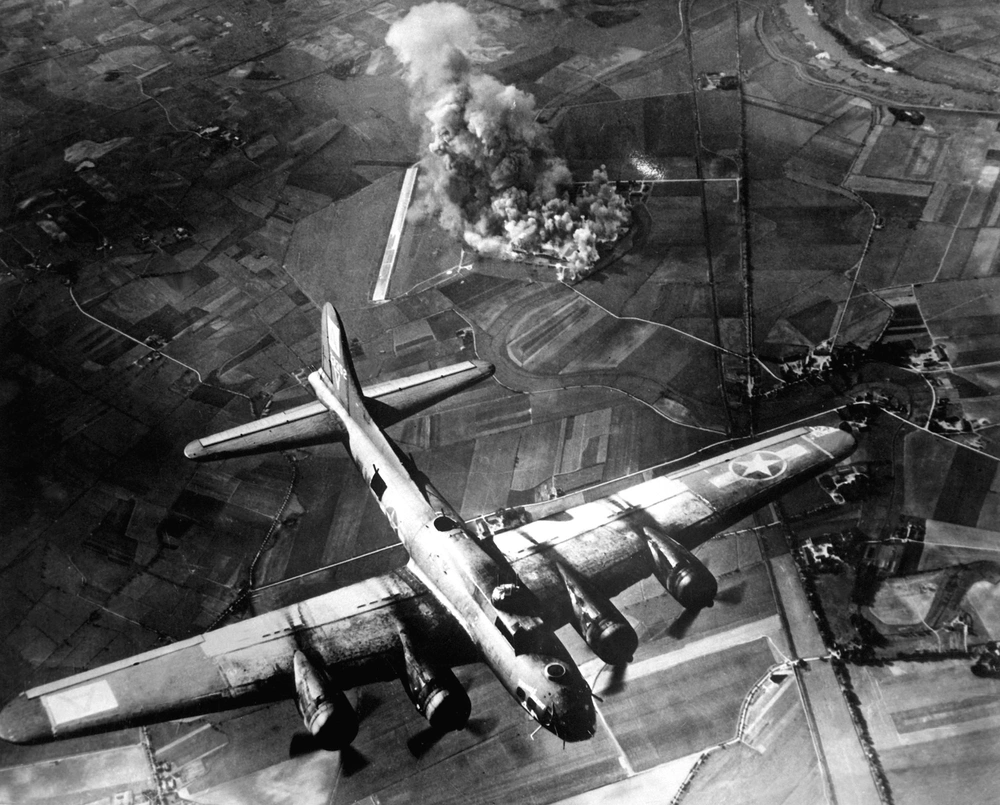
The sky and the weather were clear, giving the Allies an immediate advantage. However, this also meant that they could fast become sitting ducks across German airspace. Clear weather meant that the bombers were also a clear target for German anti-air. Still, on this particular day the Allied losses were remarkably light for such a deep air raid. The Allied bombing groups caught the Germans by surprise, and as a result the bombers managed to evade the majority of the Luftwaffe’s concentrated anti-air efforts.
Despite the fact this operation took place during the Black Week, it was the week’s most successful precision strike. The Allies managed to reach the targets and the bombing accuracy was devastatingly high. As a result, large portions of the Focke-Wulf Fw 190 aircraft assembly plant were completely leveled. The Eighth Air Force losses were relatively light when factoring in it was a deep-penetration bombing. Of the 100 B-17s sent to Marienburg, 96 reached the target and only two were lost, which was part of a wider four-target operation that saw roughly 30 aircraft lost out of 378 dispatched. The Bloody Hundredth managed to safely return all of its 17 operational aircraft without a single loss. That must’ve been a big relief after a day of staggering Allied losses.
The Most Intense Aerial Battle
A day after the relatively successful bombing of Marienburg, the Allies set their sights on the railway hubs and the urban center of Münster, Germany. This operation wasn’t only controversial after the war, but also at that time because the target obviously shifted from industrial factories to a city center. The Allies took aim directly at the German railway workers’ workforce to paralyze Germany’s infrastructure, bearing in mind the railway workers were, in fact, civilians.
While the Germans were caught by surprise just a day earlier, this time they made sure they were ready. They knew that the Allied bombers were depleted and their crews were exhausted. The Luftwaffe made sure to utilize their new, ruthless tactics.
Let me give you a little bit more background to this. Before this particular raid, the American B-17 Flying Fortresses had flown deep into Germany without long-range fighter escorts. The Germans knew this, and they knew the toll it took on the Allied crews and aircraft. Many bombers, even the ones that were used in this attack, had already sustained minor damage in one form or another, or they were low on ammunition.
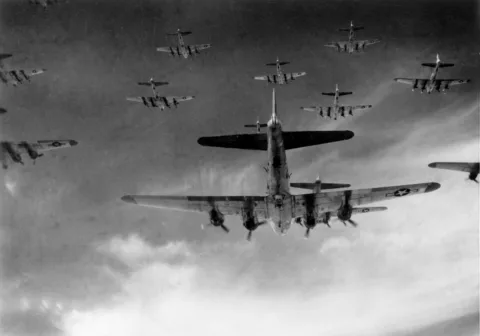
Without fighter escorts the Allies relied on a tactic that was called the ‘combat box’. They flew their aircraft in tight, stepped formations. Dozens of bombers could overlap their defensive .50-caliber machine guns, creating the so-called ‘wall of lead’. German fighters that flew too close would face assured and complete destruction. The Luftwaffe adapted to this with a new deadly tactic. They started using the heavier, twin-engine fighters like the Messerschmitt Bf 110 or the Junkers Ju 88 equipped with heavy air-to-air rockets, mainly the Werfer-Granate 21.
The Luftwaffe flew their twin-engine fighters behind the Allied combat box, firing their rockets forward into the American formation. These rockets were very heavy and therefore fired with a slight arc, almost like a mortar, to make sure they reached their intended targets. The rockets were also timed to explode directly in the middle of the American combat box. As a result, some of the B-17s had to break the formation, making them sitting ducks. The German fighters would then dive down from above and behind to attack the now isolated B-17s that had to break away from the formation.
The combat box failed miserably, and the new Luftwaffe tactic proved to be very effective and very deadly. It resulted in the loss of 30 heavy bombers of the Eighth Air Force. However, the Bloody Hundredth was virtually obliterated, losing 12 of the 13 B-17s in quick succession. The lone survivor was the ‘Royal Flush’ piloted by Robert ‘Rosie’ Rosenthal, making it back to England on two failing engines while also carrying a critically wounded crew.
It couldn’t get any worse. Could it?
Black Thursday
I hear you; this subheader doesn’t bode well for the Allies. It’s not only the subheader; the day itself also didn’t bode well for them. October 14, 1943, also known as Black Thursday, was the mission to Schweinfurt, Germany. Schweinfurt was the location of the critical ball bearing factories. The ball bearings were vital, and a catastrophic bottleneck, for military machinery. Without them, most of the German airplane and tank industries would grind to a screeching halt.
On the morning of this particular day, it was as if multiple factors were foreshadowing the drama that would unfold. Bad weather, including morning fog in England, was already delaying the operations. It played right into the hands of the Luftwaffe, that now had the time to fully arm, fuel, and position their fighters to intercept the soon-to-be-incoming Allied bombers. The Luftwaffe managed to ready over 300 fighters that were soon sent out to attack the unescorted Allied bombers. The German fighters attacked the Allied bomber formation in waves for over three hours. The Germans were having a field day, utilizing their heavy cannons, air-to-air rockets, and even dropping bombs from above onto the Allied bomber formations.
It’s not hard to imagine why this day was dubbed Black Thursday. 291 B-17 bombers crossed into Germany that day, and a staggering 60 of these bombers were shot down in action. Another 17 B-17 bombers were no longer airworthy after returning to England. Five had crashed upon landing, while another 12 were so severely damaged that they had to be scrapped immediately. The total bomber losses therefore reached 77. These bombers were not empty, meaning over 600 American airmen lost their lives, or were captured, in a single afternoon.
The one objective this air raid had to accomplish also failed. It’s true that the German factories were at least damaged by several B-17 bombers. However, the German high command quickly decentralized their ball-bearing production. Schweinfurt was no longer the main hub for the German ball-bearing production, meaning with this raid the Allies completely failed to achieve their strategic goal, and the German airplane and tank industries continued to work.
Impact of the Black Week
Mathematically, but also logically, the staggering losses that were endured during the so-called Black Week were unsustainable. During this time in the war, only about one in four Eighth Air Force bomber crewmen managed to complete a standard 25-mission combat tour. And if you thought those odds were bad, the Eighth Air Force lost approximately 26% of its attacking force on Black Thursday alone. Just one day, 26% gone.
The USAAF set their strategy around a strong belief that the B-17 and B-24 bombers could fly deep into enemy territory in tight defensive formations without the need of fighter escorts. The reality proved the complete opposite. It only made the American daytime raid formations a big and easy target for the Luftwaffe. The numbers also show the exact failure of the American strategy. During Black Week, from October 8 to October 14, the Eighth Air Force had lost 148 bombers and approximately 1,500 USAAF aircrew. We should put these abstract numbers into perspective, because they don’t tell the full story. If, for example, 1,500 crewmen out of 100,000 total were lost, that changes how we have to look at Black Week. Unfortunately, that was not the case. By the time of D-Day, up to 77% of the American airmen who had flown against the Reich before the invasion would ultimately become casualties.
After this crippling week, and maybe even month, the USAAF proceeded to suspend deep daytime raids into Germany without fighter escort. For the rest of 1943, the Eighth Air Force focused on targets within the reach of its existing fighters, holding off on deep-penetration missions until early 1944. At that time, the long-range P-51 Mustang escort fighters arrived in enough numbers to protect the Allied bombers during daytime raids. The range of the new fighters was impressive, as they could escort the bombers all the way to Berlin and back to England.
On the brink of being obliterated by the Luftwaffe even this late in the war, the Allies managed to turn the tide. The misconception is often that by 1943 and 1944 the Luftwaffe was completely crippled and unable to make any change in the war. History, however, tells us a different story. It may very well have been the case that without the long-range P-51 Mustang fighters, the Americans wouldn’t have resumed their daytime raids, losing the ability to bomb Germany around-the-clock.
Better still, with the new American fighters Lieutenant General Jimmy Doolittle released the fighter pilots from the tight bomber formations to actively hunt down and destroy the Luftwaffe. Just four months after Black Week, the Allies managed to turn the tide, culminating in the so-called Big Week.
Continue the Discussion
The Eighth Air Force believed its B-17 and B-24 formations could defend themselves deep inside German territory. October 1943 exposed the enormous cost of that assumption.
Was the original American daylight precision-bombing doctrine fundamentally flawed, or was the problem primarily the lack of long-range fighter escorts?
And how decisive was the arrival of the P-51 Mustang in changing the balance of the air war?
Join Field Reserve for free and make your case inside the WarCommons community at our Field Headquarters.
Take WarCommons with You on Android
Give the Gift of WarCommons
Know someone who loves WWII history? Give them a year of WarCommons Field Command, with original articles, premium features, and a community dedicated to exploring World War II.
WarCommons publishes long-form, source-driven World War II analysis without ads or sponsored content. If you found this article valuable, consider supporting independent research by joining Field Command.
By Nick Ravenshade — Founder & Editorial Director, WarCommons
Header image: B-17 Flying Fortresses from the 398th Bombardment Group fly a bombing run to Neumunster, Germany. April 13, 1945. Source: Wikimedia Commons. Public domain.