WARCOMMONS IS NOW ON ANDROID
Explore WWII history and stay connected with the community on the go. GET THE APP →
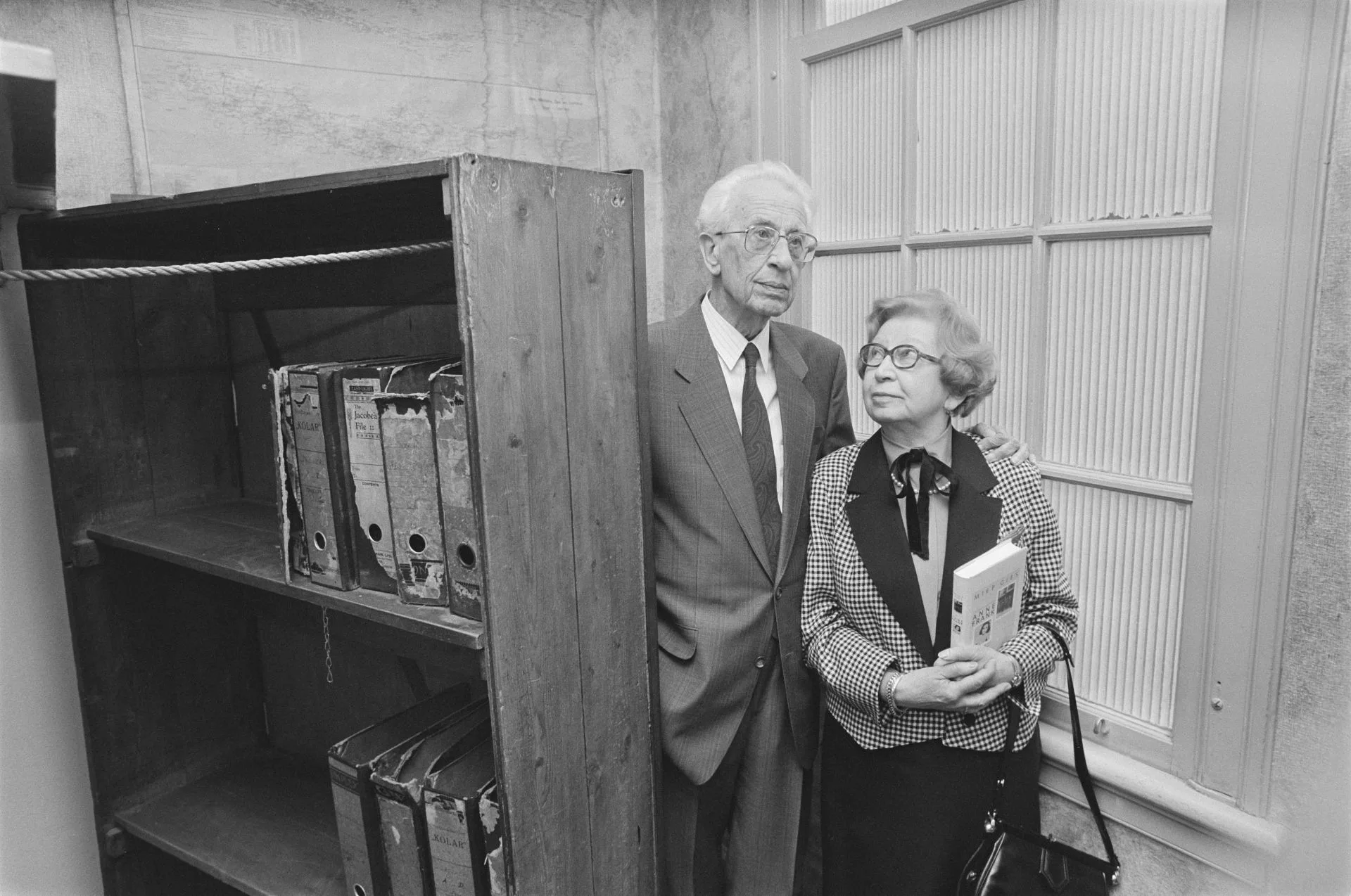

From the first postwar suspects to an AI-assisted cold case, competing investigations have left the circumstances of the 1944 raid unresolved.
I believe I can safely say that no diary has been read more than the diary of Anne Frank. Since 1947, her diary has been read by millions and millions of people. Anne Frank’s diary gives us a primary account of what it was like to live in the Netherlands under Nazi rule. In fact, it gives us a firsthand account of what it was like to be a so-called onderduiker, in this case a Jewish person in hiding. Despite the amount of information the diary gives us, there are still questions that are left unanswered. One former FBI agent sought to answer one of the long-standing questions surrounding Anne Frank.
Who Betrayed Anne Frank?
This question has been around for over 80 years. It began almost immediately after World War II ended, and when Otto Frank, the father of Anne, returned to Amsterdam in 1945. It didn’t take long before Otto started wondering who betrayed the Frank family.
Over the years there have been many theories and investigations. Perhaps the best chance to find the culprit(s) was through the initial post-war inquiries spanning from 1945 to 1948. Otto Frank, who was the sole survivor of the family, together with a small, brave group of his office employees and friends who secretly sustained and protected Anne and her family while they were hiding, identified the family’s arresting officers. A formal police investigation followed in 1947, in which the police targeted Willem van Maaren. Willem was the head warehouseman of the companies Opekta and Gies & Co, located at Prinsengracht 263 in Amsterdam, the Netherlands. Both of these companies were owned by Otto Frank. And if the address rings any bells, that isn’t without reason. This is exactly the location of the Secret Annex, where Anne was in hiding.
To no one’s surprise, Van Maaren denied any involvement. There was also insufficient proof or paperwork pointing to Van Maaren as the culprit. A complaint was filed, but the court ultimately dismissed the accusation.
Van Maaren had to live the rest of his life bearing the burden of being seen, by the public and in numerous books, as the primary suspect of the betrayal of Anne. A striking detail, however, could be the exact reason showing Van Maaren wasn’t the culprit after all. Right after the SS raided the Secret Annex, he accompanied the helpers back into the hiding place. Miep Gies and Bep Voskuijl were these helpers, and together they picked up parts of Anne’s diary from the floor. Researchers see this as at least some degree of cooperation with the Frank family. Together with a lack of evidence linking him to the the tip-off, this evidence is still being seen as the key argument for Van Maaren’s exculpation.
Be that as it may, he derived no benefit from it during his lifetime, as he continued to be viewed as the ultimate traitor. Van Maaren died an innocent man on November 28, 1971, at age 76.
Subsequent Investigations
It does make you think, was the initial investigation biased or skewed to the wrong person? And did this actually slow down or skew any of the subsequent investigations? I personally wonder how much of the initial investigation was clouded by personal interpretations and suspicions of Otto.
In 1963 a new investigation was performed. It does bring up the feeling that this should’ve been the primary focus of the initial investigation, as opposed to making Van Maaren the primary focus initially. This second police investigation, in fact, focused on the SS officer who conducted the actual raid. The investigation was triggered by famed Nazi hunter Simon Wiesenthal, who tracked down Karl Silberbauer, the SS officer in question.
We must remember that as time passes, people do too. Maybe the actual culprit was no longer alive, complicating any future investigations to find them.
Silberbauer did remember the raid, but his statements about the alleged phone call were inconsistent. In his first written statement, he mentioned a Dutchman as the caller. Later, he said he was unsure whether a call had been made or who had made it. The claim that the caller was a young woman remains unsubstantiated. Surprisingly, Van Maaren was investigated once more, before ultimately being cleared as a suspect again.
In the 2000s various historians and authors published new theories surrounding the betrayal of the Frank family. The theories pointed to new suspects previously uninvestigated. Two of the new suspects were Lena Hartog-van Bladeren and Nazi sympathizer Tonny Ahlers. Lena worked as a domestic maid in the private home of a pest-control employee associated with Prinsengracht 263. Lena was already pointed to as a possible suspect in 1998. Following a NIOD Institute for War, Holocaust and Genocide Studies report from 2003, she was cleared as a suspect.
Tonny Ahlers emerged as a suspect in 2002, following a book, The Hidden Life of Otto Frank, written by Carol Ann Lee. The book created some real media attention which prompted the NIOD to seriously look at Ahlers as a suspect. However, he was already exonerated a year later. Ahlers was known to brag about him being the one betraying the Frank family. It turned out that he was a notorious pathological liar.
A Raid by Chance
It was 71 years after World War II ended that a new, actually plausible theory was presented. In December 2016, the so-called raid by chance theory was officially introduced by the Anne Frank House Research Department. It was a groundbreaking study on a theory that was not actually brand new.
Almost all of the investigations up to this one assumed a malicious, anonymous tip that led authorities directly to the Secret Annex.We can’t overlook the fact that Silberbauer, one of the actual SS officers to have conducted the raid, mentioned a phone call from a young woman in regard to the Secret Annex. However, this 2016 theory shifted away from the noise and maybe even sensationalism that comes with just wanting to look for one betrayer. The Anne Frank House 2016 Study focused heavily on the actual duties of the agents who conducted the raid. It was no longer the question of who betrayed the family, rather what actually happened. A great starting point.
The study’s main focus was to investigate whether economic fraud taking place at the warehouse, rather than a betrayal, had led to the raid. The German Security Service, better known as the Sicherheitsdienst (SD), who entered Prinsengracht 263 on August 4, 1944, were primarily investigating illegal employment and ration-coupon fraud. This theory explores the possibility that they found the Secret Annex by chance, while investigating the aforementioned crimes.
Diary entries from Anne Frank herself mentioned the previous arrests of men who supplied illegal food coupons to the Frank house. The 2016 study proved that the authorities spent a substantial amount of time dealing with these economic offenses during the raid. The conclusion was that they likely stumbled upon the hidden annex entirely by coincidence.
This theory is still the widely accepted scientific explanation of what actually happened to the Frank family and who ‘betrayed’ them. It may very well be the case that they were never actually betrayed.
The Cold Case Controversy
It could very well be that the 2016 consensus isn’t answering all of the remaining unanswered questions. Questions like who betrayed Anne Frank and the Frank family. Asking themselves this question maybe even without realizing that it’s equally plausible that there was never any betrayal to begin with. To some, this isn’t sufficient, and they continue the quest for the betrayer.
One of these people emerged in 2022, a former FBI agent leading an international cold case team, and leaning heavily on the use of AI. You all know how WarCommons thinks about that in regard to factual history.
Retired US FBI special agent Vince Pankoke headed the investigative side of a 20-member international team that set out to find the betrayer of the Frank family. The team was composed of criminologists, data scientists, and historians, who spent six years reviewing archives. The team made no secret of their use of modern forensic techniques, including AI data algorithms. They used these tools to map out timelines, network connections, and over 30 historical suspects.
Out of their investigation one suspect emerged, with an 85% certainty according to the team. The suspect’s name? Arnold van den Bergh, a prominent Jewish notary and one of the members of the Nazi-appointed Jewish Council. He was the one who betrayed the Secret Annex, according to the team. Canadian author Rosemary Sullivan compiled these findings in her book The Betrayal of Anne Frank: A Cold Case Investigation. However, this investigation might’ve been flawed from the beginning. The core evidence was a typed copy of an anonymous note delivered to Otto Frank shortly after World War II, which explicitly named van den Bergh as the betrayer.
Unsurprisingly, the study triggered heavy criticism from organizations like the Anne Frank House. In March 2022, a coalition of prominent Dutch historians, Holocaust scholars, and wartime experts published a devastating, comprehensive 60-page Refutation Report dismantling the FBI agent-led team’s work. What the Dutch team managed to present with undeniable facts is that there was absolutely no historical evidence found that the list in question ever existed. The Nazi-appointed Jewish Council in Amsterdam never possessed addresses of people in hiding, according to what the researchers found in the archives. Therefore, the entire premise of how van den Bergh obtained the address was a near historical impossibility. To make things worse for Pankoke’s findings, historical records indicated that van den Bergh and his family were themselves in hiding or scattered during the exact timeframe of the raid. That means he lacked the protection the book claimed he was enjoying from the Nazis. Why else go into hiding?
Pankoke’s team used the anonymous note as an absolute fact, never questioning it, and even making it their so-called smoking gun. Maybe the most staggering part is that they took the note as an absolute fact without any corroborating evidence or verification of who wrote it or why.
General Consensus and Lasting Uncertainty
To put it bluntly, no one actually knows who betrayed the Frank family. It remains a mystery even after more than 80 years. The new general consensus on what happened that fateful day in the Secret Annex originates from the 2016 report. This is still accepted as the primary and most plausible theory. However, that doesn’t mean that it is actually what happened. No one can say for sure, because the definitive proof is still lacking after more than 81 years.
Adding to this, even if the 2016 theory remains the leading institutional baseline, it has faced scrutiny from alternative high-profile investigations. Unsurprisingly it’s commonly discredited or scrutinized by researchers who strongly believe in the existence of a betrayer.
This is the main reason that there is still a lasting uncertainty, even if there is a general consensus on the subject. People still want to know who betrayed the Frank family, even if they were possibly never betrayed. As long as this is still a plausible explanation of what happened, there will be people looking for who the betrayer was. It keeps feeding the lasting uncertainty which naturally prompts new investigations every now and again. This has been the case for almost a century now, and the 2022 investigation probably won’t be the last.
Until there is definitive proof, people will always look for the answer to the question of who betrayed the Frank family. But maybe, just maybe, the question shouldn’t be who did it, rather what actually factually happened on that fateful day on August 4, 1944.
Continue the Discussion
Does the 2016 raid-by-chance theory offer the most convincing explanation of the evidence, or do you think the possibility of betrayal remains open?
Join Field Reserve for free and make your case inside the WarCommons community at our Field Headquarters.
Take WarCommons with you on Android
Give the Gift of WarCommons
Know someone who loves WWII history? Give them a year of WarCommons Field Command, with original articles, premium features, and a community dedicated to exploring World War II.
WarCommons publishes long-form, source-driven World War II analysis without ads or sponsored content. If you found this article valuable, consider supporting independent research by joining Field Command.
By Nick Ravenshade — Founder & Editorial Director, WarCommons
Header image: Miep and Jan Gies at the book launch for Miep Gies: Memories of Anne Frank, held at the Anne Frank House. In front of the bookcase that conceals the entrance to the Secret Annex. Source: Wikimedia Commons. CC0 1.0.