WARCOMMONS IS NOW ON ANDROID
Explore WWII history and stay connected with the community on the go. GET THE APP →
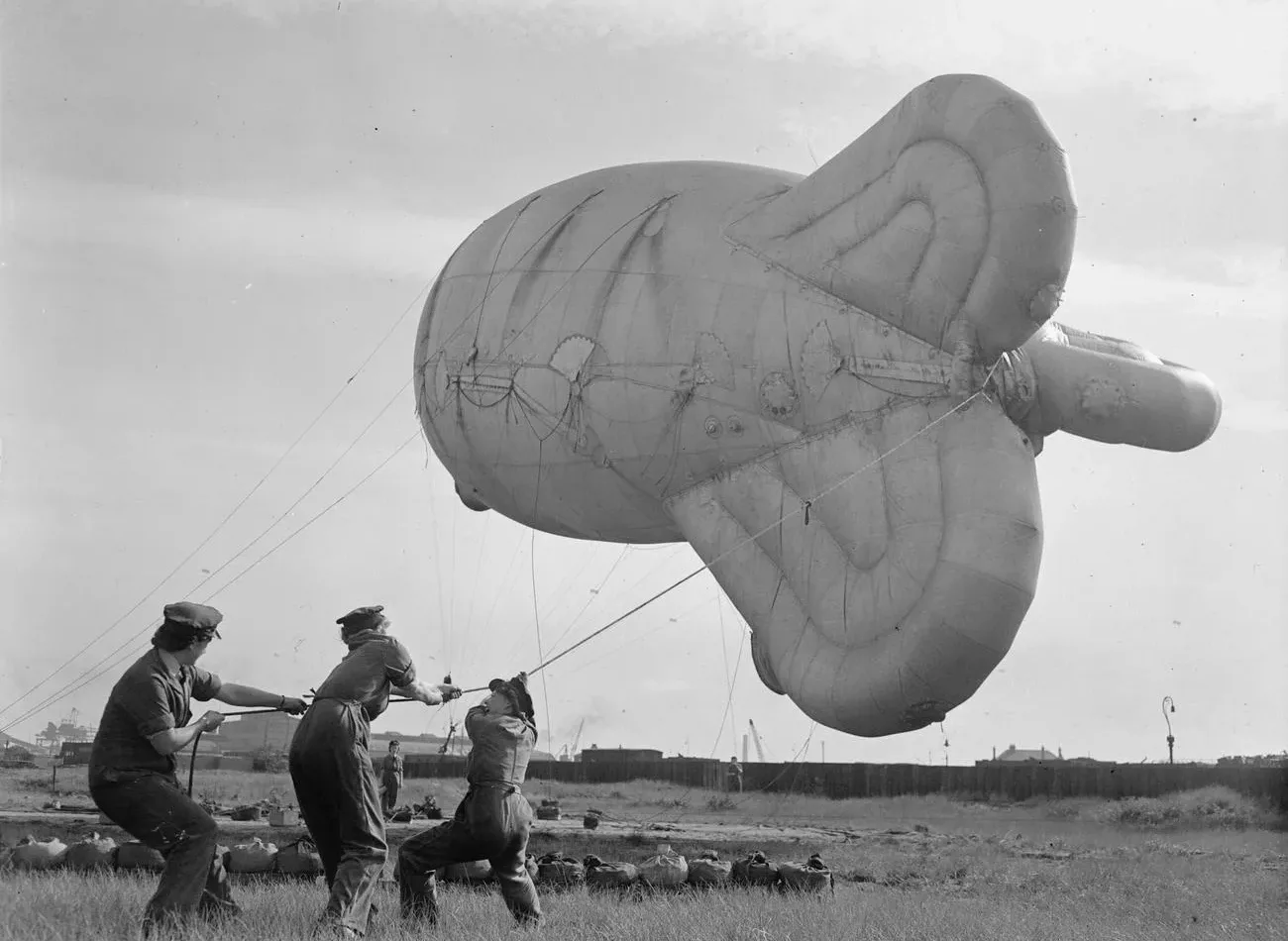

It began when a gale tore barrage balloons loose and blew them over Sweden. Two years later, Britain was launching nearly 100,000 of them at Germany on purpose.
After writing about Britain’s Operation Vegetarian, I couldn’t help wondering: what other weird operations had the British planned? As soon as there is an operation that hasn’t been written about in depth, you can rest assured we’ll write about it. That’s why I came across Operation Outward. But make no mistake: as weird as the operation was, it was also successful.
What If a Barrage Balloon Got Loose?
That’s exactly the question the British military leadership had asked itself as early as 1937. What kind of damage could such a balloon cause when it hit power lines by accident, while carrying a wire? I mean, what are the odds that something like this would even happen? Yet the concerns that had prompted the question soon proved justified. The organization responsible for the barrage balloons was the RAF Balloon Command. It was led by several key Air Vice-Marshals and commanders during World War II. At the time, Air Vice-Marshal Owen Tudor Boyd was in command, a post he held until late 1940.
Boyd wrote: “Since the outbreak of the war, I have had constant complaints from the electricity distributors regarding the damage done in this country by balloons that have broken away from their moorings.” He didn’t dismiss these complaints. Instead, he proposed a completely new strategy, writing: “…advantage might be taken of this to impede and inconvenience the enemy.”
The RAF Balloon Command planned to have the barrage balloons launched from France. By radio triangulation they could track the position of the balloons and even release the bombs they carried as soon as they drifted over a target. It wouldn’t be long before an accident answered the question for them.
Accidental Sabotage
On the night of September 17-18, 1940, a number of British barrage balloons were broken loose by a gale. The balloons were carried over the North Sea to Sweden and Denmark. In both countries the balloons damaged power lines, disrupted the railways, and even knocked down the antenna of a Swedish international radio station. Five more balloons drifted even further east, reaching Finland. Soon a report on the incident reached the British war cabinet, though it was mostly confusion mixed in with a damage assessment. Churchill clearly saw the potential. He went on to order an investigation into the use of the balloons as a weapon against Nazi Germany.
Even though the accident had effectively shown the balloons could work as an instrument of sabotage, the Air Ministry was not enthusiastic at first. They officially produced and submitted a negative report. The Ministry of Aircraft Production was also heavily opposed to the plan, because they felt that the balloons would be ineffective. But more importantly, they felt these attacks would consume too many resources.
As so often in wartime, the services disagreed, because the Admiralty was enthusiastic about using the balloons.
Intended Targets
The most obvious targets were electricity distribution networks. The incidents in Sweden and Denmark had already demonstrated what the balloons could do to power lines. The balloons would trail thin wires across the power lines, touching two or more phases as they passed. Trials had shown this could produce an arc of 4.6 meters / 15 feet. More importantly, this arc would remain active until the circuit breaker opened. This gave the arc plenty of time to melt the conductors’ aluminum outer layers.
It’s not wrong to think: so what? As soon as the threat of the balloon was neutralized and the short circuit resolved, the power would start flowing again. This was absolutely true, but there was one additional factor. Because of the nature of the sabotage action, the conductors would almost certainly be weakened as well. This would cause more frequent breakdowns in the power lines due to weather events, like ice, snow, wind, and also just normal use of the power grid by the German people.
Other targets the British found useful were large areas of heathland and pine forest in the German countryside. But why the countryside? There weren’t many military installations there. Maybe you could even say there was nothing of any interest there.
This tied into another tactic that the British had set out for the use of the balloons. It was determined that the balloons should also be able to carry incendiary bombs. By dropping the incendiaries on the German countryside, the British military leadership hoped that Germany would assign a large number of people to fire watching. People tied up in fire watching couldn’t be assigned to more productive work, or so the British reasoned.
The balloons, it was decided, would serve mainly as an instrument of disruption and chaos. The hurdle that the Ministry of Aircraft Production had raised would also be resolved. The Admiralty had concluded that it would cost little to produce the balloons. Most of the materials that had to be used in the production of the balloons would come from surplus materials. There was also plenty of hydrogen gas available to fill these balloons. And perhaps most importantly, the balloons required very few British personnel, so few people were taken away from other vital war work.
Operation Outward Is a Go
Just about everything had been worked out. It was clear what the balloons would carry and what infrastructure they would target. Operation Outward was ready to go. But it wouldn’t be a military operation without two military branches engaging in some sort of bureaucratic struggle. In September 1941, the bureaucratic struggle was over as the British Chiefs of Staff gave the go-ahead for Operation Outward. HMS Beehive was designated as the shore establishment for the operation. Contrary to the initial plans, the balloons would not be launched from France. The plan to launch the balloons from France had become redundant the moment France was defeated in the Battle of France. HMS Beehive was a shore establishment of the Royal Navy, located near Felixstowe in Suffolk. Ultimately, the balloon releases would take place at the Felixstowe Ferry Golf Club.
On March 20, 1942, the first balloon launches finally took place. The success of the operation would become clear very quickly. Within a few days, the British military leadership received reports of multiple forest fires near Tilsit in East Prussia and near Berlin. But soon unintended consequences would also reveal themselves.
The Luftwaffe
To assess the effectiveness of the operation, the British tried to intercept Luftwaffe communications. This revealed that the Luftwaffe had assigned German fighters to try and shoot down the balloons. An unintended bonus followed: the Luftwaffe also had to divert resources from its war effort to deal with the balloons.
It proved to be an encouragement for the British. The disruption the balloons caused was of great value, because it cost the Germans more in fuel, aircraft wear and tear, and ammunition to shoot the balloons down than it cost Britain to launch them. The balloons were far cheaper to produce and use than the cost to the Luftwaffe of shooting them down. But that does not even account for the other disruption it caused across the German countryside and the power grid.
Success or Failure?
Most of the so-called weird operations during World War II were limited in their success. The same can’t be said for Operation Outward. In July 1942, a second launch site was opened near Dover, at Oldstairs Bay. A balloon was launched from this location on July 12, 1942, and it was of the wire-carrying type. The balloon managed to strike a 110 kV power line near Leipzig. This resulted in a failure in the circuit breaker at the Böhlen power station, where the short circuit caused a fire. The station was affected severely enough by the fire to cause major damage and outages. This is often cited as the greatest success of Operation Outward.
The effects of these attacks were relatively easy to verify. The same can’t be said for the incendiary attacks that were carried out with the balloons. The most common issue was to determine if a certain fire in the German countryside was caused by an incendiary balloon, or if it was caused by other factors, like sabotage, bombs dropped by aircraft, or an accident. Most newspaper reports on this topic could not simply be accepted as true. Most news came from German-occupied territory, where reports typically downplayed the consequences of Allied actions. However, some reports did indicate that fires had been caused by Operation Outward.
The operation was deemed a success, but it had also caused damage in neutral and/or Allied countries. For example the incident in Sweden where two trains collided after a balloon managed to damage the electrical lines on the railway. Changing winds could also cause the balloons to be blown back to Britain. One reported incident confirms it happened: a returning balloon cut Ipswich’s electricity supply.
The so-called ‘ordinary’ launches lasted from March 20, 1942 to February 7, 1944. They were mass launches, with a total of 96,625 balloons released toward Nazi Germany during that period. As the Allied air raids over Nazi Germany increased in frequency and numbers, the Allied military command was concerned that the balloons would damage the Allied bombers. The increase in Allied air raids caused a change in tactics from April 1944, when the ordinary attacks were replaced by so-called trickle balloon launches, where balloons would not be released en masse. This trickle strategy started April 29, 1944, and lasted until September 4, 1944. This strategy used three launch sites, releasing balloons at ten-minute intervals during daylight hours only. The archival records list 96,625 ordinary launches and 6,517 trickle launches, although the recorded campaign total is given as 99,142.
On September 4, 1944, the last balloons were launched, bringing the operation’s total to 99,142. That marked the end of Operation Outward, a campaign that proved revolutionary, slightly weird, and, by many measures, effective.
Continue the Discussion
Operation Outward cost Britain almost nothing, yet it forced Germany to spend fighters, fuel, and fire watchers. Do you think cheap, low-tech harassment like this did more real damage than some of the war’s big, expensive weapons, or is it easy to overrate what we can’t measure?
Join Field Reserve for free and make your case inside the WarCommons community at our Field Headquarters.
Take WarCommons with you on Android.
WarCommons publishes long-form, source-driven World War II analysis without ads or sponsored content. If you found this article valuable, consider supporting independent research by joining Field Command.
By Nick Ravenshade — Founder & Editorial Director, WarCommons
Header image: Royal Air Force Balloon Command. WAAFs hauling in a kite balloon at a coastal site. Between 1939 and 1945. Source: Wikimedia Commons. Public domain.