WARCOMMONS IS NOW ON ANDROID
Explore WWII history and stay connected with the community on the go. GET THE APP →

Two years before the invasion of Poland, Hitler gathered his top commanders in a locked room and told them exactly what he was planning to do.
The prelude to World War II holds many stories of its own. But because the focus of World War II history content mostly lies within the years 1939 – 1945, the prelude to the war is more often forgotten. That’s exactly why we’re returning to the prelude to World War II, with the Hossbach Memorandum.
The Forgotten Memorandum
Most people have forgotten this Memorandum, but maybe not in the way you’d think. If you have ever read anything about World War II, the contents of the Memorandum often come into play. But few people realize those contents actually originate from this specific memorandum, that’s the part that’s been forgotten.
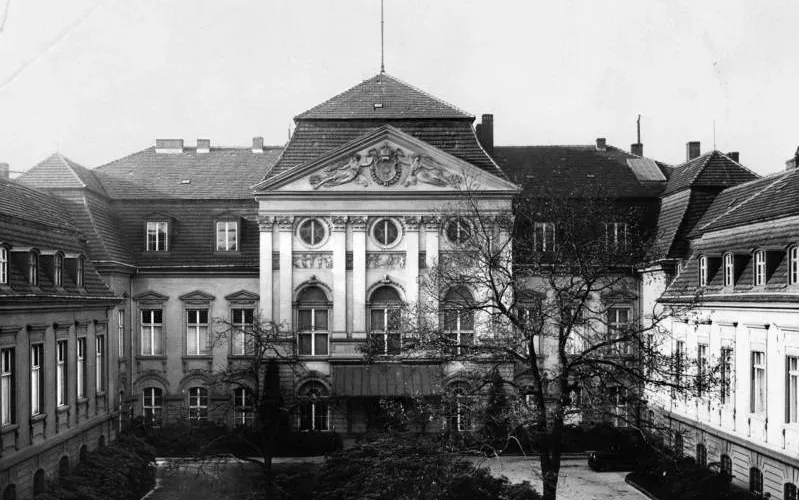
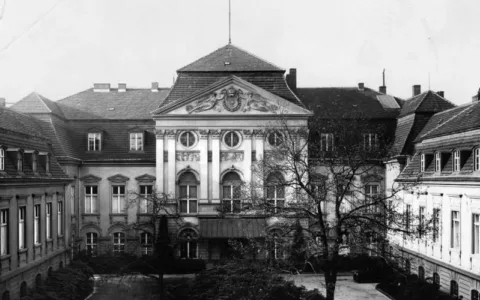
Reich Chancellery, Berlin, November 5, 1937. It’s the location and date of a secret conference that was called and attended by Hitler. Also present were Hitler’s military and foreign policy leadership. Of course it was Hitler that did most of the talking. It was probably his extremist monologue in front of others once more, something many had grown accustomed to by that point. Hitler demanded strict secrecy and stated that his speech should be regarded as a ‘political statement’ if he died.
Anyway, even if it was a secret conference, we know what was said. Based on the minutes of this meeting, the Hossbach Memorandum (also known as the Hossbach Protocol) was written.
The meeting marked the beginning of Hitler’s foreign policies becoming even more radicalized. And the Memorandum captured it all.
What Was Said at The Conference
It was Hitler’s army adjutant Colonel Friedrich Hossbach who took the minutes at the meeting. What is immediately striking about this Memorandum is that Hitler actually articulated that he did not want a war with France and Britain in 1937. He instead preferred to engage in a few small wars that would be used to plunder the adversaries.
The striking aspect, however, was that this meeting wasn’t even called for this exact reason. The meeting was essentially called because of a dispute between the Luftwaffe and the Heer versus the Kriegsmarine, and that needed resolving. Admiral Erich Raeder complained that the Kriegsmarine was receiving insufficient allocations of steel and other raw materials. He continued to argue that the navy’s entire building program was in danger of a complete collapse. But neither the Heer nor the Luftwaffe was willing or intending to reduce its steel allocations.
But as always, Hitler hijacked this moment and started providing nothing short of a lecture about his assessment of foreign policy, and declared that if he died, the contents of the conference were to be regarded as his so-called ‘political statement’. It’s very likely that Hitler had a lot of these kinds of ‘political statements’. Still, the Memorandum remains very interesting because it gives us a precise picture of exactly how Hitler was thinking.
Lebensraum and Possible Allies No More
Hitler argued in his monologue that the economy of Nazi Germany was fast approaching its breaking point. The only way of averting a drastic fall in living standards was to start with a policy of aggression. This is something that he said had to happen sooner rather than later. The most important aspect of this policy of aggression was to provide Lebensraum for the German citizens by annexing Czechoslovakia and Austria. Hitler even put a timeline on his plans. He thought it was imperative that they’d act no later than 1943-1945. He even argued that if they waited longer than that, Britain and France, whom he named the ‘two hate-inspired antagonists’ (Hassgegner) during this meeting, would close the gap in the arms race. He was very well aware of the fact that Nazi Germany was already falling behind, even before the war had ever started, and while the rearmament was going full steam ahead.
It is said that this is the first time Hitler shared his new view on Britain. He didn’t always see Britain as an enemy, let alone as the hate-inspired antagonist. Mein Kampf wasn’t Hitler’s only book, he also wrote Hitlers Zweites Buch. Although this book was not published in his lifetime, it gives us a clear idea of how he viewed Britain in 1928. In essence it was a book about his political theory, in which he also argued that Great Britain and a future German state under his leadership should be allies based on political expediency and shared Germanic racial concepts. Hitler envisioned a division of labor where Britain kept its overseas colonial empire, while Nazi Germany pursued its continental expansion and Lebensraum in Eastern Europe.
Hitler truly believed that Britain would tolerate German European hegemony if Germany did not challenge British naval or global colonial supremacy.
This book showed exactly how little Hitler actually knew about foreign policy and international politics. It’s proof that he wasn’t the all-round ‘mastermind’ he fancied himself to be. Hitler completely disregarded the fact that British foreign policy was traditionally opposed to any single European power dominating the continent. As Hitler also wasn’t diplomatic with his actions, he proved to the British leadership that he could not be trusted. The aggressive territorial demands and disregard for international treaties were the ultimate proof of that. That meant that they would’ve never become allies anyway.
During the meeting, Hitler seemingly closed the door for any sort of alliance with Britain. He said that Britain was unwilling and unable to accept a strong Germany. By calling Britain the ‘hate-inspired antagonist,’ Hitler closed the door on any future alliance between the two nations.
Autarky
Nazi Germany was of course a totalitarian autocracy. Usually states that have this kind of political system are isolated by other countries, especially by the West. Usually they can find some allies, which Nazi Germany also did. But it also creates economic issues if those few allies can’t provide Nazi Germany with everything it needs. It’s not far-fetched to assume that Hitler was also very aware of this fact. That’s why, during the meeting, he also outlined that Nazi Germany should become an autarky.
The first part of the Memorandum continued to show what Hitler said. He reasoned that a reliance on others makes a state weak. What the Memorandum does suggest is that certain types of autarky were not even possible. Some historians see this premise as a way of preparing Germany for conflict, by making the country not economically reliant on other states. And to achieve the ultimate form of autarky for Nazi Germany, war was a necessity, rather than just a hypothetical option.
It’s certainly not far-fetched. When reading the Memorandum, it’s clear that Hitler concluded that German economic and agricultural autarky was unattainable. There was a fundamental resource deficit, particularly a definitive failure regarding food self-sufficiency. The latter was used to frame violent territorial expansion and war as a necessity for national survival.
Hitler’s Contingencies
The second part of the Memorandum showed three contingencies Hitler would take if certain situations played out in Europe, as he predicted. These contingencies had the goal of ensuring the security of Nazi Germany. Again, Hitler continued to turn against the two ‘hate-inspired antagonists,’ as he stated that they were blocking every German foreign policy goal. Somewhere in the coming years, Nazi Germany would have to achieve autarky by seizing Austria and Czechoslovakia, before preparing for a possible war with France and the United Kingdom.
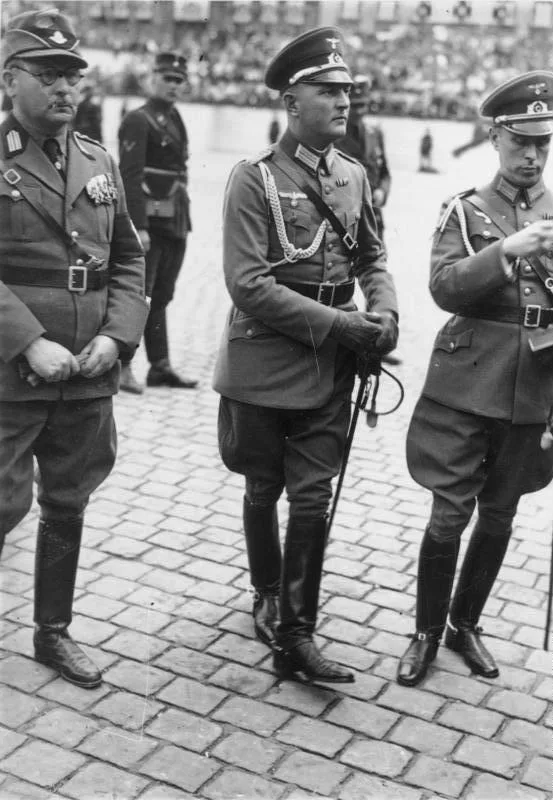
At least three of the attendees had a more realistic view of the world and Europe. Field Marshal Werner von Blomberg (Reich War Minister), Baron Konstantin von Neurath (Reich Foreign Minister), and General Werner von Fritsch (Heer Commander-in-Chief) all essentially disagreed with Hitler after the meeting, something that was always very risky to be doing. They said that the foreign policy Hitler had outlined was too risky, adding to the fact that Nazi Germany would need a lot more time to achieve a decent rearmament.
They also took issue with Hitler’s contingencies, the specific scenarios he treated as prerequisites for war, arguing that these were too unlikely to occur. Hitler had stated with certainty that the Spanish Civil War would lead to a Franco-Italian war in the Mediterranean Sea, and that France was actually on the verge of a civil war. You didn’t need hindsight to see that these were already far-fetched scenarios to begin with.
Blomberg, Neurath, and Fritsch saw it a whole lot clearer. They expressed their concerns that if Nazi Germany attacked states in Eastern Europe, it was bound to trigger a war with France because of France’s formal military alliances with countries like Czechoslovakia. What they also foresaw was that if Nazi Germany found itself at war with France after attacking one of Eastern Europe’s states, Britain would surely intervene to prevent France’s defeat. It’s still striking how right they were.
At that time, Germany was nowhere near ready for a war with France or Britain. That’s exactly the reason Blomberg, Neurath, and Fritsch actually advised Hitler to hold off on any offensives until Germany was sufficiently rearmed. Before you start thinking Blomberg, Neurath, and Fritsch must have been real heroes, they were, in fact, nothing of the sort. Not a single one of the high-ranking Nazi officials had any moral objection to Hitler’s plans whatsoever. The only thing they were divided on was the timing.
Still for Blomberg, Neurath, and Fritsch, the inevitable happened. They had criticized Hitler’s plans too much, even if they had no moral objections to carrying out the plans sooner or later. All three of them were removed from their positions.
What Is Actually True?
While the Memorandum is a primary World War II source, its accuracy has been questioned for decades. Some historians argue that the minutes were drawn up from memory five days after the meeting had ended, as opposed to minutes taken during the meeting itself. Adding to this is the fact that Hitler never actually reviewed the memorandum. He insisted, as he often did, that he did not have time to be bothered with such small details.
It’s plausible that historians have focused on the wrong aspects of the memorandum. Specifically the parts that seem to support claims that it’s inaccurate, or that the meeting didn’t happen the way it was recorded. Surely if you think that this meeting was only for Hitler to lay down his plans of world domination, you’d come to the same conclusion. We would argue that it was just one of Hitler’s many harangues. That would leave some inconsistencies here and there if it was written up from memory five days later. I mean, who could actually recollect every rambling episode Hitler had?
But it’s reasonable to continue to see the Memorandum as accurate and truthful in its core premise.
Continue the discussion
If you’d been in that room on November 5, 1937, and you could see what we now know was coming, would you have spoken up like Blomberg, Neurath, and Fritsch did? Or would silence have felt like the safer bet?
Join Field Reserve for free and make your case inside the WarCommons community at our Field Headquarters.
WarCommons publishes long-form, source-driven World War II analysis without ads or sponsored content. If you found this article valuable, consider supporting independent research by joining Field Command.
By Nick Ravenshade — Founder & Editorial Director, WarCommons
Header image: Berlin, Reichskanzlei. Source: Wikimedia Commons / Bundesarchiv, Bild 146-1998-013-20A. CC-BY-SA 3.0.


.jpg)
