WARCOMMONS IS NOW ON ANDROID
Explore WWII history and stay connected with the community on the go. GET THE APP →
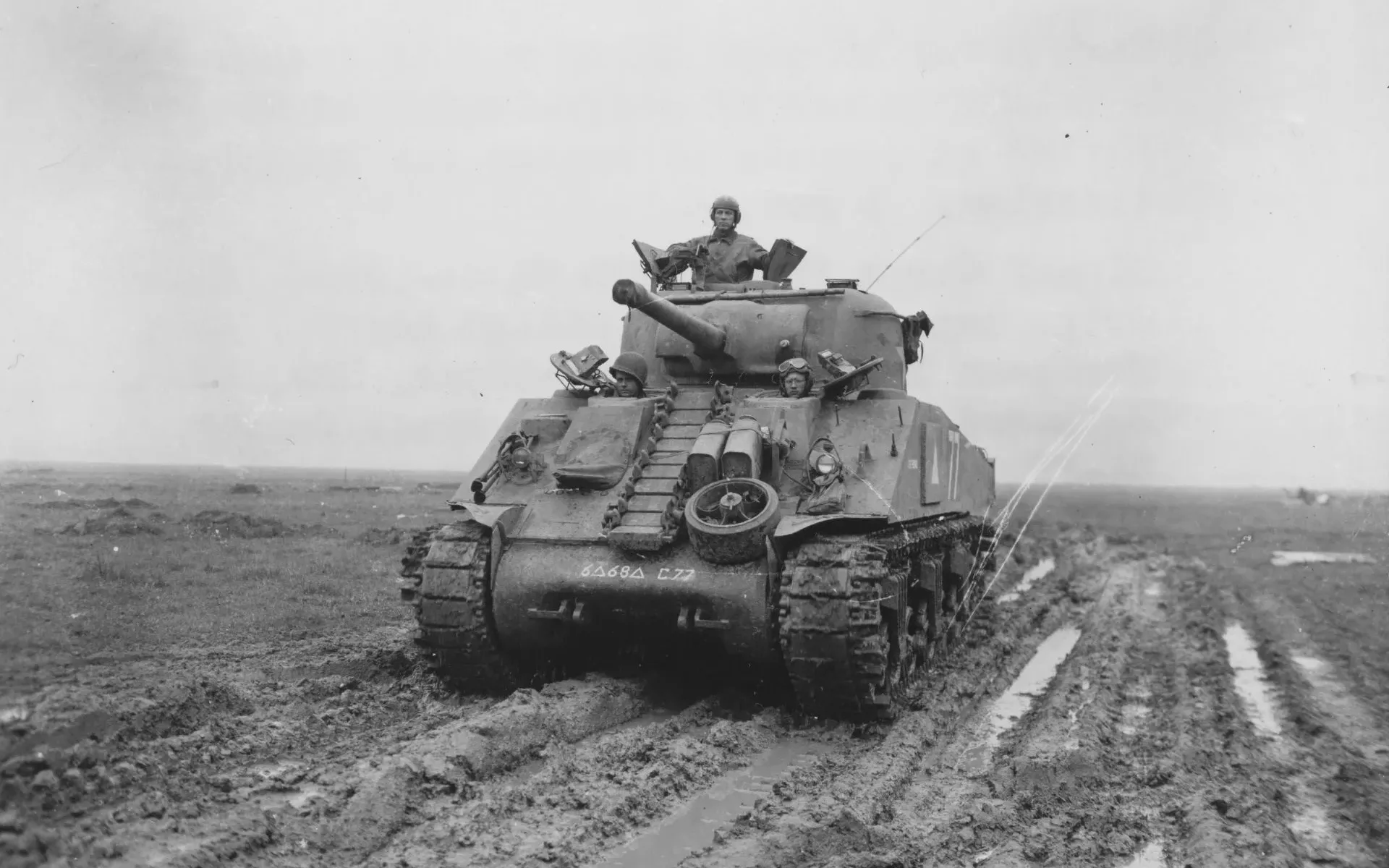

A famous memoir, a nickname that stuck, and crew survival data that tells a more complicated story. The first entry in our WW2 Myths series.
This is Part 1 of World War II Myths, an occasional WarCommons series where we test a famous claim against the evidence.
The M4 Sherman is possibly one of the most iconic Allied tanks of World War II. Officially designated the Medium Tank, M4, it was unsurprisingly a medium tank. It was the most widely used medium tank by the United States and the Western Allies during the war. A tank that was perfect for mass production, and very reliable. But was it also the so-called ‘deathtrap’ it’s often made out to be?
The Deathtrap Myth or Reality
A flimsy, fire-prone coffin, also known as the M4 Sherman. At least, that is what Hollywood wants you to believe. This depiction of the medium tank originates from pop culture, movies, and unverified post-war memoirs. That doesn’t mean there’s no truth to it at all. That’s why we sometimes have to look beyond what’s presented to us as facts to determine what is actually true here. So, was it a deathtrap after all?
What we need to weigh against pop culture, movies, and unverified post-war memoirs are statistics, wartime data, and modern historical consensus. These three sources tell us a different story. Not a story of a flimsy deathtrap, but the story of one of the safest and most ergonomically advanced tanks of the entire conflict.
The ultimate indicator of whether the M4 Sherman was a deathtrap is to look at the data of how many men actually died inside when the tank was penetrated or disabled. If you bought into the myth, you’ll probably be surprised to learn that the M4 Sherman had an extraordinarily high crew survival rate.
High Survival Rate
Verified numbers never lie. The U.S. Army’s Operations Research Office (ORO) conducted a postwar study on the M4 Sherman’s crew survivability. What they were able to verify is that the M4 Sherman averaged approximately 0.62 crewmen killed per Sherman tank that was destroyed. To put that into perspective, it meant that of a five-man crew the vast majority survived if their tank was knocked out. The caveat is that surviving didn’t mean escaping unhurt; many survivors were, in fact, wounded or burned.
Even if these are only averages, they paint a clear picture of crew survivability. German tanks commonly suffered from mechanical reliability problems, but that is a separate part of the comparison.
The M4 Sherman was designed with a central focus on crew escape and ergonomics, which directly helped keep mortality low. The Sherman tank had separate hull hatches for the driver and assistant driver, while the turret crew used the roof hatches. The hatch arrangement varied between Sherman models, and the gunner did not have a dedicated hatch of his own. Still, the Sherman offered several escape routes, and its internal layout could help the crew evacuate a damaged tank.
What often gets overlooked is that even if a projectile hit the tank without fully penetrating it, the crew could still be severely hurt. One of the common dangers in this regard was spalling. When a projectile struck armor, fragments could break away from the inside steel surface and injure the tank crew. This sometimes even happened without the projectile needing to fully penetrate the tank. Some late-war German tanks suffered from this brittleness as alloy shortages affected production. The Sherman tank’s armor was generally less prone to this kind of fragmentation, but that didn’t mean the tank was also better protected against a projectile penetrating the armor.
So, the M4 Sherman survived knockouts considerably better than its Soviet and German counterparts. Yet, it’s still the deathtrap. Or is it?
Fire Myth and Truth
We are not yet done with the myths. The M4 Sherman even had the nickname ‘Tommy Cooker’ because of its tendency to catch fire. It may surprise you, but it’s not all myth here. The early Sherman tank had a tendency to catch fire when its armor was penetrated. It may seem like it was a funny nickname, but the grim reality behind it was that the crew would be ‘cooked’ while trapped inside. Initially people thought the M4 Sherman was catching on fire due to the tank’s engine. However, later studies proved that the fires were caused by the ignition and detonation of the stored internal ammunition, and not the fuel itself. As soon as the U.S. had introduced the wet stowage in 1944, those revised tanks became much less prone to catching on fire. Wet stowage placed the ammunition in storage bins surrounded by jackets filled with a water-glycol mixture.
And again, the numbers don’t lie. Before the introduction of wet stowage, approximately 60% to 80% of the dry-stowage Sherman tanks whose armor was penetrated by a projectile caught fire. After the introduction of the revolutionary wet stowage, this rate dropped to approximately 10% to 15%.
So it’s still a myth if you are convinced that the M4 Sherman was always just catching fire and exploding as soon as it was hit. It’s also a textbook example of how a great myth has just that little aspect of truth in it to make it very likely, even if it’s untrue.
How a Legendary Tank Became Plagued by False Narratives
And so, some myths are based on early truths that changed during the course of the war, making them myths, to a certain degree, in the end. Other myths, like the deathtrap myth as a whole, collapse once you look at the data. The only issue at hand is that a myth, like the deathtrap myth, doesn’t just come out of nowhere; it has to start somewhere.
Unsurprisingly, the myth doesn’t stem from wartime statistics. One of the main instigating factors in this myth is Belton Cooper. In 1998, Cooper published his memoir called Death Traps: The Survival of an American Armored Division in World War II, and the book helped popularize this specific myth. Cooper was an ordnance lieutenant in the 3rd Armored Division. His job was to retrieve and repair highly damaged tanks. Naturally, due to the nature of his role, he commonly saw the worst-damaged tanks and vehicles. That is selection bias. Imagine only seeing destroyed M4 Sherman tanks, day in, day out. I wonder how much he is actually to blame for starting this myth. His view was heavily biased by what he saw every day. Even if it’s a myth to everyone looking at the facts, the myth was his truth.
Needless to say, modern historians Steven J. Zaloga and Nicholas Moran heavily criticized his book for widespread technical, statistical, and historical errors. It’s something we at WarCommons can stand behind, for history can only be preserved and taught when facts are leading the conversation.
That’s why we also shouldn’t act like it’s all Cooper’s fault. The myth was also fueled by the media, which helped create the so-called Tiger phobia. Allied tankers in Europe often encountered hidden Panzer IVs or anti-tank guns. Many Allied tankers reportedly misidentified enemy vehicles as Tiger tanks out of fear, helping fuel the so-called Tiger Phobia. The media, of course, had a field day with this, as they gladly focused heavily on these types of rare encounters. However, this impression was also reinforced by the army reports and Allied commanders. What the public subsequently read gave them false impressions that the M4 Sherman was often hopelessly outmatched in almost every single battle.
The Truth
When looking at the facts and the numbers, the Sherman tank wasn’t a deathtrap. And it predominantly caught on fire earlier in the war. After the changes were made to the tank, it was one of the most reliable and survivable tanks on the battlefield. The tank was easy to mass produce and was used in a variety of roles. U.S. doctrine expected armored divisions to exploit breakthroughs on the battlefield, while other tank battalions could support infantry. It’s true that if it was forced into head-on matches against German heavy and medium tanks, such as the Panther or the Tiger tank, the Sherman tank was at a tactical disadvantage. But fighting heavy tanks was never its purpose. The M4 Sherman tank generally used as intended, as part of a combined-arms force. It had superb mechanical reliability and a rapid turret traverse. These were all factors that ensured the M4 Sherman was very effective when used in coordinated combined-arms tactics.
When we strip away all the myths and false information about the M4 Sherman, what remains is an unprecedented and extraordinarily high crew survival rate for its time.
No matter what myths have come before or are yet to come, the Medium Tank, M4 (Sherman), deserves to be called one of the greatest tanks of World War II.
World War II Myths returns whenever the next myth is ready. Have one you want tested? Post it in the Field Headquarters.
Continue the Discussion
Belton Cooper only saw the Sherman tanks that had been wrecked, and his view shaped a myth that lasted decades. Which other WWII ‘common knowledge’ do you think comes from someone who only saw the worst cases? And what should we test next in World War II Myths?
Join Field Reserve for free and make your case inside the WarCommons community at our Field Headquarters.
Take WarCommons with you on Android.
WarCommons publishes long-form, source-driven World War II analysis without ads or sponsored content. If you found this article valuable, consider supporting independent research by joining Field Command.
By Nick Ravenshade — Founder & Editorial Director, WarCommons
Header image: Sherman tank moves through thick mud in France to demonstrate one of newly-installed “Duck Bills” on outside of tracks for better traction. November 5, 1944. Source: Wikimedia Commons. Public domain.