WARCOMMONS IS NOW ON ANDROID
Explore WWII history and stay connected with the community on the go. GET THE APP →

Hitler’s scientists turned coal into edible fat, fed it to concentration camp prisoners to prove it was safe, then incorporated it into Wehrmacht rations.
Information and misinformation on highly processed and synthetic foods have tended to dominate the news in recent years. Yes, you’re still on the WarCommons website. Yet I mention this current dynamic because it turns out that synthetic foods emerged right before and during World War II. We’re talking about a new kind of butter that is sometimes referred to as Hitler’s butter. But, let’s have the privilege of being the first to call it ‘the butter that nuked human kidneys.’
Essential Fat Deficit
Previously we published an article on how Nazi Germany transitioned into pursuing autarky. Because of the country’s 1930s policy, the Nazi regime knew that in a future war the Allied naval blockades could, and probably would, cut off imports of petroleum and vital agricultural fats. Especially imports of fats like South American linseed, Antarctic whale oil, and Asian soybeans were vital to Nazi Germany. The country already had a massive domestic deficit that was also known as the Fettlücke, meaning Fat Gap, that started around 1933, immediately following the Nazi rise to power.
When a country chooses to completely rely on itself, there are more shortages to be expected. Nazi Germany also had a fuel crisis, but it also had very bright scientists and chemists. Two of these bright chemists were Franz Fischer and Hans Tropsch. They developed the so-called Fischer-Tropsch process. This process used steam, heat, and catalysts to convert the copious amounts of German coal into liquid synthetic fuel.
But what does that have to do with Germany’s essential fat deficit? Well, you might be surprised, but the topic is still the butter that nuked human kidneys.
The Butter That Nuked Human Kidneys
A major byproduct of the Fischer-Tropsch process turned out to be a waxy, industrial sludge that was called paraffin wax, sometimes referred to as gatsch.
One chemist was absolutely paying attention to this new industrial process. That chemist was Arthur Imhausen. Imhausen ran a soap factory in the industrial Ruhr valley. He realized that this paraffin byproduct could be chemically modified. He saw an opportunity to try and modify this byproduct so it was safe for human consumption, which could help Nazi Germany with its essential fat deficit. So, a chemical byproduct of a process that turns coal into liquid synthetic fuel, what can go wrong?
Apparently no one thought of that question. The company Imhausen & Co. started developing a method of paraffin oxidation to break down the wax into synthetic fatty acids. This was possible because both the paraffin and natural dietary fats are composed of carbon chains. To their credit, the chemists did think of turning the industrial grease into something humans could ingest. They even came up with a recipe, like it was just something out of a cookbook. It started with oxidizing the coal paraffin to extract the edible-grade fatty acids. Right after that process, the chemists would esterify the fatty acids with glycerol. This created the actual synthetic triglyceride (fat). Like in every good recipe, it now had to be mixed with 20% water and salt. The process continued with adding a carrot extract which would give it a natural yellow color and the appearance of being vitamin-rich. The final step was to inject diacetyl. This is a chemical flavoring agent to mimic the distinct smell and taste of real dairy butter. Diacetyl is the chemical flavoring agent that is still used to this day, for example in microwave popcorn.
Follow the recipe and what they made was a highly durable, artificial margarine-like paste. This butter would never go rancid and it didn’t even need any refrigeration. No red flags here…
Honorary Aryan
The ultimate credit went to Imhausen. In 1936, he opened his first synthetic butter factory called Deutsche Fettsäure-Werke, where the industrial production officially began. It took about 60 kilograms / 132.2 pounds of coal to produce 1 kilogram / 2.2 pounds of the butter that nuked human kidneys. That means it was very inefficient and costly to produce.
Hitler didn’t care, though. He and Hermann Göring were absolutely thrilled when they learned of this invention. It was a thrilling discovery, especially because it had a very high propaganda value. Hitler saw it as the ultimate proof that German science could overcome any blockade. A real step towards a workable Autarky too.
There was just one small issue, Arthur Imhausen’s mother was Jewish, making him a so-called half-jew (Mischling) under the Nuremberg Laws. Hitler was forced to use the only escape method he had for these kinds of situations, being to grant the title of ‘Honorary Aryan’. Imhausen’s work was deemed very critical for the German war effort. Therefore, in 1937, Hitler granted him and his family the official dispensation, by declaring them ‘Honorary Aryans’.
So taking everything into account, one could conclude all was well. It was surely safe to eat.
Not So Safe For Human Consumption
The German military was obviously very interested in using this product in its frontline military rations. However, they were maybe the first to question if this new butter was safe for human consumption. What was clear is that they demanded proof. In the quest for proof, the Nazis wouldn’t be Nazis if they didn’t turn to human experimentation. Of course, the Nazis utilized their network of concentration camps and their prisoners to test the butter. It is said that more than 6,000 inmates of the Sachsenhausen concentration camp were forced to eat Hitler’s butter while doctors would monitor them.
It was an absolute success, according to the Nazis. In 1943, Nazi scientists even published a paper on Hitler’s butter. It triumphantly declared the world’s first synthetic food safe for human consumption. The fact that the butter was tested on prisoners was, of course, ‘accidentally’ left out of the paper.
Given the nature of this article, you might be surprised to learn that a pure, perfectly synthesized carbohydrate or fatty acid is theoretically usable by the human body. However, the issue was that the industrial processing of coal was highly imperfect and highly toxic. Coal in itself contains a lot of heavy metals, such as mercury, arsenic, and lead. Even if the process was revolutionary, the crude purification methods of the 1930s were imperfect. That meant that the butter would often carry the chemical impurities with it.
We now also know that the synthetic fat contained odd-chain fatty acids and branched-chain isomers that were uncommon in natural fats. That inherently means that the human liver and cellular metabolism would struggle to properly process the butter. This would result in metabolic strain when it was used over a prolonged timeframe.
Germany’s military leadership didn’t have to wait until 1943 for the proof that they sought. They were given the ‘proof’ earlier, as the concentration camp tests had already started in 1936. It only took a few concentration camp doctors to decide that the butter provided enough basic caloric energy to prevent immediate death in the field. For the German military leadership, this was enough to serve as proof.
Actual Use and Distribution of the Butter
As Germany’s military leadership was reassured about the use of the butter, they started to implement it from 1941 onwards. You could say it flooded the military rations as the Wehrmacht and the Waffen-SS integrated the butter into standard field rations. The troops were issued a daily fat allowance which they carried in their standard-issue Bakelite butter dishes (Fettbüchse).
It was absolutely fantastic to use because it didn’t require any refrigeration and it would never go bad. It could withstand the blazing heat in the North African campaign and the unstable weather conditions on the Eastern Front. That meant that Erwin Rommel’s Afrika Korps also used this butter. Naturally, the butter was an excellent addition to the U-boat crews as well, as they could carry the butter while at sea for long periods of time, without the butter spoiling.
You could say the German military had just begun to eliminate itself with the use of a toxic butter. But there were also innocent citizens that were caught in this situation. The butter was also distributed as a mandatory addition to the rations of heavy industrial laborers, hospital patients, and concentration camp inmates.
The Real Concentration Camp Testing Results
Now this is something that was completely omitted in the 1943 paper and also within the Nazi regime. One could wonder how much of this the German military leadership knew, as they did ask for proof that the product was safe for human consumption. If they knew the truth, it remains open to interpretation whether the German military leadership would have implemented it. Chris van Tulleken’s historical investigation, Ultra-Processed People, makes it very likely that the actual test results were intentionally omitted and falsified to the German military leadership.
The truth about these tests, however, was absolutely shocking.
It wasn’t only the results of the non-consensual and highly exploitative human testing inside the Sachsenhausen concentration camp that were shocking. Prior tests were performed on animals. Both testing processes showed the same shocking consequences. The butter caused calcium loss, severe kidney inflammation, and chronic kidney failure.
The metabolic disturbance was also documented. The butter caused the inability to make energy, because it created an enzymatic blockade in the test subjects. Their bodies were flooded with dicarboxylic acids, hydroxy acids, and keto acids. This commonly resulted in an excess of acid in the urine, causing the body’s internal chemistry to destabilize from within.
The concentration camp prisoners who were lucky enough to survive the horrors they faced, in addition to being experimented on with Hitler’s butter, reportedly suffered lasting chronic health issues and permanent renal damage for the rest of their lives.
Why It Ultimately Failed
It should be really straightforward. The butter that nuked human kidneys failed because it was nothing short of pure poison. Or did it?
It didn’t.
The simple fact was that this butter ultimately failed because it was an economic disaster. Remember that the actual health issues and consequences were buried by the concentration camp doctors. The fact that 60 kilograms / 132.2 pounds of coal was needed to produce just 1 kilogram / 2.2 pounds of butter made the process very inefficient and costly. That same coal was desperately needed to power trains, generate electricity, run steel mills, and produce synthetic military fuel. Burning through massive amounts of coal to produce a tiny amount of edible fat was fast becoming a logistical nightmare. This was simply not sustainable in the long term.
It failed as a long-term, practical method of food production. But in the short term, during World War II, it was successful in its own right. It absolutely killed people from within. But it also closed the ‘Fat Gap’, and it kept people alive. It could save and kill you at the same time. In an actual starvation crisis, the butter could provide approximately 700 calories per day. The alternative was 0 calories per day and death by starvation.
The butter’s failure became clear as soon as World War II ended. Normal agriculture resumed and Autarky was no longer Germany’s goal. The factories that produced synthetic butter were shut down, which left this specific chemical processing permanently abandoned. It also left an unknown number of people to suffer from the butter that nuked human kidneys.
Continue the discussion
This butter kept German soldiers and civilians alive during a real starvation crisis. While slowly destroying the kidneys of those who ate it, especially the prisoners forced to test it. Does knowing it also saved lives change how you judge it, or does the concealment and exploitation behind it make that question irrelevant?
And with ultra-processed synthetic foods now a daily part of modern diets, how different is the ethical calculus really?
Join Field Reserve for free and make your case inside the WarCommons community at our Field Headquarters.
Take WarCommons with you on Android.
WarCommons publishes long-form, source-driven World War II analysis without ads or sponsored content. If you found this article valuable, consider supporting independent research by joining Field Command.
By Nick Ravenshade — Founder & Editorial Director, WarCommons
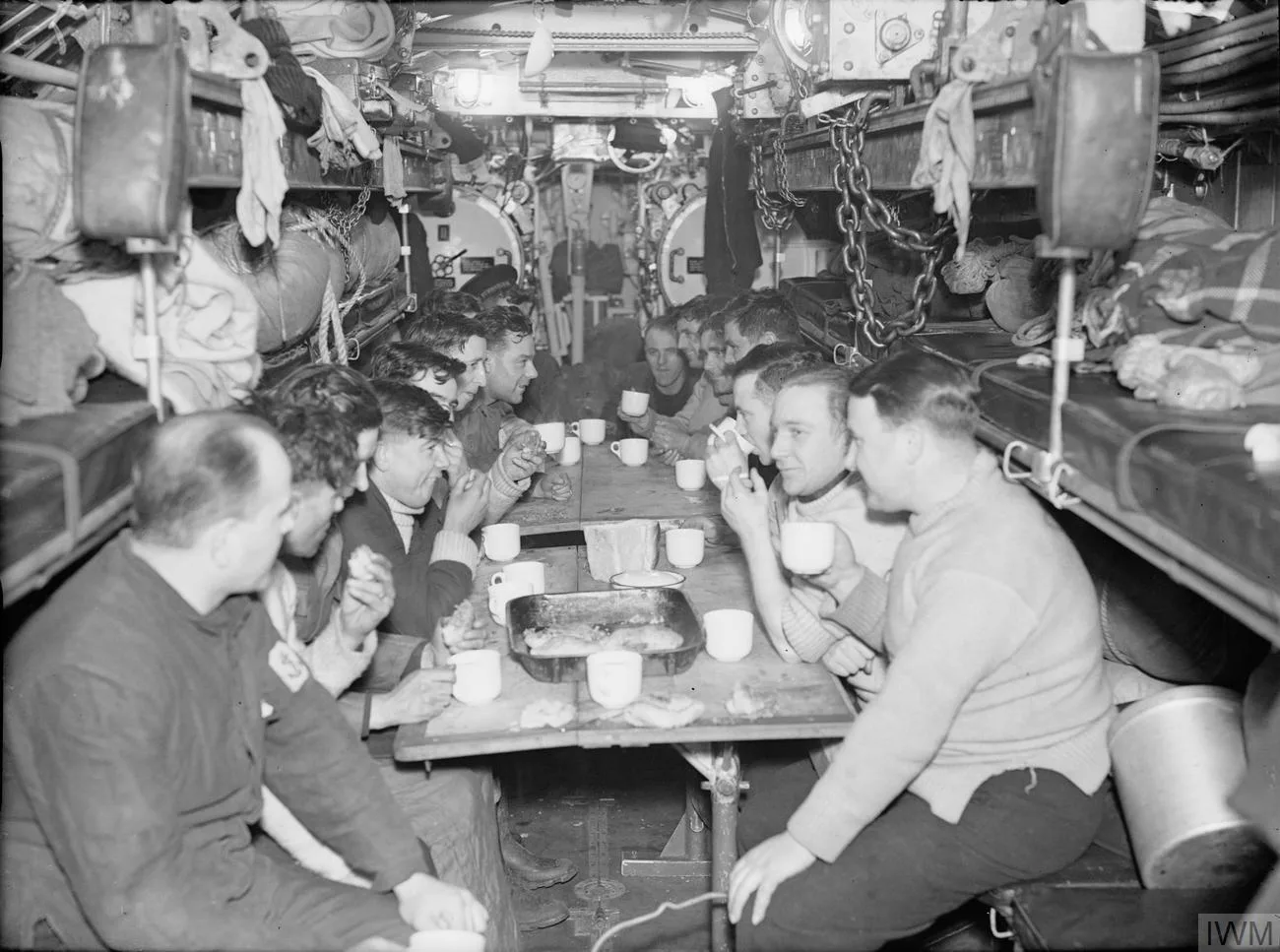
Header image: In the fore end, the crew having their supper on board HMS GRAPH (ex U-Boat U 570). October 1941. Source: Wikimedia Commons. Public domain.