WARCOMMONS IS NOW ON ANDROID
Explore WWII history and stay connected with the community on the go. GET THE APP →

When it comes to Adolf Hitler, his rise to absolute power, and Nazi Germany, most discussions focus on the well-documented instances of propaganda that took place from 1933 through 1945. Countless articles have been written on this subject.
People fail to realize that the true starting point of Nazi propaganda was as early as 1919. It was not 1933, the year of the Reichstag fire. Nor was it the publication of Mein Kampf in 1925. It was 1919. I will therefore take you back to the true beginning of Nazi propaganda, the year 1919. The true prelude to Hitler’s absolute rule.
The German Workers’ Party (DAP)
To understand the origins of Nazi propaganda, we must go back to the beginning. The beginning is the moment when the DAP was formally founded. The DAP was founded by Anton Drexler and Karl Harrer. It was January 5, 1919.
When it was founded, the DAP was a small, völkisch, and anti-Semitic group. Between January and September 1919, the DAP mainly held small-scale and modest gatherings in Munich. These gatherings were usually held in the basements of beer halls, the well-known bierkellers. During these gatherings, Drexler, and occasionally others, spoke to a small audience of workers. The DAP sought to appeal to the workers by opposing “international big capital.” The DAP advocated for a strong and people-oriented state.
However, they had a problem. The DAP was neither a well-known nor a major political player in Germany. It was just one party among many others. In the turbulent post-war period following World War I, there were countless völkisch splinter parties.
Everything was about to change. On September 12, 1919, another modest gathering of the DAP was scheduled to take place at the Sterneckerbräu beer hall in Munich. In 1919, this beer hall served as a regular meeting place and the DAP’s first office. A young German spy, working for the Reichswehr (the German army during the Weimar Republic), was preparing to attend the DAP meeting. The spy was required to attend the DAP meeting because the Reichswehr had ordered him to do so. The mission had three parts: investigate whether the party posed a threat to stability, determine whether the DAP was radical-left or communist, and find out what the party’s ideology stood for.
The German spy? Adolf Hitler.
The meeting of September 12, 1919
Hitler is looking for a spot from which he can keep a close, secret watch on the gathering. It works to his advantage that he is, at that moment, a pale, thin man with a black mustache. He is, therefore, only too happy about this, given the nature of his mission.
It was Adalbert Baumann who, during the closing debate of the meeting, argued that Bavaria should secede from the German Empire. This struck a nerve. It is widely accepted among historians that this was the moment when Hitler delivered his first speech, in which he defended the honor of the German people and impressed the party leaders, including Drexler, with his rhetorical skills.
However, the facts regarding the events that took place during this meeting are based solely on the book Mein Kampf. In his book, Hitler looks back on this moment. In it, he recounts that he verbally intervened in a conversation when a speaker made a point with which he disagreed. He says that this made him stand out and is why he was invited to return soon and become a member. It has been established that he himself identified September 12, 1919, as the beginning of his political career.
And so it came to pass. In September 1919, Hitler officially became the 55th member of the DAP.
First signs of propaganda being used
After Hitler officially joined the DAP, the first signs of the use of propaganda began to appear. Hitler and Drexler envisioned the DAP as a public political party, featuring large public gatherings and populist speeches. This marked the beginning of their use of propaganda. Initially, the meetings were held in beer cellars, which likely attracted no more than a few hundred people. Hitler was now able to set the course, however, and he favored a grand approach. Under his leadership, large beer gardens were rented to reach a wider audience. Leaflets were also printed. These leaflets contained calls to readers to attend DAP meetings. They were distributed on the streets by DAP staff, and in the beginning, by Hitler himself. The DAP also used pamphlets and leaflets containing short, easy-to-read texts. With these, they sought to reach the public directly and win support.
In 1919, the propaganda manifested itself primarily through speeches delivered at gatherings in beer halls and the use of pamphlets and leaflets to repeat slogans and emotional rhetoric. The rhetoric capitalized on the widespread discontent among the population regarding the Treaty of Versailles. But the rhetoric was also nationalistic and anti-Semitic in nature. All of this was intended to win over supporters and draw crowds to the gatherings. Another key element was Hitler’s public speech on October 16, 1919, at the Hofbräukeller. This is the earliest documented organized public speech by Hitler.
These efforts soon bore fruit. The first so-called mass rally was organized by the DAP on February 24, 1920, at the Hofbräuhaus in Munich. In contrast to the usual attendance of around a hundred people, approximately 2,000 people were present at this mass rally.
It was here that the party presented its 25-point program and announced the name change. The Deutsche Arbeiterpartei officially became the Nationalsozialistische Deutsche Arbeiterpartei (NSDAP).
NSDAP propaganda in the early years
Following the name change in February 1920, the NSDAP engaged in active and targeted propaganda. The aim of this propaganda was rapid mass recruitment for the party. The propaganda tools used to achieve this goal were still primarily beer hall meetings, speeches, pamphlets, and leaflets. However, there was also a significant development in this area: the party’s formal takeover of the newspaper Völkischer Beobachter on December 25, 1920.
Völkische Beobachter
The Völkische Beobachter emerged in 1919 from the Münchner Beobachter, after the latter was purchased in 1918 by the anti-Semitic Thule Society. In 1920, the newspaper was purchased by the NSDAP. The exact purchase price of the newspaper appears to be a point of contention in the literature. In fact, no one really knows how much the NSDAP paid for the newspaper in 1920. What is known is that the purchase was initiated by Dietrich Eckart and Ernst Röhm. The purchase was financed by a combination of secret military funds, wealthy donors, and support from the Thule Society. Dietrich Eckart consequently became the newspaper’s first editor-in-chief.
This became the NSDAP’s key propaganda tool. In terms of reach, however, it was still somewhat limited in the early years. Circulation at that time hovered around 8,000 copies. But this grew to 25,000 copies by 1923.
However, the history of the Völkische Beobachter was not entirely without its problems. The newspaper was banned in 1923, along with the NSDAP. This was a consequence of the failed Beer Hall Putsch, which took place that same year. It was not until February 26, 1925, that the NSDAP was reestablished and the newspaper began publication again.
From the moment the NSDAP took over the newspaper, it was used as an effective propaganda tool. The party utilized the newspaper as its official mouthpiece. The editorial line and reporting were fully aligned with the party’s goals and strategies. Hitler and other NSDAP leaders, in particular, personally contributed articles and speeches to the newspaper. In this way, the party’s positions were conveyed directly to the reader. Readers were presented with a one-sided worldview, as the reporting relied heavily on framing. This framing primarily focused on anti-parliamentarianism, anti-Semitic stereotypes, accusations against left-wing opponents, and the Weimar Republic. Large headlines, caricatures, and photographs were also used effectively to stir up emotions among readers and to reinforce political messages.
The Völkische Beobachter was, however, not the only component of the NSDAP’s propaganda apparatus. In the party’s early years, another key player also emerged.
Joseph Goebbels
In February 1924, the trial against Hitler began. The trial was a result of the failed Beer Hall Putsch of November 1923. The trial attracted a great deal of (media) attention and thus served as a platform for Hitler’s political ideas. All of this also caught the attention of Goebbels, who at the time was still trying to find work as a journalist.
Goebbels was still finding his political footing, but he did follow the developments in Hitler’s trial with interest. This led him to develop sympathy for nationalist and völkische ideas. However, he was not immediately impressed, as is often assumed. There was, however, a problem. The NSDAP was still banned at that time. Consequently, he could not join the party in 1924. He therefore became involved in the National Socialist movement through völkische political networks and the circle around Gregor Strasser. He worked with Strasser in the movement’s northern organization.
Goebbels officially joined the NSDAP in 1925, shortly after the party was reestablished, and was assigned membership number 8762. After joining, it wasn’t long before he met Hitler. Goebbels was truly impressed by Hitler during their first meeting. On July 12, 1925, a meeting of the party leadership took place regarding the northern organization of the NSDAP. Goebbels was present there through his association with Gregor Strasser. Hitler was present as a speaker. Goebbels’ own words best describe this moment. In his diary entry from July 12, 1925, Goebbels wrote about the impression Hitler made on him. He spoke for three hours, Goebbels wrote. The impression was genuine: this was how a leader should be.
This is often seen as the moment when Goebbels personally came under Hitler’s influence. However, in that same year, Goebbels provides us with another account from the past, which allows historians to prove almost beyond a doubt that Goebbels had already developed a strong personal loyalty to Hitler by 1925.
In November 1925, Goebbels wrote in his diary that Hitler had everything a leader needed. This marked the beginning of Goebbels’s unconditional loyalty to Hitler, which he never wavered from after 1925.
After all these experiences, Goebbels gained increasing experience as a public speaker within the NSDAP. As history has shown, he proved to possess strong rhetorical and public relations skills. He was only too happy to use this talent to spread the National Socialist message on behalf of the party. In doing so, he sought to win the public over to Hitler.
In his early years, his written propaganda, in the form of newspaper articles, was seen primarily as a statement against the French occupation forces in the Rhineland. He enjoyed Hitler’s trust even at this early stage. In 1926, Goebbels was therefore appointed by Hitler as Gauleiter (party leader) of Greater Berlin. And in 1927, he launched the magazine Der Angriff, with the slogan: “For the oppressed, against the exploiters.” Der Angriff was initially used primarily to mobilize NSDAP members during the nearly two-year ban on the party in Berlin.
Another fact that is sometimes overlooked is the significance of Goebbels’ appointment as Reichspropagandaleiter of the NSDAP in April 1930. It was through his vision and dedication that the NSDAP, through its propaganda, began to portray Hitler as a decisive, messianic leader. He created a veritable Hitler myth. He intensified, streamlined, and coordinated the Nazi message throughout Germany and oversaw the coordination of party rallies and publications. It can be argued that with Goebbels’s appointment, propaganda became even more professionalized, thereby increasing its effectiveness. It was the foundation upon which the NSDAP based its propaganda.
The cornerstones of Nazi propaganda
And so history shows that the cornerstones of Nazi propaganda were already laid in 1919 by the DAP and the NSDAP. The propaganda tools used by the DAP and the NSDAP starting in 1919 were employed throughout the entire period from 1919 through 1945. However, these tools did evolve in terms of their use and effectiveness. But above all, they evolved in terms of the purpose for which the propaganda was deployed.
From 1919 to 1933, propaganda was primarily used to raise awareness and attract members and voters. The focus was on building power, developing a political weapon, and capitalizing on the prevailing discontent and crisis within German society at the time. By repeatedly publicizing their narrative through posters, leaflets, their newspaper, and public speeches, the NSDAP gradually managed to gain a following.
But did this actually have the desired effect for the NSDAP?
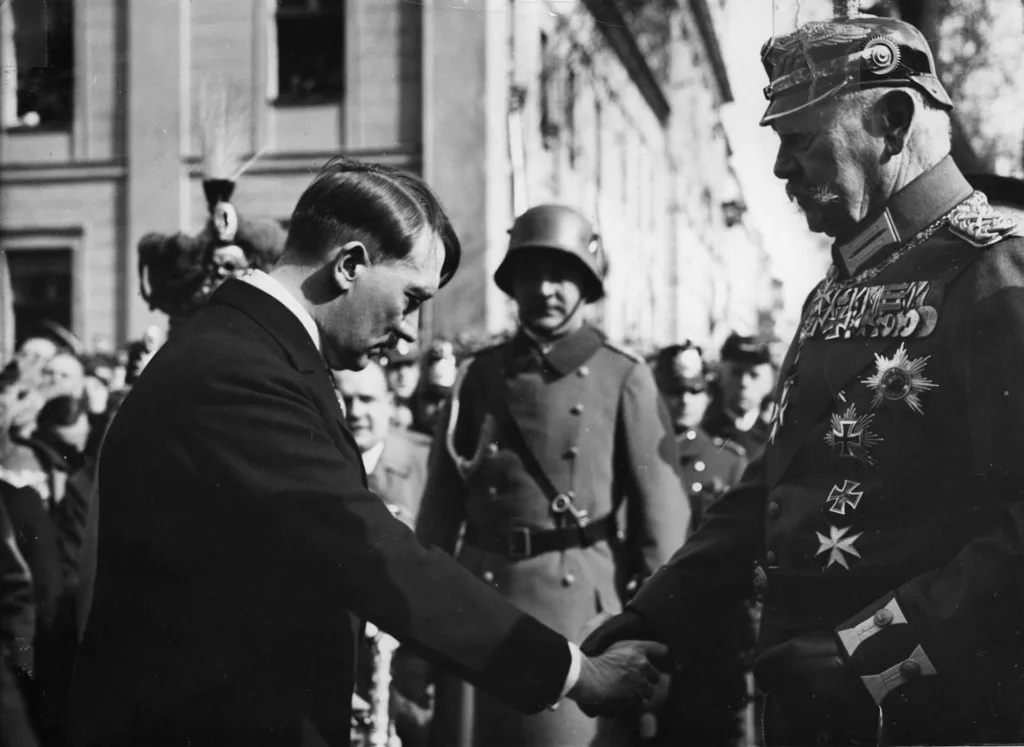
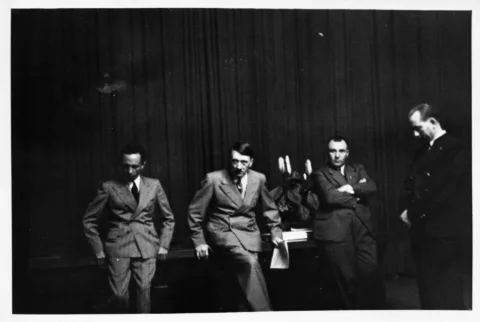
Source: Wikimedia Commons, Bundesarchiv, Bild 183-S38324. CC-BY-SA 3.0.
Nazi propaganda in the elections
A good indicator of whether Nazi propaganda had any effect between 1919 and 1933 is the obvious event of the national election. After all, by looking at the number of votes received, a tentative conclusion can be drawn about the popularity of the NSDAP, which at that time must have stemmed primarily from all the propaganda efforts the party undertook.
1928 Elections
The Reichstag election of May 20, 1928, did not yield the desired result for the NSDAP. At least, when one considers all the propaganda efforts of the preceding years since 1919, a cautious conclusion can be drawn that the desired result was not achieved. The NSDAP garnered approximately 2.6% of the vote. The ban on the NSDAP from 1923 to 1925 had taken its toll. It turned out that the NSDAP still needed more time to organize and disseminate its propaganda on an even larger scale, including through a nationwide press infrastructure.
However, this low percentage did not necessarily mean that the propaganda already being disseminated was ineffective. In 1928, the party’s efforts to recruit voters had to focus primarily on capitalizing on social discontent, major economic instability, and the German collective hatred of the Treaty of Versailles. But the 1928 election year coincidentally fell during a period of relative economic stability and recovery under the Weimar Republic. With the disappearance of collective discontent, voters nevertheless returned to the established parties of the time: the SPD, Zentrum, DNVP, and so on. As a result, these established parties still dominated the 1928 Reichstag elections.
1930 Elections
Nevertheless, a second opportunity would soon arise, specifically on September 14, 1930. Elections were held again on this date, as political instability was common at the time. A catalyst was the Great Depression of 1929, which caused a massive economic shock. This resulted in the ruling coalitions being weakened and new elections being called. The all-important factor, which had temporarily faded from view during the 1928 elections, returned during the 1930 elections: collective discontent. This was precisely the strong point that the NSDAP’s propaganda skillfully capitalized on.
The Völkische Beobachter’s efforts also proved to be influential, along with Hitler’s public speeches and the campaign by local NSDAP branches. However, much of the credit must be attributed to the state of Germany in 1930. There was a massive rise in unemployment. This exacerbated the economic uncertainty that had been triggered by the Great Depression just a year earlier. Many voters were therefore now receptive to so-called protest parties, such as the NSDAP, which was able to taste a small breakthrough for the first time.
It can be argued that during these elections, Goebbels also played an undeniable role in the campaign for the first time. Goebbels shamelessly exploited the death of Horst Wessel for propaganda purposes. Horst Wessel died on February 23, 1930, from complications of sepsis he contracted while being treated for his injuries. His injuries were caused when he was shot in the head at close range in his Berlin apartment on January 14, 1930. The perpetrator was Albrecht “Ali” Höhler, a member of the communist Rotfrontkämpferbund. Although there is broad consensus among historians that the murder was not politically motivated, Goebbels seized the opportunity. He mythologized Horst Wessel’s death and turned him into a party martyr. The NSDAP consequently transformed Wessel’s funeral into a massive propaganda event.
Thanks to all these efforts, the NSDAP won approximately 18.3% of the vote. It wasn’t enough to secure a majority, but it was a significant development.
Despite the increase, the established parties remained in power.
1932 Election
The government falls. It is 1932. The political instability that persisted from the previous elections in 1930 through 1932 ultimately led to the downfall of the sitting government. There was widespread long-term unemployment, and the established parties had failed to find solutions to the economic crisis and unemployment.
This is the most compelling example of Nazi propaganda, which had already begun in 1919, starting to bear fruit.
An inherent feature of a prolonged crisis is that more people turn to protest parties. The NSDAP was the perfect candidate for this. People truly saw the party as an anti-establishment alternative to the system that had failed them throughout the crisis.
The NSDAP continued to evolve and skillfully capitalized on the crisis. By 1932, a much more effective national organization of the NSDAP had already been established. More and more impressive mass rallies were held. Posters, flyers, the Völkischer Beobachter, and photographic propaganda were printed and distributed en masse throughout society. However, the party was also revolutionary in its campaigning. Unprecedented and unheard of at the time, Hitler managed to be present in multiple cities in a single day to address the public. While other political parties relied on slow train journeys or travel by car across the country, and could therefore be present in only one city per day at most, Hitler and the NSDAP utilized air travel. This significantly increased the party’s reach as well as its visibility.
It gave the party speed, national reach, and a media presence. As a result, Hitler was able to reach many more voters directly than the established parties. The efficiency of traveling by plane was clear. While the established parties were stuck on long train and car journeys, during which they could not campaign, Hitler, using his method, was already campaigning in the next city in the meantime.
But the choice of transportation itself also became the talk of the town, which in turn drew attention to the NSDAP and Hitler. In 1932, air travel was still relatively new. As a result, it received extra attention in the media, in newspapers, and especially through photo reports. After all, everyone in Germany simply had to see it.
It can be argued that during the 1932 elections, Goebbels began to play an even more significant role in mobilizing voters. He contributed more actively to the campaign and delivered speeches to large audiences. He also professionalized urban propaganda through newspapers, pamphlets, speeches, and the local organization of the NSDAP.
Thanks to this revolutionary campaign strategy, and with the Nazi propaganda machine running at full speed, the NSDAP won 37.4% of the vote in the elections of July 31, 1932.
The path to the Chancellorship was completely cleared for Hitler. Now even the established parties could no longer ignore the NSDAP and Hitler.
The Path to the Office of the Chancellor
The path to the Chancellorship lay wide open for Hitler. But the time had not yet come. The July 1932 elections were not, in fact, the last Reichstag elections of that year. Following these elections, Hitler and the established parties were unable to form a stable government. The political negotiations broke down. This meant that Reichstag elections had to be held again on November 6, 1932.
However, these elections nearly created a precarious situation: the NSDAP’s share of the vote dropped to 33.1%. The declining voter turnout is one of the direct causal factors that can explain this drop. Turnout fell from 84.1% to 80.6%. However, this was not the only reason. Among historians, a number of other events are also widely cited as explanations for this decline. Disillusionment among protest voters is often cited as an explanation. Some of the voters who had cast protest votes for the NSDAP in July 1932 realized immediately after the elections that it had not brought them rapid power. As a result, their motivation and enthusiasm waned. This led to voters who stayed away from the polls in November 1932 or voted for other parties, which may explain the increase in votes for the KPD and DNVP. But there were likely also internal tensions within the NSDAP. After the July 1932 elections, expectations within the party were high. However, the result did not immediately lead to power. It is widely accepted among historians that this created a situation in which recruiting (new) voters became more difficult.
Despite losing some voters, the NSDAP remained the largest party, though without a majority. Even so, the established parties could not ignore the NSDAP and Hitler. They were once again forced to reach a consensus among themselves.
The government of Franz von Papen
Franz von Papen and his government were among the key figures to whom Hitler ultimately owed his appointment as Chancellor.
In 1932, the government was still formally led by Franz von Papen. However, his cabinet did not have a majority in the Reichstag. At that point, his government was no longer politically viable without presidential support. This was particularly evident in the motion of no confidence passed against him in September 1932.
Given the results of the November 1932 elections, no coalition could easily secure a majority. The NSDAP and the KPD, in particular, refused to cooperate with other parties.
To avoid new elections, the parties had to find a way forward. This was no easy task for Franz von Papen. The President of Germany, Paul von Hindenburg, considered allowing Papen to govern again without a parliamentary majority. But another entity put a stop to this. It was the German military leadership, led by Kurt von Schleicher. He warned that an open conflict between the government and the Reichstag could lead to civil war-like situations. Apparently, this made an impression on President Hindenburg. Afterward, Papen lost the president’s support.
Yet Hitler did not become Chancellor on December 3, 1932. Hindenburg, in fact, appointed Schleicher as Chancellor. Schleicher had laid out a clear plan. The NSDAP had to be split. He intended to achieve this by bringing the faction of the NSDAP centered around Gregor Strasser into the government while simultaneously seeking support from the moderate parties.
His plan failed, however. Hitler prevented his NSDAP from splitting. How this was achieved is not entirely clear. One indication, however, is that Strasser ultimately resigned from his party positions within the NSDAP. What is documented following Strasser’s resignation is that Hitler convened a meeting with the Gauleiters and the regional party leaders of the NSDAP after this incident. During these meetings, Hitler demanded personal declarations of loyalty to him. In addition to Strasser’s resignation from the party, these personal declarations of loyalty effectively isolated him politically within the party.
From that point on, things also went downhill for Schleicher. He lost Hindenburg’s support. Schleicher did, however, ask Hindenburg to dissolve the Reichstag so that he could govern by emergency powers. Hindenburg refused this request, effectively bringing Schleicher’s government to a collapse.
It is widely believed that none of the parties with which Hitler had to negotiate trusted him. But because he had won so many votes, they could not ignore him. This also gave Hitler a strong negotiating position against the established parties. Papen and Hitler began negotiating secretly behind the scenes. Together, they came up with a number of proposals, which they then presented to Hindenburg. Hitler was to be appointed Chancellor, and Papen was to become Vice-Chancellor.
Papen thought he was playing a power game with Hitler. He was fully confident that he, the elite, and the rest of the established parties could manipulate and contain Hitler, thereby using him to restore parliamentary stability. A government under Hitler would have to be governable. It was with this approach that Papen negotiated with Hitler.
The power struggle, the miscalculation, and the Office of the Chancellor
The power struggle consisted of several key elements that, according to Papen, would ensure they could keep Hitler under control. The established parties proposed bringing Hitler into the government so that the most important ministerial posts could be filled by members of the established parties rather than by the NSDAP. By having the key ministerial posts filled by the established parties, they believed they could block Hitler’s policy decisions. This detail was explicitly included in the agreement that ultimately secured Hitler’s appointment as Chancellor.
Papen, other aristocrats, industrialists, and parts of the German military were convinced that Hitler was a populist mass leader. They believed, therefore, that Hitler would need their respectability. This conviction was further reinforced by the belief that Hitler would become politically moderate once he became part of a government in which the established parties held sway. This overconfidence is often recognized as the motivation behind their policies.
However, it was not merely the overconfidence of the established parties themselves. Hitler was catastrophically underestimated in terms of his political acumen and his ability to swiftly and effectively consolidate personal power within the political arena. Established parties viewed Hitler solely as a political tool against the left-wing parties, rather than as an independent force to be reckoned with. The established parties also retained a deep confidence in the institutional and personal power they had built up. Central to this confidence was the president’s authority to appoint a Chancellor and to continue governing through presidential emergency decrees. The established parties were therefore confident that they could formally exercise control through Hindenburg and the army.
History has taught us that the power struggle was also a miscalculation on the part of the established parties. Another miscalculation is that Hindenburg’s appointment of Hitler as Chancellor was not inevitable.
What must never be overlooked is that propaganda played a vital role in the power struggle, the miscalculation, and the Reich Chancellorship. In its propaganda, the NSDAP used the repetition of mass rallies, photographs, and newspapers to portray Hitler as a decisive and national leader. This made him recognizable and popular among various segments of society. As a result, many voters and observers saw Hitler as the answer to the problems of social discontent, economic instability, and unemployment. The propaganda was successful in framing Hitler. He increased his electoral and public legitimacy. All of this created a preconceived perception of Hitler that also generated political pressure. It is not far-fetched to argue that the foregoing directly led to the established parties being presented with a perception of inevitability.
The established parties viewed Hitler’s rise to power as inevitable. So, if Hitler was going to come to power anyway, they reasoned, it might as well be under the control of the established parties.
And so it came to pass on January 30, 1933. Hitler was appointed Chancellor.
In his cabinet? Only three Nazi ministers.
WarCommons publishes long-form, source-driven analysis without ads or click incentives. If you found this feature valuable, consider supporting our research by subscribing to help fund future investigations.
By Nick Ravenshade — Author
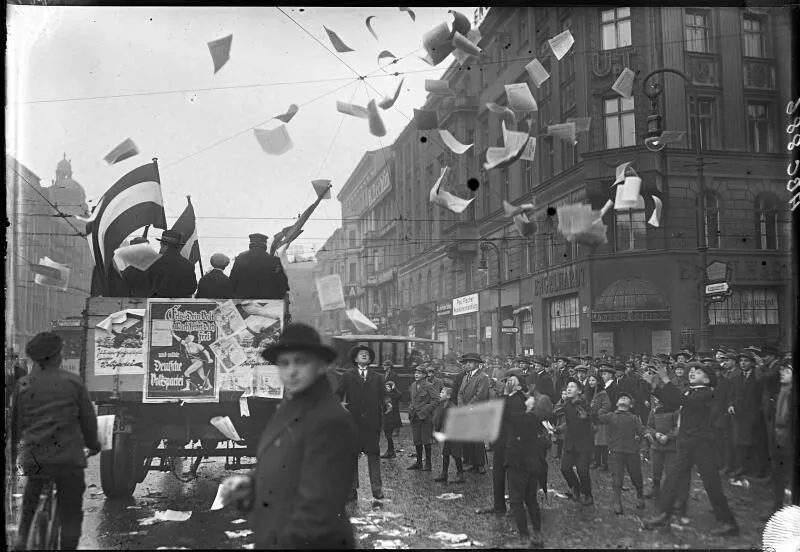
Header image: Reichstag elections on December 7, 1924: Trucks belonging to the German People’s Party drive through Berlin.
Source: Wikimedia Commons / Bundesarchiv, Bild 102-00886 / CC-BY-SA 3.0.