
WARCOMMONS IS NOW ON ANDROID
Explore WWII history and stay connected with the community on the go. GET THE APP →
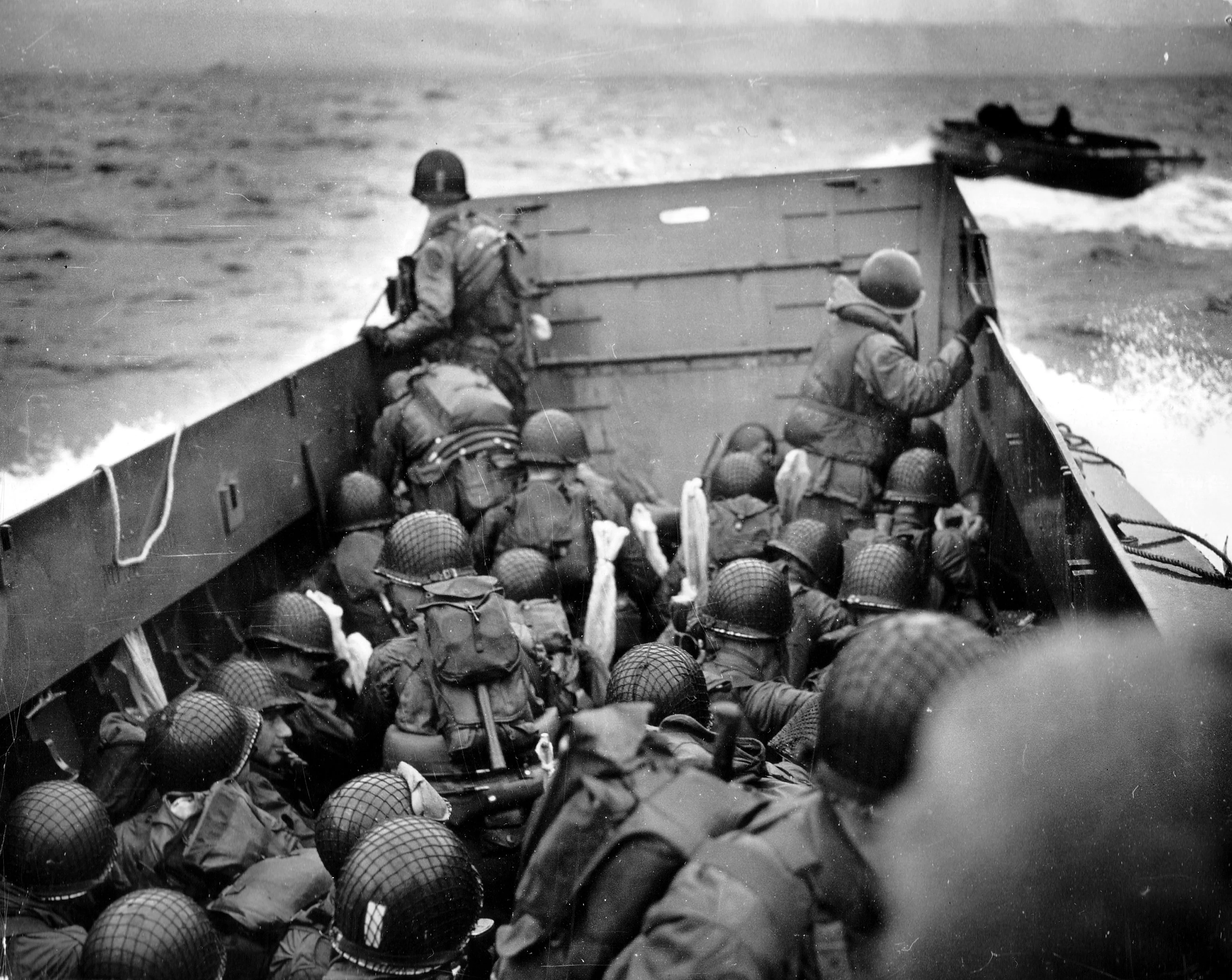

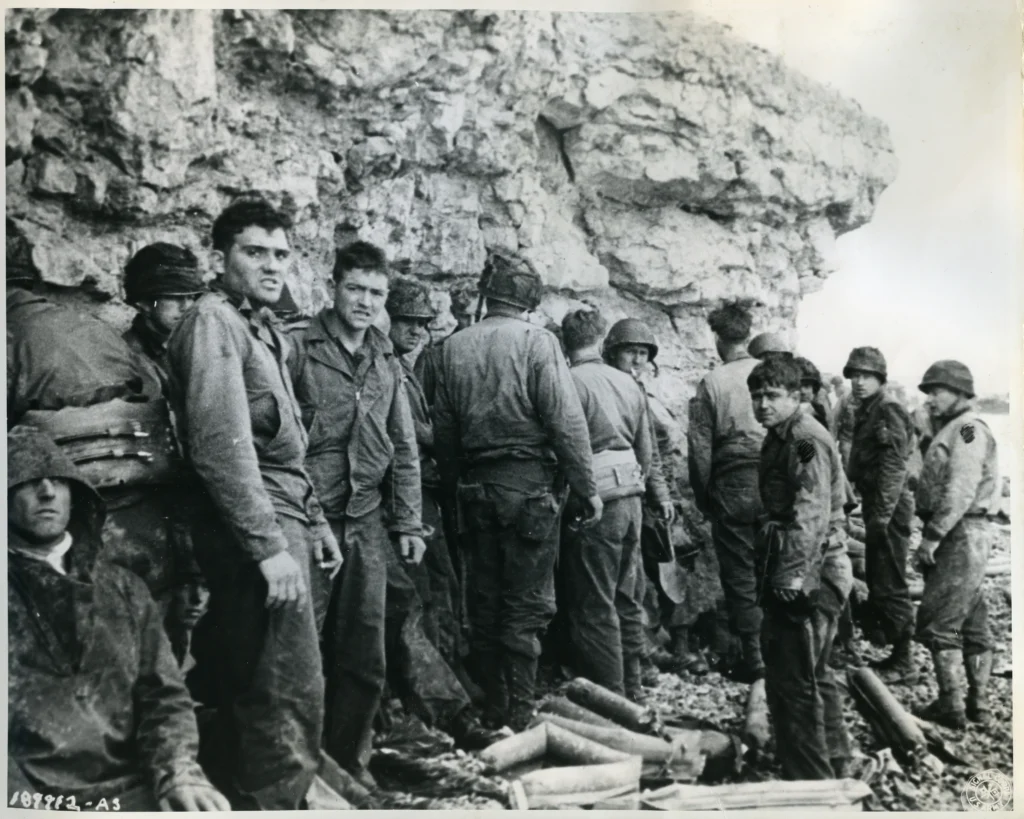
Nowhere was the nearly complete failure of D-Day more evident than at Omaha Beach, particularly in the central sector codenamed Easy Red.
It was there that the 1st Infantry Division, better known as the Big Red One, was tasked with carrying out the offensive. E Company, led by Captain Edward Wozenski, and F Company of the 16th Infantry Regiment were the spearhead and the first wave of the D-Day offensive in the Easy Red sector. Although the irony of the code name Easy Red became clear after the events of D-Day, the offensive was anything but.
Codename Easy Red
Operation Overlord was the overall plan of the Western Allies that outlined and planned the Allied beach landings in Normandy. Five beaches were deemed suitable for an Allied landing as part of Operation Overlord. Each beach was given its own code name: Utah, Omaha, Gold, Juno, and Sword. The beaches were divided among the Allies from west to east. Utah and Omaha were assigned to the Americans. Gold and Sword fell under British control, and Juno was the responsibility of the Canadians. The goal? To liberate Western Europe from Nazi tyranny.
It was at Omaha Beach in Normandy that the sector codenamed Easy Red was located. A stretch of beach approximately 8 kilometers long, divided into eight sectors: Charlie, Dog Green, Dog White, Dog Red, Easy Green, Easy Red, Fox Green, and Fox Red. Easy Red was the centrally located sector of Omaha Beach, near Saint-Laurent-sur-Mer. The Allies had specifically designated this sector as crucial, particularly for a breakthrough inland into Normandy.
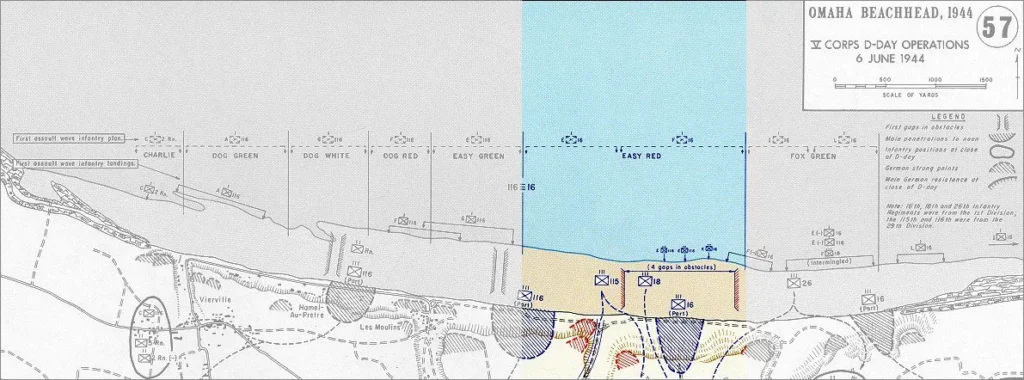
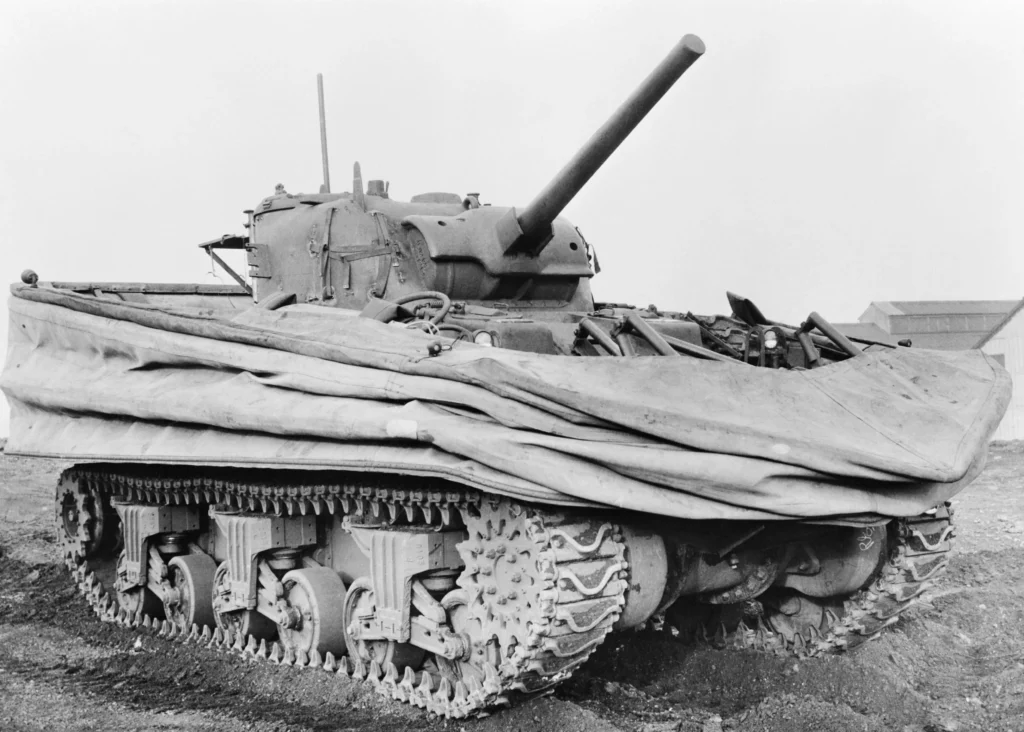
The landings at Omaha Beach, sector Easy Red, were to be carried out by, among others, E Company and F Company. E and F Companies were part of the 2nd Battalion, 16th Infantry Regiment of the 1st Infantry Division. They were to be supported by DD-Tanks and bulldozers. The DD-Tanks were also jokingly referred to as Donald Duck tanks. This spearhead, consisting of the infantry supported by the tanks, was tasked with forcing the beach exits, also known as “draws,” with a frontal assault.
The attack on Easy Red
Immediately prior to the offensive, Easy Red, as part of the larger Operation Overlord, had already been bombarded several times by the Allies via naval bombardments. This was the preliminary phase of the actual invasion, aimed at weakening the German defenses.
In the early morning of June 6, 1944, the moment had arrived. The Big Red troops, including E Company, began gathering in the Higgins landing craft (LCVPs) and checked their equipment one last time. The mortar teams, BAR teams, and bazooka teams received final instructions and orders from their officers. Meanwhile, the tanks were being prepared on the ships to land off the coast and fight their way through the defenses.
The objective was simple: to clear the draws behind Easy Red as quickly as possible, thereby enabling Big Red to reach the cliffs.
On the beach, units of the German 352nd Infantry Division, led by Major General Dietrich Kraiss, were ready to defend. The German division consisted of 12,020 troops, of whom approximately 6,800 were experienced combat troops. The experienced combat troops were mainly veterans of the Eastern Front and had already fought bitter battles. The less experienced part of the German division consisted mainly of young recruits. The division had strong artillery and was prepared to repel any attack from the sea at the water’s edge. The defensive concentration was centered on fortified positions along the coast. In Sector Easy Red, Widerstandsnester (WN 61/62) were also deployed to cover the beach zone.
By sunrise, there was no turning back. The first LCVP’s and Landing Ship Tanks (LST’s) were making their way to Omaha Beach. The honor fell to 29 DD tanks, still aboard the LSTs, to be the first to land in central Sectors Easy Red and Fox Green. Their task was to suppress the German defenses and their barrage of fire directed at the beach. This had to be done for 10 minutes before E and F Companies were allowed to make their way to the beach.
The landing on Easy Red
Even before the first assault force could set foot on the beach, chaos had already broken out. The DD-Tanks were launched as planned, but in smaller numbers. Instead of 32 DD-Tanks, only 29 were deployed. This was not the only problem.
Not only were fewer tanks deployed than planned, but they were also launched too far from the coast. The tanks were launched more than 5 kilometers from the coast. This was much farther than planned, but also much farther out to sea than the tank crews had practiced. Add to that the fact that the sea was particularly rough that day, and the result was that 27 of the 29 launched tanks were lost.
Each tank crew consisted of 5 men. They sank along with their tanks, within minutes of being launched. Even before the actual battle at Easy Red had begun.
For the men of E and F Companies, however, this did not mean that the invasion in their sector had failed and been called off. Minutes later, the Higgins boats were already on their way, at full speed. This, too, did not go without a hitch.
The approach to the beach took a long time. From the moment the men of E and F Company set foot in their Higgins boats, it took as long as three to four hours. The Higgins boats, just like the DD-Tanks, were battered by rough seas. High waves caused the boats to move erratically, resulting in seasickness for many. However, it wasn’t just the rough seas and high waves. The German 352nd Infantry Division was ready and bombarded the landing force, exactly as their defensive tactics dictated. Their goal: to defeat the enemy right at the water’s edge. This barrage from the Germans began the moment the Higgins boats were a few hundred meters from the coast. The Germans used bombardments from their shore-based artillery, mortars, and machine-gun fire.
Waves one to two meters high pounded hard against the plywood hulls of the Higgins boats. Bullets ricocheted off the flat steel bows. The men of E and F Companies, some of them seasick, ducked beneath the boat’s gunwales to avoid the relentless enemy fire. The only thing that could really provide adequate cover was the steel ramp. This was the front of the Higgins boats, made of thick steel, while the rest of the boat was held together with plywood. The men therefore crouched, especially at the front, for some protection against the incoming barrage.
It wasn’t enough to save everyone. In the Higgins boats, casualties were already occurring before the boat’s front ramp had even opened.
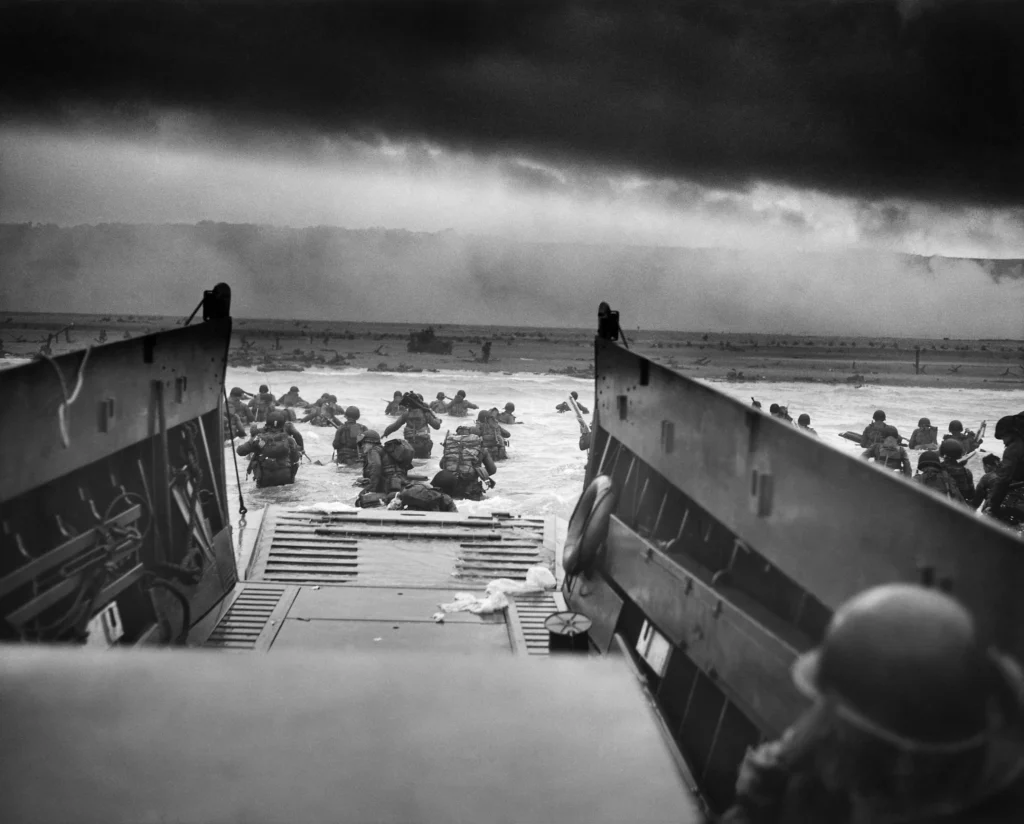
Those who considered themselves lucky to have survived this hellish ordeal at sea were disembarked from their boats about 50 to 100 meters off the coast. However, the boats had drifted onto parts of the beach where they were not supposed to be, due to ocean currents. Some troops suddenly found themselves in the Fox Green sector instead of Easy Red. It also became clear then that all the Allied bombardments prior to the invasion had missed their mark. The German defenses and fortifications were intact. The men of the first assault wave had only one option: straight ahead, launching a frontal assault on the German defenses. The only way was through the steel ramps, which dropped open into the sea, leaving them with no more protection.
Many had to brave not only the German barrage but also the sea itself. The water came up to chest height for many of them, and their packs were heavy. Their only protection at that moment was the bodies of their fallen brothers in arms.
They ran as fast as they could, but many were simply running to their deaths.
The invasion at Omaha Beach, however, seemed doomed to fail. There is broad consensus that approximately 65% of the total casualties in the Easy Red sector occurred within the first 15 minutes of the invasion. The 16th Infantry Regiment, which landed in the Easy Red sector, suffered nearly 1,000 casualties on D-Day, about a third of its strength. With only two tanks for support, instead of the promised 32, it was all up to the infantry. The men of E and F Companies.
Lasting Courage
Heroes emerge from the chaos. One of the most pivotal moments during the invasion of Sector Easy Red belongs entirely to Technician Fifth Grade John Joseph Pinder Jr. His story is a fine example of how heroes rise to the occasion in moments of utter despair, with defeat looming.
Like many others, Pinder landed about 100 meters from the shore. Under German machine-gun and artillery fire, he had to fight his way through the water near the shore. The water came up waist-deep where he landed. He was carrying an extremely important radio, which was intended to ensure that the command unit overseeing the invasion could establish direct contact with the landing force on the beaches. He was also one of many who was hit by German barrage fire immediately after stepping off the boat. Seriously wounded. Pinder, however, did not give up. Despite being seriously wounded, he still managed to reach the beach. He delivered his radio to the beach and was already severely weakened by the massive blood loss and pain. He refused, however, to take cover on the beach alongside his brothers in arms. He also refused to accept medical assistance. It is not unreasonable to think that he had already accepted his fate, but still wanted to help his brothers in arms until the very end, regardless of the price he would have to pay.
But that wasn’t all. He braved the German barrage three more times to retrieve communications equipment. On the third attempt, he was hit again, in his legs, by German machine-gun fire. Yet even then, he did not give up. Although he was growing weaker by the minute, he still helped establish the vital radio link on the beach. While establishing the vital radio link, Pinder was hit for the third and final time. He then succumbed to his injuries and died.
It was these heroic actions that helped ensure the fiasco in the Easy Red sector did not result in defeat.
For his actions, Pinder was awarded his country’s highest honor on January 4, 1945: the Medal of Honor, awarded posthumously, sealing his heroism.
Pinder, however, was not the only one to emerge as a hero from the chaos and impending defeat. There was also the man known as “The Greatest Unsung Hero of World War II”: Technical Sergeant Philip Streczyk of E Company.
Streczyk became famous for being one of the first men to reach Omaha Beach. It is widely acknowledged that Streczyk and his men were instrumental in enabling the breakthrough in the Easy Red sector on D-Day.
He and his platoon landed in this sector and reached the gravel embankment largely unscathed, unlike most platoons in the first wave of the assault. He managed to find a path toward the defensive works, navigating through all the landmines and fortifications. He and his platoon managed to reach the draw known as Exit E-1. This allowed them to continue their advance upward, where the German defensive works were located. Once at the top, he attacked the enemy fortifications from the rear. He neutralized the trenches and bunkers along the exit of Exit E-1. His actions also resulted in him taking prisoners of war. Because he also spoke fluent English, German, and Polish, he was able to interrogate the prisoners of war he captured, particularly those from the German Ost Battalion. This most likely yielded valuable information about the German defenses. Later on D-Day, he was involved in fighting further inland near Colleville-sur-Mer.
For his heroic deeds, Streczyk was awarded the prestigious Distinguished Service Cross and the British Military Medal.
However, there is one more person without whom this story would not be complete. That person is First Lieutenant Jimmie W. Monteith Jr.
As an officer in the 16th Infantry Regiment, 1st Infantry Division, he knew what his duty was: to lead his brothers in arms. He was also part of the first wave of the assault on Omaha Beach near Colleville-sur-Mer.
Under heavy German fire, he fought his way to the beach at Omaha Beach. Without regard for his own safety, he began organizing the troops for further attacks almost immediately. To do so, he moved constantly across the beach. He then led the attack over a narrow, sheltered ridge and across the flat, exposed beach toward a cliff, which offered the most protection at that moment. After making it to safety unscathed, a journey many did not survive, he also ran back across the exposed and heavily fired-upon field. This was because two tanks had been trapped on the beach and were immobilized, having come under heavy German artillery and machine-gun fire. Monteith was completely exposed to the intense barrage, but nevertheless led the two tanks on foot through a minefield to the firing positions the tanks were to take up.
His leadership that day, guiding the scattered platoons, led to the destruction of several enemy positions. He then rejoined his own company. Under his command, his men captured a strategically important position on the hill. He oversaw the defense against German counterattacks on their newly captured positions, all the while disregarding his own safety. Repeatedly, he crossed 200 to 300 meters of open terrain to reinforce the links in his defensive line under heavy fire.
Despite his efforts, the Germans managed to completely encircle Monteith and his unit. However, he did not give up and led the fight to free his men from the encirclement. During this action, Monteith was killed by enemy fire.
President Franklin D. Roosevelt concluded that Monteith’s courage, bravery, and fearless leadership were worthy of emulation. His heroic deeds were therefore recognized and honored with the highest distinction his country can bestow upon a soldier: the Medal of Honor.
These three heroes changed what seemed like a certain destiny, the complete failure of the assault on Easy Red. It is certain that if these three heroes had not been there that day, the outcome of the invasion at Omaha Beach and in the Easy Red sector might well have been different. This is the story of a single regiment, which was awarded no fewer than two Medals of Honor. The story of a regiment of enduring courage. Often overshadowed by the Band of Brothers, yet it is precisely through their actions and achievements that they far surpass that shadow.
WarCommons publishes long-form, source-driven analysis without ads or click incentives. If you found this feature valuable, consider supporting our research by subscribing to help fund future investigations.
By Nick Ravenshade — Author
Header image: U.S. Army troops crouch behind the bulwarks of a landing craft as it nears Omaha Beach on D-Day. June 6, 1944. Source: Wikimedia Commons. Public domain.




.jpg)
