
WARCOMMONS IS NOW ON ANDROID
Explore WWII history and stay connected with the community on the go. GET THE APP →
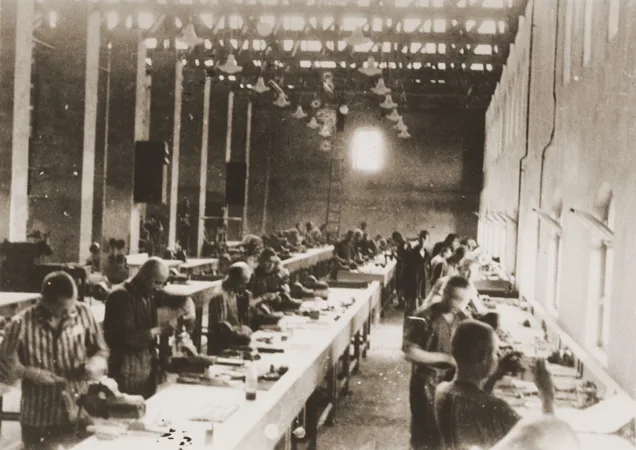

Volkswagen, Krupp, and Siemens didn’t just survive Nazi Germany. They built their fortunes on it.
Cracking a joke about a serious existential war like World War II is mostly still not very much appreciated, not even after more than 80 years since the war had ended. Still, we as consumers don’t have any issue with buying products from so-called Nazi companies. Companies that contributed to the Holocaust. Companies that thrived under Nazi Germany’s favoritism. Companies that exist, only because Hitler existed. That’s something else. So while you’re buying something from a company that had unmistakable connections with Hitler, don’t forget to crack a joke every now and again.
Hitler’s Company
As Hitler had promised, Germany would thrive again. That meant that the industrial sector would thrive again, the construction sector, and the car manufacturing sector as well. Volkswagen isn’t just some car brand name, it’s still directly linked to Hitler. It’s like the exact equivalent to Lada, the people’s car of the Soviet-Union. Hence the name as well, Volkswagen is by name exactly people’s car. In the 1930s owning a car was a luxury, this was also the case in Germany. Only the rich could own their own cars. Still Adolf Hitler sought to change this and he wanted to create a basic, mass-producible vehicle. The catch, however, was that the car had to cost less than 1,000 Reichsmark and it had to be able to transport a family.
What other name aligns better with Nazi propaganda than a real people’s car, a real Volkswagen? To be honest, the company’s original name was Gesellschaft zur Vorbereitung des Deutschen Volkswagens mbH in 1937. But that soon changed to Volkswagenwerk GmbH in 1938. The very first car was in fact the exact equivalent to the current Volkswagen Beetle, but with a much less catchy name, and more of a Nazi propaganda name. It was called the Kraft durch Freude-Wagen, or KdF-Wagen, meaning Strength through Joy.
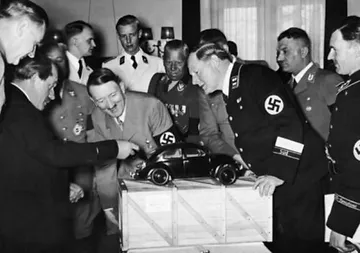
Although there wasn’t that much joy. And it also turned out that Hitler’s promise had to be taken with a grain of salt. Almost none of the ordinary German citizens got their prestigious Volkswagen. Ordinary citizens were given the possibility to save up for the car through an installment savings plan. German workers paid 5 Reichsmark each week into a state fund so that they could save up the 990 Reichsmark needed for the KdF-Wagen. Over 300,000 citizens used this savings plan, with contributions reaching approximately 280 million Reichsmark. But not a single ordinary citizen got their KdF-Wagen. All of the savings were put into the Nazi war machine, because World War II had begun in 1939 and the state needed the money.
Holocaust
As if this theft wasn’t enough, Volkswagen was also directly linked to the Holocaust and especially slave labor. Volkswagen was a core part of the Nazi war machine. It was the Fallersleben Concentration Camp, an official satellite camp of the Neuengamme concentration camp, that was built directly on Volkswagen factory ground. And it wasn’t there to give every prisoner their own Volkswagen. By 1944 approximately four out of every five workers, at the main Volkswagen plant, were not even employees. They were enslaved human beings working as forced laborers. By approximation it is said that around 300 male Hungarian prisoners were selected directly from Auschwitz and forced to work on the V-1 pulse-jet powered flying bombs, under brutal and deadly conditions.
But there is still one more aspect. One more thing that is often forgotten and overlooked completely. So you must also think that it doesn’t matter that much then. What I’m referring to is The Rühen Nursery Atrocity. Volkswagen executives set up a nursery in the nearby village of Rühen. Especially female Eastern European slave laborers were separated from their infants so they could return to the assembly line. A lot of babies were deliberately neglected and starved, resulting in hundreds of these babies dying.
Let’s end on a positive note. To the credit of Volkswagen, after hiding behind legal defenses that the Nazi state was responsible for war crimes and not the private businesses, in 1998 Volkswagen had a change of heart. They became the first major German corporation to formally acknowledge its moral guilt. They established a private restitution fund to pay the surviving Nazi-era slave laborers, even opening their corporate archives to independent historians.
The same cannot be said for most of the companies that have a direct link with the Holocaust and even contributing to it.
Alright, at least the company was only brought into existence because of Hitler. It’s not like they were Ferdinand Porsche…
Profiting From Nazi Germany
Volkswagen was actually a really unique case, because it’s the only company that was directly brought into existence by Hitler, and is still active today. But there were also companies that already existed before Hitler even came to power. Still, that doesn’t make them a victim of the Nazi regime. Especially not if you really look at the facts and see how deliberately they profited from the Holocaust, Nazi Germany, and Hitler.
Steel Manufacturing
Krupp was a fairly widely known company that was established in 1811. Even after their name change in 1999, the name Krupp remains known. The steel manufacturer made weapons during World War I and continued to do so during the interbellum. Still, a change was soon made when Hitler came to power in 1933. Almost immediately Krupp became Hitler’s go-to company for producing steel war equipment, ranging from artillery pieces to ships. For this huge task Krupp had to, of course, cherrypick its employees. Well, not exactly employees, but more like slaves. Krupp representatives were sent directly into the Auschwitz concentration camp to hand pick prisoners for labor. They even created the Auschwitz workshop, near the Auschwitz concentration camp. This made it possible to utilize a constant flow of forced laborers from the camp.
At least Krupp also paid a few of their employees, but not in the way you’d think. Krupp also had a factory near a forced labor camp, called Berthawerk. For this location Krupp leased Jewish women directly from the SS, paying a direct fee of 4 Reichsmark per day. These women had to manufacture artillery fuses, as forced laborers, being paid 0 Reichsmark per day, every day, 365 days per year. Until death.
And that’s exactly how Krupp ran their manufacturing. Vernichtung durch Arbeit, meaning extermination through labor. And yes, that was exactly the case. Krupp implemented this Nazi regime practice that meant using exhaustion, starvation, and abuse to kill off populations the Nazis deemed sub-human. Krupp killed thousands of slave laborers that died directly on the factory floors, having worked themselves to death. If you became too weak or sick to work, that was no relief. But in that case Krupp would just ship back the slave laborers to the gas chambers, to be murdered.
Approximately 100,000 people were forced to work for Krupp. This included civilians, prisoners of war, concentration camp inmates, and foreign civilians, while Jewish and Slavic prisoners could count on receiving the most brutal treatment above all others. They were kept in squalid, freezing barracks while only receiving starvation rations and beatings by the guards.
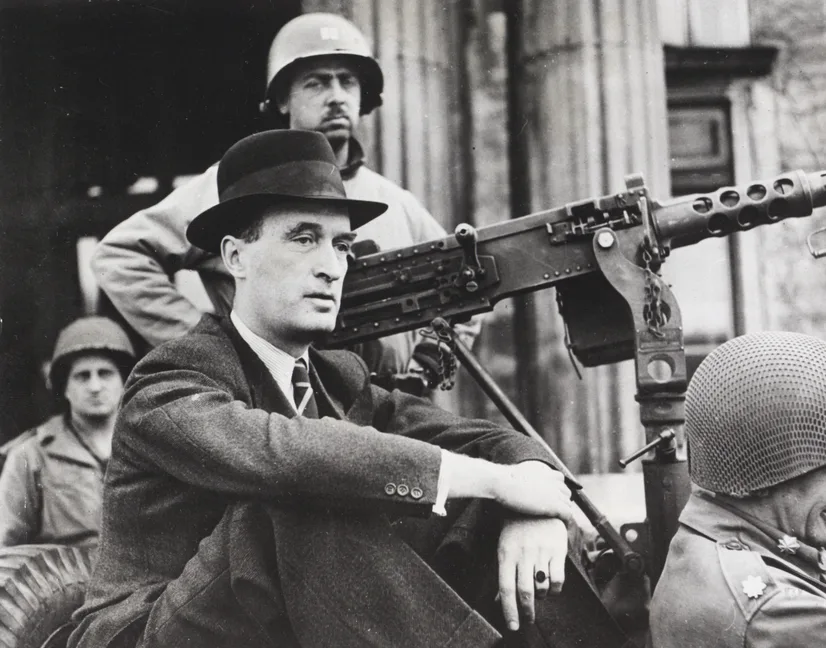
Of course after the war, the Allies were more than interested in Krupp. They built weapons for the Nazis, maybe there was still some useful information left for the Allies. While Nazis in those positions mostly got away scot-free, Alfried Krupp was not that lucky, or was he?
Alfried Krupp von Bohlen und Halbach was in fact convicted of crimes against humanity and war crimes, together with his top directors. The charges he was convicted of were specifically for deporting, exploiting, and abusing slave laborers. Alfried was sentenced to 12 years in prison. Justice? Not really!
U.S. High Commissioner John J. McCloy pardoned Alfried Krupp in 1951. Alfried served only a fraction of his sentence and his multi-billion dollar industrial empire was fully restored to him. And the legacy of Krupp still lives on as part of the massive public German multinational industrial engineering and steel conglomerate, that is thyssenkrupp AG. Still paying homage to their legacy, I guess?
Electronics
Siemens is still a very well-known company to this day. The only difference is its clientele was just a bit different over 80 years ago. Because the main clients were the Nazis. As other German companies did, Siemens followed by building and operating a manufacturing plant inside, or at least directly adjacent, to a concentration camp. From 1943 to 1945 Siemens operated a machine tool and electrical component facility inside the Bobrek subcamp of Auschwitz. And they also built around 20 industrial workshops directly next to the Ravensbrück women’s camp. Here over 2000 female prisoners were forced to work 12-hour shifts making precise electrical components, switches, larynx microphones, and carbon microphones for the V-1 pulse-jet powered flying bombs and V-2 rockets.
From 1940 to 1945 Siemens had used almost 80,000 forced and slave laborers. These laborers took up around one-third of Siemens’ entire workforce. It’s no wonder that Siemens was the largest electrical contractor for Nazi Germany. That also meant direct involvement inside the gas chambers. Siemens manufactured and installed electrical components and ventilation components that were used in the construction and operation of the gas chambers and crematoria. Mainly the German extermination camps, including Auschwitz-Birkenau.
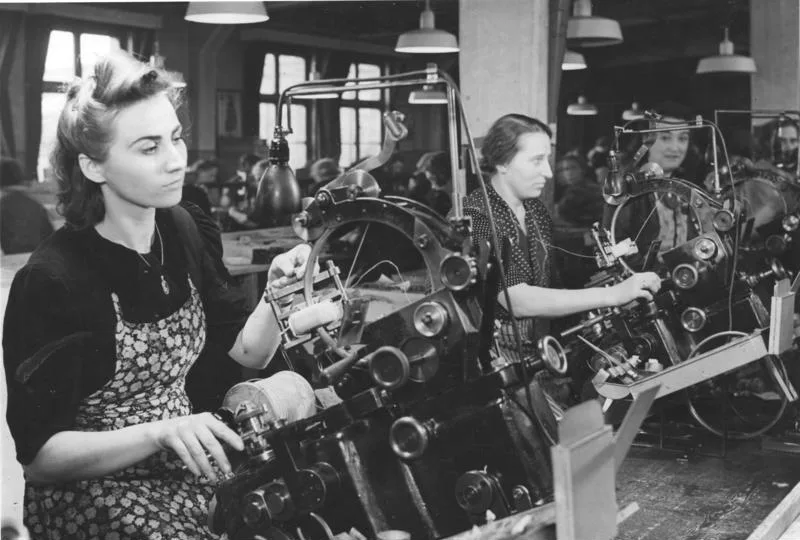
Still it is a known fact that Carl Friedrich von Siemens wasn’t a Nazi himself. He just saw nothing wrong with helping the Nazis and did so gladly. Making him directly involved in the Holocaust and supplying Hitler’s war machine. Maybe he was a true capitalist, as long as the Nazis paid what they needed to, Carl would gladly comply. Even if that meant taking an active role in the so-called Aryanization of Germany, especially the German economy. It was a systematic, state-sanctioned theft of Jewish-owned properties. Again, Siemens gladly complied, targeting, seizing and buying out Jewish-owned electronics businesses and foreign companies in occupied territories. They were buying out these companies for pennies on the dollar. Carl died in October 1941, meaning most of Siemens’ actions were initiated by his successor.
Following the surrender of Nazi Germany, Siemens lost around 80% of its total value. This was in part due to physical destruction, as nearly half of all of Siemens’ production lines, buildings, and machinery were destroyed. But also, the Allies seized every single piece of tangible property, including bank accounts and subsidiary infrastructure that Siemens owned outside of Germany. Maybe the most painful part was that the Allies also stripped Siemens of all of its intellectual property, taking away all patents Siemens once held. This was also self-serving for the Allies, as they too wanted to jumpstart their postwar economies once more. What better way to do this than stealing the patents of a main competitor?
After all of this Siemens still managed to prevent being split up by the Allies and even returned to turning a profit as soon as the year 1948. However, what they didn’t do for almost 50 years is owning up to what they’d done during the war. Only after facing a class-action lawsuit did they change their rhetoric, like many other companies that were involved in the Holocaust. But not before trying to trademark the name Zyklon for a new line of consumer products, including home ovens. Make of that what you will. Maybe it was their little wink to their past?
How Many Were There?
These were of course not all companies that were directly contributing to the Holocaust and thrived under Nazi rule. Don’t get me wrong, it wasn’t a crime to do financially well, even when Hitler was in power. The only problem was, of course, the way by which this prosperity was accumulated. By directly supporting and contributing to the Holocaust, using slave and forced laborers, and doing whatever the Nazis wanted you to do, as long as you’d get paid. The duality is also striking: crack a joke about World War II, no one will laugh. Only to go to a store and buy something from a company that once contributed to the Holocaust.
Don’t get me wrong, this isn’t a call to boycott anyone’s company. It serves as a reminder what many of us have forgotten. It also serves as a reminder of how large the scale of the Holocaust actually was. Still a question remains. What could the companies have done? Did they have any other choice? The extent of their involvement is still shocking, building factories and production right at concentration camps, that says a whole lot. And of course, were there any more companies?
Part II – Coming Soon!
Continue the discussion
Do you ever take a minute to think about if, and to what extent, a company was involved in WWII? Or does it maybe not even matter anymore?
Join Field Reserve for free and make your case inside the WarCommons community at our Field Headquarters.
WarCommons publishes long-form, source-driven World War II analysis without ads or sponsored content. If you found this article valuable, consider supporting independent research by joining Field Command.
By Nick Ravenshade — Founder & Editorial Director, WarCommons
Header image: Prisoners at forced labor building airplane parts at the Siemens factory in the Bobrek labor camp, a sub-camp of Auschwitz. 1944. Source: Wikimedia Commons. Public domain.



.jpg)

