WARCOMMONS IS NOW ON ANDROID
Explore WWII history and stay connected with the community on the go. GET THE APP →

Berlin and Tokyo were separated by 8,900 kilometers and even more by ideology, yet the alliance held until the bitter end. Here’s what Hitler actually believed about his Axis partner.
Nazi Germany and Japan, Allies. It isn’t the first thing that comes to mind. Two countries of which their respective capitals are 8,915 km / 5,540 mi apart. Talk about distance. That’s not really right around the corner. But it’s not only distance that makes us call Nazi Germany and Japan an unholy alliance. They both had very different goals. And they both had a very different world view. So how did these countries even become allies? And what did Hitler actually think of the Japanese people?
An Unholy Alliance
Or was it? Maybe Germany and Japan weren’t all that different. Of course, Japan had nothing to do with the holocaust and the Nazi atrocities. But Japan had its own atrocities they committed. They were also both very expansionistic, very anti communist, and very much isolated by the Western powers. Maybe the only thing remaining that makes it an unholy alliance, is the distance.
Germany and Japan had good relations before World War II. After 1868 Germany helped Japan to modernize its military and institutions. So a certain historical link between these countries was already present. The only issue was that during World War I, they did become estranged. Well, maybe that is an understatement. Actually, they were even at war with each other. During World War I Japan decided to join the allies and even went as far as to seize German territories in the Pacific.
Even after all of this bad blood, they somehow managed to find some form of rapprochement. And just maybe, it was all mixed together with the saying: ‘The enemy of my enemy is my friend’. Because in 1936 Germany and Japan signed an Anti-Comintern Pact. Meaning they’d work together in their fight against communism, but maybe more importantly, against the Soviet Union. As relations improved, they ultimately led to the Tripartite Pact, a defensive alliance. With that, it was suddenly no longer simply Germany against the Allies. Now the Axis powers divided global control between themselves. Japan took charge of East Asia, while Germany and Italy controlled Europe.
It is also quite ironic that this unholy alliance would set in motion one of the chains of events leading to Nazi Germany’s downfall. After Japan’s surprise attack on Pearl Harbor, Hitler chose to declare war on the United States as well. Foreshadowing the inevitable end.
Japan and Hitler
It’s fairly straightforward why Japan and Nazi Germany became allies. It wasn’t shared racial or ideological conviction, it was mainly convenience.
By the standards of the era, the European powers still held a great many colonies. Mainly the British, French, and Dutch colonies were meaningful for Japan. So Japan actually loved that Hitler was crushing these three colonial powers in Europe. Because by weakening them, Hitler left their resource-rich Asian colonies vulnerable for Japan to take.
No matter how it looked to the outside world, Japan never actually trusted Hitler. It was more that they used him to their own advantage. A catalyst for this distrust was also the non-aggression pact that Nazi Germany signed with the Soviet Union, their mutual enemy. Japan also never forgot this, sort of, betrayal. Right before Unternehmen Barbarossa was launched, Japan signed a neutrality pact with the Soviet Union. In his plans for the offensive against the Soviet Union, Hitler essentially counted on Japan for help. Japan should’ve attacked the Soviet Union from the east, splitting Stalin’s forces. Because Stalin was now reassured that Japan would not attack from the east, he could safely redeploy his elite Siberian divisions to defend Moscow. The defense ultimately succeeded.
You could almost argue it was becoming a pact of one-sided convenience.
Japan was also very aware of the Nazi racism and extermination practices, but it ignored them. This was because Japan needed the alliance which would help its geopolitical goals. But it never meant that Japan would also facilitate Nazi Germany in its Nazi practices. Japan actually completely ignored Hitler’s obsession with the so-called “Jewish question”. The Japanese government viewed the anti-Semitism as a European issue and mostly refused German requests to round up or execute Jewish people and refugees across Asia.
Honorary Aryans
So far it doesn’t seem like it was an alliance that was all that great. It seemed more like one side was using the other, and rather one-sidedly at that. That also brings us to the question of what Hitler actually thought of the Japanese.
Publicly Hitler called the Japanese people “Honorary Aryans”. Whatever that’s supposed to mean. It was a way for Hitler to keep the alliance running smoothly. For Hitler, it was imperative that Japan remain with the Axis powers. Before D-Day, it was important that Japan continue fighting the Americans. This was one of the ways Hitler could ensure that an American invasion in Western Europe would be avoided.
But this also meant that Hitler had created a duality in his attitude towards Japan and the Japanese people. In his book, Mein Kampf, Hitler also called the Asian people “Culture-bearing” rather than “culture-creating”. He even wrote about the big and meaningful changes Japan had gone through at the start of the 20th century. But he also wrote about what would happen if Japan no longer received aid from the so-called “Aryan West.”
Hitler wrote that without this aid, what he called Japan’s ‘true nature’ would reassert itself, a people he believed capable only of copying rather than creating, trapped within what he saw as a static, frozen civilization. Without the help of the Aryan-West, this would once more gain the upper hand in Japan. This was also a reference to Japan’s Edo period, when the country isolated itself from the world for over two centuries.
But it also wasn’t until the war ended that we got a new insight into how Hitler viewed his Japanese allies. During the Nuremberg Trials official transcripts were introduced into evidence. These transcripts show us that Hitler, in essence, betrayed Germany’s anti-communist alliance with Japan in August 1939. He did this with the Nazi-Soviet non-aggression pact. But to justify this betrayal to his generals, he told them:
‘We shall have to take into the bargain the defection of Japan… My going together with Japan never was popular. We shall continue to create disturbances in the Far East and in Arabia. Let us think as ‘gentlemen’ and let us see in these peoples at best lacquered half-maniacs [often translated as half-monkeys] who are anxious to experience the whip [knout].’
The transcript that was introduced into evidence is better known as the Lochner memorandum (Document L-3). It was an unofficial, leaked transcript of Hitler’s August 22, 1939 Obersalzberg Speech to his military commanders. It does need a sidenote as the transcript is very controversial among historians. It is more likely an exaggerated version of what Hitler actually said. Still it’s important to take note, because it does give us an insight on how Hitler viewed the Japanese.
The Death of the Alliance
Even so, the two allies remained worlds apart, literally and figuratively At their closest point of territorial expansion, the distance between the German forces and the Japanese forces was approximately 4,570 km / 2,839 mi (Norway–Manchuria Border).
More importantly, the alliance never broke. It is still kind of amazing that two countries that were fundamentally very different held on to their alliance throughout World War II. The alliance only officially ceased to exist when Nazi Germany ceased to exist. It also proves how powerful the policy of “the enemy of my enemy is my friend” actually is. And the distance between the two countries actually proved to be an advantage rather than a liability. Nazi Germany and Japan never shared a border, meaning they never had border disputes or conflicts over land and resources. This also meant that they both had their own spheres of influence. Japan sought only to conquer and dominate Asia and the Pacific, while Hitler wanted to dominate Europe, Russia, and Africa.
When Nazi Germany surrendered, the Nazi regime completely ceased to exist. Japan’s leadership did in fact express a deep disappointment that Nazi Germany had given up. But they vowed to keep fighting the war alone.
Continue the discussion
What do you think kept this alliance alive throughout World War II? Was it in fact the convenience, or was there more to it?
Join Field Reserve for free and make your case inside the WarCommons community at our Field Headquarters.
WarCommons publishes long-form, source-driven World War II analysis without ads or sponsored content. If you found this article valuable, consider supporting independent research by joining Field Command.
By Nick Ravenshade — Founder & Editorial Director, WarCommons
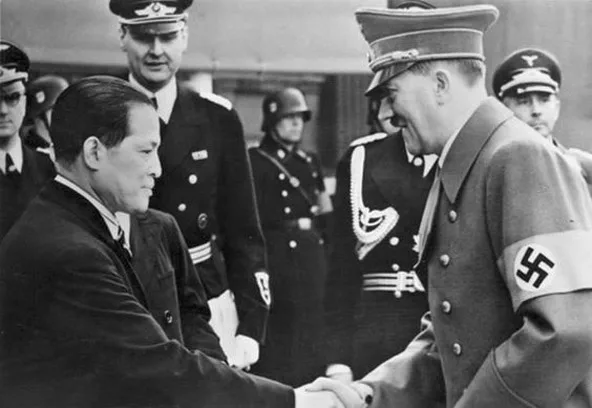
Header image: Adolf Hitler meeting Japanese ambassador to Germany Hiroshi ?shima. 1942. Source: Wikimedia Commons. Public domain.