WARCOMMONS IS NOW ON ANDROID
Explore WWII history and stay connected with the community on the go. GET THE APP →

Three rival teams, one fatal rivalry, and a führer who called nuclear physics “Jewish science.”
It’s a topic that often comes up when discussing “what if” scenarios. What if Hitler had built a functional atomic bomb before the United States did? It’s often argued that if that had been the case, Nazi Germany might well have won the war. But here at WarCommons, we don’t write about “what if” hypothetical scenarios regarding World War II. We write about World War II and its events. Still, we can reflect on the same topic: Nazi Germany and the atomic bomb. The fact is that Nazi Germany was indeed working on developing an atomic bomb, with the help of highly intelligent German scientists. But it could very well be that a largely unseen rivalry meant that, by the end of World War II, Nazi Germany was still very far from developing an operational atomic bomb.
Discovery of Uranium
It had long been clear that Nazi Germany did not have an atomic bomb by the end of World War II. But the German scientists were closer to achieving it than people had thought for decades. If the German scientists had joined forces, they might have been able to build a functioning nuclear reactor before the end of the war. After all, building a nuclear reactor can lead to the construction of a functional atomic bomb. In fact, they were already quite far along in building a nuclear reactor. It is therefore all the more ominous to think about what might have happened. It is no coincidence, then, that this is one of the most discussed “what-if” topics.
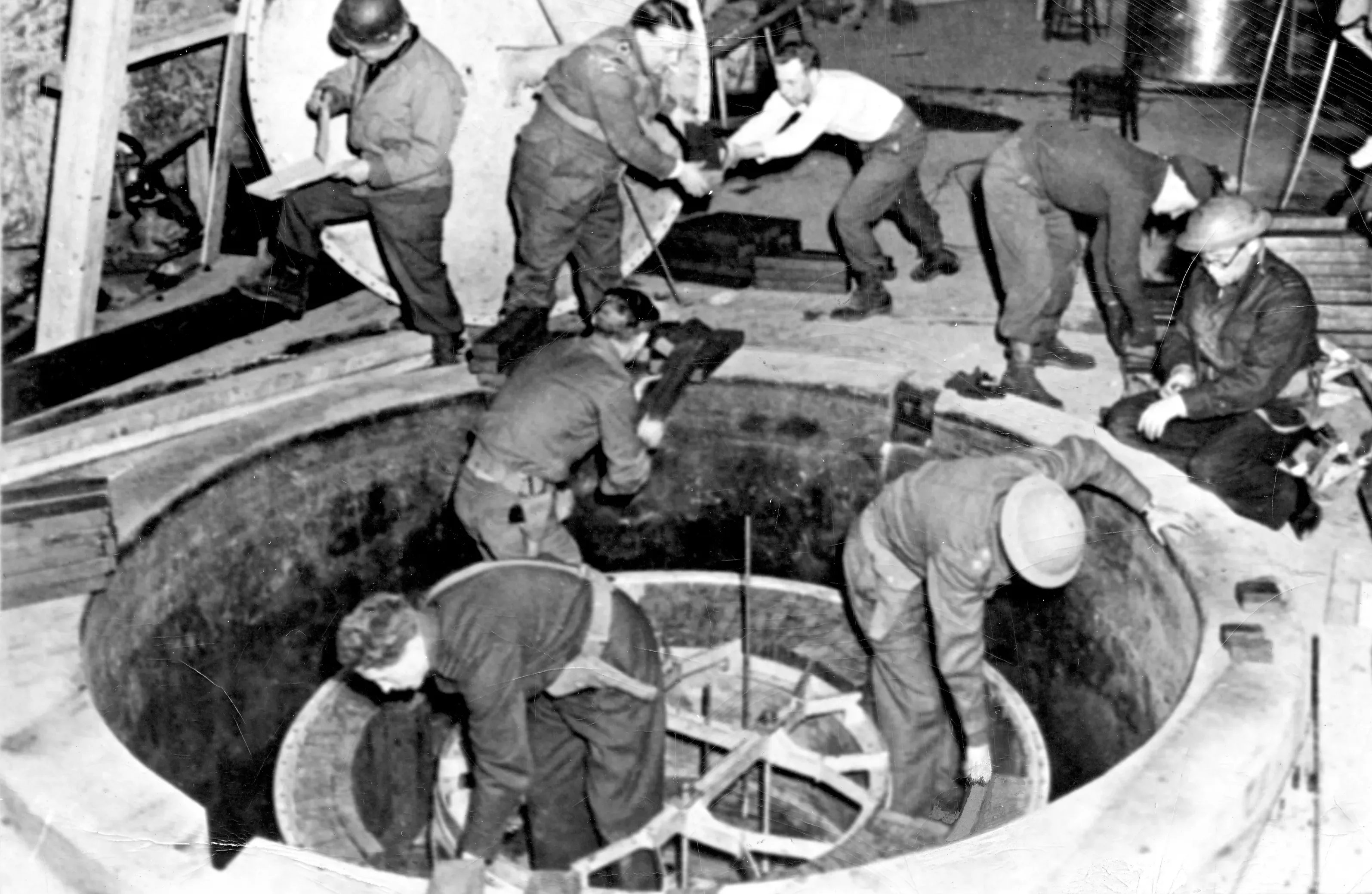
The topic remains relevant and well-documented. Two American physicists also studied this topic after becoming interested in it in 2013. They were Timothy Koeth and Miriam Hiebert. That year, Koeth received a small block of uranium. It turned out to date from World War II and had come from the Nazis. After investigation by these scientists, it became clear that this block was part of a total of 664 blocks. This group of blocks was used as fuel rods for the Nazis’ experimental reactor. This experimental reactor was located in southern Germany, in the town of Haigerloch. The Nazis intended to use these blocks to sustain a chain reaction in the reactor. However, with only 664 blocks in the reactor, the chain reaction could not be sustained. It was simply not enough. But, of course, there were other research teams in Nazi Germany.
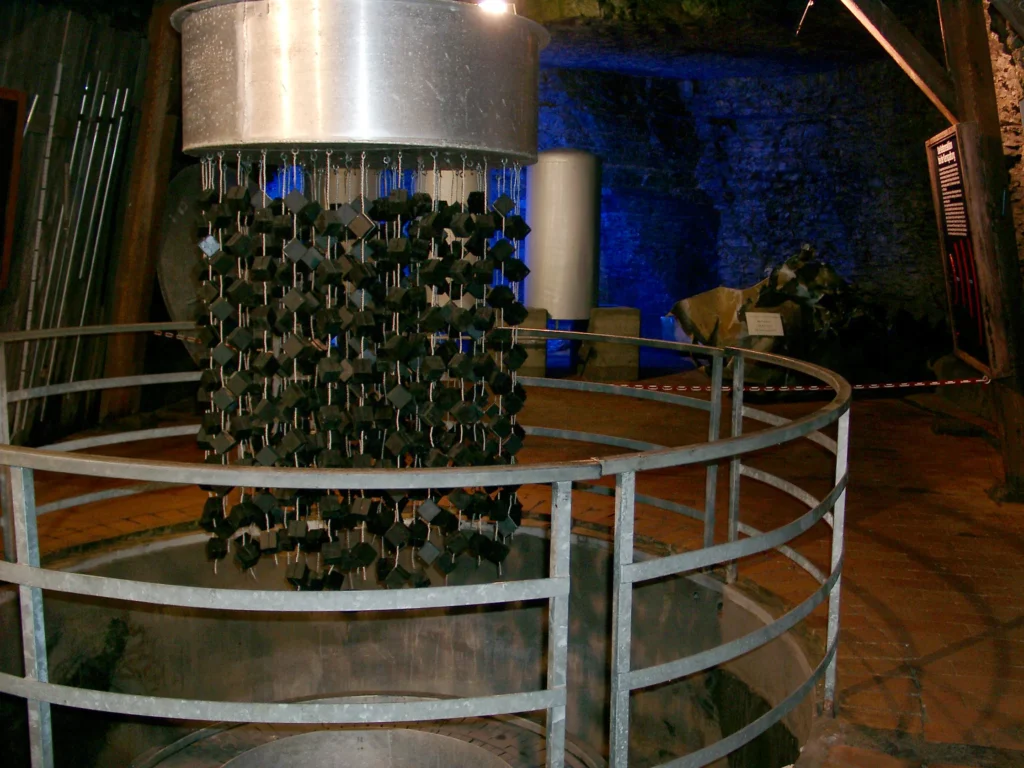
However, the scientists also discovered that one of the other German research teams had 400 uranium cubes. In their study, Koeth and Miriam conclude that if these 400 cubes had been combined with the other 664 cubes, the reactor in Haigerloch would in all likelihood have worked.
But why weren’t these blocks combined if the scientists in Nazi Germany had undoubtedly reached this conclusion themselves? And why were there actually three separate research teams tasked with providing Hitler with the first operational atomic bomb?
German Research Teams
In fact, Germany had started its nuclear program fairly early on. While the Manhattan Project officially began on August 13, 1942, Nazi Germany’s nuclear program had already begun in April 1939. Yet the United States had developed a working atomic bomb much earlier.
Uranverein or Uranprojekt, those were actually the two main names for the German project. They stand for “Uranium Society” and “Uranium Project.” From the very beginning, the project was characterized by and plagued by rivalry and fragmentation. There were actually three research teams. And contrary to what you might expect, each team was part of a different organization. Sometimes, a bit of rivalry and competition between teams can be very beneficial, especially when they all fall under the same umbrella organization, and when they’re all given equal resources to achieve the same goal. But in the case of Nazi Germany’s research teams, the situation was very different indeed. Take, for example, the German scientist Werner Heisenberg of the Kaiser-Wilhelm-Institut. He was actually the most famous theoretical physicist. He was primarily focused on his own reactor design. But the Wehrmacht itself also had scientists working on the same subject. The leading scientist there was Kurt Diebner of the Heereswaffenamt. He was the military administrator and an experimental physicist who was primarily engaged in testing reactor designs in Gottow. And the third major competitor was Paul Harteck of the University of Hamburg. He focused primarily on isotope separation and methods for enriching uranium.
In fact, there was intense competition among these three research teams. This was because all three were led by different organizations and were not under a single central and authoritative leadership. This was the exact opposite of the Manhattan Project, which officially began even later and had produced a working atomic bomb before the end of World War II. No, within Nazi Germany, scientists worked in small, isolated silos. And because they viewed one another primarily as competitors rather than as scientists with a single shared goal, they did not share data, calculations, or progress with one another. In fact, they often concealed most of this information from one another.
Resources were scarce in Nazi Germany. The three teams therefore had to compete for funding and to be the first to secure resources. Often, they were also simply dependent on the goodwill of the Nazi leadership. Whenever each team received a small allocation, none of them had enough to produce anything meaningful within the scope of their research. The resources were always just barely insufficient. But that wasn’t the only problem. There was also no cooperation whatsoever among the three main teams. This meant that if one team discovered something that another team might actually need, it wasn’t shared. They were, in effect, artificially holding each other back. As a result, even the brilliant theorist Werner Heisenberg clung to his own, and sometimes erroneous, calculations. As a result, his team in particular made major errors in estimating the required critical mass. They also mistakenly believed that graphite could not be used as a moderator. Because of this assumption, Heisenberg’s team continued to rely exclusively on heavy water, which was also in short supply.
One possibility remains unverified but worth considering: that the process was deliberately slowed to ensure Nazi Germany never achieved a working bomb before the war ended.
Hitler Dismissed the Bomb
The fact that there weren’t enough resources, and that the scientists were also competing with one another, was actually already disastrous for the research. With this approach, Nazi Germany would have been a very long way from developing a functional atomic bomb. But this cannot be attributed solely to the scientists and their competition with one another.
Behind the scenes, there was another important factor: Hitler. He didn’t really believe in the atomic bomb as a means of salvation. This was not the first time Hitler had underestimated a weapons system. He had never truly believed in U-boats either. Although he could have had more U-boats built earlier, he didn’t consider them all that important in the battle for the Atlantic. No, Hitler believed only in large, prestigious battleships, such as the Bismarck. As a result, Dönitz did not receive a sufficient budget and, at the most crucial times in 1940 and 1941, had to make do with only 22 to 27 operational U-boats that had the range for Atlantic operations.
The same was true of the atomic bomb. Hitler viewed groundbreaking discoveries in the field of nuclear physics, such as the theory of relativity, as “Jewish physics.” This was because these discoveries were made by Jewish scientists, such as Albert Einstein. Hitler therefore wanted nothing to do with it and labeled it “Jewish physics” within Nazi ideology. But impatience also played a major role. Like many aspects of World War II, research into the atomic bomb coincided with Operation Barbarossa. Nazi Germany was facing increasingly difficult conditions on the Eastern Front. Hitler therefore wanted to see and hear only about “wonder weapons” when it came to new developments. These so-called wonder weapons were supposed to turn the tide on the Eastern Front. Quantum mechanics and invisible atoms were likely too abstract and intangible for Hitler. Without understanding how long such research takes, he most likely lost interest quite quickly.
The so-called “1942 rule” reinforced this even further, as an informal directive. In 1940–1941, Hitler issued an order. Any project that would not result in a concrete, usable weapon for the front within nine months was no longer given any priority at all. In 1942, Armaments Minister Albert Speer was the scientists’ primary point of contact, but they were honest. That year, Albert Speer asked Werner Heisenberg whether an atomic bomb could still decide the war. The difficulties on the Eastern Front were growing by the day. Heisenberg was characteristically direct in his answer, stating that it would take a few more years before the desired results were achieved. This was effectively the death knell for an atomic bomb for Nazi Germany. From that moment on, the research was downgraded to a study of a nuclear reactor as an energy source for ships.
Hitler, the self-proclaimed military master strategist, ultimately seemed to make more blunders than strategic victories. Ironically, it wasn’t until the end of World War II that Hitler realized just how important nuclear weapons could have been in the war. By then, he had become obsessed with superweapons that might still turn the tide in Nazi Germany’s favor. However, his neglect of the project in the preceding years meant it was far too late for him. Hitler’s fate had already been sealed by 1942.
WarCommons publishes long-form, source-driven World War II analysis without ads or sponsored content. If you found this article valuable, consider supporting independent research by joining Field Command.
By Nick Ravenshade — Founder & Editorial Director, WarCommons
Header image: Dismantling the German experimental nuclear pile at Haigerloch, 50 km S.W of Stuttgart. April 1945. Source: Wikimedia Commons. Public domain.