WARCOMMONS IS NOW ON ANDROID
Explore WWII history and stay connected with the community on the go. GET THE APP →

How a student union campaign became state censorship, and why the Nazis feared the written word.
It’s a recurring theme in history, and not just in the history of World War II. It’s been going on for ages. I’m talking, of course, about book burnings. This practice dates back so far, even as far back as 213 B.C., during the Qin Dynasty. But it was no different in Nazi Germany where massive book burnings took place. This is how it happened.
Deutsche Studentenschaft
The German Student Union was partly responsible for the book burnings in the 1930s. When Hitler came to power, there was more leeway to justify such practices. The books that were burned were primarily those considered a threat to the Nazis, that is, books that could undermine Nazi ideology or books whose authors were seen as supporters of an anti-Nazi ideology. The idea was that this applied only to books considered Schmutz und Schund literature. The latter was, in fact, already banned under the Weimar Republic. In other words, such books were prohibited.
Schmutz und Schund literature literally translates to filth and trash literature. Books deemed unsuitable for young readers fell under this category. Lists of banned books were even maintained under the Gesetz zur Bewahrung der Jugend vor Schund- und Schmutzschriften. So it was quite strict, but in 1935 these strict rules were tightened even further with additional censorship.
So it provided a convenient justification for the Nazis to burn books, as if they needed one. It is therefore not surprising that it was mainly books by Karl Marx and Karl Kautsky (a Austro-German Marxist theorist) that were burned. Later, books by Albert Einstein were even added to the list. It comes as no surprise that Albert Einstein’s books were also burned. As a Jewish man, his writings were quickly labeled as Schmutz und Schund literature. The books of the well-known Helen Keller shared the same fate; along with those of other authors, they were viewed as incompatible with Nazi ideology.
Given the principles that Nazi ideology stood for at the time, it is not surprising that so many books were viewed as incompatible with this ideology. Cultural genocide, that’s another way to describe the book burnings. It’s a concept coined in 1944 by legal scholar Raphael Lemkin, who also introduced the term “genocide.” While it is merely a concept, it does highlight the importance of literature. At the time, such actions could have a massive impact, to the point where entire collections of books could be destroyed. Not physically, but rather in the sense that all copies were destroyed. Whereas today books can be stored in 100 different places online, things were very different back then.
But how were these book burnings actually organized by an organization, the Deutsche Studentenschaft, that didn’t seem particularly important?
Call to Action
Actually, the book burnings were no different from any other “event.” After all, it always starts with a call to action.
On April 8, 1933, the Central Office for Press and Propaganda of the German Student Union (Deutsche Studentenschaft – DSt) announced a nationwide campaign, the so-called “Campaign Against the Un-German Spirit.” It may have seemed insignificant at first, merely a call from a student union. But it ultimately culminated in a so-called Säuberung. A true purge, but in the form of book burnings.
It was a veritable propaganda machine. The local chapters of the DSt drafted press releases and articles and then provided them to the local press, which published them. But it went even further than that. The DSt even sponsored well-known Nazis so that they would come and speak at public gatherings. They even tried to arrange for Joseph Goebbels to come and speak. Through the Ministry of Propaganda, they sought to secure support for their campaign from the highest echelons of power. But Goebbels, too, saw this as an opportunity for himself.
Goebbels was, of course, an open anti-Semite. He is often viewed as a true and pure hater of Jews. But what many people don’t know is that in the past, during his own student days, Goebbels had actually praised several Jewish professors. In 1933, when the Nazis had just come to power, it was, of course, crucial for him to clearly display his anti-Semitism. After all, he also feared that someone might discover that he had spoken so positively about Jewish professors in the past. Speaking publicly at a DSt event was therefore an excellent opportunity to distance himself from those earlier associations and prove his antisemitic credentials. He accepted the invitation at the very last moment and came to speak.
Book Burnings
On May 6, 1933, German students and SA members stormed the Institut für Sexualwissenschaft. Their target was the institute’s library and archives. Approximately 20,000 books and journals were seized and burned in the street. These were unique items that were part of the institute’s collection. The books and journals dealt primarily with intersexuality, transgender issues, and homosexuality. These books and journals were seized and later added to the main book burning on May 10. This marked the first major book burning.
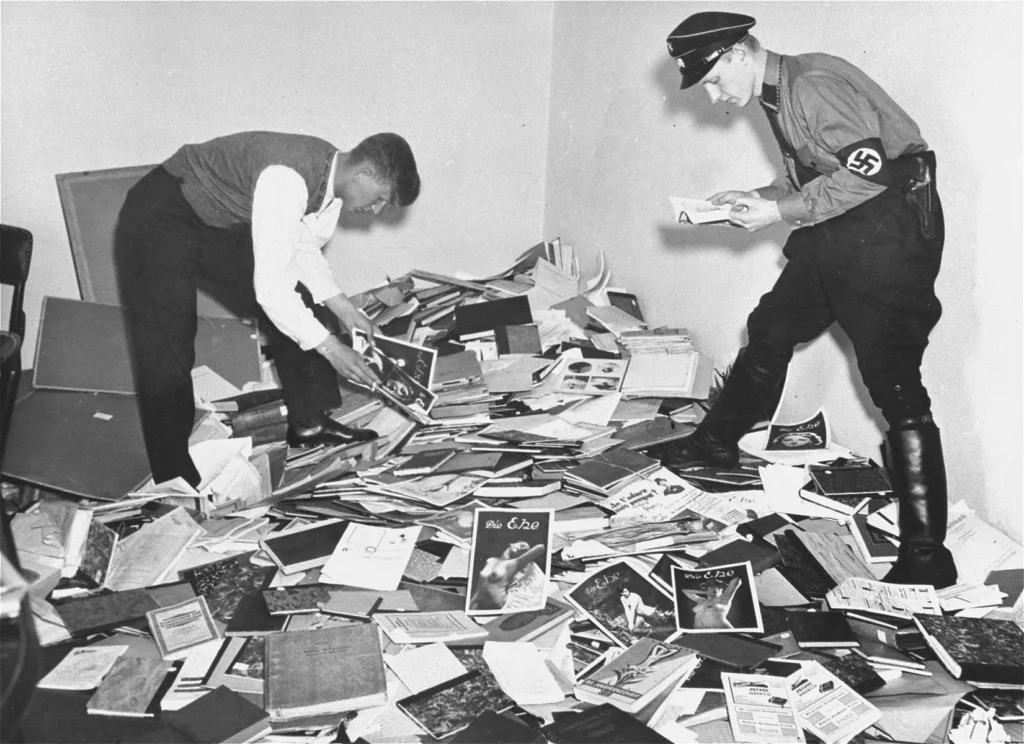
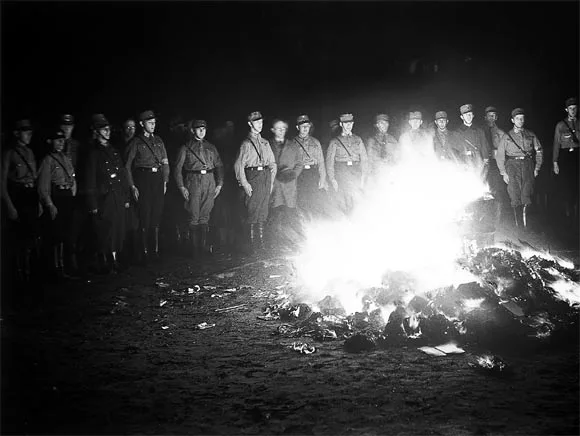
Just a few days later, on May 10, 1933, more than 25,000 books were burned. This book burning took place in Berlin, on the square in front of the State Opera House. It effectively marked the beginning of state censorship that allowed for no exceptions. And it marked the first major book burning.
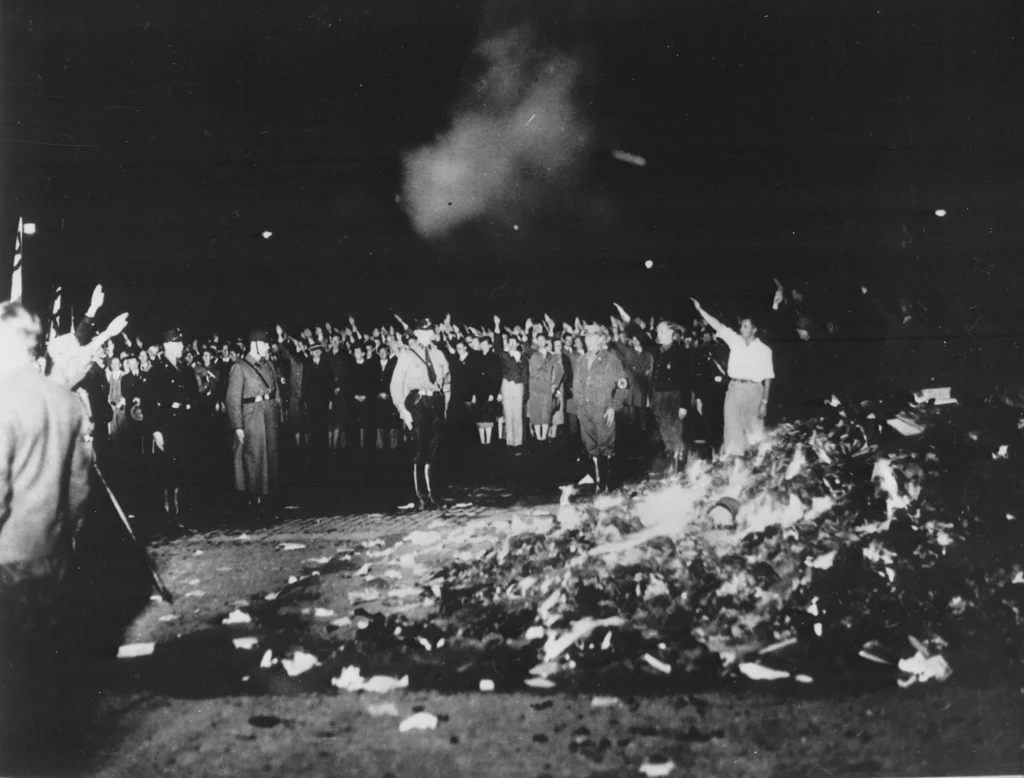
Other university towns followed suit not long after. Nazism was riding high. Parades organized by nationalist students had become the rule rather than the exception. During these parades, “banned” books were looted and burned. High-ranking Nazi officials were also present to address the spectators.
Of course, burning books from universities cannot go on indefinitely. Burning every single book would simply be impossible, even with mass book burnings. Once the looting at universities and institutions was all but over, they simply turned their attention to bookstores. Books were also looted and burned from bookstores. Public libraries were also officially ordered to display only books that met Hitler’s standards. All other books deemed “banned” had to be destroyed by the libraries.
These were all book burnings that took place on home soil, within Nazi Germany. But once World War II had truly begun, the book burnings did not stop there. In occupied territories, such as Poland, approximately 80% of the schoolbooks were burned, as were three-quarters of the books found in academic libraries.
And, of course, the Nazis had not forgotten the Jewish communities, especially those in Eastern Europe. Their books, too, were confiscated and burned. Yet the intention was that a number of old and rare books would be preserved. They were, in fact, already looking far into the future. These old and rare books were ultimately meant to become historical relics once the “Final Solution” had been successfully carried out.
In the end, it was all for nothing. And history has taught us why that was the case. Book burnings actually serve no purpose, because an ideology can never be eradicated. It is therefore quite possible that such book burnings will never take place again, since so much has been digitized. The original can, of course, be destroyed, but the words will simply continue to exist.
WarCommons publishes long-form, source-driven World War II analysis without ads or sponsored content. If you found this article valuable, consider supporting independent research by joining Field Command.
By Nick Ravenshade — Founder & Editorial Director, WarCommons
Header image: Joseph Schorer: Book Burning. 1933. Source: Wikimedia Commons. Public domain.