WARCOMMONS IS NOW ON ANDROID
Explore WWII history and stay connected with the community on the go. GET THE APP →
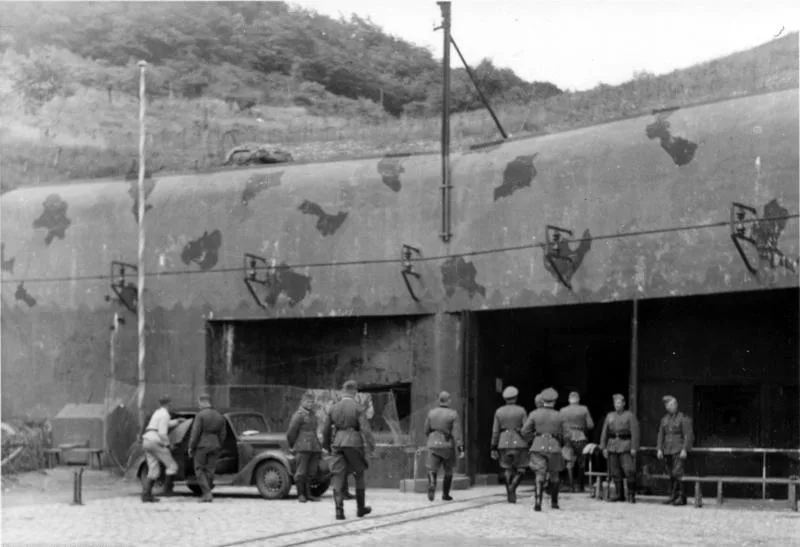

The infamous Maginot Line had one purpose: to protect France from a surprise attack, such as the one during the Franco-Prussian War of 1870–1871. During that war, France lost Alsace and part of Lorraine to Germany. Yet it took only six weeks before France fell into the hands of Nazi Germany in June 1940. The Maginot Line stood there, an impressive line of approximately 700 kilometers of reinforced concrete and heavily fortified strongholds. Yet it failed to prevent what it was supposed to prevent.
Was it the strategy that failed?
Origins of the Maginot Line
Alsace and the part of Lorraine that France had lost to Germany during the Franco-Prussian War of 1870–1871 returned to French control after World War I. Not only had the old defensive works changed after World War I, but they were also too far from the new French border. Because France had lost enormous numbers of soldiers during World War I, the defense of northern and eastern France could no longer be guaranteed. A new plan was needed.
It was Paul Painlevé, the French Minister of War, who believed he had the answer to the question of how France should be defended. He was, therefore, the driving force behind the line. But it was not he, but André Maginot, who ensured that the construction plan was submitted to the French parliament. André Maginot was a war veteran and the Minister of War who succeeded Painlevé.
The project was budgeted at 2.9 billion French francs. The widely accepted assessment among historians is that the final costs were significantly higher than the budget of 2.9 billion French francs. This was partly due to the complex construction and the technical innovations that France incorporated into the line. This was therefore a major strain on the French postwar economy, which was in the midst of an economic crisis. But for France, the situation was clear. Defense against Germany was of vital importance, especially after Hitler came to power.
To a small extent, the construction project actually benefited the economy. The construction of the line created about 20,000 new jobs and also brought electrification to the border regions.
The Maginot Line was constructed between 1930 and 1936. However, its construction was never fully completed. It was intended to provide defense along the borders with France’s northern neighbors, Belgium, Luxembourg, and Germany; and its southern neighbor, Italy. The Maginot Line consisted of artillery forts, which the French called Gros Ouvrages, and infantry forts, which were called Petit Ouvrages. During the construction of the Maginot Line, the French high command had deemed the area near the Belgian Ardennes unsuitable for tanks. Consequently, the section north of the main section of the Maginot Line along the Belgian Ardennes was not developed. The natural terrain and dense forests there were believed to provide a sufficient and natural barrier against attacks from Germany.
Historians often attribute France’s defeat in part to the Maginot Line and its construction. It is frequently concluded that the construction was inadequate and that France acted short-sightedly by failing to extend the Maginot Line along the Belgian Ardennes. However, it was not merely the way the Maginot Line was built. It was primarily the strategy that marked the beginning of the end for France.
Failing strategy
The flawed strategy surrounding the Maginot Line stemmed from France’s experience with warfare up to that point. Much of that experience came from World War I, the latter stages of which were primarily a static war fought in the trenches. This is why people sometimes refer to the “Maginot Line mentality” of the French. Complete confidence in the imposing and massive Maginot Line defensive fortifications. A direct consequence of this was a number of economic and political decisions that were made. This can also be classified as a strategic failure. The enormous resources that were to be allocated to the armed forces went to the Maginot Line. This financially limited the ability to invest in mobile units and the air force at the same pace and within the same budget. The political comfort provided by the Maginot Line (the belief that no one would ever be able to breach it) hindered military reforms driven by political forces.
France believed that its static Maginot Line provided a solid defense against a surprise attack from Germany and other nations. This was, in fact, a major strategic miscalculation that led to the failure of the Maginot Line. The defense was static, while modern warfare demanded speed and flexibility, particularly against tanks and aircraft and how they were deployed in the then-revolutionary offensive strategy known as the Blitzkrieg. The German response to the Maginot Line was precisely that: Unternehmen Fall Gelb, conceived by Erich von Manstein and executed by Heinz Guderian with his famous Blitzkrieg doctrine.
While the sight of the Maginot Line was imposing and colossal, the strategy behind it was anything but. Nowhere was this more visible than around the Belgian Ardennes. France was convinced that no German tank could get through the Belgian Ardennes. Although the Maginot Line had not been extended northward into the Belgian Ardennes, it was primarily the strategy that had led to the decision not to build it there. Consequently, against all expectations, Germany was able to break through the Maginot Line because they had crossed the Ardennes with their Blitzkrieg.
As a result, the remaining strongholds were practically useless, since the Germans had already advanced past the entire Maginot Line through the Belgian Ardennes.
However, it was not only the strategy and the fortifications that failed. It was also the strategy supporting the fortifications that failed. At the start of the German attack, France did not have enough mobile reserves to deploy along the Maginot Line, and there was also a lack of coordination.
Because of the complete reliance on the Maginot Line itself, these mobile reserves were not in place during the German attack. As a result, France did not have sufficient rapid armored and air support ready to plug gaps in the defense when Germany launched its attack. Furthermore, due to a lack of coordination and adequate reserves, the French were unable to mount an effective counterattack.
While the structure itself is often criticized, it can be convincingly argued that it was not the structure that failed France, but rather the underlying political and military strategy.
The Maginot Line actually served its intended purpose. After all, the Germans never managed to break through the sections of the Maginot Line that were actually occupied and defended. Much of the structure remained intact, but became obsolete.
It is therefore too simplistic, and unfair, to say that the Maginot Line failed as a military structure. It was not the structure itself, nor the Maginot Line, but the strategy behind it that led to France’s defeat during World War II.
WarCommons publishes long-form, source-driven analysis without ads or click incentives. If you found this feature valuable, consider supporting our research by subscribing to help fund future investigations.
By Nick Ravenshade — Author
Header image: Visit to the Hackenberg artillery plant on the Maginot Line, ammunition entrance. June 1940. Source: Wikimedia Commons / Bundesarchiv, Bild 121-0363. CC-BY-SA 3.0.