WARCOMMONS IS NOW ON ANDROID
Explore WWII history and stay connected with the community on the go. GET THE APP →
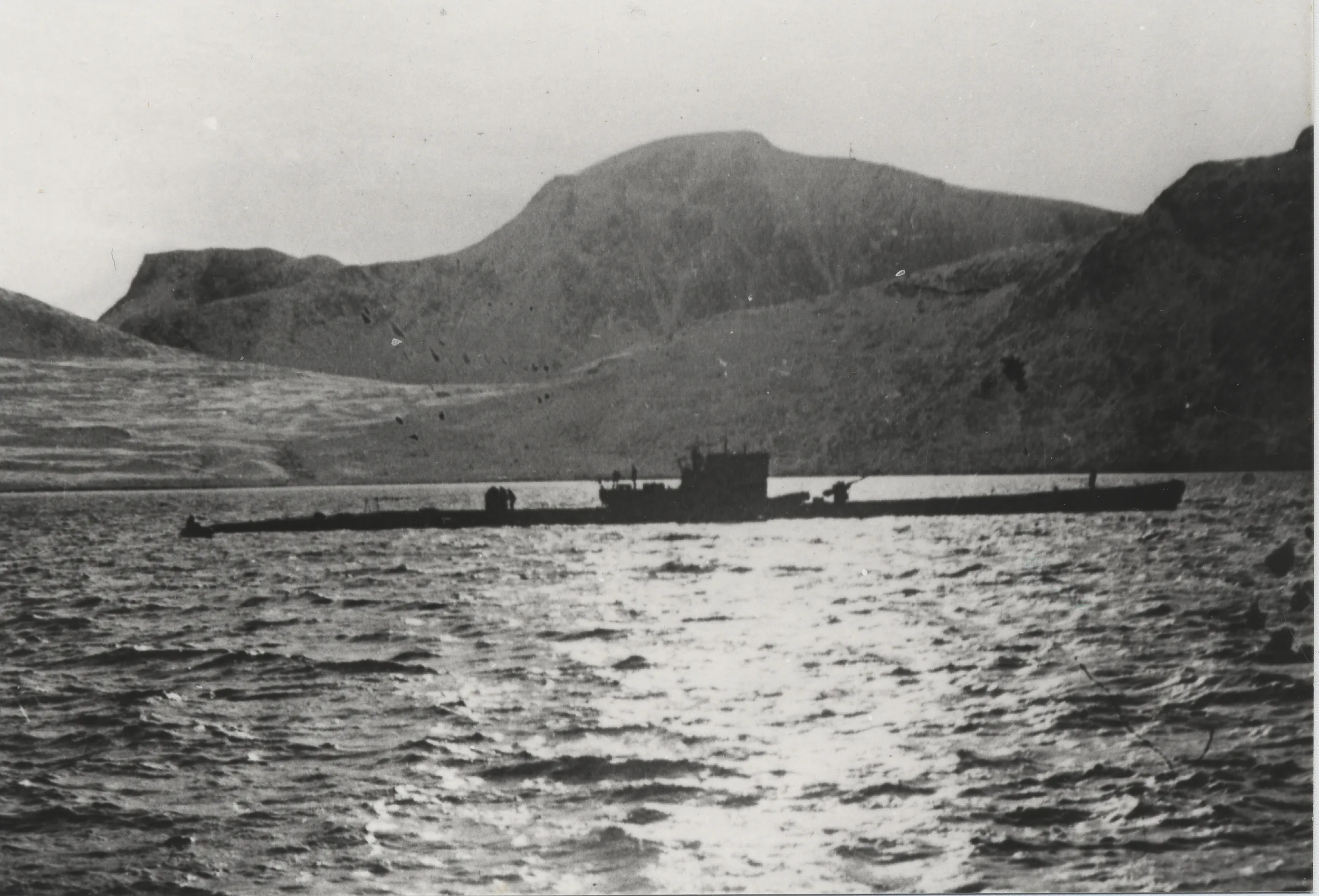

A German U-boat crew secretly landed on North American soil, built an automated weather station, and sailed away undetected. Then the operation vanished from history until 1977.
On September 26, 2026, we sent out our newsletter YANK issue no. 17 in which we, as always, featured a short war story. However, this short war story was possibly too short, because there was much more to the story. And as promised in our newsletter, the full story would be published soon on the WarCommons website and Android app. And so, this is one of the war’s strangest secret operations that played out in near-total silence.
Meteorology and Weather Forecasting During World War II
Today it’s mostly taken for granted. You open your phone, or start up your computer, and with just a few clicks you can see the weather forecast. You can even see what the temperature will most likely be two weeks from now. However, during World War II, the reality was completely different.
Meteorology and weather forecasting get almost no attention at all when discussing World War II. Maybe it’s because we take it for granted today. It’s just something that is there, and mostly accurate in terms of weather predictions. But behind the scenes thousands of people all over the world work every day to bring you these weather predictions.
That’s why people also tend to forget that the largest amphibious invasion in history, Operation Overlord, also hung in the balance because of weather forecasting.Even lesser-known operations are commonly forgotten, like Weather Station Kurt (Wetter-Funkgerät Land-26).
If you could get the same weather information as your adversary, you’d have an advantage in wartime. That’s exactly what Nazi Germany tried to accomplish.
Were they successful? One fact does stand out: Weather Station Kurt was in fact forgotten, then rediscovered in 1977.
Weather Station Kurt
In German, this station was named: Wetter-Funkgerät Land-26 (WFL-26). This station was located at Martin Bay in northern Labrador. During World War II this part of North America belonged to the British Dominion of Newfoundland, not Canada. It was a secret automatic weather station.
The head of the Abwehr, German military intelligence, Admiral Wilhelm Canaris, came up with the strategic plan to deploy automated weather stations, including Weather Station Kurt. Admiral Canaris recognized that Germany was at a severe tactical disadvantage in the so-called ‘Weather War’.
The Atlantic weather systems flow from west to east, meaning the United States had an informational advantage, purely based on location and time. The Allies naturally had the advantage: their network of weather stations in Greenland, North America, and Iceland let them make far more accurate forecasts than the Germans could. Nazi Germany could only rely on the weather information they could accumulate from continental Europe.
German military leadership did try to negate this disadvantage by using their network of deployed U-boats. U-boats like the Lauenburg were operating in the North Atlantic, so their crews could send weather reports back to the German ports. There were also other clandestine weather stations located in the remote parts of the Arctic. Readings from the Arctic stations were gathered by flying specially equipped weather aircraft to the area.
Germany had to make do with what it had, and the weaknesses were extensive. Especially utilizing U-boats for this goal brought some very high risks. For the U-boats to report back weather information, they had to break radio silence. Breaking radio silence meant that the Allies could locate the U-boat and track its movements by using radio triangulation. The U-boats would face total discovery just by reporting some weather data back to Germany. The aircraft flying to collect the data sent out by the Arctic stations also held a disadvantage. The aircraft mostly got incomplete data because of the limited range of operation, and they were susceptible to Allied attacks.
Therefore, Admiral Canaris authorized and initiated a plan to covertly plant automated weather stations in Allied territories across the Western Hemisphere. While other discovered or known German weather stations were being captured or dismantled by the Allies, this new weather station had to be very secret to finally gain the same advantage the Allies held.
A Dangerous Transatlantic Journey
On September 18, 1943, U-537 departed from Kiel, Germany, commanded by Kapitänleutnant Peter Schrewe. It was the first combat patrol for this particular U-boat. Meteorologist Dr. Kurt Sommermeyer and his assistant Walter Hildebrandt were also aboard the U-boat. They were carrying Kurt. No, that wasn’t one of their colleagues, Kurt was the codename of the WFL-26. WFL was designed by Dr. Ernst Ploetze and Edwin Stoebe, and it had multiple measuring instruments.
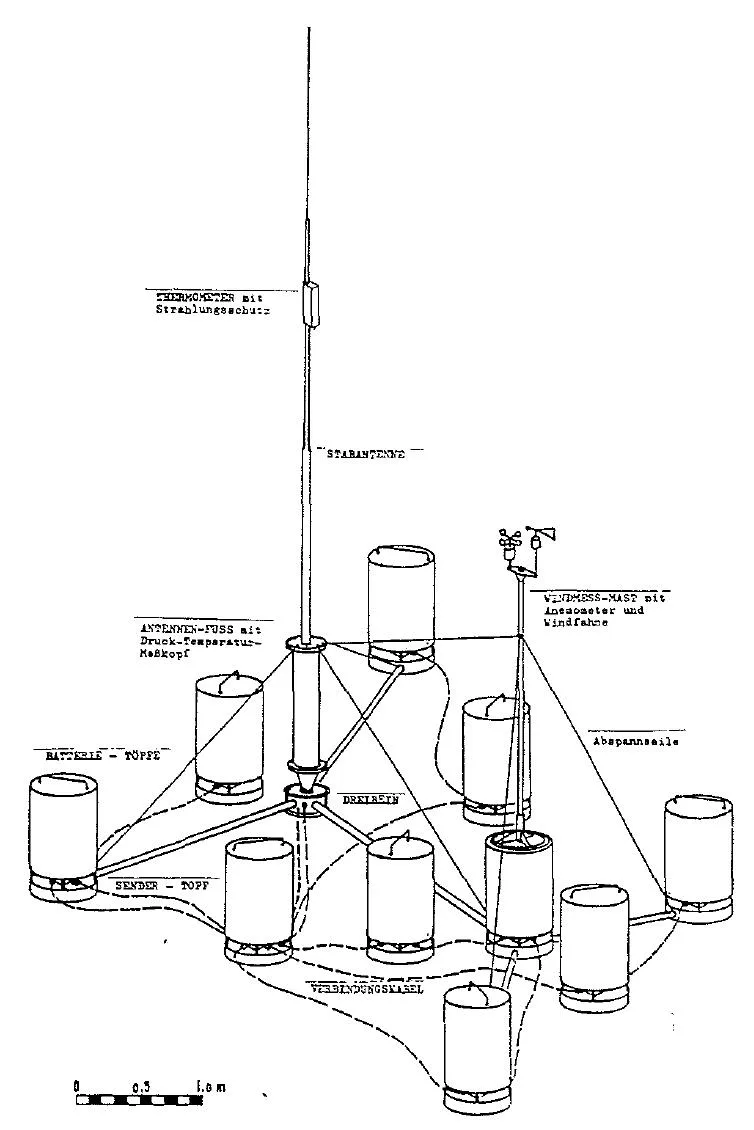
Once the WFL was set up, it would send weather readings every three hours. One transmission of data would take around two minutes. It was designed to stay operational for six months, but the lifetime was heavily influenced by the number of battery canisters present. Nazi Germany had already stationed 14 WFLs in the sub-Arctic and Arctic regions, including Greenland, Bear Island, Spitsbergen, and Franz Josef Land. Five WFLs were placed around the Barents Sea. U-537 was carrying one of two WFLs that were meant for North America.
One year after U-537 set off on its journey, another mission showed just how dangerous the endeavor really was. In September 1944, U-867 was deployed with the other WFL meant to be set up in North America. As the U-boat set sail, it was hit by a British air attack just to the northwest of Bergen, Norway. In the attack, the British used depth charges, ultimately hitting and sinking U-867.
Back in September 1943, U-537 was already en route to North America, when all of a sudden the U-boat was caught in a massive storm. A giant breaking wave slammed into the U-boat, causing extensive exterior and interior damage. The sheer force of the water caused multiple hull leaks, and it completely washed away one of the U-boat’s anti-aircraft gun mountings. The storm had absolutely hammered the U-boat’s structural integrity. The structural damage also temporarily compromised the submarine’s ability to dive safely, and it could no longer effectively defend itself from air attacks.
U-537 barely made it, but it remained undetected by any Allied ships or planes. If the Allies had found them while being seriously crippled, Weather Station Kurt would’ve never existed.
Martin Bay, Labrador
On October 22, 1943, U-537 made it to Martin Bay, Labrador. It was a very remote location. Still, Schrewe had to make sure the location was remote enough to avoid discovery by local Inuit communities. Schrewe gave the order to have the anchor dropped, halting U-537 on the surface in Martin Bay. Soon after dropping anchor, a search party was deployed from the U-boat to find a suitable site to set up Kurt. It is said that they found a suitable site not even an hour after dropping anchor.
The crew was forced to split up in two groups, because U-537 was very damaged. Dr. Sommermeyer and his assistant Hildebrandt set out to the designated site, together with 10 Kriegsmarine troops. From that moment on, their only objective became to install the weather station. The remaining crew stayed on the surfaced U-boat to repair the storm damage. A small group of the Kriegsmarine troops were designated as armed lookouts and posted on the nearby high ground.
Dr. Sommermeyer and Hildebrandt had finished installing the weather station, but the work wasn’t done. Even if it was a very remote location, there was always a risk that someone might just stumble upon the site. So, the last finishing touches had to be put in place.
Camouflage
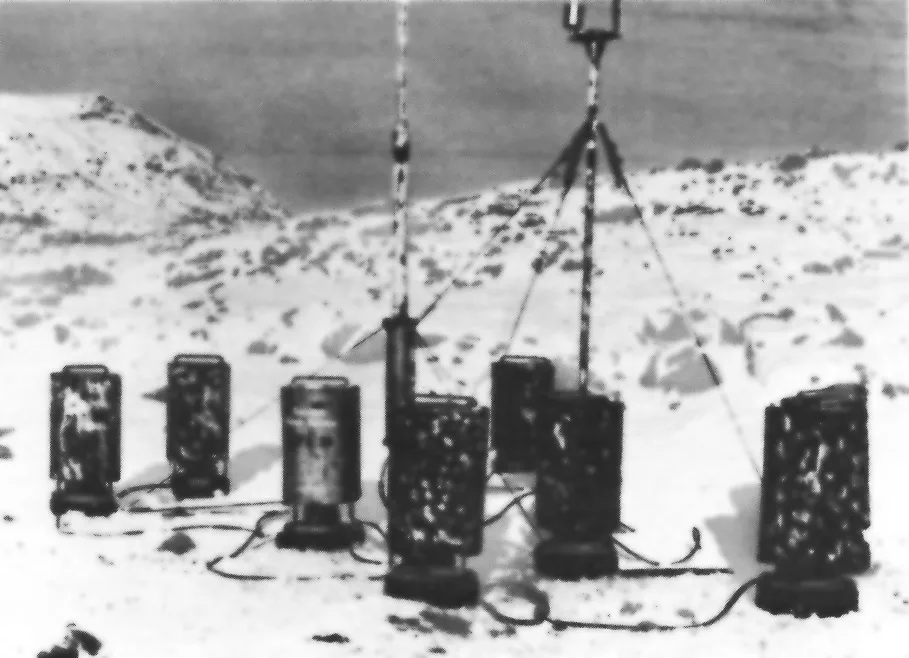
Imagine being all alone on planet Earth. That’s exactly what it felt like being on Martin Bay. Still, nothing was left to chance. The weather station had to be undetectable. And if, by chance, someone would stumble upon it, they had to suspect nothing at all. The crew of U-537 proceeded to camouflage the station for concealment, and it was rather genius.
Of course you couldn’t just put a net around the weather station and call it a day. You couldn’t conceal it physically per se, so they had to make it appear as if it was just some weather equipment that belonged to the Allies. They began spreading empty American cigarette packets around the site to deceive any Allied personnel that might stumble upon it. The concealment wasn’t faultless, though. One of the canisters that the crew placed had ‘Canadian Meteor Service’ written on it. The only issue was that such a service had never even existed. It was an attempt to avoid suspicion if the site was to be discovered. They had tried to simulate ‘Canadian Weather Service’, but ended up misspelling the service.
Perhaps it was just a small mistake no one would probably notice. However, the area in which the weather station was installed wasn’t even a part of Canada. Their effort was probably sufficient, but would the crew even know this?
U-537
There was no time to rest. As one part of the crew worked through the night to install Kurt, the other part of the crew also worked through the night to repair the battered U-boat.
It took the crew just 28 hours to set up Kurt and finish the repairs. The repairs were enough to ensure U-537 could remain seaworthy for the voyage back to Nazi Germany. And Dr. Sommermeyer and Hildebrandt confirmed that the weather station was functioning as intended.
The crew had successfully invaded North America, unseen. No one knew they were there, and no one would find out for a very long time. The covert operation was a staggering success. Or was it?
Leaving Labrador
U-537 was seaworthy enough to leave Labrador and engage in its next objective, conducting an anti-shipping patrol off Newfoundland, with its ultimate goal to reach its homeport of Lorient, France.
Just nine days after leaving Labrador, on October 31, 1943, the crew encountered a Canadian Lockheed Hudson aircraft from the No. 11 Squadron RCAF, that was operating out of Gander, Newfoundland. The Hudson intercepted U-537 and fired eight unguided rockets at it. The crew was caught completely by surprise, as their Naxos radar-warning receiver was out of service. Luckily for the crew, though, all eight rockets missed their target. U-537 logs not only noted that the Naxos was out of service, they also reported that there were no bombs or depth charges dropped during this first encounter.
Yet, there was no rest to be expected for the crew. Ten days after their first close call, U-537 was operating in the western North Atlantic, near Cape Race. Again, a Canadian intercepted them. It was a Canadian Consolidated Canso/Catalina flying boat from the No. 5 Squadron RCAF. To make the situation more painful, the Canadian caught U-537 while being surfaced and therefore dropped four depth charges. You can probably figure out how that should have ended. However, the depth charges detonated in the water but failed to achieve a direct hit. The U-boat’s crew also actually managed to dive and escape completely unharmed once more.
Dr. Sommermeyer and his assistant Hildebrandt also had to live through these attacks. After two failed attacks, it could’ve been the third time’s a charm for the Allies. And believe me, they most certainly tried.
On November 11, 1943, just a day after the last attack that U-537 had to live through, the Allies managed to locate the U-boat once more. It was yet another Canadian Consolidated Canso/Catalina flying boat from the No. 5 Squadron RCAF. It’s hard to imagine, but yet again U-537 was caught while being surfaced and the Canadian dropped four depth charges on it during this nighttime strike. It was the most successful attack of the U-boat’s patrol.
However, the U-boat only caught slight operational damage from this latest attack. The Allies were now ready to finish off U-537. Allied air controllers called in nearby navy vessels to launch a surface hunt. The only one working against the Allies at this point was mother nature. A heavy and thick fog started covering the Atlantic, meaning the surface ships could no longer successfully locate U-537.
The U-boat was barely hanging on. That forced Kapitänleutnant Schrewe to make an executive decision. He also still had Dr. Sommermeyer and his assistant Hildebrandt aboard the submarine. Schrewe decided to abort further offensive maneuvers and use the cover of fog to make an escape back to their homeport of Lorient. U-537 survived three attacks without having any deck weapons left.
On December 8, 1943, the ordeal was finally over for the U-boat’s crew, Dr. Sommermeyer, and his assistant Hildebrandt as they managed to reach the homeport of Lorient.
Ultimately, on November 10, 1944, U-537 was sunk with all hands in the Java Sea.
A Secret Advantage
Weather Station Kurt was set up and operational, even during all the hardship U-537 had to endure on its voyage back to Lorient. Now Nazi Germany finally held a secret advantage the Allies knew nothing of. It gave the Germans the same weather information the Allies were able to accumulate. By all means, this operation that carried no specific name was a logistical and tactical success. It remains the only armed German military operation on land in North America during World War II.
On their way to Martin Bay, Labrador, the crew managed to evade Allied radar, air coverage, and naval patrols, to ultimately execute a top-secret landing on enemy soil. They spent 28 hours there, setting up the complex WFL.
The WFL started transmitting the weather readings back to occupied Europe in Morse code every three hours for up to six months. The station worked perfectly, but that only lasted a few days. Within three weeks, somewhere by mid-November 1943, Weather Station Kurt completely fell silent. Even if the unnamed operation was technically a spectacular success, the WFL failed miserably.
The WFL failed due to multiple factors. Of course, the extreme, and brutal North Atlantic conditions soon took their toll, but the deterioration of the weather station was sped up by the corrosive saltwater winds. The batteries depleted rapidly in these conditions, mainly due to the freezing Arctic temperatures, which permanently disabled transmission far too soon.
Failure, Or Was It?
You’re probably with me in being torn between the two conclusions. Was it a failure? Was it a success? What was it?
I believe this is completely open to interpretation. Therefore, I encourage you to come to the conclusion yourself. As I mentioned, the operation was in fact a success in terms of operational, logistical, and tactical accomplishments. The only aspect that completely failed was the WFL itself.
I just want to address one more aspect of the operation in this regard.
Rediscovery
No one ever knew or found out. That in itself speaks volumes about the operation. A covert operation that no one knew about, that’s about as good as it can get. Kurt remained in Martin Bay, Labrador for decades. Untouched and unsighted, on a remote, wind-swept ridge.
It wasn’t until July 1977 that someone stumbled upon rusted metal canisters in northern Labrador. That someone was Peter Johnson. He was conducting unrelated geographic and archaeological work close to where Kurt was still stationed. He proceeded to document the site, naming it Martin Bay 7. After 34 years, the camouflage efforts the crew of U-537 made were finally put to the test. Their only mistake was the misspelling on the canisters. Johnson looked at the print on the canister and read: ‘Canadian Meteor Service’. And no, he didn’t realize there was something behind this. Johnson actually assumed it was a forgotten, defunct Canadian military or government outpost. He took his notes and left. He left Kurt exactly where it was installed 34 years ago.
It was staggering to think that even Dr. Sommermeyer didn’t live to witness it. He did survive World War II, but he died on February 13, 1969, at the age of 62.
Siemens
But there was to be a breakthrough eventually, and that breakthrough happened in Germany. Franz Selinger was researching the history behind Siemens corporation, his former employer, as he was in the process of writing a historical book. Siemens is the company that originally manufactured the automatic weather arrays for Nazi Germany.
Selinger went through all of Dr. Sommermeyer’s private papers that Siemens had in their archives. There Selinger discovered undocumented photographs of a weather station together with a U-boat crew that didn’t seem to match any known Kriegsmarine Arctic operations. He knew there was something more to this. You could safely say he was at least getting intrigued by what he discovered. So, he dug deeper into declassified German naval archives that were located in Freiburg, Germany. There he made an amazing discovery, the Kriegstagebuch (war diary) of U-537. Inside the Kriegstagebuch, Selinger found exact coordinates that were logged by Kapitänleutnant Peter Schrewe.
Return to Martin Bay, Labrador
You guessed it, the coordinates pointed exactly to a location in Martin Bay, Labrador. As far as Selinger was concerned, there was no question about it. The Kriegsmarine had successfully executed a landing on North American soil that the Allies apparently knew nothing of. Selinger didn’t stop there and was determined to find the site. He proceeded to contact Dr. W.A.B. (Alec) Douglas, who was the official chief historian for the Canadian Department of National Defence. However, the Canadian authorities were, of course, highly skeptical. The skepticism was understandable, as there was absolutely no mention or record of a ‘Canadian Meteor Service’ operating in that area during the war. In fact, this service had never even existed.
Selinger had no other option left but to present his trump card, the photographic evidence that he uncovered from the Freiburg archive. The Canadian military quickly realized that Martin Bay 7 couldn’t be anything else other than a Nazi German installation.
In July 1981, Dr Douglas, Franz Selinger, and a team of Canadian researchers finally made the voyage to Martin Bay 7. What they found could’ve been something out of a time capsule. Weather Station Kurt and its canisters were found exactly where the crew of U-537 had bolted them down, 38 years earlier. They proceeded to dismantle the station, and they had it airlifted from the site to be brought to Ottawa. Today, Weather Station Kurt is still fully assembled and on display at the Canadian War Museum. The canisters still have the fake markings the crew of U-537 had painted on them: ‘Canadian Meteor Service’.
After all that was said and done, maybe, just maybe, the conclusion is twofold. It’s true that Weather Station Kurt failed within weeks. But everything surrounding the operation can only be seen as a resounding success that was only discovered multiple decades later.
Continue the Discussion
U-537 successfully reached North America, installed Weather Station Kurt, and escaped without being detected. The biggest issue was that the station itself failed within weeks. What matters more when judging the mission: the failure of the station, or the success of keeping the entire operation secret for more than three decades?
Join Field Reserve for free and make your case inside the WarCommons community at our Field Headquarters.
Take WarCommons with you on Android.
WarCommons publishes long-form, source-driven World War II analysis without ads or sponsored content. If you found this article valuable, consider supporting independent research by joining Field Command.
By Nick Ravenshade — Founder & Editorial Director, WarCommons
Header image: Type IXC/40 submarine U-537 at anchor in Martin Bay, Labrador, Dominion of Newfoundland on 22 October 1943. Crewmen are visible on deck offloading components of Weather Station Kurt into rubber rafts. October 22, 1943. Source: Wikimedia Commons. CC0 1.0.