WARCOMMONS IS NOW ON ANDROID
Explore WWII history and stay connected with the community on the go. GET THE APP →

Millions died by his regime. But only one death may have been by his own hand.
These days, the Holocaust hardly needs any explanation. Everyone knows what the Holocaust entails. But everyone also knows how many victims World War II claimed. Who is primarily to blame? Adolf Hitler’s Nazi regime.
Casualties by the Hand of the Nazi Regime
It is estimated that somewhere around 11 million people were murdered by Adolf Hitler’s regime. This goes beyond the Holocaust alone. It includes people who were knowingly and intentionally killed by this murderous Nazi regime. Regardless of age, skin color, ethnicity, religion, social status, gender, and so on. Of all these murdered people, approximately 6 million were Jews. Approximately 5 million of the dead were other civilians and prisoners.
But if we look further, there’s also a conclusion to be drawn that you might not think of. Perhaps because you’re afraid of how it might come across. Or because people might get the wrong impression. But WarCommons does draw that conclusion, because we base our findings solely on facts. The conclusion within all of this is, in fact, that Hitler did not kill these people himself.
No, he certainly never operated a gas chamber or fired a shot alongside the Einsatzgruppen. But of course he is still responsible. After all, it was Hitler himself who enacted the laws and regulations that ensured such a destructive policy was carried out, the policy that led to all these mass murders, which in turn led to the gas chambers, concentration camps, and the Einsatzgruppen.
There aren’t many murderers who can match these death tolls. At least, in the sense of being directly responsible for such shocking numbers of deaths. In recent history, there are probably two people responsible for even more deaths: Joseph Stalin of the Soviet Union and Mao Zedong of China. Yet you hear very little about them in this context. And that is, to say the least, somewhat striking.
In any case, Stalin and Zedong were both so-called “desk killers.” Of all those millions of deaths, they never actually killed anyone themselves. But was Hitler also a so-called “desk killer”?
Hitler’s Murders
Although we could explain all the details in depth, the simple answer is just no. No, Hitler never personally took anyone’s life. He never turned on a gas chamber, nor did he fire a firearm to kill anyone. Even though Hitler served in the military during World War I, he didn’t kill anyone then either.
There is, however, one striking detail in his story. Perhaps it’s more than just a detail. In any case, it’s worth considering in this context. This detail concerns Geli Raubal, Hitler’s half-niece.
Hitler was extremely possessive of his half-niece and also intensely jealous, to the point of extremes. Geli was never allowed to leave the house on her own, nor was she permitted to have ordinary friendships with others, let alone romantic relationships. The older Geli got, the more trapped she felt in Hitler’s apartment in Munich. For her, it was like a prison, under the constant supervision of none other than Hitler himself.
On September 19, 1931, Geli was dead. She was found dead in her apartment in Munich. The cause of death was determined to be suicide, with a gunshot wound to the chest. However, it was also determined that Geli had other injuries to her face. For years, decades, even a century, there has been debate over whether this was truly a suicide. It is more plausible that Hitler murdered her after all.
The murder weapon? Hitler’s pistol. The day before her death, Geli and Hitler had had a heated argument. She wanted to leave for Vienna. And, of course, Hitler wouldn’t hear of it. The only place Geli was allowed and able to be, according to Hitler, was the apartment in Munich. Shortly after the argument, Hitler left the city. And the very next morning, the case was quickly dismissed as a suicide. But why? In any case, the Nazi Party quickly dismissed all accusations as propaganda.
Yet something doesn’t add up, because Geli had been shot in the chest, which is very rare in a suicide. It is, in fact, very common in a murder, a murder in which the victim was shot at close range. But Hitler continued to claim that he had already left the city when Geli died. And, of course, his alibi was supported only by his loyal followers.
Hitler’s friend also played a part in the story. On the orders of Justice Minister Gürtner, Geli’s body was examined only superficially. Gürtner was a close friend of Hitler’s. Yet at least one person voiced a dissenting opinion, an opinion that was forgotten by history: the priest. Contrary to tradition, Geli was buried in consecrated ground. According to the priest who was present, Geli had certainly not committed suicide.
Officially, Geli’s death remains recorded as a suicide. No investigation since has overturned that ruling. But officially recorded is not the same as true, and common sense points elsewhere. And to stick to the facts, Hitler does have one murder to his name, a murder committed with a pistol in the Führerbunker: his own suicide.
WarCommons publishes long-form, source-driven World War II analysis without ads or sponsored content. If you found this article valuable, consider supporting independent research by joining Field Command.
By Nick Ravenshade — Founder & Editorial Director, WarCommons
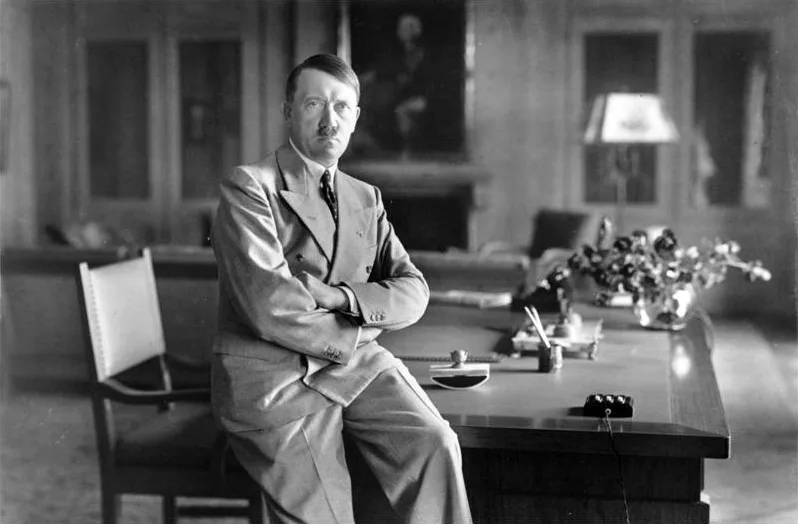
Header image: Obersalzberg, Berghof, Adolf Hitler in office seating on his desk. 1936. Source: Wikimedia Commons / Bundesarchiv, Bild 146-1990-048-29A / Heinrich Hoffmann. CC BY-SA 3.0 DE.