WARCOMMONS IS NOW ON ANDROID
Explore WWII history and stay connected with the community on the go. GET THE APP →
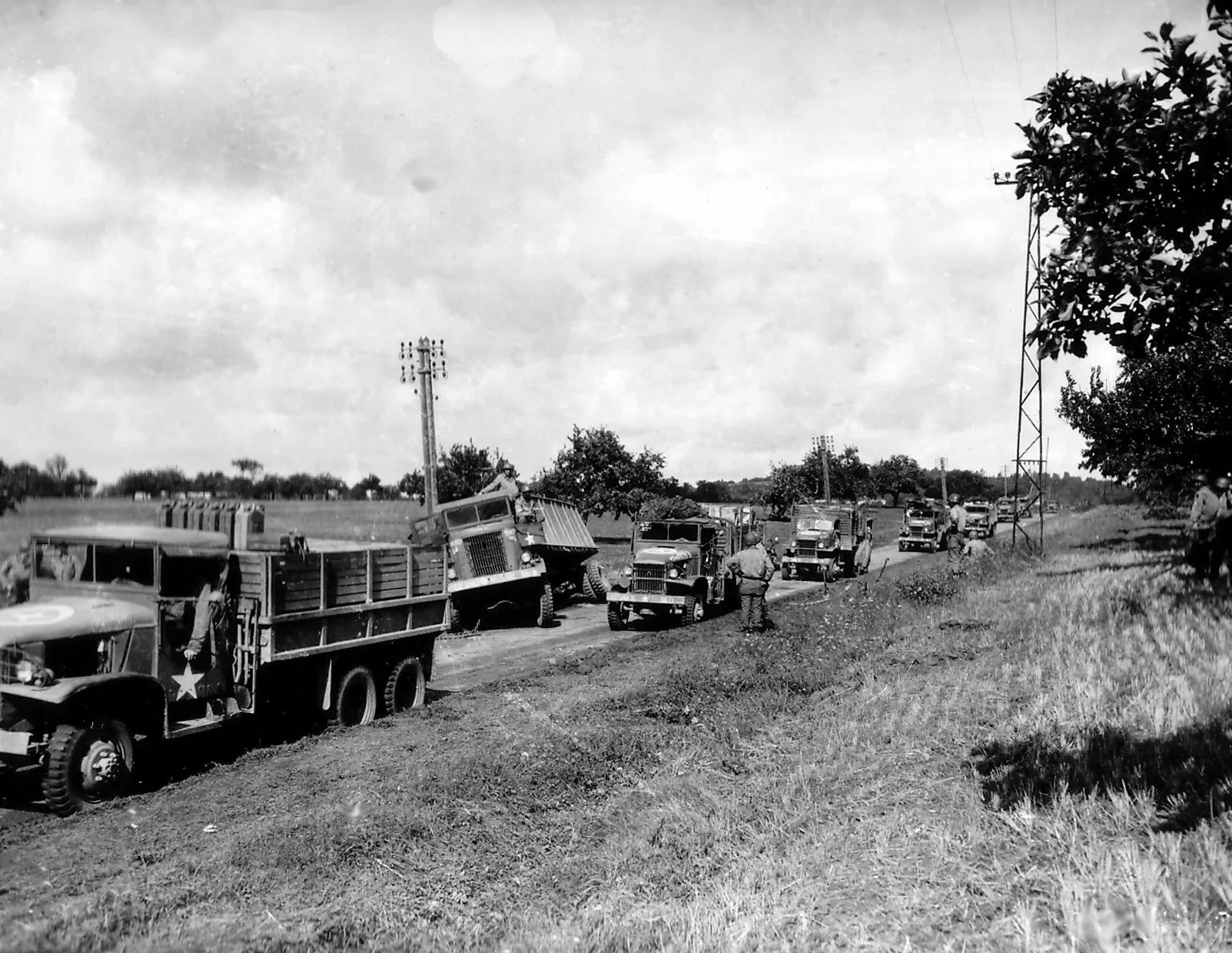

The Red Ball Express is generally well known in the history of the Second World War. A film of the same name has even been made about it. Yet the impact of the Red Ball Express is sometimes forgotten. It tends to fade into the background, simply because it is not quite a story filled solely with thrills and exciting moments of combat. Nevertheless, the Red Ball Express was so important that it could even be called a lifeline. This is the story of the Red Ball Express. Often forgotten, but now restored to its rightful place.
The origins of the Red Ball Express
The name refers to the military logistics operation that ran initially from the port of Cherbourg to supply dumps near Chartres, extending further east as the Allied advance progressed. Following the Allied landings in Normandy, they advanced rapidly inland, encountering little resistance from the Axis powers. This led to a classic problem associated with military offensives. Logistics fell behind. This caused problems in the supply lines for ammunition, fuel, other military equipment and food to the Allied troops at the front. That is why the Allies came up with an idea: the Red Ball Express along the so-called Red Ball Highway. It was the logistics route running mainly from the port of Cherbourg to the rapidly advancing Allied front lines near Paris and further east towards Belgium.
It all began on 25 August 1944.
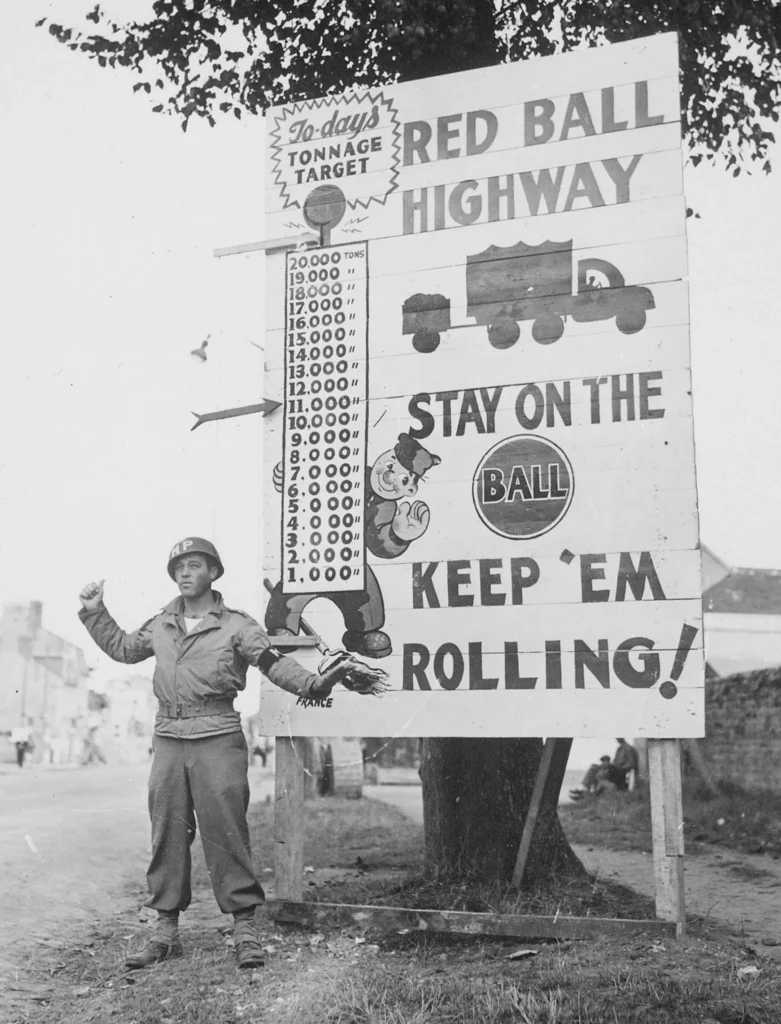
These were routes stretching over hundreds of kilometres, and sometimes more than 1,000 km return. The Allies used 6,000 lorries for this logistical operation. These were often GMC lorries, sometimes better known as ‘Deuce and a half’. Around 75% of the drivers of these lorries were African American. Unfortunately, this is also one of the most frequently forgotten facts: the impact that the African American drivers managed to make.
For the Allies, there was really no better alternative. In the run-up to the Allied invasion, the French railway network had already been heavily bombed. The aim of this was to prevent the Wehrmacht from bringing in further reinforcements by rail to defend Normandy. When General Omar Bradley’s US First Army and General George S. Patton’s US Third Army broke out of Normandy towards the River Seine, it became clear that there was a great need for a huge quantity of supplies to be brought in. As the railway had been virtually destroyed, transport by road was the only viable option to keep the logistics running.
Logistics in practice
Command of the Red Ball Express was entrusted to Colonel Loran A. Ayers and Major Gordon K. Gravelle. They were responsible for the personnel, the loading and unloading, and, of course, the lorries. The GMC lorries had a load capacity of 5 tonnes. However, the route these lorries had to travel was extremely challenging. Road conditions, combined with the vehicle weight limits on damaged French roads, meant the lorries could often only set off with approximately half a load of 2.5 tonnes. The Autocat U-7144T was also used, a lorry capable of hauling a semi-trailer with a total weight of 10 tonnes. And for the really heavy work, such as transporting tanks, the Diamond T M-20 was used. Although it was primarily intended for transporting armoured vehicles, the Allies had made a number of minor modifications to the truck. This conversion enabled the Diamond T M-20 to transport large quantities of ammunition as well.
With so much supplies needing to be transported daily via the Red Ball Highway, traffic jams were a constant threat. That is why two routes were opened: a northern route and a southern route. The northern route ran from Cherbourg towards the front, and these lorries were loaded with fuel, ammunition and supplies such as food. The southern route was the return journey from the front to the port of Normandy. There, the lorries were reloaded. Both routes were one-way to prevent traffic jams and congestion. Only military traffic was permitted on this route. The route was heavily used and in operation day and night. Vehicles in a convoy were not allowed to overtake one another, nor were separate convoys permitted to do so. This would, after all, contribute to traffic jams. A ten-minute break was held every two hours as standard. During the break, the goods were checked and, where necessary, maintenance was carried out on the lorries. There was also a half-hour break four times a day, to rest and eat.
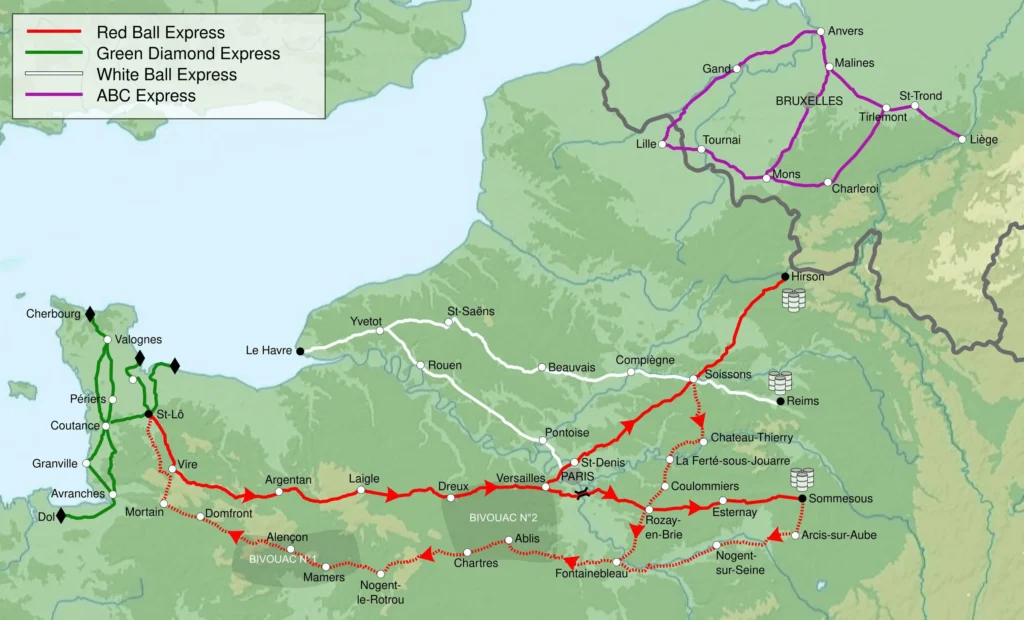
As the lorries themselves consumed around 1 million litres of fuel a day, the fuel shortage at the front lines only became more acute. Following the liberation of Paris on 25 August 1944, the route was also used to supply the city’s inhabitants. There was a severe food shortage following the liberation. Part of the Red Ball Express was therefore deployed to supply food to Paris. As Paris was now liberated, the Red Ball Express’s eastern depot could be moved even further inland, some 250 km further. As a result, the depot moved ever closer to Belgium, first to Sommesous and then to Hirson. Because the depots could be situated further inland, the route also became longer. A return journey meant a trip of over 1,000 km and 72 hours for the Red Ball Express. However, the liberation of Paris brought with it another welcome logistical bonus: a functioning rail network to the north and east of Paris. These areas had been bombed far less than the supply lines immediately adjacent to Normandy. From that point onwards, some of the goods that would otherwise have had to be transported by lorry were taken over by rail.
When the operation ended on 16 November 1944 a staggering total of 412,000 tons of supplies had been delivered.
The drivers
Whilst traffic jams and logistical bottlenecks are usually a direct problem in most wars, this was not quite the case with the Red Ball Express. Traffic flowed smoothly, as did the supply lines. It was maintenance, a shortage of drivers and a lack of sleep that caused the most problems. Many drivers were, therefore, overworked.
Unfortunately, much of the history surrounding the Red Ball Express has been forgotten, with the focus tending to be on just how well the logistics were organised. None of this would have been possible without African-American drivers. Sadly, their role within the Red Ball Express remains insufficiently recognised. But not any longer.
The lifeline known as the Red Ball Express was made possible by some 23,000 personnel. However, around 75% of them were African-American soldiers. No, they were not referred to as soldiers at the time. They were quartermasters, drivers, and support workers. But in reality, they were nothing less than that, soldiers, and they deserve the honour due to soldiers.
The period during which the Second World War took place was one in which segregation was still regarded as normal by Americans. Many Americans publicly condemned the Nazi racial laws. At the same time, Americans had no qualms about treating Black people or African Americans as second-class citizens, excluding them from daily life and denying them the opportunity to make a collective contribution to the defence of their country. They remained segregated from the rest of the army throughout the Second World War. They had separate units and were often only permitted to serve in support roles, such as quartermasters or in transport, and not in combat roles. This was also the case within the logistics operation, the Red Ball Express.
The African-American drivers were truly the backbone of this entire logistical operation. They kept the front lines running and continued to drive along the long and dangerous routes. Tired, exhausted and overworked, they spent day and night in their lorries, delivering vital supplies to the front lines. And they had to handle the heavy loading and unloading themselves.
They were undervalued and segregated. Yet they were the true face of the Red Ball Express; without them, the Allied advance across Western Europe would have been far more difficult. They were expected to perform menial and support roles. Yet they became the backbone of the Red Ball Express. They are the story of the Red Ball Express.
WarCommons publishes long-form, source-driven analysis without ads or click incentives. If you found this feature valuable, consider supporting our research by subscribing to help fund future investigations.
By Nick Ravenshade — Author
Header image: Red Ball Express convoy. Source: Wikimedia Commons. Public domain.