WARCOMMONS IS NOW ON ANDROID
Explore WWII history and stay connected with the community on the go. GET THE APP →

How Nazi propaganda invented the story of Polish uhlans charging German tanks and why it took decades to correct the record.
You may have heard something about this before. It is said that, after the German invasion of Poland, the Polish cavalry fought against German tanks and armored divisions. Horse against machine. But was this actually true? The fact is that much of the Nazi propaganda continues to influence how we view World War II to this day. Images of massive German tanks and long columns of armored vehicles. Behind that, however, lay a different truth: namely, that the Wehrmacht, too, primarily deployed horses at that time and used tanks only to a limited extent.
This specific incident is said to have taken place in the Polish village of Krojanty. When the Wehrmacht launched its offensive in Poland on September 1, 1939, this was one of the first places where German troops encountered any Polish resistance.
The Polish Cavalry
The battle erupted in Krojanty, with the Polish uhlans playing a leading role on the Polish side. Simply put, they were mounted lancers. And they played an important role in September 1939. Nazi propaganda portrayed the Polish uhlans as recklessly charging German tanks with their lances. But nothing could be further from the truth.
It was no secret that the Polish cavalry was suffering casualties. The initial battles had claimed the lives of more than 20 Polish horses. What followed was a textbook propaganda campaign. Following this small-scale slaughter, the Wehrmacht immediately invited journalists and photographers to the site where the fighting had taken place. They also told a remarkable story. The dead Polish horses were the result of reckless attacks by the Poles aimed at the German tanks. The journalists eagerly wrote about a Polish act of desperation, in vivid detail. But it was not based on facts, far from it. The Polish cavalrymen recklessly and desperately attacked the tanks with their lances and sabers. This was the narrative put forward by the journalists, which the Germans then eagerly exploited once again. As a result, the story spread around the world. Nazi propaganda also emphasized that the Poles were very primitive.
This narrative was accepted as fact even as late as 1960. For example, journalist William L. Shirer wrote the following in his book titled The Rise and Fall of the Third Reich: “Horses against tanks! The cavalryman’s long lance against the tank’s long cannon! Brave and valiant and foolhardy though they were, the Poles were simply overwhelmed by the German onslaught.”
But who should you actually believe? It might be wrong to dismiss everything outright as propaganda or Nazi propaganda. But what were the facts, then?
The Facts As Far As We Know
Primary sources are often the most important form of information when determining whether something actually took place. But sometimes the primary source is a firsthand witness whose reliability is difficult to assess. And it is difficult to say whether every witness statement from World War II was that reliable. Heinz Guderian, on the other hand, did recall the battle. The German invasion forces in northern Poland were under Guderian’s command. He even mentioned it in his memoirs Panzer Leader (Erinnerungen eines Soldaten), which were published in English in 1952. He, too, described an attack carried out in vain by the Polish cavalry.
The accounts of the journalists who wrote about this in 1939 were primarily based on what the Germans had said about this battle. They wrote the following about the Battle of Krojanty. The battle is said to have begun with a surprise attack carried out by Polish cavalrymen. The Poles had managed to push back and drive off the German infantry. But then the German tanks and armored vehicles arrived, which, according to their account, killed more than 20 cavalrymen.
This narrative continued to be accepted for many years, as seen, for example, in journalist William L. Shirer’s book The Rise and Fall of the Third Reich, but also more recently, in 2014, in a book by the Danish historian Søren Mørch titled: Den store krig.
But what, then, was still Nazi propaganda, and what had actually happened?
The search for the facts was actually fairly straightforward, provided one could find the right sources, sources such as after-action reports. In fact, the work had already been done for us. Several historians have conducted source research on this specific battle at Krojanty. What they were actually able to establish was that there were no German tanks present at this battle at all. The Wehrmacht had deployed only armored cars equipped with machine guns against the Polish defenders and cavalrymen. It is a textbook example of Nazi propaganda as seen in countless episodes of Die Deutsche Wochenschau (the Nazi newsreel), showing tanks rolling forward unstoppably.
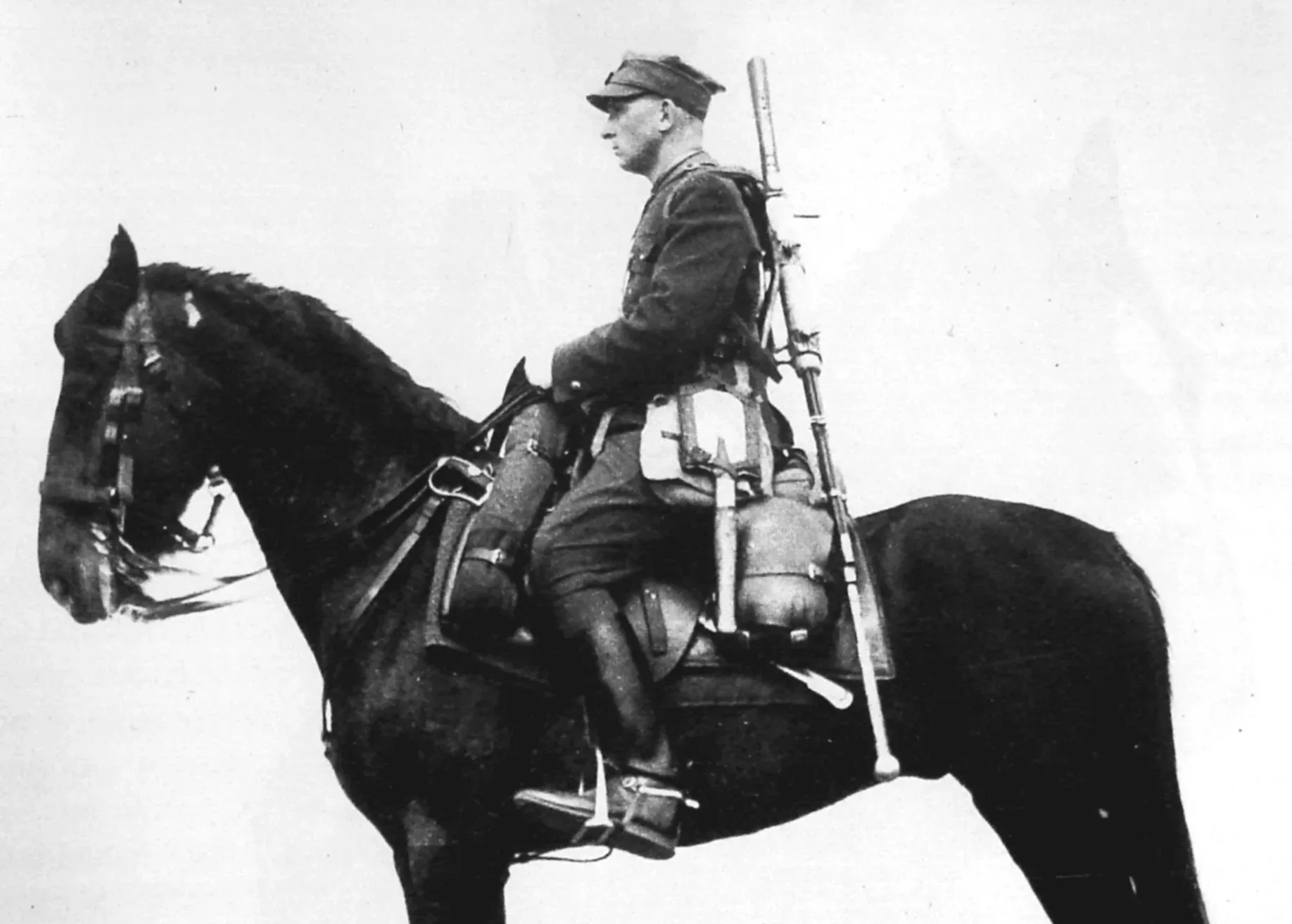
Once the Polish cavalrymen found themselves truly trapped in the open terrain near Krojanty, they did not attack the German armored vehicles at all. They retreated as quickly as they could. One key detail has also been established as fact in this regard. The Polish cavalry, although indeed on horseback and armed with sabers and lances, carried much more with them. In fact, they also used the karabin przeciwpancerny wz. 35, 7.92 mm anti-tank rifle, in their defense against the German attack. This anti-tank rifle was powerful enough to penetrate the German light armored vehicles. These were far more effective weapons than the Polish troops could deploy against the German armored vehicles than just lances and sabers.
The myth served both sides. And both sides chose to keep it alive.
The Myth and Propaganda
However, the myth of the Polish uhlans did not work solely to Germany’s advantage. Germany’s narrative was that the Polish cavalrymen were primitive and committed acts of desperation that stood no chance against the all-powerful German tanks and armored vehicles.
The Polish troops used this story to craft their own narrative, one that underscored the tradition of the Polish Uhlans. This was, in fact, a proud part of the Polish cavalry tradition, which dates back to the 18th century. These troops, who even back then could be called outdated, were a source of the myth in favor of the Polish side. After all, they were able to offer resistance against the German tanks. Such vulnerable troops, facing the German tanks. Brave and heroic Polish uhlans and cavalrymen against the German armored vehicles. Horse against tank.
It was such a compelling narrative that it was hardly surprising it endured for so long. So, in fact, we can conclude that both warring sides wanted to preserve the same narrative in their own way. The same underlying facts, twisted in such a way that they fit perfectly into the narrative that was needed, one in favor of Nazi Germany and the other in favor of Poland.
What can therefore be firmly established is that Nazi propaganda was central to both narratives. But the story that the Polish cavalry attack was carried out solely with lances and sabers is, in fact, a myth. And this myth originated in nothing other than German Nazi propaganda. In fact, the Polish troops were by no means incompetent in their defense. Although Poland had fallen completely into the hands of Nazi Germany and the Soviet Union within 36 days, German troops had to endure multiple cavalry attacks from the Polish side. In fact, these Polish attacks were not at all all failures.
The fact is, after all, that the Polish uhlans had indeed destroyed German tanks. This doesn’t exclusively apply to the battle of Krojanty and the exact numbers are still difficult to determine. Of course, not all of these were destroyed solely by the Polish uhlans. What the Polish uhlans did do was that they rode up behind a tank and dismounted from their horses, along with the anti-tank weapons they actually possessed. They then fired at the rear of the armored vehicle, always the weak spot of a tank or armored vehicle.
We can therefore come to no other conclusion than the following: The attack, as portrayed by Nazi propaganda, had in reality never taken place.
Field Command members: the Author’s Note for this article is available in the Field Command area.
WarCommons publishes long-form, source-driven World War II analysis without ads or sponsored content. If you found this article valuable, consider supporting independent research by joining Field Command.
By Nick Ravenshade — Founder & Editorial Director, WarCommons
Header image: Polish uhlan with wz. 35 anti-tank rifle. 1938. Source: Wikimedia Commons. Public domain.