WARCOMMONS IS NOW ON ANDROID
Explore WWII history and stay connected with the community on the go. GET THE APP →

How the Rhineland crisis of March 1936 became the last moment the Allies could have stopped Hitler, and why they chose not to
We’ve discussed this before on WarCommons. Hitler’s march toward absolute power in Germany and the beginning of his Third Reich, an empire that was supposed to last a thousand years. But once Hitler came to absolute power, it didn’t take long for people to discover his true motives and motivations. Several significant events had already taken place. But one of the most crucial moments was this one: the remilitarization of the Rhineland.
The Prelude to the Remilitarization
There is still much debate about what actually created the conditions that allowed Hitler to seize absolute power. In online discussions, it is sometimes argued that Hitler would have come to power even without the Treaty of Versailles. This is an interesting debate, one that also has a direct impact on the remilitarization of the Rhineland, since, in principle, the Treaty of Versailles also forms the basis for that. We will certainly analyze and study this in greater detail. But whatever the case may be, the Treaty of Versailles is, in fact, the basis for the remilitarization. So what exactly led up to it?
The demilitarization of the Rhineland was stipulated in the Treaty of Versailles. After World War I, Germany was “forbidden to maintain or construct any fortification either on the left bank of the Rhine or on the right bank to the west of a line drawn fifty kilometers to the east of the Rhine.” If Germany were to attempt to violate these provisions of the Treaty, it would be regarded as a hostile act and an act that could disrupt the world order. “[a violation] in any matter… shall be regarded as committing a hostile act… and as calculated to disturb the peace of the world.”
The Treaty of Versailles was not, in and of itself, the sole factor that determined the demilitarization of the Rhineland. Supplementing this treaty, the Treaty of Locarno was concluded in October 1925. This treaty consisted of a series of seven international treaties intended to ease tensions among the European great powers following World War I. When certain aspects are considered, the Treaty of Locarno was even more significant in this context than the Treaty of Versailles. The Treaty of Locarno also entailed Germany’s voluntary acceptance of the demilitarized status of the Rhineland, whereas under the Treaty of Versailles, this demilitarization had been nothing more than an obligation imposed by the Allies. A so-called diktat, and nothing less. The Treaty of Locarno was concluded by France, Great Britain, Belgium, Italy, and Germany. Through Germany’s intervention, it was also stipulated that the demilitarization would be permanent. This was an important addition to the Treaty of Versailles, and perhaps, in the context of the demilitarization of the Rhineland, even more significant than a mere addition. The terms of Locarno also stipulated that Italy and Great Britain were to come to the aid of their ally France should Germany launch an attack on France. It is also evident that the Allies were keen to have Italy on their side and to keep it there.
But the demilitarization of an area does, of course, mean that no military personnel are allowed to be present at all. Neither German troops nor Allied forces were permitted to enter the area. According to the Treaty of Versailles, the Allies were also required to withdraw from the area, in any case no later than 1935. Yet the Allies did not need all that time. The last British soldiers left the Rhineland in 1929, and the French soldiers in 1930.
So the Allies actually knew that it was only a matter of time before the demilitarized Rhineland would no longer provide protection against a possible German attack. For although the area was free of German troops, there were also no Allied troops present there. In any case, France had no confidence in it; otherwise, they would not have begun building the Maginot Line in 1929. In effect, the French traded the demilitarized Rhineland for the Maginot Line as protection against a German attack.
The Diplomatic Tribulations
What I have often argued is that the interwar period was, in fact, a vast European arena for diplomacy. High-stakes games were sometimes played, with every effort made to ensure that Germany was kept in check. Consequently, no exceptions were made regarding the demilitarization of the Rhineland.
It was in March 1933 that news first emerged of German plans to remilitarize the Rhineland. These plans stemmed from those drawn up at the behest of General Werner von Blomberg, the German Minister of Defense. Not long after these plans were unveiled, in the fall of 1933, the first steps toward remilitarization were already being taken. A number of paramilitary Landespolizei units stationed within the Rhineland were provided with covert military training and weapons. What was ostensibly intended as simple training for police officers was actually the first step in the covert remilitarization of the Rhineland. However, there was another high-ranking official who shared the same views. General Ludwig Beck had drafted a memorandum in March 1935. This memo revealed that Beck had recognized that the Rhineland must be remilitarized as soon as it became diplomatically feasible. According to Beck, this was an essential prerequisite for securing and safeguarding Germany’s lebensraum in Eastern Europe. That Germany saw a need to remilitarize the Rhineland was, in any case, clear and something of an open secret. But they were also in reasonable agreement on the timeline. Remilitarization would not be possible before 1937 in any case.
It was undoubtedly no coincidence that this course of action became clear in March 1933. After all, by January 1933, Hitler had managed to seize complete control of Germany. Given Hitler’s public rhetoric regarding the Rhineland and the Treaty of Versailles, the Allies were, in principle, somewhat aware of what lay ahead. Nevertheless, diplomacy between the nations was primarily focused on de-escalation, as evidenced by the so-called policy of appeasement. Moreover, at the time, they did not know what we now know more than 80 years later. There was still a great deal of uncertainty regarding Hitler’s true long-term plans. Hitler spoke primarily about the Treaty of Versailles and the dictates imposed on Germany as a result. In fact, these were extremely onerous obligations for Germany, not just the demilitarization of the Rhineland. Consequently, it simply wasn’t clear to the British government. Did Hitler merely wish to overturn the Treaty of Versailles? Or did he actually intend to subjugate all of Europe to his own authority? What should also not be forgotten is that the British were actually able to muster some sympathy, at least for the German people. After all, the terms of the Treaty of Versailles were so restrictive and unbalanced that the British could well understand why there was so much opposition to it. This mild sympathy was also one of the direct factors that led the British to later sign several treaties and agreements with Nazi Germany in the run-up to World War II, such as the Anglo-German Naval Agreement (1935) and the Munich Agreement (1938). The Munich Agreement will be covered in future WarCommons articles.
The British Rapprochement and Vigilance
British diplomacy therefore took on a two-pronged approach. On the one hand, the British listened to Germany’s legitimate complaints about the Treaty of Versailles. A direct example of this goodwill is simply the Anglo-German Naval Agreement. The British, in fact, also believed that the Treaty of Versailles was too harsh and restrictive. The Anglo-German Naval Agreement, in fact, relaxed a number of the Treaty of Versailles’ conditions regarding the German navy. On the other hand, German rearmament also played a prominent role in the diplomatic landscape. German rearmament was, in principle, simply an open secret, and the Allies had known about it for a long time. This process had, in fact, begun even before Hitler came to power. Hitler merely accelerated this process; he did not initiate it.
Germany, however, was not the only country that began to rearm. The United Kingdom, too, was emerging from a period of defense budget cuts and anticipated difficulties. Rearmament therefore became a top priority for the British as well. But rearmament against whom? In February 1934, this question was all but answered. At that time, a secret report was drafted by the British Defense Requirements Committee. In this secret report, Germany was classified as the “ultimate potential enemy.” British rearmament, therefore, had to be directed primarily against this ultimate potential enemy.
Still, the British were also quite clear about what they intended to do. They would avoid stationing large divisions of troops on the European mainland and instead focus on investing in the air force and the navy. The army, on the other hand, was given the lowest priority in terms of funding. With the memory of World War I still fresh in their minds, it was the British who wanted to prevent a repeat of those events. The British would focus their efforts primarily at sea and in the air. Not entirely unexpectedly, the French, of course, reacted with bewilderment. They believed that Germany could only be defeated with a large ground force. They also rejected the idea that Germany should be defeated through ground battles that would primarily be fought on French soil. Perhaps even then, the French did not have complete confidence in their Maginot Line.
The Alliance Against Nazi-Germany
The French were therefore also eagerly searching for a weapon against Nazi Germany. And they were still seeking that weapon through diplomatic channels. What France wanted to achieve was a network of countries that would form an alliance encircling Germany. Geographically, Germany had to be contained, as it were, in order to deter any attempt at military aggression as much as possible.
The initiative for this came, among others, from Louis Barthou, the French Minister of Foreign Affairs. He saw opportunities with the Soviet Union and Italy, but these countries were not yet true allies of the Allies. The Soviet Union had, in fact, been supporting Hitler for years in his challenge to the Treaty of Versailles, which Soviet leaders had always claimed was a capitalist conspiracy to “enslave” Germany. The Soviet Union had also been secretly supporting German rearmament since 1922. This came to an end in September 1933, partly because of France’s diplomatic overtures. But mainly because Stalin himself had also noticed that the German regime was increasingly speaking of Lebensraum in Eastern Europe. The Soviet leaders then revised their position and suddenly thought it was a fantastic idea to uphold the Treaty of Versailles. It was primarily Maxim Litvinov, the Soviet Commissar for Foreign Affairs, who, under the guise of collective security, gave this new interpretation to the Treaty.
High Rising Italo-German Tensions
It was actually quite remarkable that Italy ever became an ally of Hitler and Nazi Germany. During the interwar period, roughly until Mussolini’s war in Abyssinia began, it seemed entirely unlikely that Italy and Germany would ever become allies. Sometimes, simply being led by a dictator is not enough to bring two countries closer together. In the 1920s, as Italian prime minister, Mussolini provided funding to the Austrian Heimwehr movement, Austria’s home defense force. Engelbert Dollfuss was, in part because of this, an ally of Mussolini, and in March 1933, Dollfuss seized dictatorial power in Austria. This meant that, from that moment on, Austria fell directly within Italy’s sphere of influence. That was, of course, a thorn in Hitler’s side. By then, it was already no secret that, sooner or later, the Anschluss would be carried out.
However, Dollfuss’s reactionary regime also had an arch-enemy: the Austrian Nazis. And there was no doubt about who supported the Austrian Nazis. It was, in fact, Nazi Germany. The sole aim of these Austrian Nazis was to overthrow the Dollfuss regime in order to make the Anschluss possible. It was therefore not surprising that tensions ran quite high between Hitler and Mussolini. In fact, Mussolini had previously warned Hitler that Austria did not fall within Germany’s sphere of influence, but rather within Italy’s. Hitler was urged to cease his attempts to overthrow Dollfuss, Italy’s protégé.
Hitler apparently paid no attention to this, or perhaps he believed he had a plausible alibi. For on July 25, 1934, the July Putsch took place in Vienna. During this coup, Dollfuss was murdered by Austrian SS members. The Austrian Nazis effectively seized power and declared that the Anschluss was imminent. This was an important part of the history of the Anschluss that is often forgotten. The fact that Hitler was able to drive into Austria so easily and was greeted with cheers and flowers was made possible in part by the July Putsch and the course of action set by the Austrian Nazis.
But before that could happen, the Austrian Nazis were not yet done with their actions. In fact, all of Austria first had to come under their control. The Austrian SS Legion, which was based in Bavaria, began attacking border posts along the German-Austrian border. To the outside world, this looked very much like the start of a German invasion of Austria. Mussolini also viewed it as such and did not let the matter rest. He mobilized the Italian armed forces and positioned them along the Brenner Pass. He also issued a warning to Hitler: Italy would go to war against Germany if Germany were to invade Austria following the July Putsch. It goes without saying that Hitler was deeply offended by this move on Mussolini’s part. Hitler had no choice but to withdraw from Austria. The July Putsch had essentially failed in that the Austrian Nazis ultimately did not succeed in bringing all of Austria under their control.
Stresa-Front
But then came October 9, 1934. Louis Barthou, one of the key figures tasked with forging the France-United Kingdom-Soviet Union-Italy alliance, was assassinated. He was succeeded by Pierre Laval. Laval did his best to form and secure the Stresa Front. Mussolini was therefore pleased. On January 7, 1935, Laval gave Mussolini a “free hand” in the Horn of Africa. In effect, Mussolini was given carte blanche to invade Abyssinia. At the very least, France would not oppose Italy’s aggression. In April 1935, the Stresa Front was formed between the United Kingdom, France, and Italy. They would work together to oppose Germany’s violations of the Treaty of Versailles, after Hitler had declared in March 1935 that he would no longer abide by Part V of the Treaty.
An alliance that was clearly intended to be anti-German was taking shape. On May 2, 1935, Laval even traveled to Moscow to sign an alliance treaty with the Soviet Union. Hitler immediately launched a diplomatic offensive with a fierce press campaign. The German side argued that this new alliance violated the Treaty of Locarno and also posed an enormous threat to Germany. After all, Germany was now surrounded by countries pursuing an anti-German course instigated by France. But perhaps Hitler knew that this strategy would not work. May 21, 1935, therefore became the setting for what we now know as the so-called “peace speech.” Hitler publicly declared that Germany, in particular, would fulfill all its obligations under the Treaty of Locarno. But only as long as the other parties did the same. It was a sentence written by Baron Konstantin von Neurath, the German Minister of Foreign Affairs: “In particular, they [the Germans] will uphold and fulfill all obligations arising out of the Locarno Treaty, so long as the other parties are on their side ready to stand by that pact.”
It was intended to reassure foreign leaders after Hitler had announced in March 1935 that he would unilaterally renounce Part V of the Treaty of Versailles. This part of the treaty dealt with the disarmament of Germany following World War I. But as has been noted, the reassurance contained a caveat: namely, that Germany would abide by the Locarno Pact if the other signatories did so as well. Plans for the remilitarization of the Rhineland were, in fact, already firmly in place. This was because the Allies, through the Stresa Front, had adopted a new course, an anti-German course. Hitler, on the other hand, was also consistent in his speeches. He always maintained the position that Germany did not consider itself bound by the Treaty of Versailles, which had been unilaterally imposed on Germany with only terms detrimental to the country. However, Germany would comply with and respect any treaty it had signed voluntarily, such as the Treaty of Locarno, including the permanent demilitarization of the Rhineland. In his so-called “peace speech,” this was reiterated and confirmed: Hitler promised to always abide by Locarno, but not by Versailles.
The Opportunity and Remilitarisation
The situation was clear. Germany was surrounded and encircled by countries that were now all pursuing an anti-German course. Looking back on this period really raises only one question: How could it all have gone so terribly wrong? Italy was an ally of the two European great powers, France and the United Kingdom. And the Soviet Union had switched sides. Support for Germany was completely cut off, and they, too, adopted an anti-German stance. Yet everything was on the verge of changing, all because of a single person with the same drive for expansion as Hitler: Mussolini.
October 3, 1935. Mussolini invaded Abyssinia. After all, Italy had been given carte blanche by France in the Horn of Africa. But the British had other ideas. They immediately began advocating for sanctions against Italy. The League of Nations was to be responsible for enforcing these sanctions. The British were, in fact, advocates of collective security, but their stance against Italy led to tensions between France and the United Kingdom. The French had their own priorities. They were determined to preserve the Stresa Front at all costs and considered sacrificing Abyssinia a small price to pay. French security interests took precedence over everything else. The tensions between the British and the French only intensified. This provided the opening to seriously consider the remilitarization of the Rhineland. Mussolini became further isolated from the Stresa front, the French, and the British, as you can read more about in this deep dive.
Because Hitler provided Italy with military support in addition to his covert aid to Abyssinia, Mussolini actually still regarded Hitler as his only true ally. France and the United Kingdom had, in fact, all but written Mussolini off in his war. Mussolini also received no significant support from the Soviet Union. But Hitler was there, with a new ally: Mussolini. This was the cornerstone that made remilitarization and the Anschluss possible.
Setting the Pretext for the Remilitarisation
Anthony Eden, the British Foreign Secretary, remained firmly convinced that Germany would rejoin the League of Nations in 1940, accept restrictions on armaments, and renounce its territorial claims in Europe, provided that Germany were allowed to regain the Rhineland, reconquer its former African colonies, and gain economic influence along the Danube River. In essence, this was nothing less than a diplomatic trade-off.
But before any exchange could actually take place, the pact between France and the Soviet Union was submitted for ratification in January 1936. Hitler saw this as a potential problem for the Locarno Treaty. Both Neurath and State Secretary of Foreign Affairs Prince Bernhard von Bülow viewed the pact between France and the Soviet Union as a violation of the Locarno Treaty. But instead of demanding official arbitration, Germany initially took no action. This line of thinking traces back to the peace speech. If other parties were to violate Locarno, then Germany would no longer consider itself bound by the treaty either. This provided an opportunity to justify the remilitarization of the Rhineland. If they were to invoke official arbitration, as prescribed by the Treaty of Locarno, this justification might well disappear.
Plans to remilitarize the Rhineland were accelerated in January 1936. Originally the remilitarization was to take place as early as 1937. Hitler realized that the League of Nations was ineffective on virtually every front; the Stresa Front was falling apart, and the ratification of the pact between France and the Soviet Union had become a reality. But economic problems in Germany also made the recapture of the Rhineland almost a necessity. Germany could no longer do without the industry located in the Rhineland. He had an unexpected ally, Mussolini, who was driven even further into the arms of Nazi Germany by the sanctions against Italy. Mussolini even spoke of an Austro-German agreement. It was therefore up to Joachim von Ribbentrop and Neurath to navigate this diplomatic minefield. A solution simply had to be found, but the goal was already clear. Germany was determined to reclaim the Rhineland through the remilitarization of the region. Hitler asked von Ribbentrop and Neurath to assess what the possible international reactions would be to a potential remilitarization. As expected, there was division, because von Ribbentrop and Neurath absolutely could not stand each other. Von Ribbentrop believed that swift, immediate action was required. Neurath, on the other hand, advocated for so-called “quiet diplomacy,” which he believed would ultimately ensure that remilitarization could be carried out.
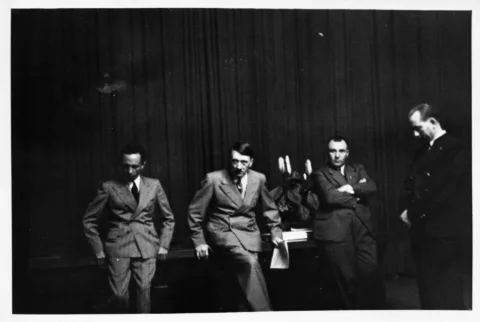
Neurath set in motion the justification for remilitarization. He drafted documents stating that the Franco-Soviet Pact was a violation of the Treaty of Locarno and provided justification for remilitarization. However, he advised deploying only a small force so that it would not also be seen as a flagrant violation of the treaty. But whether that would have made much difference remained to be seen. Meanwhile, Hermann Göring traveled to Poland to ensure that Poland would remain neutral if France were to go to war against Germany following the remilitarization. The “triangle of evil”, Hitler, Goebbels, and Göring, discussed remilitarization on February 27, 1936. Nevertheless, Hitler concluded that it was still a little too early for remilitarization. Still, it would not be long. What followed was an interview with Hitler conducted by Bertrand de Jouvenel. This interview was published on February 29, 1936. During the interview, of course, all blame for the remilitarization was shifted onto the French government. After all, they had violated the Locarno Pact through their alliance with the Soviet Union. On March 1, 1936, the decision was officially made. Hitler officially decided to remilitarize the Rhineland, taking advantage of the Abyssinian crisis and the fact that the League of Nations had its hands full dealing with that war.
The German Action
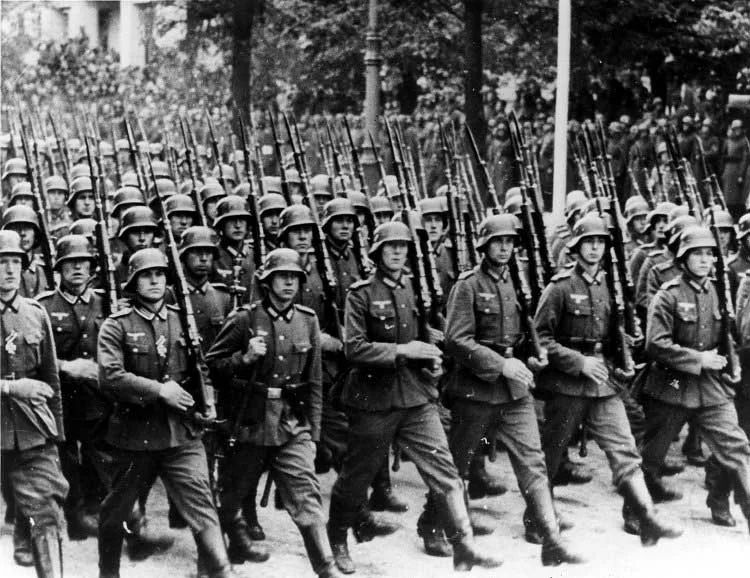
Unternehmen Winterübung, March 7, 1936. Nineteen infantry battalions and several German aircraft crossed the border into the Rhineland. This constituted a direct violation of Articles 42 and 43 of the Treaty of Versailles and Articles 1 and 2 of the Treaty of Locarno. By late morning, the German troops had reached the Rhine, where three battalions crossed to the west bank. At the same time, Neurath summoned the British, French, and Italian ambassadors to Berlin to present them with the note. This note contained the justification for remilitarization, the denunciation of the Treaty of Locarno, and the official announcement that Germany had remilitarized the Rhineland.
Although France immediately mobilized thousands of French soldiers along the German border, no direct conflict ensued. The French never crossed the border, and furthermore, not a single Allied nation was willing to take even the slightest action against this remilitarization. Of course, the Allies condemned Germany’s actions, but took virtually no action. The League of Nations, too, took no significant measures. It was essentially a case of everyone standing by and watching. This gave Hitler just the extra confidence he needed. He felt emboldened and saw the Allies as divided and passive. No one would stand in his way, and his drive for expansion had begun. Shortly thereafter, the Anschluss and the annexation of the Sudetenland followed.
Field Command members: the Author’s Note for this article is available in the Field Command area.
WarCommons publishes long-form, source-driven World War II analysis without ads or sponsored content. If you found this article valuable, consider supporting independent research by joining Field Command.
By Nick Ravenshade — Founder & Editorial Director, WarCommons
Header image: German soldiers marching in the Rhineland region of western Germany, March 7, 1936. Source: ww2db.com. Public domain (This anonymous work originating in the European Union is in the public domain. Its copyright expired 70 years after the work was made available to the public.)