
WARCOMMONS IS NOW ON ANDROID
Explore WWII history and stay connected with the community on the go. GET THE APP →

It may be hard to imagine: an agreement between the United Kingdom (UK) and Nazi Germany. But in 1935, this was a reality for both Germany and the UK. It arose in part from sympathy for Germany, not because of its National Socialist course, but mainly because of the harsh and severe terms of the Treaty of Versailles. It is one of the links in the story of Germany, the Treaty of Versailles, and the way in which German rearmament was built up and also tolerated.
How It Came to Be
The Anglo-German Naval Agreement (AGNA) was signed on June 18, 1935, between the UK and Nazi Germany. It was essentially a relaxation of the terms of the Treaty of Versailles and, at the same time, a gesture of goodwill. The UK, in fact, also wanted to strengthen and improve relations between the two countries. This agreement was included in the League of Nations Treaty Series on July 12, 1935.
Hitler was likely pleased with this, as it provided another cover for the secret rearmament. Yet, from the very beginning, there were differences in the interpretation of this agreement. Nazi Germany, or rather, Hitler’s distorted worldview and foreign policy, viewed this agreement as the beginning of an Anglo-German alliance against the Soviet Union and, of course, France. But the UK interpreted this agreement differently. The UK viewed this agreement as the first of several agreements intended to ensure that Nazi Germany’s rearmament, and thus its drive for expansion, would remain limited.
A striking detail, however, is that France and Italy were completely excluded from the negotiations on this agreement. Neither country was consulted. And that remains strange, especially given how France viewed Germany after World War I. At the time, France was notorious for its anti-German stance. In fact, no relaxation of the measures or rapprochement with Germany was acceptable. It is almost the attitude of a bad winner toward a bad loser. Yet it is understandable; France was also very afraid of a new war on its territory. And the fact that this new agreement represented a relaxation of the restrictions set forth by the Treaty of Versailles was undeniable. A tonnage ratio of 35:100 was agreed upon. For Germany, this meant that the German fleet could never exceed 35% of the total combined tonnage of the British fleet. So for every 100 tons of British ships, Germany was allowed to build 35 tons.
This was a clear breach of the Treaty of Versailles. The Treaty stipulated that the German fleet could consist of no more than 6 battleships, 6 light cruisers, 12 torpedo boats, and 12 destroyers. The construction and possession of submarines were prohibited, as were super-dreadnoughts (heavy battleships). The Treaty also imposed restrictions on displacement. The maximum displacement was 10,000 tons for battleships, 6,000 tons for cruisers, and 800 tons for torpedo boats.
The agreement between Germany and the UK thus eased many of the restrictions on Germany. But the most significant change was that Germany was once again permitted to build submarines. In principle, a new restriction applied: from no submarines to a maximum of 35% of the UK’s submarine fleet. The international community had not yet had much experience with Hitler and his foreign policy. However, after the conclusion of this agreement, it should have been clear to the international community. Hitler’s early foreign policy was clear: if you give him an inch, he takes a mile. He believed that, with regard to submarines, there should be equal parity between the UK and Germany. That is, a ratio of 100:100. If England had 100 tons of submarines, then Germany was also allowed to have 100 tons of submarines. This was not only a relaxation of the Treaty, but at the same time a massive escalation that only reinforced Germany’s naval rearmament. What was still maintained, however, was the 35:100 ratio. So even though Germany was allowed to have the same “number” of submarines as the UK, this was still not permitted to exceed the total tonnage ratio. In hindsight, or rather, what people should have known at the time and not been so naive about, is that it could never, of course, have been called a lasting agreement intended to preserve peace for years to come. It was merely a major opportunity for Germany to rearm even faster and on an even larger scale, only under a new, slightly broader pretext.
In short, Germany could match Britain submarine for submarine, as long as it did not exceed the overall 35% total.
The Significant Prelude to the Anglo-German Naval Agreement
As with many events in the 1920s and 1930s, the Anglo-German Naval Agreement was rooted in a period of instability, crises, and turbulence. Underlying the Anglo-German Naval Agreement were the Washington Naval Conference of 1921–1922 and the London Naval Conference of 1930. As a result of these agreements, the British navy bore the brunt of the consequences. Significant restrictions were imposed on the Royal Navy. The budget cuts resulting from these two conferences, combined with the effects of the Great Depression, led to the complete collapse of a large part of the British shipbuilding industry in the early 1930s.
Throughout the 1930s, this served only to hinder any form of rearmament the UK sought to achieve for its navy. The overture to Germany in 1935 was, as is often the case with nations, primarily in the UK’s own interest. Make no mistake about this. More often than not, self-interest is at play, whether exclusively or not. The British Admiralty had traditionally been proud and powerful. But the budget cuts of the 1920s and 1930s, combined with the Great Depression, forced the UK to adopt a new doctrine or approach regarding its maritime dominance. The British Admiralty saw the best option as concluding treaties containing quantitative and qualitative restrictions on potential enemies. This was the only remaining and best way to ensure that the Royal Navy could maintain its supremacy over the seas, according to the thinking. It is precisely this doctrine, then, that is reflected in the Anglo-German Naval Agreement.
A strong advocate of these types of treaties within the British Admiralty was Admiral Sir Ernle Chatfield. He served as First Sea Lord from 1933 to 1938. These treaties were intended to use a standardized classification of naval vessels. But perhaps even more importantly, technical innovations were to be discouraged. This, too, was in the UK’s own interest, as it could not always keep pace with these new technical innovations under the circumstances prevailing at the time.
The German Kriegsmarine’s Deutschland-class Panzerschiffe were seen as a particular threat. These heavy cruisers were built from 1929 through 1936 and served from 1933 through 1945. The British Admiralty recognized the power of these ships, as they combined the characteristics of both cruisers and battleships. Sir Chatfield held a worldview centered on standardized warships and their designs. He therefore viewed these German Deutschland-class Panzerschiffe as a direct threat to that vision. After all, they represented something that, at the time, fell completely outside the established and accepted designs for warships. He consequently advocated that Germany abolish these warships. The press in the UK also jokingly referred to the Deutschland-class Panzerschiffe as the so-called “pocket battleships.”
What followed was therefore a combination of appeasement policies and the new doctrine. Preparations for the Anglo-German Naval Agreement began subtly, yet clearly. In 1932 and during the first months of 1933, the British Admiralty publicly declared that Germany had “a moral right to some relaxation of the treaty,” referring to the Treaty of Versailles. These were the British Admiralty’s first attempts to ensure that Germany would scrap its Deutschland-class Panzerschiffe.
The prelude to the Anglo-German Naval Agreement can therefore be seen as a combination of primarily the UK’s self-interest, a blend of appeasement and doctrine, and partly out of necessity, as the UK’s own navy had been weakened by budget cuts and crises.
A Decade Filled With Conferences
The 1930s were not only a time of global instability and the rise of National Socialism. It was also a decade filled with conferences, in which Germany often played a central role. It actually spoke volumes about just how unrealistic the Treaty of Versailles really was. For if a treaty requires a conference time and again to make new agreements, how adequate is that treaty really?
That is why another conference was held in February 1932. This time, it was the World Disarmament Conference in Geneva. What is often forgotten is that this took place even before Hitler came to power. Even the more moderate faction within German politics already wanted to be rid of the overly burdensome demands of the Treaty of Versailles. During this conference, Germany demanded what was known as Gleichberechtigung. In other words, Germany demanded equality in armaments, which essentially amounted to a call to abolish Part V of the Treaty. It is, of course, no surprise that France was diametrically opposed to this position, insisting on maintaining Part V of the Treaty to thereby guarantee its own security and continue to restrict Germany’s rearmament.
The UK adopted a neutral stance and attempted to act as a mediator. The UK delegation was primarily seeking compromises between Germany and France. In essence, it turned into a farce. The UK supported Germany’s Gleichberechtigung to the extent that rearmament would be permitted, but not to the extent that it would pose a threat to France. However, every British proposal along these lines was met with disapproval by both Germany and France. Both sides found virtually every British compromise unacceptable.
No agreement was reached at that time, as the German delegation walked out of the conference in September 1932. According to them, it was not possible to achieve Gleichberechtigung. Meanwhile, 1932 was, of course, also the scene of a pivotal moment in German politics. After all, Hitler achieved his first electoral successes in 1932. London was alarmed by this. Everything indicated that the Nazis would come to power if the current government failed to achieve successes in foreign policy. To get the Germans back to the negotiating table before the Nazis took power, the British came up with a plan. The British chose to put pressure on Germany by ensuring that the delegations of all other involved countries agreed to the resolution that would make the “theoretical equality of rights in a system which would provide security for all nations” possible. By December 1932, all countries except Germany had agreed, including France after persistent pressure from the British. It ultimately had the desired effect. Germany subsequently returned to the negotiating table. Even before Hitler came to power, all other countries involved had already accepted that Germany could proceed with its rearmament, beyond the conditions set forth in the Treaty of Versailles. However, the actual extent of German rearmament remained unresolved. Negotiations on that matter continued.
The New German Government
When Hitler came to power as Chancellor in 1933, he automatically gained a strong negotiating position for his country in the Geneva talks. However, a breakthrough still did not materialize. The talks ended in a stalemate. The German delegation withdrew again in October 1933 and issued an ultimatum to the conference. Germany’s final demand was that all countries must comply with the restrictions of the Treaty of Versailles or that Germany be permitted to proceed with rearmament outside the framework of the Treaty.
The stance of the new German delegation was quite clear. In fact, the UK and France were not really taken seriously. Germany had its own plan, and it would be carried out no matter what. Yet it was the British who had blamed the French for Germany’s withdrawal from the conference. It was said to be the French lack of willingness to reach a compromise that had led Germany to walk away from the negotiations. Nevertheless, this did not mark the end of the efforts. The UK continued to try to get Germany to return to the conference. But in essence, the Germans themselves sabotaged these attempts, disguised in the proposals they made for their return. These proposals had to be accepted first, but were of such a nature that France would never agree to them. The drama continued until April 17, 1934, with the Barthou Note. The final German offer to France was rejected by French Foreign Minister Louis Barthou. In his note, he stated that Germany’s latest offer was unacceptable and that the French delegation had withdrawn from the conference. From then on, France would ensure its own security.
But how did the Anglo-German Naval Agreement come about, then?
Renewed Negotiations
Now that France had, in effect, been reduced by Germany to the role of a bystander at the conference and in the negotiations on naval rearmament, Germany put forward a proposal in November 1934 that was directed solely at the UK. The German government officially informed the British that it was prepared to conclude a treaty allowing the German navy to grow to a maximum of 35% of the Royal Navy’s size.
In principle, this percentage was actually one-third the size of the Royal Navy. However, it would not apply to destroyers, cruisers, and submarines. Hitler, however, found this rhetorically awkward. And Erich Raeder, in turn, considered a ratio of 35% to be too low. Hitler, however, went his own way and ignored the opinion of Raeder, who was then the admiral of the Reichsmarine.
On the British side, it was Sir Chatfield who was the main voice advocating the course the British should take. He was well aware of Germany’s desire to expand its navy beyond the restrictions of the Treaty of Versailles and saw a naval treaty with Germany as the only option. In his view, this was the only realistic way to influence, limit, and regulate the future size of the German navy.
The UK was being calculating, with Sir Chatfield as its main voice. The British Admiralty indicated in principle that a tonnage ratio of 35:100 was the highest the UK would accept, regardless of which European power was involved. And according to the British, Germany could not achieve such a ratio relative to the UK until 1942.
And so it was bound to happen eventually. The first meeting was scheduled for March 1935, but it was postponed. Hitler had caught a cold, according to Germany’s official line. However, there was another real reason behind this. The British government had just released a so-called white paper stating that the UK considered a larger defense budget justified because Germany had violated the Treaty of Versailles. Hitler disagreed with this and was reportedly taken aback by the content of the white paper. And so, no official meeting took place between Hitler and Simon. While Hitler was supposedly recovering from his cold, the German government coincidentally made time to formally reject, at that very moment, all clauses of the Treaty of Versailles relating to disarmament on land and in the air. It was a cunning tactic, for it was also an open secret in the 1930s that the British harbored an extreme and perhaps irrational fear that Germany would carry out bombing raids on London that would completely destroy the city. The UK therefore attached great importance to the fact that an air pact would be concluded with Germany in which aerial bombardments would be prohibited.
The Final Moves
Concluding a naval agreement would have been a logical step toward the next agreement, which should have been the air pact. A meeting between Simon, his deputy Anthony Eden, and Hitler took place on March 26, 1935. During one of these discussions, Hitler stated that the disarmament clause regarding the German navy was completely rejected, but that he was willing to agree to a treaty that would regulate the rearmament of the German navy.
What followed was Hitler’s so-called “peace speech” on May 21, 1935. Hitler actually extended an olive branch to the UK. Germany was prepared to formally discuss a treaty in which the German navy would forever maintain a tonnage ratio of 35:100 relative to the UK. Moreover, Hitler also denied that Germany had any intention of becoming embroiled in a naval arms race with the UK. This was precisely the pride the British held, and the British naval status quo would thus remain in place. Hitler stated: “[The German Reich government] willingly recognises the overwhelming vital importance of predominant sea protection for the British Empire, just as we are determined to do everything to protect our own continental existence and freedom.”.
It essentially amounted to a trade-off. The UK would be able to maintain its dominance at sea, while Germany would effectively be granted control over the European continent.
A British response was not long in coming. It also illustrated the way the British still viewed the French. On May 22, 1935, the British government gave a positive response to Hitler’s offer from the previous day. The offer had to be formally accepted as soon as possible. It was Sir Eric Phipps, the British ambassador in Berlin, who further emphasized the necessity. According to Phipps, no opportunity for a naval agreement with Germany should be lost due to “French shortsightedness.” But Sir Chatfield also had his opinion ready: “[unwise to] oppose [Hitler’s] offer, but what the French reaction to it will be is more uncertain, and its impact on our own battleship replacement even more so.”.
It was Joachim von Ribbentrop who, as head of the German delegation, was tasked with negotiating a potential naval treaty with the British. Ribbentrop, then Extraordinary and Plenipotentiary Ambassador, was accompanied by the Minister of Foreign Affairs, Baron Konstantin von Neurath. He was initially opposed to a naval treaty, but later changed his mind. Not because he suddenly believed in the cause, but because he believed that the UK would never accept the 35:100 ratio. The fact that Ribbentrop was the head of the mission, however, was Neurath’s reason for supporting the plan after all, and it also happened to be an excellent opportunity to discredit his rival. Neurath’s direct competitor was Ribbentrop, and a failed negotiation under Ribbentrop’s responsibility was exactly what Neurath had been hoping for.
Ribbentrop arrived in London in early June 1935, and talks began on June 4, 1935. The negotiations took place at the Admiralty offices. Ribbentrop represented the German side, while Simon represented the British side. Ribbentrop was determined not to leave London until a treaty had been agreed upon. The German position was therefore clear from the outset; Ribbentrop opened by stating that the British could accept a tonnage ratio of 35:100 before the weekend and that this was final and non-negotiable. If the British did not agree to this, the German delegation would return immediately to Berlin, and the German navy would continue to expand to its desired size.
A strong opening move, met with an equally strong response. Surprisingly, it was not the German delegation that walked away from the negotiating table, but Simon. He was not pleased with Germany’s forceful opening move in the negotiations. It was Simon who replied: “It is not usual to make such conditions at the beginning of negotiations.”.
A Naval Agreement After All
Despite the fact that it appeared to be yet another failed negotiation, it was now the British who returned to the negotiating table with a new perspective. The British delegation’s change of heart is best summarized in the report it sent to the British government: “[The British Delegation was] definitely of the opinion that, in our own interest, we should accept this offer from Herr Hitler while it is still on the table…. If we now refuse to accept the offer for the purposes of these discussions, Herr Hitler will withdraw the offer and Germany will seek to build to a higher level than 35 percent…. Having regard to past history and to Germany’s known capacity to become a serious naval rival of this country, we may have cause to regret it if we fail to take this chance…”.
This turning point came on June 5, 1935. But that was not the only noteworthy event of that day. Just before the agreement was accepted, an incident occurred that likely provided the final push. Discussions took place between Sir Robert Craigie and Admiral Karlgeorg Schuster. Sir Craigie was a naval expert at the British Foreign Office and also head of the American section of that office. Admiral Schuster was Ribbentrop’s deputy. During this conversation, it was confirmed that Germany would express the tonnage ratio in terms of ship tonnage. And the German government would increase the tonnage to the level of British tonnage within the various categories of naval and warships.
And again on that same day, on the afternoon of June 5, 1935, the British Cabinet agreed to a tonnage ratio of 35:100 between Germany and the UK. On the evening of June 5, 1935, Ribbentrop was informed of the decision taken by the British government. The limit had been set, and so all that remained was to fill in the details within that limit. Technical issues, calculations, and tonnage ratios by category were still being discussed. These technical agreements stipulated, for example, that a ratio of 45% would apply to submarines, which could be raised to 100% under certain circumstances. In 1935, Ribbentrop was eagerly seeking a victory on the world stage. Whereas Germany had initially set forth fundamental demands, Ribbentrop was now primarily in “yes, sir” mode. Virtually all British demands were accepted by Ribbentrop.
It didn’t take long after that. On June 18, 1935, the agreement was signed in London by the new British Foreign Secretary, Sir Samuel Hoare, and Ribbentrop. But it was probably Hitler who was most pleased of all. He called the day of the signing “the happiest day of his life” because he still believed that this was the very beginning of a long-lasting Anglo-German alliance.
A Bittersweet Agreement
It must certainly have been a bittersweet feeling for the Allies. Perhaps not for the UK, since it believed it had secured its own safety. But certainly for France and Italy, for example. These two countries were informed by the UK of the agreements between the UK and Germany. And certainly not about the agreements within the Naval Agreement that, on closer inspection, were indeed secret, such as the provision allowing Germany to build more powerful warships in certain specific categories than any of the other three Western European great powers possessed. The French government was not pleased and accused the UK of betrayal. The British were said to have acted primarily out of self-interest, thereby weakening the peace treaty. It would also only play into the hands of Germany’s growing military power.
To make matters worse for France, the naval agreement was signed on the very day marking the 120th anniversary of the Battle of Waterloo, the very battle in which British and Prussian forces defeated Napoleon’s French army. It’s not hard to guess who chose the date.
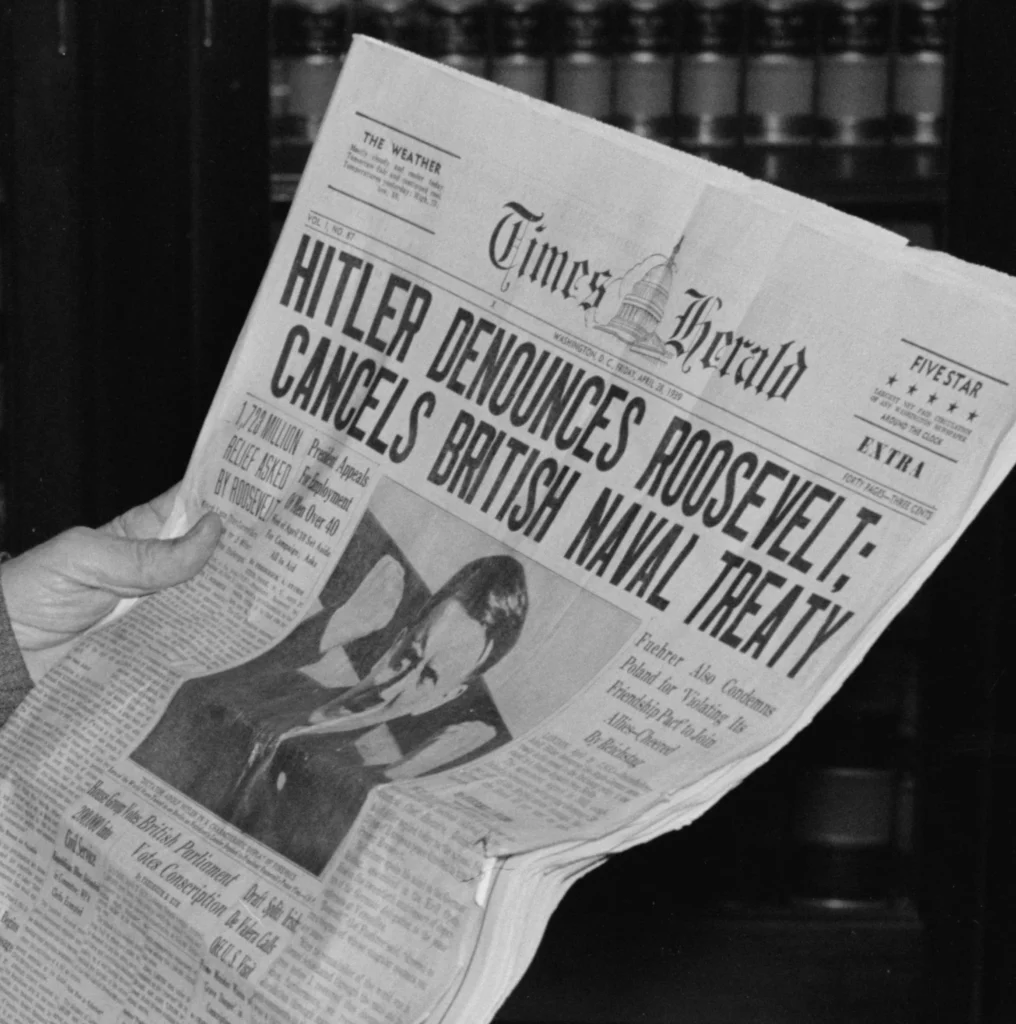
But it was not only bittersweet for the Allies who were not involved in the negotiations and the conclusion of the agreement. For Germany, too, domestic factors, such as design problems, a lack of shipbuilding capacity, and a shortage of workers, meant that it would not reach the agreed tonnage ratio until 1942. But even before Germany came anywhere near the ratio, it had already renounced the treaty. While Chamberlain was still preaching “peace for our time” on September 30, 1938, it was Hitler who, on April 28, 1939, had already unilaterally renounced the Anglo-German Naval Agreement. In a speech to the German Reichstag, the Anglo-German Naval Agreement was terminated on the grounds that the British guarantee of Polish autonomy was part of a so-called “policy of encirclement” directed against Germany.
Before a single provision of the Anglo-German Naval Agreement could be enforced against Germany, the agreement had already been terminated.
Field Command members: the Author’s Note for this article is available in the Field Command area.
WarCommons publishes long-form, source-driven World War II analysis without ads or sponsored content. If you found this article valuable, consider supporting independent research by joining Field Command.
By Nick Ravenshade — Founder & Editorial Director, WarCommons
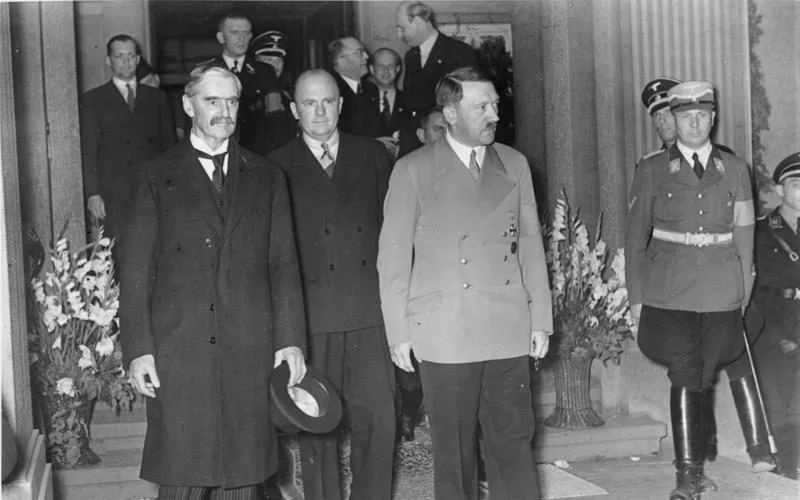
Header image: British Prime Minister Neville Chamberlain (left) and German Chancellor Adolf Hitler, leave their meeting for the Munich Agreement at Bad Godesberg. 23 September 1938. Source: Wikimedia Commons / Bundesarchiv, Bild 183-H12751. CC-BY-SA 3.0.



.jpg)
