WARCOMMONS IS NOW ON ANDROID
Explore WWII history and stay connected with the community on the go. GET THE APP →
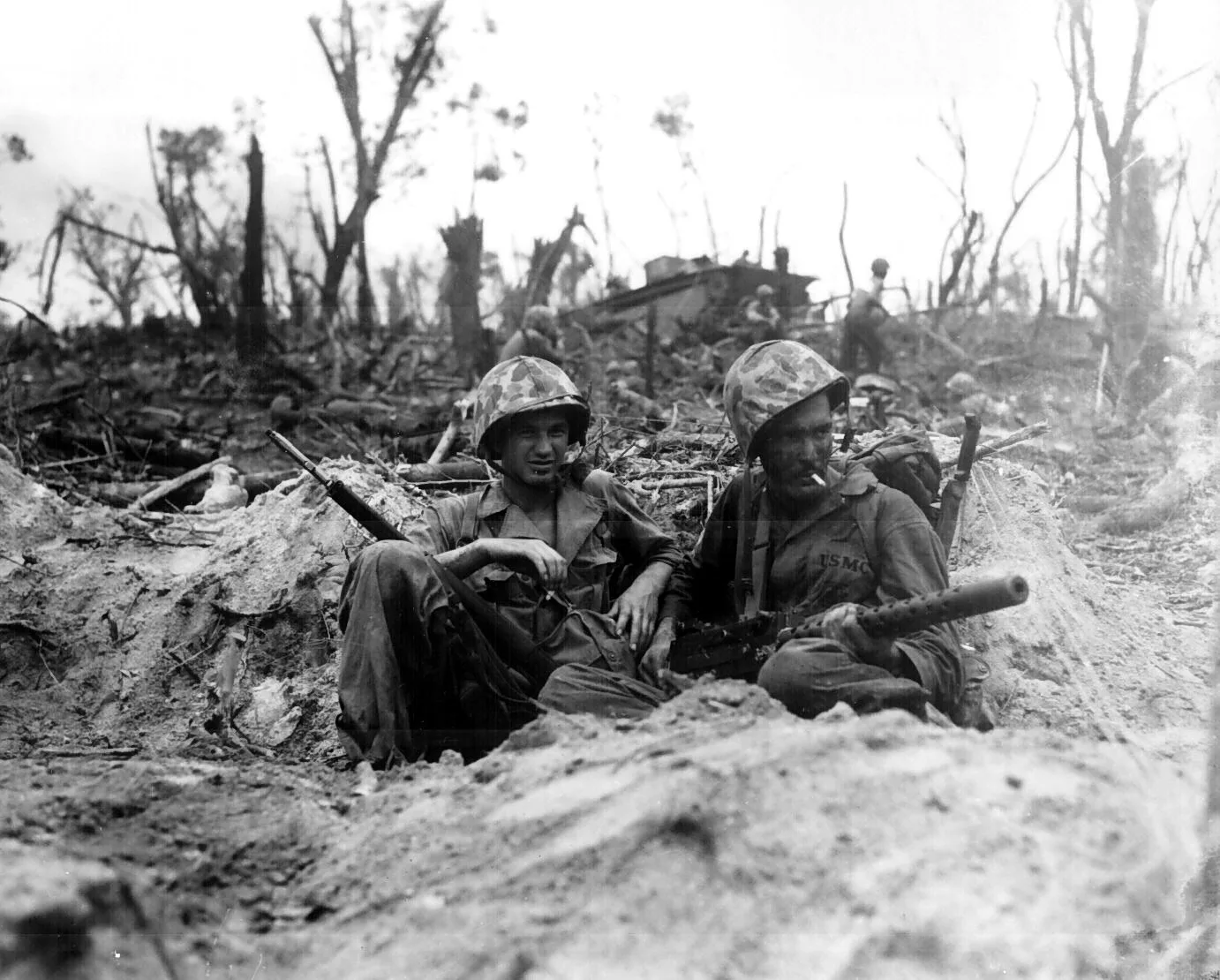

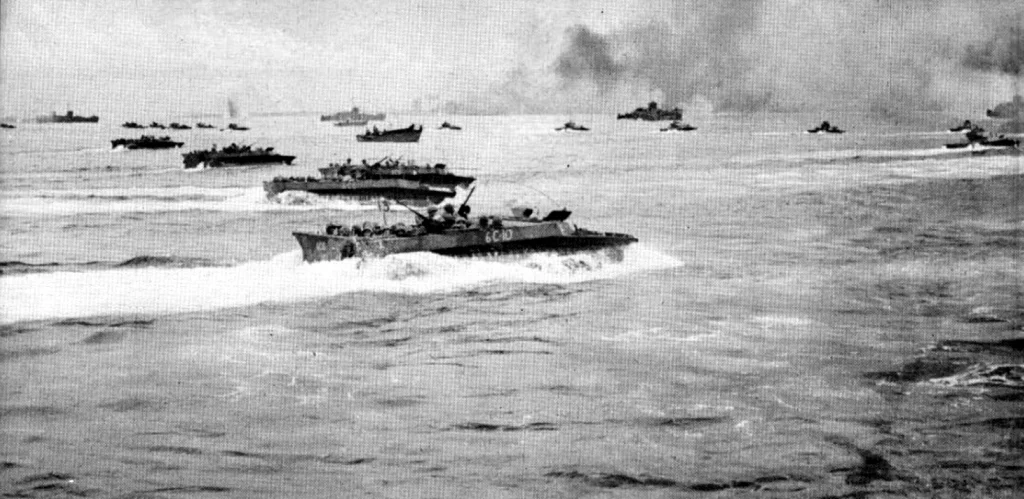
September 15, 1944. The first wave of U.S. Marines landed in their LVTs, the Landing Vehicle, Tracked. Their final destination was the island of Peleliu. A large portion of the Marines would never leave the island alive. It was all part of the larger operation known as Operation Forager. This is the story of what may have been a needless operation.
The Battle of Peleliu
The Battle of Peleliu, also known by its code name Operation Stalemate II, began on September 15, 1944, and officially ended on November 27, 1944. By design, it was intended to be a short operation, though several underlying factors proved otherwise. This battle was fought between the United States (U.S.) and the Japanese Empire on the island of Peleliu. It was the U.S. Marines of the 1st Marine Division who had the dubious honor of landing on the beach at Peleliu in LVTs. They were followed by American soldiers from the 81st Infantry Division. They fought for an airfield located on the island. But according to Major General William Rupertus, the commander of the 1st Marine Division, he was certain of the outcome. The island would be secured by the U.S. Marines within four days. What the general hadn’t counted on was that his enemy was also evolving.
By the time the Battle of Peleliu took place, the Japanese Empire had already suffered several defeats in battles over the smaller islands in the Pacific Ocean. As a result, the Japanese Empire had developed a new tactic for defending its islands. But that wasn’t all; they had also implemented new defensive works and fortifications on the islands they still held. Thanks to these new developments, Japan was able to prolong the defensive battle by more than two months, as they could now offer much stiffer resistance against the attackers. The only disadvantage Japan still faced, technically speaking, was that they were still outnumbered by the Americans leading the offensive. But the Japanese resistance was immense and fueled by their fighting spirit, fighting to the death in the name of the Japanese Emperor. The island of Peleliu thus earned a fitting nickname: Emperor’s Island.
However, it is also a fact that this battle was highly controversial in the U.S. The island had negligible strategic value for the Americans. They could have achieved their objectives just fine without it. In fact, it was a battle that the National Museum of the Marine Corps dubbed “the bitterest battle of the war for the Marines.”
But how did it come to this?
Why Peleliu Was Deemed Important
By 1944, the Americans had already achieved many victories in the Pacific. The Americans liberated the southwestern and central parts of the Pacific with great determination. They ensured that the war was brought ever closer to the Japanese mainland. Japan’s occupation of the many islands in the Pacific was slowly but surely undone by the Americans. Perhaps of the greatest importance to the Americans was taking control of the airfields on each island. This brought American bombers and aircraft ever closer to the Japanese mainland and the main Japanese islands.
As with any reasonably large-scale military operation, there was bound to be disagreement among the top commanders. This was often the case during World War II. But in this specific instance, it involved two very well-known generals who could not agree on the overarching strategy for defeating the Japanese Empire. General Douglas MacArthur favored a strategy of recapturing the Philippines, followed by the island of Okinawa, and then the main Japanese islands. After all, General MacArthur had made a promise in the Philippines, with three simple words: “I shall return,” which he had uttered in March 1942. At that time, he had to flee from the advancing Japanese troops.
But Admiral Chester W. Nimitz had made no promises and was not forced to flee the Philippines in 1942. His strategy was based primarily on a direct approach. He wanted to bypass the Philippines and capture the islands of Okinawa and Taiwan directly. These two locations were to serve as staging grounds for an attack on the Japanese mainland. The invasion would then take place from the southernmost part of the main Japanese islands.
What had been decided, in any case, was that the U.S. 1st Marine Division had already been selected to carry out the attacks. It was up to U.S. President Franklin D. Roosevelt to decide on the strategy to be followed. He traveled to Pearl Harbor, the place where World War II began for the Americans. He went there to meet with Admiral Nimitz and General MacArthur. It was up to the admiral and the general to make their case. When all was said and done, President Roosevelt decided to follow General MacArthur’s strategy. But before General MacArthur could capture the Philippines, the Palau Islands had to be secured, or so the thinking went. Primarily the islands of Peleliu and Angaur had to be secured so that airfields could be built there. From these airfields, the southern flank of the planned landings in the Philippines could be protected.
Prelude to the Attack on Peleliu
Intensive preparations were made before the attack could be carried out. But it wasn’t just the Americans who were preparing. The Japanese were ready as well.
In 1944, the island of Peleliu was occupied by approximately 5,500 Japanese troops. These were primarily troops from the 14th Infantry Division, also known as the Dai-jūyon Shidan. This division was codenamed the Shining Division (Teru Heidan). It was regarded as an elite unit. In a military context, this meant that the division was an elite, highly trained, and deeply experienced group of troops, a division of unparalleled discipline and morale, or the best of the best. After the Marshall Islands fell earlier in 1944, this division was detached from the Kwantung Army, which was stationed in Manchuria. The Shining Division was tasked with garrisoning the island of Peleliu. It was Colonel Kunio Nakagawa, the commander of the division’s 2nd Regiment, who was responsible for making preparations for the island’s defense. The division arrived on the island of Peleliu in May 1944. In addition to the primary force of 5,500 Japanese troops, there were also approximately 4,000 Japanese naval troops present. 1,500 of these men were part of the 45th Base Guard Force, also known as the 45th Naval Guard Unit (Dai-45 Keibitai). These troops were trained to serve as infantrymen. The remaining 2,500 troops consisted mainly of maintenance personnel, aircraft crews, and other support personnel. They were supplemented by a large group of construction workers of Japanese and Korean descent.
New Japanese Defence Strategy
But as mentioned, the force was not very large. Perhaps sufficient for a single island, but numerically no match for the American offensive force. The Japanese troops therefore had to rely primarily on their newly developed strategy.
After the Japanese Empire suffered losses in the Solomon, Gilbert, Marshall, and Mariana Islands, the Imperial Japanese Army (Dai-Nippon Teikoku Rikugun) established a research team. Together, they were tasked with developing a new island defense strategy. Previously, Japanese defensive works on the islands had fiercely contested enemy landings on the beaches themselves. This allowed the Americans to continue effectively bombarding the Japanese defensive works.
The new strategy would shift the battlefield from the beach to further inland. They had finally realized that the beaches were difficult to defend. So now the focus shifted to what was truly defensible on the island: the island’s interior. Peleliu, in particular, was known for its steep and winding ridges. This was actually ideal for a depth defense on the island. Colonel Nakagawa recognized this as well and ordered heavily fortified bunkers, caves, and underground positions to be connected. In essence, he created a honeycomb system. But that wasn’t all. Japan was known for its banzai attacks. But Colonel Nakagawa wanted to put a stop to this; it was merely a waste of manpower and had also proven ineffective. The new strategy that Colonel Nakagawa would implement was primarily aimed at forcing the Americans into a war of attrition. The Americans would then be forced to devote more troops, time, and supplies to securing the islands.
The honeycomb system essentially consisted of connecting caves and bunkers through vast tunnel and trench networks. These ran through the center of Peleliu. This allowed Japanese troops to evacuate and reoccupy positions. The mines and caves were also incorporated into this system of defensive positions. Armored steel sliding doors and multiple openings were installed. It provided excellent protection against artillery and machine guns. The cave entrances were also modified to be angled. This helped against shelling and flamethrower attacks.
But a new strategy and a solid defensive network were useless without adequate firepower. The Japanese troops on Peleliu were also well-armed with 81 mm (3.19-inch) and 150 mm (5.9-inch) mortars. In addition, they had 20 mm (0.79-inch) anti-aircraft guns. The infantry on the island was supported by a light tank unit and an anti-aircraft detachment. What worked particularly to the Japanese advantage was the beach terrain. The northern end of the invasion beaches lay directly opposite a 9.1-meter-high coral ridge. From there, the Japanese troops overlooked the beaches from a small peninsula. The Marines therefore called this spot “The Point.” The Point was used by Japanese troops to position a 47 mm (1.85-inch) gun and six 20 mm guns in the caves of The Point. These caves were then sealed off until only a small slit remained. From here, the Japanese troops could fire on the beach without themselves being fatally hit. Similar positions were also built on the western shore of the island.
The beaches themselves were also made difficult to navigate by the use of obstacles for landing craft, such as mines and heavy artillery shells. These would explode as soon as a landing craft drove over them. Colonel Nakagawa also deployed a battalion along the landing beach. Not to try to repel the American attack there, but to slow down the American advance inland. In fact, the entire Japanese military leadership, including the colonel, knew that Peleliu would not hold out for the Japanese Empire. Essentially, the sole objective was to delay the American forces, not to defeat them. Consequently, there were absolutely no plans for any evacuations on the Japanese side. It would be a fight to the death for every Japanese soldier.
American Offensive Strategy
While the Japanese army demonstrated innovation, the Americans stuck to their own tried-and-true strategy. However, this strategy had often proven to result in heavy casualties. One example is the Battle of Biak. Although the Americans had won there, they had suffered no fewer than 3,000 casualties during that landing. There, they had to counter Japanese delaying tactics and fight against well-hidden and entrenched Japanese troops. Even after all this, the Americans would employ exactly the same strategy again.
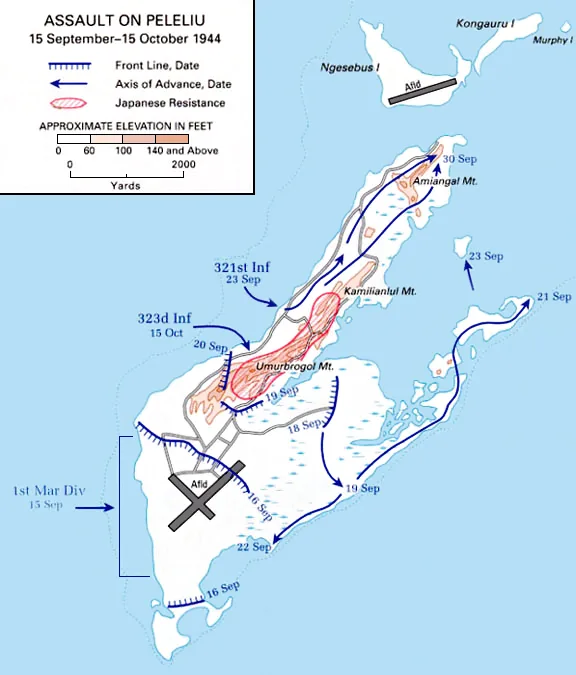
The American landings were to take place on the southwestern beaches of Peleliu, as this was close to the island’s airfield. The 1st Marine Regiment, led by Colonel Lewis B. “Chesty” Puller, was to land on the northern beach. The southern sector was assigned to Colonel Herman Henry Hanneken and his 7th Marine Regiment. The center of the island was for Colonel Harold “Bucky” Harris and the 5th Marine Regiment.
Colonel William Hartwell Harrison also played a role in this battle. He commanded the division’s artillery regiment. This regiment was to land on the beach only after the infantry regiments. The 1st Marine Regiment and the 7th Marine Regiment were first to move inland to secure the flanks of the 5th Marine Regiment. With this support, the 5th Marine Regiment would be able to advance to the island’s east coast, thereby splitting the island into two sectors. The 1st Marine Regiment would then be able to move north toward Umurbrogol. The 7th Marine Regiment would then only need to secure the southern part of the island. The Americans kept only one battalion in reserve. And the U.S. Army’s 81st Infantry Division stood ready to provide support for the offensive from Angaur, which lay south of the island of Peleliu.
The Attacks
September 4, 1944. The Marines departed from their base on Pavuvu, north of Guadalcanal. This was only the beginning of a 3,380-kilometer journey across the Pacific Ocean. A Navy Underwater Demolition Team had already cleared the landing beaches of Peleliu of a number of obstacles. This was done as the warships began the pre-invasion bombardment of Peleliu on September 12, 1944. This, too, was part of the American offensive strategy. An area of 16 square kilometers of beach was bombarded by the Americans for three days. The only break taken was to allow for air strikes by the three aircraft carriers, five light aircraft carriers, and escort carriers. The bombardments were carried out under the command of the command ship Mount McKinley, by the battleships Pennsylvania, Maryland, Mississippi, Tennessee, and Idaho; the heavy cruisers Indianapolis, Louisville, Minneapolis, and Portland; and the light cruisers Cleveland, Denver, and Honolulu.
The island of Peleliu endured three days of intense bombardment. A total of 519 salvos of 410 mm (16-inch) shells were fired, along with 1,845 salvos of 360 mm (14-inch) shells and 1,793 230 kg (500 lb) bombs. One might say that nothing and no one could survive such heavy bombardment. The Americans were therefore satisfied, and these bombardments were deemed a success. Admiral Jesse Oldendorf believed that after these bombardments, the Navy had no further targets. After all, everything had already been targeted and destroyed. How could it be otherwise with such an enormous number of salvos fired? But was that really the case?
What the Americans didn’t know at the time, but would soon find out, was that most of the Japanese soldiers had simply survived all those volleys. And the battalion on the beach that was supposed to defend it? It, too, remained virtually unscathed, even though such firepower should certainly have decimated them. The Japanese troops simply let it wash over them and were primarily focused on maintaining an extraordinary and highly unusual level of firing discipline. As a result, they did not give away their positions. However, the Japanese troops did lose their ability to call in air support. The bombings had destroyed the Japanese aircraft and the buildings on and around the airfield.
But after the bombings, the Japanese troops remained calmly on the lookout and, in the meantime, reinforced their defensive positions, waiting for the American beach landing to begin.
The Peleliu Beach Landings
September 15, 1944, 8:32 a.m. The American beach landing on the island of Peleliu began. As planned, the 1st Marine Regiment landed in the north of the island, on sectors White Beach 1 and 2. The 5th Marine Regiment and the 7th Marine Regiment landed in the center and south of the island, on sectors Orange Beach 1, 2, and 3. Additional landing craft approached the beaches, but this caused problems almost immediately. The Marines who had already come ashore found themselves caught in crossfire, with the enemy in front of them and their brothers in arms behind them. The Japanese troops opened their steel doors and fired on the American troops with their artillery. The positions the Japanese troops had established on the coral headlands guarding each flank opened fire on the American marines. The Americans came under fire from 47 mm and 20 mm cannons. It was nothing short of a massacre. By 9:30 a.m., just under an hour after the first American troops landed, the Japanese troops had already destroyed 60 LVTs and Ducks (DUKWs).
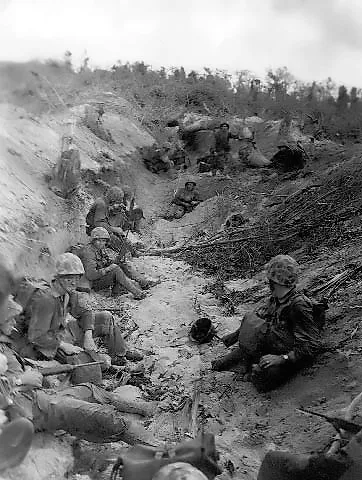
The marines also came under fire from The Point. This fire was directed primarily at the 1st Marine Regiment, which soon became bogged down due to the heavy fire they had to endure from the 9-meter-high coral cliffs on their left flank.
Colonel Puller’s LVT was also hit at this point by a high-velocity artillery round dud. But his communications section fared worse; it was completely destroyed on the beach by a direct hit from a 47 mm shell.
Things did not go much better in the sector known as Orange Beach 3. The 7th Marine Regiment encountered obstacles. These were natural obstacles in the terrain, but also man-made obstacles that the Japanese had placed on the beaches. As a result, the marines in this sector were forced to regroup and advance in a column alongside their LVTs.
The 1st Marine Regiment suffered heavy losses in the White Beach 1 sector. The line the Marines had established had been breached at several points. These marines faced the threat of total annihilation in the event of a counterattack. But that Japanese counterattack never came. After all, the new Japanese strategy was to lure the marines further inland, rather than launch counterattacks and banzai charges. The sole purpose of the Japanese troops on and around the beaches was to delay the American offensive. The commander of the 3/7, in other words the 3rd Battalion, 7th Marine Regiment, was Major Edward Hunter Hurst. He later recounted: “The enemy was groggy, disorganized, and devoid of communications, although bitterly defending every step of the way. At no time did we feel him capable of organizing a successful counterattack.”
Despite all the setbacks and the new Japanese strategy, the American marines managed to capture the bridgehead. They advanced side by side. However, the fierce resistance had resulted in very slow progress compared to the original four-day timeline.
Losses were particularly heavy in the White Beach 1 sector. One of the U.S. Marine tank crews described the scene: “When the tide went out that night, you could have walked 300 yards across the beach on the bodies of dead Marines.” At the same time, most of the Japanese troops still on the beachhead retreated northward, toward the ridges in the center of the island. The Japanese troops who did remain often formed isolated groups that continued to fight the Marines behind the lines.
Japanese Attacks
Most of the progress on the first day was made by the 5th Marine Regiment. They were able to advance under the cover of the coconut plantations. The Japanese launched their first counterattack as the Marines approached the airfield. Colonel Nakagawa’s first counterattack consisted of 11 to 17 light tanks, and Japanese troops advanced across the airfield with the aim of pushing the Marines back. The Japanese light tanks raced across the airfield’s runways, sometimes with infantry still on board. They opened fire on the Marines, but the Americans effectively countered the Japanese counterattack with tank fire, airstrikes, and heavy machine guns. Ultimately, the American Marines succeeded in repelling the counterattack. The Japanese troops had, however, come close. Some Japanese tanks had, in fact, already reached the Marines’ lines.
In their counterattack strategy, Japanese commanders often made the same mistakes. Specifically, the counterattack was launched inland. This occurred at a time when the Americans had already landed the bulk of their tanks and other heavy equipment on the island. By the time the Japanese troops decided to launch the counterattack, it was actually already too late. After the first counterattack was repelled by the Marines, the Japanese troops carried out a number of small-scale counterattacks in the hours that followed. At that point, however, they were supported by only two light tanks in each counterattack.
Be that as it may, the state of the battle on the first day spoke for itself. By the end of the first day, the Marines had captured only a 3.2-kilometer stretch of territory. This was a long strip of beach, which was essentially limited to the landing beaches. Nothing else.
The largest Marine assault took place on the southern side of the island. There, they had advanced 1.6 km inland. But on the northern side, where the 1st Marine Regiment was stationed, little progress had been made. What was achieved, however, was a massive number of American casualties. On the first day of the battle, there were approximately 200 killed and 900 wounded on the American side. But Major General William Rupertus was still unaware of the new Japanese strategy after the first day. He waited, expecting the Japanese defense to collapse quickly once the American marines had broken through their perimeter.
The cunning of the Japanese troops knew no bounds. As night fell on the first day, the Japanese troops began infiltrating American lines. Some Japanese troops had taken the helmets of dead Americans to disguise themselves. They got very close. Three infiltrators even managed to penetrate all the way to an American command post, which was located even behind the Marines’ lines.
The Battle For the Airfield
September 16, 1944. The 5th Marine Regiment succeeded in capturing the Peleliu airfield and advancing to the eastern side of the island. However, the entire regiment had to cross the airfield. They all did so at the same time. This meant they had to move through heavy artillery fire, which is why they suffered heavy casualties. But once the Marines had succeeded in their mission to secure the eastern side of the island as well, it resulted in the Japanese troops in the south becoming isolated. The Japanese 2nd Battalion, 15th Infantry was positioned there. The 7th Marine Regiment was tasked with securing this isolated sector and destroying the remaining Japanese troops there.
However, the Japanese troops did not simply give up the south. They still had many bunkers and defensive positions there. But at that point, the Japanese were not the only ones the Marines had to fight against. The heat index on the island at that time was around 46 degrees Celsius, or 115 degrees Fahrenheit. It was also an exhausting battle in which many Marines died from heat exhaustion. But that wasn’t the only problem. The Marines’ drinking water was distributed in empty oil drums. As a result, the water became contaminated with oil residue and was essentially no longer usable.
Despite these setbacks, the 5th Marine Regiment and the 7th Marine Regiment managed to achieve their objectives. The airfield and the southern side of the island were captured by the Americans. Yet the airfield remained the focal point of the battle, as the Japanese continued to shell it until the bitter end.
Starting on September 17, 1944, the Americans began using the Peleliu airfield for their missions.
After the airfield had been captured, the 5th Marine Regiment had to press on toward the northern part of Peleliu. To the north lay another island, Ngesebus, where Japanese artillery was positioned and an airfield was under construction. Although Ngesebus was connected to Peleliu by a narrow causeway, Colonel Harris opted for an amphibious landing on that island. On September 28, 1944, the island was bombed, with a different outcome than the bombings on Peleliu. Most of the defenders had now been eliminated, although the Japanese still offered resistance from the ridges and caves. But the losses for the 5th Marine Regiment remained fairly limited. There were approximately 15 killed and 33 wounded on the American side, while the Japanese suffered about 470 casualties.
The Battle For The Point
The Point remained a Japanese stronghold that continued to inflict heavy casualties on the Marines at the northern end of the landing beaches. Colonel Puller ordered Captain George P. Hunt to capture the positions at The Point with the 3rd Battalion, 1st Marine Regiment. The problem, however, was that Hunt was short on supplies and equipment. They had also lost most of their machine guns during the approach to the position. To make matters worse, Hunt’s second platoon was also stuck in an antitank trench between the fortifications. When the Japanese then broke through Hunt’s line, his unit was completely surrounded and its right flank cut off.
A rifle platoon was tasked with taking out the Japanese artillery positions one by one. With the help of smoke grenades, the platoon advanced through all the positions and destroyed them at close range through close-quarters combat and rifle grenades. Six machine gun positions were neutralized. But there was still a cave containing a 47 mm cannon. A lieutenant threw a smoke grenade inside to blind the Japanese troops in that cave. Corporal Henry W. Hahn then threw a grenade through the cave’s opening, causing the 47 mm shells to detonate. The Japanese ran out of the cave, some of them literally on fire, causing the ammunition belts around their waists to explode. A Marine fire team was also waiting for them, so most of the Japanese who fled the cave were shot.
But the Japanese did not give up without a fight, despite all this. Colonel Nakagawa launched a counterattack anyway. What followed was a 30-hour firefight, during which Japanese troops launched four counterattacks against a single U.S. Marine company. Due to a lack of supplies and water and the American troops being virtually completely surrounded, the firefight devolved into hand-to-hand combat to repel the Japanese attacks. By the time the Americans finally arrived with reinforcements for this company, the battle was all but over. Although the Japanese attacks had been successfully repelled, all that remained of the company were 18 men. There had been 157 casualties on the American side within this company during the battle for The Point. Hunt and Hahn were ultimately awarded the Navy Cross for their actions during the battle for The Point.
But this was not the last battle.
Bloody Nose Ridge
After the 1st Marine Regiment had secured The Point, Bloody Nose Ridge remained. The Marines had given this nickname to the Umurbrogol pocket. Colonel Puller led his men in several attacks on this position. But each attack resulted in heavy losses for the Marines due to Japanese barrage fire. The 1st Marine Regiment was forced to maneuver through narrow paths and ridges, while relying entirely on direct and indirect fire support.
The Japanese continued to demonstrate excellent fire discipline. They fired on the Americans only when they believed they could inflict maximum casualties. Japanese snipers also targeted the stretcher bearers, and at night they continued their strategy of infiltrating the enemy and getting behind the lines.
Perhaps the bloodiest battle, or at least one of the fiercest, took place on Hill 100, on Bloody Nose Ridge. Major Raymond Davis commanded this assault. Six days of fighting resulted in 71% casualties. Captain Everett P. Pope and his company did manage to push deeper into the ridges. What remained were 90 men, whom he led to Hill 100. After a day of fighting, he reached the top of the hill, or so he thought. However, what he and his remaining men found themselves in was another ridge, occupied by many more Japanese troops. Captain Pope was trapped and came under relentless attack from the Japanese troops all night long. They ran out of ammunition, and the Marines had to fight the Japanese troops with their fists and knives. Miraculously, Captain Pope managed to hold his ground with his remaining comrades. But the Japanese attacks grew increasingly fierce, and Pope had to abandon the position with his men. They were down to just nine men.
Captain Pope later received the highest American honor for a soldier, the Medal of Honor.
The End of the Battle of Peleliu
Despite heavy losses on both sides, it was November 24, 1944. Colonel Nakagawa sent his final message to his superiors. The message reportedly read: “Our sword is broken and we have run out of spears.” He had 56 men left, whom he divided into 17 groups. These last men were ordered to attack the enemy everywhere. He burned his regimental flag and committed seppuku, ritual suicide, together with Major General Murai. Colonel Nakagawa was posthumously promoted to the rank of lieutenant general, which he had earned for his coordinated defensive campaign on Peleliu.
The Americans declared the island secure on November 27, 1944. The battle ultimately lasted 73 days and was exceptionally bloody.
The battle was also highly controversial on the American home front. Many believed that too many American lives had been lost for an island that had little strategic value. In fact, the Japanese forces did not even have sufficient resources to thwart any American operations in the Philippines, so protecting an American flank from Peleliu was therefore unnecessary. Furthermore, the Peleliu airfield was never used for any significant military operations after it was captured. For the invasion of Okinawa, the Ulithi Atoll in the Caroline Islands was used as a base of operations. The final number of casualties recorded on the American side during the Battle of Peleliu was higher than in any other amphibious operation during the Pacific War. The U.S. casualties on Peleliu numbered 1,544 killed in action and 6,843 wounded. The 1st Marine Regiment suffered a staggering 70% of casualties, that amounted to 1,749 men in just six days of fighting.
But the fact that the war was all but over, and had effectively ended in 1945, had still gone unnoticed by a number of Japanese soldiers. A Japanese lieutenant was still holding out, along with 26 soldiers from the 2nd Infantry Regiment and 8 sailors from the 45th Guard Force. In the caves of Peleliu, they continued to fight for the Japanese Empire. All the way until April 22, 1947, when a former Japanese admiral finally managed to convince them that the war had long since ended.
Field Command members: the Author’s Note for this article is available in the Field Command area.
WarCommons publishes long-form, source-driven World War II analysis without ads or sponsored content. If you found this article valuable, consider supporting independent research by joining Field Command.
By Nick Ravenshade — Founder & Editorial Director, WarCommons
Header image: Marine Pfc. Douglas Lightheart (right) cradles his 30-cal. machine gun in his lap, while he and his buddy Pfc. Gerald Thursby Sr. take time out for a cigarette, while mopping up the enemy on Peleliu Island. September 14, 1944. Source: Wikimedia Commons. Public domain.