WARCOMMONS IS NOW ON ANDROID
Explore WWII history and stay connected with the community on the go. GET THE APP →
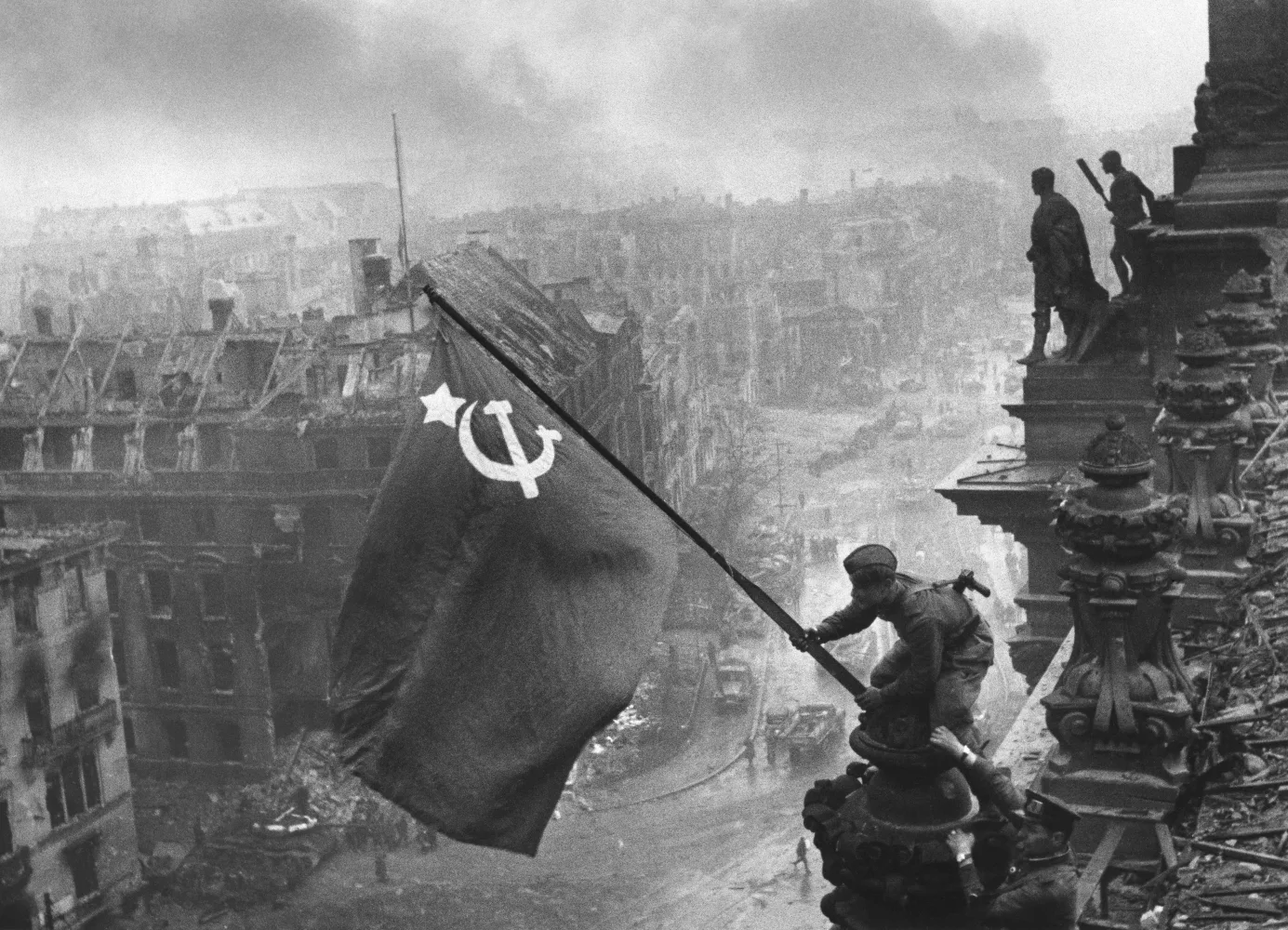

The Red Army raised their flag. But the story of how they got there was invented the same night.
On April 30, 1945, the Nazi flag was no longer flying over the Reichstag. No, it was now the Soviet flag’s turn: the hammer and sickle in red, surrounded by the distinctive red star. However, it was not until May 2, 1945, that the Reichstag was fully captured and secured by the Red Army. It is often claimed that this happened after they had finally overcome the fighting room by room. It evokes a sense of Stalingrad, where at times both the Red Army and German troops were present in the same building, each trying to capture it. But was this actually the reality at the Reichstag? Were there really room-by-room battles inside the Reichstag?
The Narrative That Dominated
The critically acclaimed historian Anthony Beevor described the battles for the Reichstag in his book Berlin: The Downfall 1945. It immerses you in an atmosphere of despair and futility, the final days of Nazi Germany. Anthony Beevor wrote: “More self-propelled guns and tanks were also brought across the Moltke Bridge during the course of the morning to support the attack. Some ninety guns, including 152mm and 203mm howitzers, as well as Katyusha rocket launchers, fired continuously at the Reichstag.”
In fact, by the evening of April 30, 1945, the Reichstag had been almost completely destroyed. Anthony Beevor also described how the Red Army infantry attacks made their way toward the Reichstag: “They finally managed to break into the main hall, but German defenders threw hand grenades or fired panzerfaust rounds at them from the balconies above. One of the attackers, Senior Lieutenant Belyaev, vividly remembered the blood splattering on the huge pillars.”
A narrative of courage, love of country, and heroism. In other words, for Mother Russia! I may be saying this somewhat tongue-in-cheek, but not without reason. After all, what was widely published in books and articles was, in fact, exactly this. It painted a picture of courageous Red Army soldiers who took the Reichstag room by room and secured it. A scene that would have been every bit as intense as the close-quarters combat at Stalingrad. However, these books and articles had one thing in common, including Anthony Beevor’s book, they were all based exclusively on accounts from Russian sources. Not from the Americans or the British, and certainly not from the Germans.
There is no doubt that the soldiers were brave, and that can be said of all parties involved, as a factual statement and without judgment. But does that automatically mean the entire narrative from a single party must be accepted as fact?
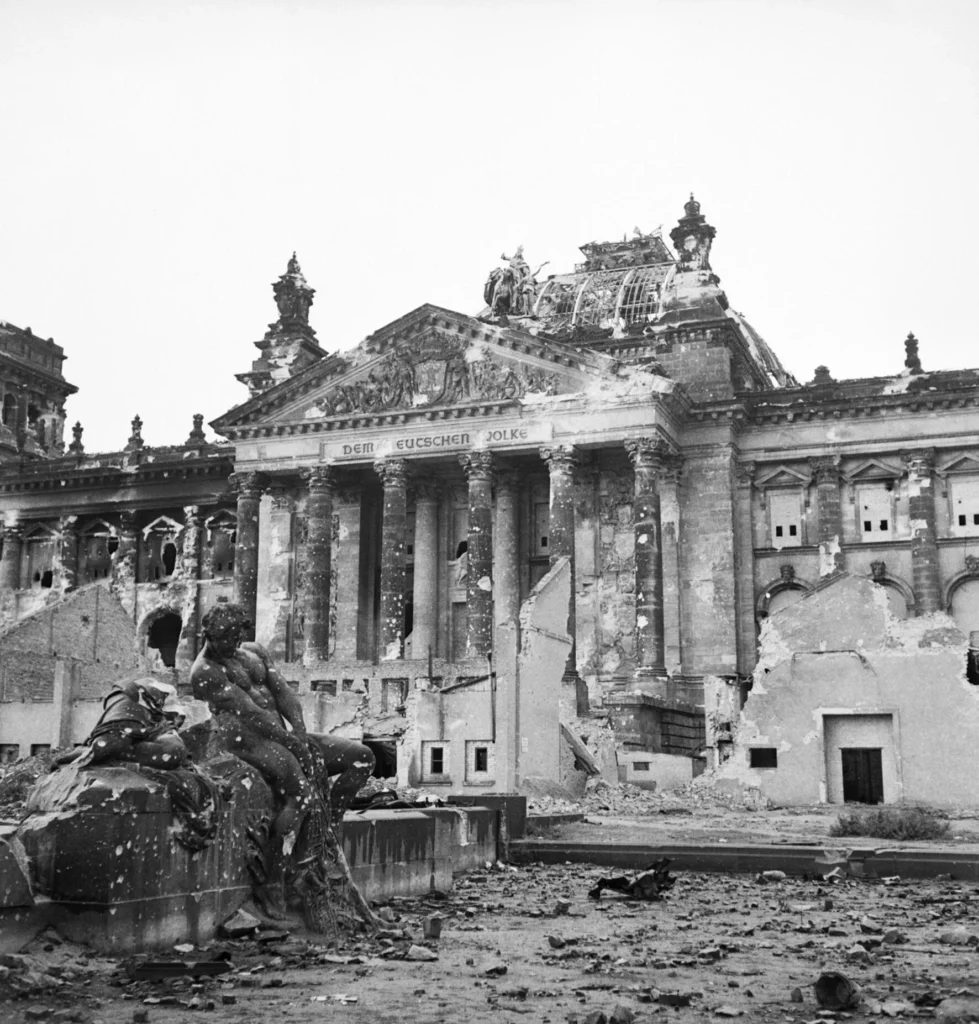
The Forgotten Voices
It goes without saying, of course, that, especially in the immediate aftermath of World War II, journalists and writers were lining up to hear from the victors. Those were simply the stories people wanted to read. And that remains true to a certain extent even to this day. It wasn’t until much later after the war that people became more interested in how the Germans had actually experienced the war. It was no longer the case that only the Allies could interpret the narrative of the war, and perhaps even skew it toward their own version of the truth. That’s not to say there were lies. But every now and then, the Allies did bend the truth to their advantage. And perhaps that is also evident in the narrative surrounding the Stalingrad-like battles inside the Reichstag.
Despite this fact, it is still remarkable that a different perspective on the events did not emerge until 2010. That year, an interview was published by Historia in which Ernst Bittcher was given the opportunity to tell his story. He was a Flak assistant in Berlin during the final days of Nazi Germany. In 1945, he was 16 years old when he stood in front of the Reichstag. Around noon on April 30, 1945, Bittcher experienced heavy shelling that lasted for about an hour. After that, it fell silent.
The Reichstag officially fell two days later. Bittcher said, “It was so quiet you could hear the birds singing.” He suspected that after the war, writers simply copied each other, drawing from a single account provided by the Red Army. The stories were accepted at face value, and the bias was clear. According to the newspapers and the Red Army, it was nothing but fighting, screaming, and bloodshed. Bittcher also expressed this in the interview, while shrugging his shoulders.
Stalingrad II or an Easy Defeat?
But what is the truth, anyway? He said, they said. Competing accounts with no neutral arbiter. Weigh it all against each other, and you’re left with different perspectives that are practically useless. After all, why should you assume that what he said is true, if the truth is what she said? That’s why we need to look at what was said and what the facts tell us. Or at least, what the actual state of affairs was. This can then be compared to the witnesses’ accounts.
The fact is that no one has ever contradicted the Russians regarding the events surrounding the final days of Nazi Germany. That’s not surprising in itself, because most of those who could have offered a counterargument really wanted nothing more than to forget the war. And, of course, people were afraid that if they contradicted anything the Allies said, they would immediately be labeled a Nazi, something that remains true to this day. But the Reichstag was also well-defended and fortified, especially in the final days. The advancing Red Army reported that the building’s windows had been bricked up. A deep moat was also said to have been dug on Königsplatz, in front of the building. In fact, German troops continued to fight even after the Reichstag had officially fallen.
But the record reveals something that doesn’t add up. In fact, there wasn’t a deep moat on Königsplatz at all. It was actually a collapsed tunnel that was part of the capital’s large-scale transportation system. The tunnel was later filled with water from the Spree. It’s also true that the Reichstag wasn’t all that important. It wasn’t the symbol of Nazi Germany. In fact, it had already lost its significance in 1933, when Hitler came to power. The parliament was essentially an empty shell that no longer served any purpose. Wilhelmstraße was actually much more important. That was where all the ministries were located. And, not to mention, the Führerbunker, whose exact location the Red Army was still uncertain of until the final days of April 1945.
So if the story of a supposed second Stalingrad isn’t true, why has this never been refuted?
Perhaps the question can be answered with a counter-question. Was it really that important to challenge the Red Army’s narrative of victory? In reality, it didn’t matter. The war was over, and the search for the truth was limited to investigating the Nazis’ war crimes. Except for the “useful” and “valuable” Nazis, of course, since they were allowed to simply go on working for the Allies (Operation Paperclip, among others). Simply put, no value was placed on setting the record straight about what the final days of Nazi Germany really looked like. But also, speaking out in favor of the German troops was stigmatized. It immediately labeled you a Nazi. Do you see things differently than the Allies? Then you must be on the side of the Nazis.
May 1, 1945
Look a little beyond the surface, and a different picture emerges. A promise had been made to Stalin. The generals of the Red Army had promised him that Berlin would be captured by May 1, Labor Day. As it happened, the fighting spirit among the Russian troops, though you might not expect it, was waning. They, too, knew that Nazi Germany had been defeated and that Der Führer was dead. It was the home stretch, with the outcome already decided. No one, not even the Russians, wanted to die in the final days and hours of the war.
Although Berlin was as good as fallen and the war was as good as over, the Red Army’s advance in those final days and hours was extremely slow. Everything seemed to indicate that the capture of the capital would not be achieved by May 1, 1945. The Red Army therefore needed a good and plausible excuse, or explanation. That excuse became the Reichstag, the grand building that, for the Soviet Union, symbolised the defeat of fascism itself. This also made it the perfect backdrop for explaining the slow advance. The Reichstag would thus be fiercely defended by determined Germans who continued to fight.
Actually, the Red Army’s narrative already gives itself away. It was preceded by a massive blunder. On April 30, 1945, General Shatilov prematurely reported that the Reichstag had been captured. The reason the general had relayed this was to please Marshal Zhukov and Stalin. In reality, it was a lie. And this lie, the “glorious victory”, was immediately spread throughout Moscow. But as it turned out, the building wasn’t even fully in the Red Army’s hands yet. It didn’t take long for this realization to set in, which simply triggered a panic reaction. The Red Army hadn’t even made it past the steps of the Reichstag and the lobby. They knew what would happen if Stalin found out that the report of a victory was false. Then only one fate would await them: immediate death.
They therefore had to find a way to have the Soviet flag flying over the building that very same day, even though the building had not yet been captured. The report of the capture had, in fact, been sent out even before the Soviet flag was raised on the building. That is why teams of Russian troops had to spend the entire day and night trying, by any means necessary, to find their way to the roof. Through enemy fire and smoke bombs.
Afterward, a story had to be concocted to explain why it took so long for the Reichstag to finally be captured. It became a tale of heroic room-to-room fighting, reminiscent of the battles at Stalingrad.
This story actually illustrates quite well why WarCommons exists. It’s all about facts, not whether you’re on the side of the Allies or whether you’re immediately labeled a Nazi. The history of World War II is a fraught one. Countless crimes were committed, and humanity’s moral core nearly collapsed during those five years of war. If, 81 years later, the events can no longer be described factually, or if a blatantly false Allied narrative can no longer be questioned, then we have a problem once again.
The pursuit of truth and writing based solely on the facts therefore allow us to conclude that the narrative of a near-repeat of Stalingrad inside the Reichstag was not true. The battles, as described based exclusively on statements from the Red Army, are simply exaggerated.
WarCommons publishes long-form, source-driven World War II analysis without ads or sponsored content. If you found this article valuable, consider supporting independent research by joining Field Command.
By Nick Ravenshade — Founder & Editorial Director, WarCommons
Header image: The iconic “Raising a flag over the Reichstag” photo by Yevgeny Khaldei. May 2, 1945. Source: Wikimedia Commons / Mil.ru. CC BY 4.0.