WARCOMMONS IS NOW ON ANDROID
Explore WWII history and stay connected with the community on the go. GET THE APP →
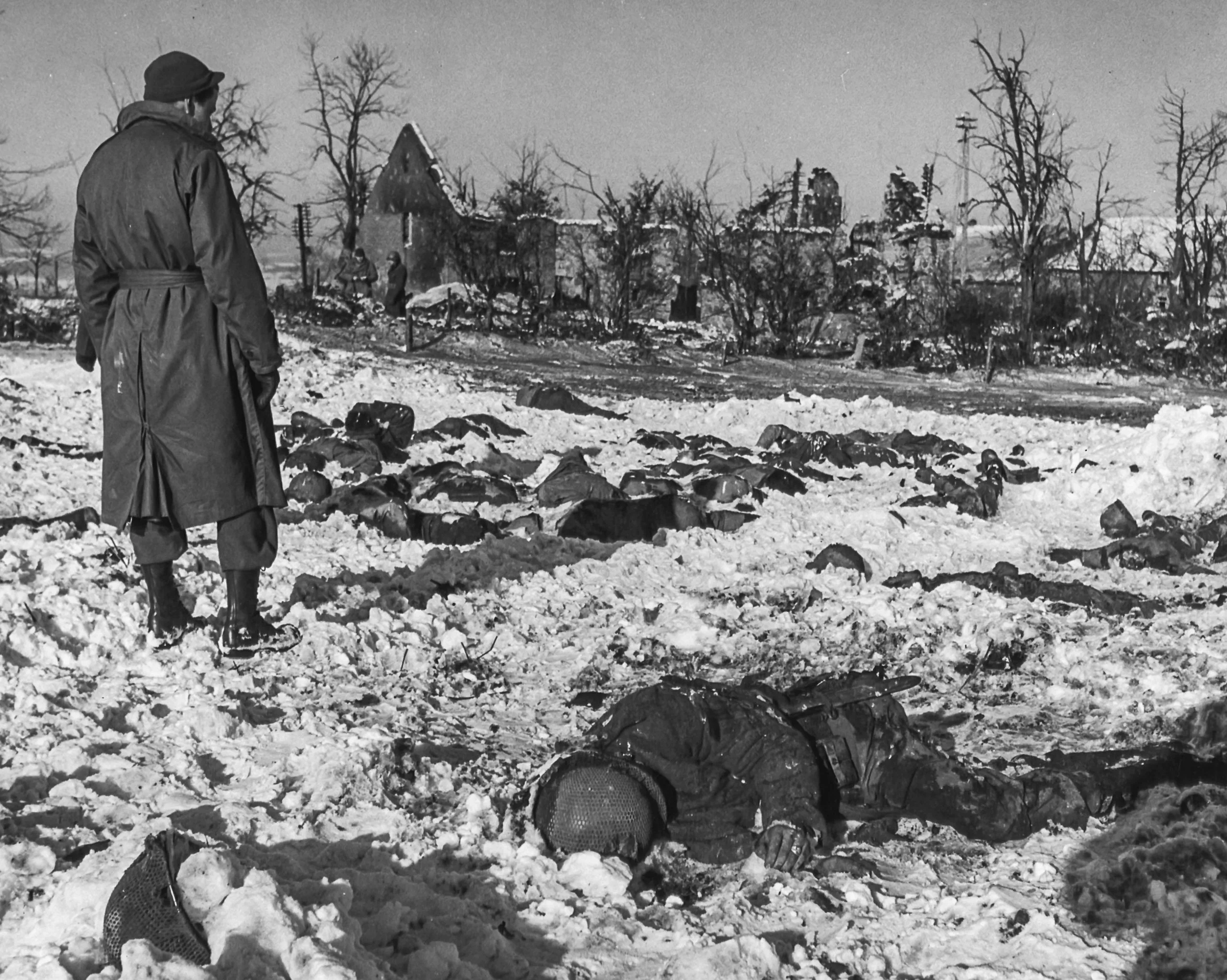

The Malmedy Massacre, sometimes also known as the Baugnez Massacre, was an incident during World War II in which 84 American prisoners of war were killed by Kampfgruppe Peiper after being captured. This event was later classified as a war crime. Of the 120 to 130 captured soldiers from the 285th Field Artillery Observation Battalion, 43 survived the massacre. Their stories and testimonies are horrifying. But these were not the only massacres committed by Kampfgruppe Peiper.
War crimes as psychological warfare (h2)
In the later stages of World War II, when Germany’s prospects were virtually limited to total defeat, war crimes had become a daily occurrence. The Wehrmacht and the Waffen-SS employed this as a form of psychological warfare. The Allies were thus intended to develop a deep fear of the Wehrmacht and Waffen-SS on the Western Front. After all, Germany could not stop the Allies’ rapid advance in the West by military means alone. On the contrary, Germany was a sitting duck. Hitler therefore issued direct orders to conduct the fighting in the West with the same ruthless brutality as they had employed on the Eastern Front against the Soviet Union. The fear was intended to ensure that Allied soldiers, overcome by terror, would no longer dare to advance toward Germany at the same pace.
Nowhere was this new doctrine more evident than during the Ardennes Offensive.
Ardennes Offensive War Crimes h2
During the Ardennes Offensive, SS General Sepp Dietrich commanded the 6th Panzer Army. His objective was clearly defined: he was to break through the Allied front in the Ardennes between the towns of Monschau and Losheimergraben, then cross the Meuse River to reach and capture Antwerp. Part of the 6th Panzer Army was the now infamous Kampfgruppe Peiper, under the command of SS-Obersturmbannführer (Lieutenant Colonel) Joachim Peiper.
Kampfgruppe Peiper’s column was tasked with reaching the Meuse, passing through Stavelot and Trois-Ponts, among other locations. But from the very beginning, Kampfgruppe Peiper’s advance was hampered, if not by fierce American resistance and defense, then by logistical issues and traffic jams.
Honsfeld h3
In any case, on December 17, 1944, Kampfgruppe Peiper arrived in Honsfeld, after having been delayed for a long time near the village of Lanzerath in Belgium. It was 4:30 a.m. on December 17, 1944. The German troops of Kampfgruppe Peiper arrived in the village of Honsfeld. Accounts from that time indicate that the German troops were surprised to find a convoy of American vehicles and equipment present, but without any American troops. The American troops were sleeping in the houses in the village. They were American soldiers from the 99th Infantry Division. The American troops were soon alerted to the presence of the German forces. But there was little they could do. The German troops took approximately 300 prisoners of war. Kampfgruppe Peiper also captured 50 vehicles and 17 anti-tank guns. A small remnant of the American troops who had not yet been captured attempted a counterattack against the Kampfgruppe. Using anti-tank guns, they managed to destroy two Flakpanzer IV Wirbelwind vehicles. Honsfeld had fallen and remained under German control. Kampfgruppe Peiper continued its advance. However, during the course of the day, a number of American prisoners of war were brought to the streets of Honsfeld.
Nineteen American prisoners of war were subsequently killed. They were executed by Kampfgruppe Peiper, in what historians believe was retaliation for the small counterattack the Americans had attempted earlier that day. The bodies of the American prisoners of war were left in the street. In addition to American troops, two local civilians were also executed by Kampfgruppe Peiper. They were suspected of having aided the Americans by providing intelligence on German troops and assisting the Americans.
Baugnez (h3)
After Honsfeld, Kampfgruppe Peiper moved on to Büllingen. Although there is often a misconception about this place, it is highly unlikely that any large-scale executions were carried out here by Kampfgruppe Peiper. In Büllingen, Kampfgruppe Peiper took approximately 200 American prisoners of war. Here, the Kampfgruppe shot and killed a wounded American soldier with a shot to the head. The only documented war crime that took place here was the murder of the American soldier and prisoner of war Bernard Pappel. Instead of continuing his advance toward Elsenborg, Peiper turned back to capture Ligneuville first. After Ligneuville, Peiper turned his attention to Baugnez, a junction between Malmedy, Ligneuville, and Waimes.
December 17, 1944, around noon. Kampfgruppe Peiper reached the intersection at Baugnez. At that very moment, an American convoy was on its way to Ligneuville. The convoy belonged specifically to B Battery of the 285th Field Artillery Observation Battalion. They were to rejoin the 7th Armored Division at Sankt Vith. The convoy came into the sights of Kampfgruppe Peiper, which in turn took out the lead and rear vehicles of the convoy. This brought the entire convoy to a halt. The American troops within the convoy were armed only with rifles and small arms. As a result, they were forced to surrender due to the overwhelming show of force by Kampfgruppe Peiper.
Joachim Peiper continued on with his Kampfgruppe, while some elements of the Kampfgruppe remained behind with the prisoners. Films and TV series often portray this moment as the moment when Joachim Peiper himself gives the order to execute the American prisoners of war, just before he continues his advance with his Kampfgruppe. However, this was most likely not how events unfolded. Yet witness accounts tell us more than those movies and TV shows can. About 120 American prisoners of war were gathered in a field by the remaining elements of Kampfgruppe Peiper. To this day, it remains a mystery, but the German troops unexpectedly opened fire on the American prisoners of war. It is widely believed among historians that a number of prisoners of war, from the rear ranks, attempted to escape toward the nearby forest. The German troops are said to have opened fire in response, causing panic to break out. Another theory, which is not widely accepted by historians, is that the prisoners of war managed to retrieve their weapons and return fire on the German troops.
Be that as it may, in January 1945, 84 bodies were recovered from that site. And the facts, which cannot be denied or disputed, show that more than 20 of the bodies had sustained gunshot wounds to the head. These injuries dated to the moments immediately following the shooting, as German troops inspected each body. Every American prisoner of war who was still alive was shot in the head. During the massacre, a number of American prisoners of war tried to escape; they ran toward a café. Most were shot down during the escape attempt. But a small number managed to enter the nearby café. The Germans then set the café on fire and shot everyone who ran out of the burning building.
Miraculously, 43 American soldiers managed to escape this massacre. They returned to Malmedy to make contact with American troops. They were questioned by their comrades about what had happened. All 43 gave the same account: a massacre at Baugnez. After hearing about this atrocity, some American units stationed near Malmedy decided to stop taking German prisoners of war. This primarily concerned the Waffen-SS troops, whom these American units no longer took prisoner but shot on the spot.
Malmedy massacre h2
The war crimes committed at these two locations are often grouped under the umbrella of the Malmedy massacre. But when people think of the Malmedy massacre, they tend to focus solely on the massacre at Baugnez. From now on, let us not only think of the Malmedy Massacre, but also of the war crimes that truly belong to the Malmedy Massacre: the massacre at Baugnez and the massacre at Honsfeld.
By keeping these historical events alive and remembering them, we hope that war crimes of this kind will never happen again. Because every war victim is one too many.
Would you like to read more about who ultimately stopped the advance of Kampfgruppe Peiper? Then continue reading this story here.
WarCommons publishes long-form, source-driven analysis without ads or click incentives. If you found this feature valuable, consider supporting our research by subscribing to help fund future investigations.
By Nick Ravenshade — Author
Header image: a U.S. soldier views corpses of 84 executed U.S. POWs. 17 December 1944. Source: Wikimedia Commons. Public domain.