WARCOMMONS IS NOW ON ANDROID
Explore WWII history and stay connected with the community on the go. GET THE APP →

When one thinks of the resistance during the Second World War, the main movements that spring to mind are the French Resistance, La Résistance, and the Polish Home Army, Armia Krajowa. But the resistance could not have survived without information from the Allies. In an occupied territory, secret information cannot simply be shared in secret. Danger was always lurking in the form of German counter-espionage and the tracking down of the resistance. The resistance was therefore heavily dependent on the radio. For La Résistance, that was Radio Londres.
The origins of Radio Londres
Radio Londres was broadcast by the BBC in London between 1940 and 1944 to Nazi-occupied France. It was an entirely French radio station, run by the Free French. The French exile volunteers had escaped from the part of France occupied by Nazi Germany and ended up in London, where they began their work for the radio.
The aim of Radio Londres was to counter propaganda broadcasts. The main disseminators of propaganda radio broadcasts were Radio Paris, controlled by Nazi Germany, and the Radiodiffusion Nationale, run by the Vichy government of France. However, countering enemy radio propaganda was not the only objective. It was also used to call on the French people to resist and to disseminate coded messages to the French Resistance.
The first radio broadcast and the ban
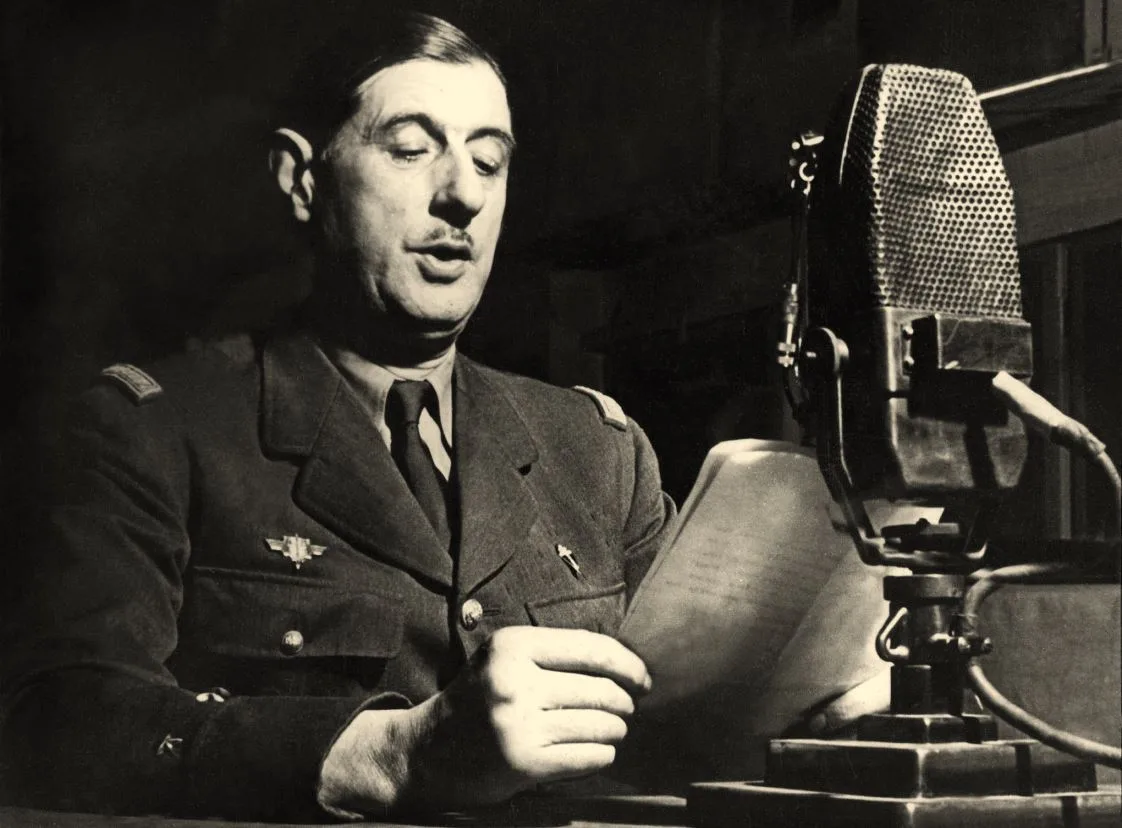
The first radio broadcast took place in 1940, when the BBC also opened the studio. The studio itself was intended for members of the French Resistance, those who had managed to escape the Nazi German occupation. This radio station became a daily fixture for the French people. Every radio broadcast began with the now iconic words: “Ici Londres! Les Français parlent aux Français…”. It meant: “This is London! The French are speaking to the French…”. It is etched into the French collective memory. It was the Free French Forces, under Charles de Gaulle, who produced the broadcasts. Perhaps his most iconic radio address was that of 18 June 1940, in which he called on his fellow French citizens to resist the occupiers.
It soon became clear that Radio Londres was having an impact on the French population. After all, the radio gave the French Resistance a powerful voice that could be heard throughout the country, and even beyond. Nazi Germany itself soon realised this. Radio Londres’s broadcasts had a negative impact on Nazi Germany’s occupation of France. It also proved to be a significant counterweight to Nazi propaganda. The Germans therefore soon felt compelled to ban listening to Radio Londres in October 1940. In addition, Hitler ordered the confiscation of radio sets.
However, the fact that the Germans had banned the radio did not spell the end for Radio Londres. It was merely the beginning. Many residents continued to listen to the radio, albeit in secret. People devised inventive ways to hide their radios. And, in particular, broken or old radio sets were handed over to the Germans when they came to confiscate them.
Radio Londres was a leading voice in encouraging resistance against the occupying forces. De Gaulle was often heard on the airwaves at such times. For example, he called on people to clear the streets of Paris for one hour as a sign of resistance. But the radio was also used to organise demonstrations and make preparations for D-Day, such as the V campaign. The V stood for Victory. This was intended as an act of resistance aimed at undermining authority, and so the V-sign appeared in many places.
With all the turmoil on the European continent, they also tried to lighten the mood and keep things light-hearted. A number of young presenters, including Jacques Duchesne, Jean Oberlé, Pierre Bourdan, Maurice Schumann and Pierre Dac, were primarily focused on breaking the formal tone of the radio broadcasts. Through sketches, songs, comical adverts, jokes and personal messages, they tried to spread more cheer.
Radio Londres was not just for the general public. It was also used by the Allies as a genuine coordination tool for the resistance.
The French Resistance and the coded messages
Across occupied Europe, the resistance was coordinated or supported by the SOE, which stood for the Special Operations Executive. The SOE was a clandestine wartime organisation established to conduct espionage, sabotage, and reconnaissance in occupied Europe. The idea of using radio broadcasts to disseminate coded messages to the resistance came from an SOE agent. His name was Georges Bégué. He saw an opportunity in transmitting seemingly innocuous personal messages to the resistance in the field. This was intended to reduce the risk of interception.
If there were messages for the resistance on a particular day, the radio broadcast would begin as follows: “Before we begin, please listen to some personal messages”. In reality, everyone knew that what followed were coded messages. The content that followed was often highly amusing, completely disjointed and lacking in context.
A number of the examples used are well documented. For instance, they said: “Jean has a long moustache” and “There is a fire at the insurance agency”. As you can see, nobody really knew what this actually meant, other than that they were coded messages. However, each message did have meaning for a specific resistance group, which could thus be used individually, for all to hear. Not only were messages passed on to the resistance in this way, but resistance members could also be thanked for a particular effort, or pseudo-coded messages were used. The latter was used to give the impression that something was being prepared by the resistance, whilst in reality nothing was about to happen at all.
The resistance had code books to decipher messages of this kind. As most of the messages made no sense whatsoever, it was virtually impossible for the Germans to decipher them. In fact, no synonyms or descriptions were used at all, just nonsensical sentences that had no meaning whatsoever without a code book and occasionally merely provoked a laugh. The Germans therefore did not bother trying to decipher the messages, as it was a futile endeavour. Instead, they focused on jamming the radio signal with jammers.
This continued between 1940 and 1944. The Germans were hunting for radio sets and busy jamming the radio signals, the SOE was busy sending coded messages to coordinate the resistance, and the Free French were busy keeping up the morale of the French population under German occupation and calling for resistance. Until June 1944.
The last broadcasts
June 1944 was entirely dominated by D-Day, the Allied landings in Normandy, France, on 6 June 1944. But June 1944 was not the moment when Radio Londres fell silent. On the contrary. The moment marked an explosion in the number of coded radio messages from Radio Londres. On 1 June 1944 alone, more than 200 messages were transmitted. As this had never happened before, people knew they were on the eve of a major event.
The Germans were skilled at jamming radio signals. But through all the static, Beethoven’s Fifth Symphony could be heard. The first four notes of the piece corresponded to the letter V in Morse code. V for Victory.
Music was often used as a code to announce an event. The most notable instance was the radio broadcast just before the Allied landings in Normandy. The first stanza of Paul Verlaine’s poem entitled Chanson d’automne was used. It concerned the first part of the stanza: “Les sanglots longs des violons de l’automne” or “the long sobs of the violins of autumn”. This signalled to the Resistance that an invasion was imminent and that it would take place within 24 hours. The second part of the poem was used to call the Resistance to action: “Blessent mon cœur d’une langueur monotone” or “wound my heart with a monotonous languor” was used to spread a call to action amongst the Resistance.
Radio Londres is the perfect example of how a seemingly insignificant device can mobilise an entire population against an oppressive occupying power. It gave the people hope, a sense of involvement and, at times, a smile during dark and difficult times.
When the Allies had secured victory in France at the end of 1944, this marked not only the end of the Nazi German occupation. It also signalled the definitive end of Radio Londres.
WarCommons publishes long-form, source-driven analysis without ads or click incentives. If you found this feature valuable, consider supporting our research by subscribing to help fund future investigations.
By Nick Ravenshade — Author
Header image: General Charles de Gaulle speaking to the BBC in London, 30 October 1941. Source: Wikimedia Commons. Public domain.