WARCOMMONS IS NOW ON ANDROID
Explore WWII history and stay connected with the community on the go. GET THE APP →

Dresden was the scene of one of the most horrific bombings carried out during the Second World War. A massive firestorm broke out, killing approximately 25,000 people. Almost all of them were civilians. Most military and industrial targets were missed and the historical city center of Dresden was obliterated. But why?
The planning
Dresden was regarded by the Allies as a legitimate and justified target. This was because Dresden was part of the state of Saxony, which was considered an industrial stronghold. The city was a communications and railway hub, with around 50,000 workers and 110 factories. This was evident from USAAF reports that were declassified long after the war ended. The bombings were to be carried out by the USAAF and the RAF.
The bombings were not only intended to paralyse the transport and communications hub. They were also meant to disrupt troop movements in what was known as a Nazi stronghold, so that Red Army troops could make a rapid advance in the east. In the run-up to the bombings, during the Yalta Conference, the Soviet military leadership had even requested that German railway junctions be disrupted. This was the direct reason why Dresden was placed on the list of cities and areas to be bombed.
Prior to the bombings in 1945, Dresden was still one of the few German cities that had not been bombed. It had therefore become a refuge for refugees from other German cities, who sought safety in Dresden. But the RAF viewed the city in a different light. It was said to be one of the Third Reich’s most important industrial centres. The Wehrmacht’s armaments office there was said to comprise 127 large to medium-sized workshops and factories that supplied the Wehrmacht with equipment.
The air raids
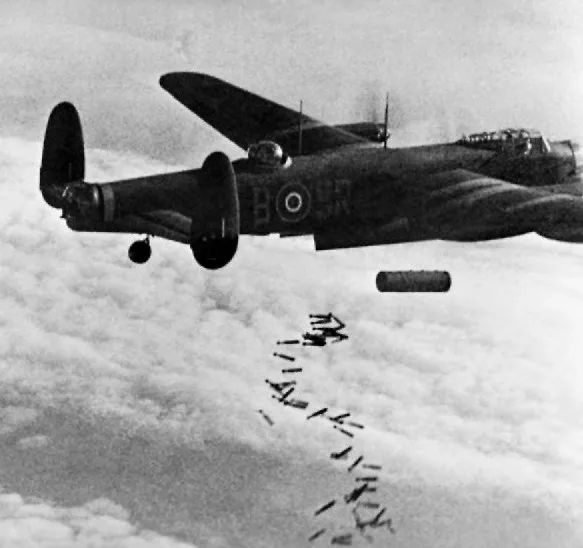
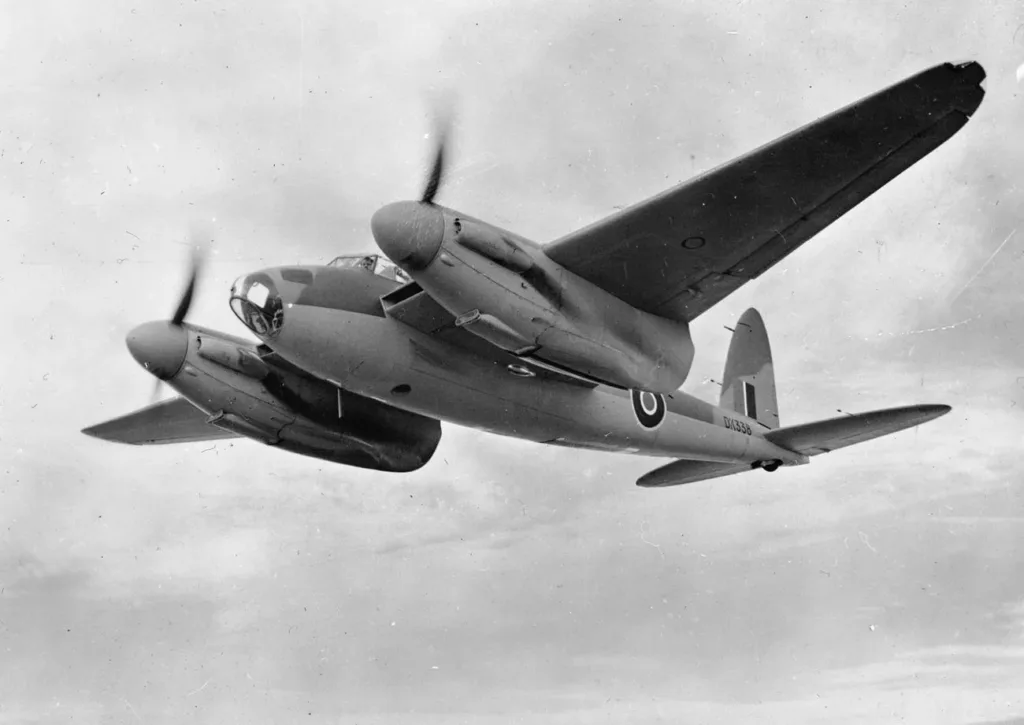
It was 13 February 1945. The USAAF’s Eighth Air Force was about to commence the bombing of Dresden. However, poor weather across Europe prevented the USAAF from launching the attack. It was therefore up to the RAF to begin the bombing that evening once the weather cleared. It was to be a two-stage attack, with an initial bombardment followed by a secondary bombardment three hours after the first. The second bombardment often meant that the rescue teams were also targeted, as they were still busy extinguishing the fires caused by the initial bombardment. No fewer than 360 Lancasters and Halifaxes, the RAF’s heavy bombers, began the bombing raids on a factory producing synthetic oil. This was in Böhlen, 97 km from Dresden, intended as a diversionary raid. In addition, there were 71 de Havilland DH.98 Mosquito medium bombers attacking Magdeburg. The same Mosquitos, the medium bombers, were also present in small numbers in the skies above the cities of Bonn, Misburg near Hanover and Nuremberg.
The Polish pilots were also due to take part in the bombing raids over Dresden. But things almost went wrong. Whilst the Polish pilots were preparing for the upcoming mission, the Yalta Agreement was announced to them. This caused an uproar, as the agreement stipulated that parts of Poland were to be ceded to the Soviet Union. Matters escalated to the point where mutiny was openly discussed among the Polish pilots. This resulted in British officers having to confiscate the Polish pilots’ service weapons. However, their own government had clearly settled the matter. The Polish government ordered the pilots to follow their orders and carry out the mission over Dresden. They complied and took part in the forthcoming bombings.
The first attack
13 February 1945, 17:20 CET. The first British aircraft takes off from England. The crew faces a journey of around 1,100 km. It was the first in a group of Lancaster heavy bombers from Bomber Command’s 83 Squadron, No. 5 Group. This group were the so-called pathfinders, also known as the flare force. Their task was clear: to locate Dresden and mark it with magnesium parachute flares. The Germans also referred to these as ‘Christmas trees’. This was intended to ensure that Dresden was illuminated and marked in the darkness of the night.
After the flare force, it was the turn of the Mosquito marker aircraft to make their way to Dresden. Their task was to mark specific target areas within Dresden. This was done by dropping 1,000-pound (450 kg) target markers. These markers were intended as targets for the heavy bombers, onto which they could drop their bombs. The markings were clear. The first attack was concentrated on the Ostragehege sports stadium, right next to Dresden’s medieval Altstadt. A densely populated area containing the characteristic and highly flammable half-timbered buildings.
The flare force and the so-called target indicators that followed had done their job. It was now time for the main air force.
254 Lancaster heavy bombers formed part of the so-called Plate Rack, the main bomber force. The group carried 500 tonnes of high-explosive bombs and 375 tonnes of incendiary bombs. This amounted to a total of 200,000 incendiary bombs that Dresden would receive. The high-explosive bombs, on the other hand, weighed between 500 and 4,000 pounds, or 230 to 1,810 kg. The two-tonne high-explosive bombs were also known as ‘blockbusters’. They earned this name because they were capable of completely destroying an entire street or a very large building. What remains a point of debate is the theory that the Allies used the high-explosive bombs to burst water pipes and blow out the windows, roofs and doors of buildings. The aim of this was presumably to expose the interiors of many buildings in Dresden and create a draught that would fan the fires caused by the incendiary bombs. Whatever the intention, the result spoke for itself. And it is not far-fetched to suggest that the Allies knew what would happen when these bombings were combined, given the experience gained from previous bombings over several years.
By the time the Plate Rack’s Lancasters had crossed the German border via France, only 244 Lancasters remained of the original 254. At 21:51 CET, the sirens began to wail in Dresden. Maurice Smith, ‘Master Bomber’ Wing Commander, was also in the air, in a Mosquito. Maurice Smith gave the following orders: “Controller to Plate Rack Force: Come in and bomb the glow of red target indicators as planned. Bomb the glow of red TIs as planned”.
About half an hour later, all hell broke loose over Dresden. It was 22:13 CET. In a span of no more than 15 minutes, the Lancasters had dropped 881.1 tonnes of bombs on Dresden. 57% of these were high-explosive bombs and 43% were incendiary bombs. At 22:28 CET, the last bomb had been dropped. The result was the total destruction of an area 2.01 km long and approximately 2.82 km wide at its widest point. But the living hell for Dresden was not yet over; no, it had only just begun.
The second attack
Three hours later, the second bombing raid followed. This group, however, had no trouble locating Dresden from the air. From as far as 97 km away, the flames from Dresden could be seen from the ground, a picture of hell on earth with thousands upon thousands of flames dancing through the city. But from the air, it was even more visible; from as far as 140 km away, the Lancaster bombers saw Dresden engulfed in flames. Now that the area clearly no longer needed to be marked, the pathfinders of the second group decided to expand the target area. At both outer edges of the firestorm, they dropped their target indicators. The areas marked were the Hauptbahnhof, the main railway station, and the Grosser Garten, a large park.
13 February 1945 turned into 14 February 1945 at 01:05 CET, in the middle of the night. The sirens in Dresden sounded again. Between 1.21 am and 1.45 am CET, the second group of 529 Lancasters dropped more than 1,800 tonnes of bombs.
The final attacks of 14 and 15 February 1945
Following the RAF’s night-time aerial bombardments, the inferno engulfing Dresden was not yet complete. It was now the turn of the USAAF, with its doctrine of daytime bombing.
Around midday, the 1st Bombardment Division of the Eighth Air Force was to bomb Dresden with 431 bombers. Meanwhile, the plumes of smoke above Dresden rose to an impressive height of 4,600 metres, meaning that the USAAF did not have to guess where Dresden was. An air armada of around 2,100 USAAF aircraft was to fly over the state of Saxony that day.
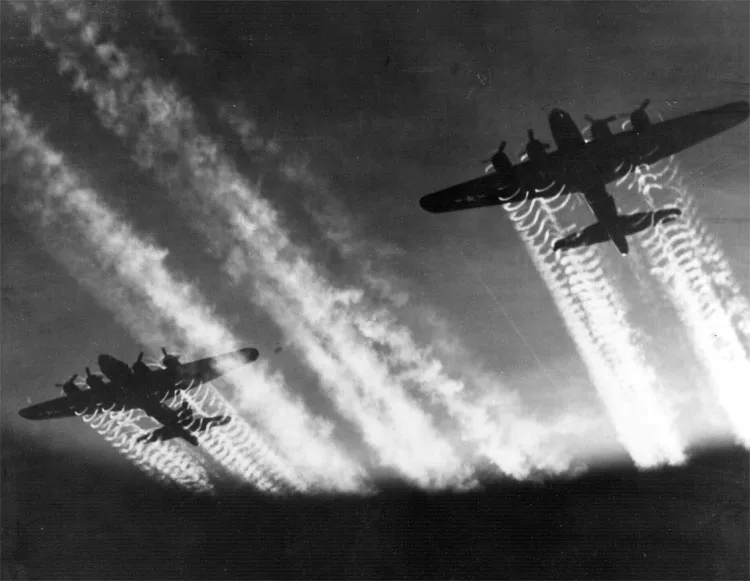
316 of the B-17 Flying Fortresses bombed Dresden with 771 tonnes of bombs. The rest of the formation, 115 USAAF heavy bombers, missed their targets.
At 12:17 CET, the 379th Bombardment Group began bombing Dresden, targeting the area not obscured by smoke and/or clouds. This amounted to the marshalling yard and the Friedrichstadt district, situated to the west of the city centre. Due to poor visibility, Dresden was bombed using H2X radar. Several groups of heavy bombers followed, with the last arriving around 12:30 CET. The result was a firestorm and a total inferno that engulfed Dresden. Most groups completely missed their targets; for instance, the first group mainly bombed the south-eastern suburbs of Dresden.
Little came of the American doctrine of precision bombing on these days.
An eyewitness
Only an eyewitness can describe the horror of these bombings; no analysis or account could ever come close to it.
“It is not possible to describe! Explosion after explosion. It was beyond belief, worse than the blackest nightmare. So many people were horribly burnt and injured. It became more and more difficult to breathe. It was dark and all of us tried to leave this cellar with inconceivable panic. Dead and dying people were trampled upon, luggage was left or snatched up out of our hands by rescuers. The basket with our twins covered with wet cloths was snatched up out of my mother’s hands and we were pushed upstairs by the people behind us. We saw the burning street, the falling ruins and the terrible firestorm. My mother covered us with wet blankets and coats she found in a water tub.”
“We saw terrible things: cremated adults shrunk to the size of small children, pieces of arms and legs, dead people, whole families burnt to death, burning people ran to and fro, burnt coaches filled with civilian refugees, dead rescuers and soldiers, many were calling and looking for their children and families, and fire everywhere, everywhere fire, and all the time the hot wind of the firestorm threw people back into the burning houses they were trying to escape from.”
“I cannot forget these terrible details. I can never forget them.”
The aftermath
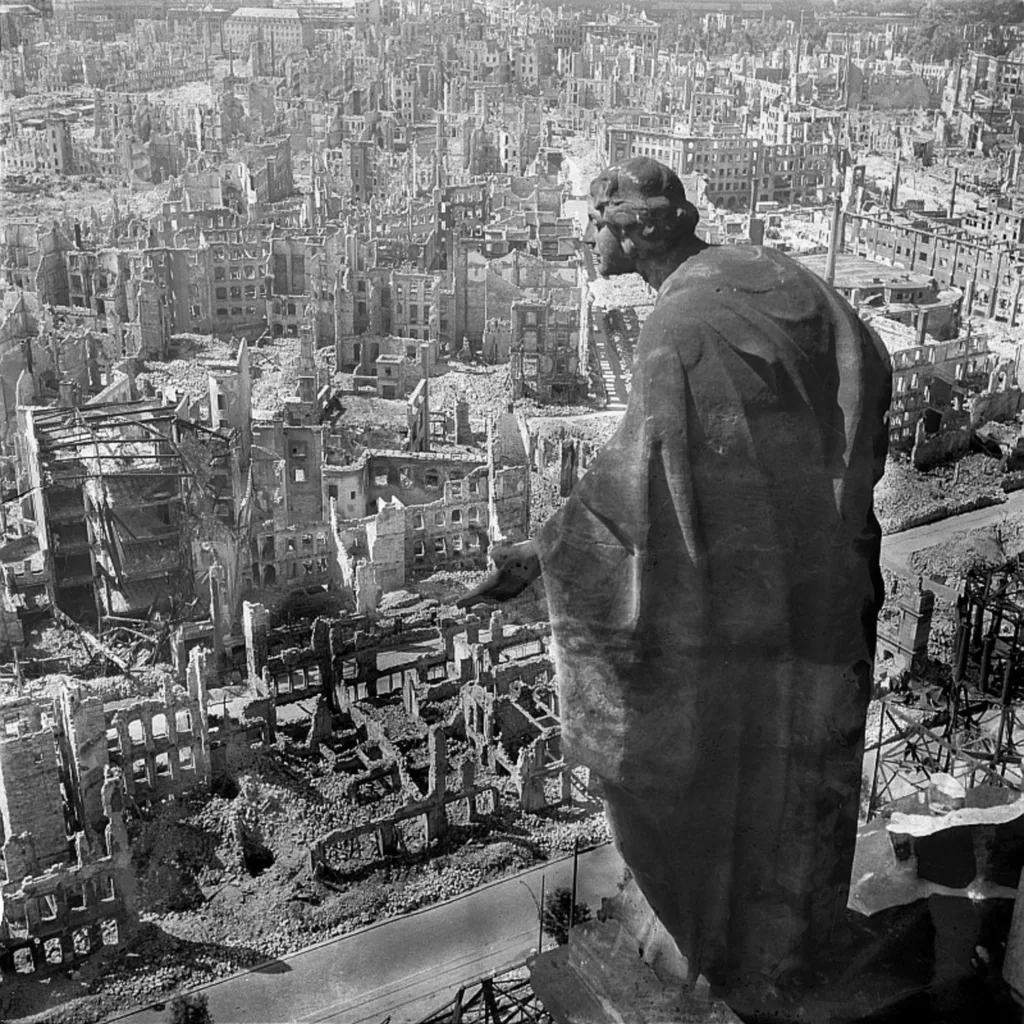
There was no sign of a carefully targeted bombing campaign against military targets in Dresden. Many targets were missed, and it escalated into large-scale area bombing by both the RAF and the USAAF. Although some military and logistical targets were hit, it was mainly the centre of Dresden that bore the brunt. The bombing raids resulted in a so-called firestorm. The fire consumed everything in its immediate vicinity; the oxygen and draughts in the streets acted as direct fuel for the fire, which by that point could no longer be extinguished.
6.5 km² of the city centre was completely destroyed and there were approximately 25,000 fatalities, mostly civilians.
The transport and communications infrastructure were not all hit as planned, and the industrial zones outside the city centre were virtually untouched by the bombing. What remained was the bombing of a historic city centre. The indiscriminate bombing of civilian targets and an attack that was disproportionate and no longer commensurate with the military gains that were supposed to have been achieved.
In principle, the Allied bombing of Dresden at that time did not constitute a war crime. The standards in force at the time, based on the Hague Conventions of 1907, remain at the heart of the debate as to whether or not the bombings can be regarded as war crimes. These conventions primarily prohibited the bombing of undefended places, which Dresden certainly was not. After all, Dresden was a place defended by Germany.
By current standards and treaties, the attack on Dresden could indeed be regarded as a war crime. However, it would be factually incorrect to apply these new standards to a historical war event. What can be argued and established, however, is that the attack was at the very least immoral, extraordinarily destructive, and targeted civilians.
There is, however, one fact that occurred after the bombings which demonstrates whether the Allies had achieved their objective. After all, according to the British, Dresden was one of the Third Reich’s most important industrial centres, indispensable to the German war effort. The industry and infrastructure supporting the German war effort had to be brought to a standstill, come what may. Yet within three days, rail traffic within Dresden had already resumed.
Would you like to read more about the differences between the bombing doctrines used by the RAF and the USAAF? If so, be sure to read my article on RAF and USAAF bombing operations here / RAF vs USAAF: The Bombing Doctrine Split That Divided the Allies.
WarCommons publishes long-form, source-driven analysis without ads or click incentives. If you found this feature valuable, consider supporting our research by subscribing to help fund future investigations.
By Nick Ravenshade — Author
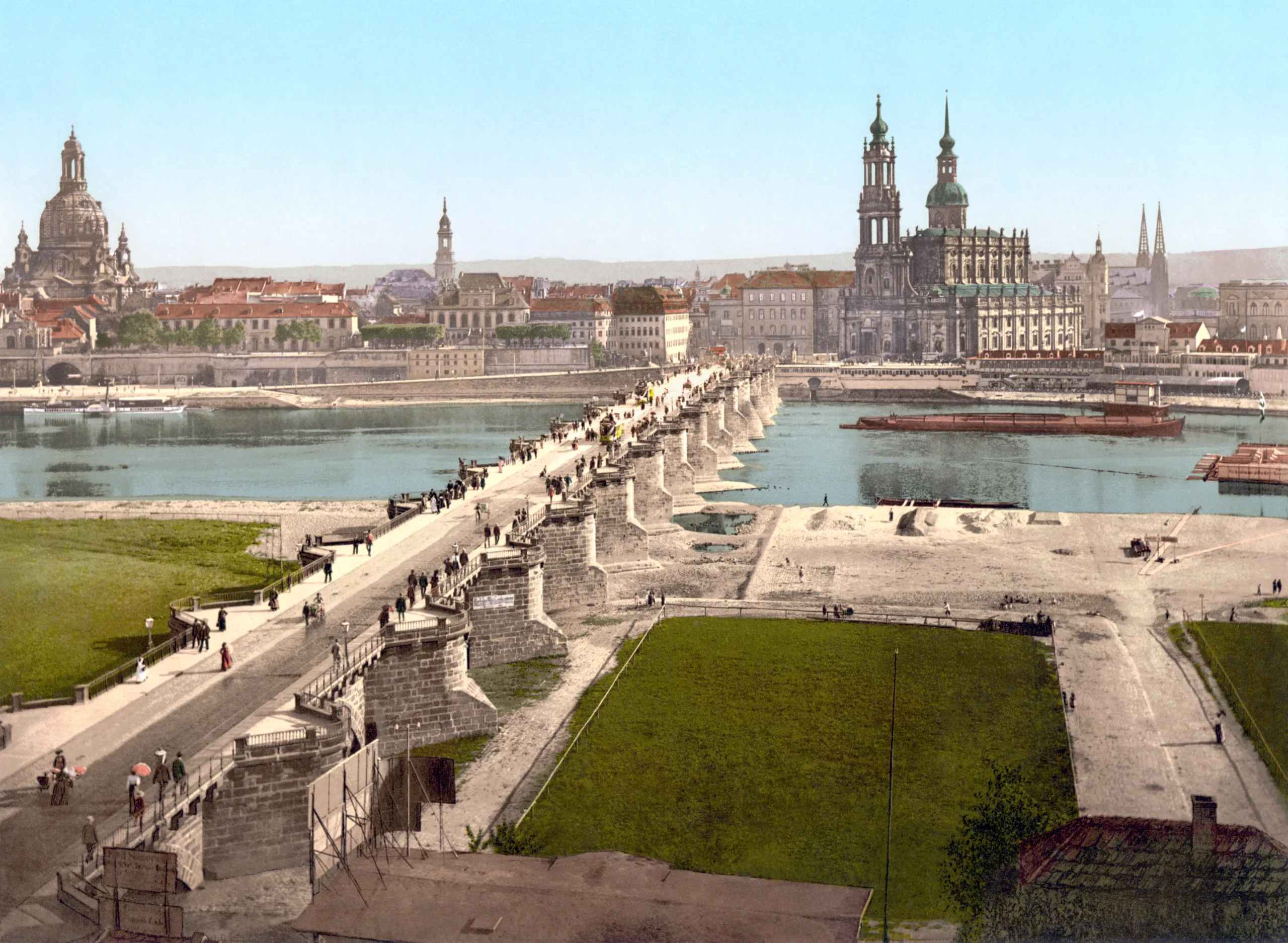
Header image: Altstadt (old city), Dresden in the late 19th century. View from the War Ministry. Late 19th century. Source: Wikimedia Commons. Public domain.