WARCOMMONS IS NOW ON ANDROID
Explore WWII history and stay connected with the community on the go. GET THE APP →
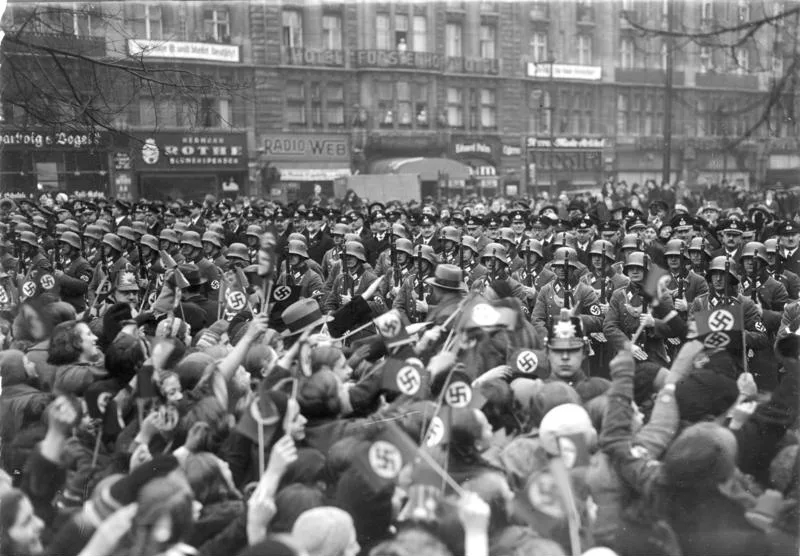

When historians write about the road to World War II, the same factors often come up. Social and economic discontent and the Reichstag fire are frequently central to these factors. But just as important were the small diplomatic successes Hitler achieved. These successes, in fact, cemented his power and shaped public perception of him. Given the manner in which Hitler came to power in Germany, he had a great need to build political credibility. That opportunity arose in 1935: the Territory of the Saar Basin (Saarbeckengebiet). This was Hitler’s stage for a major and significant political and diplomatic victory.
The Territory of the Saar Basin
The Saar region originally belonged to the German Empire. But after World War I, the Treaty of Versailles changed that. Articles 45 through 50 of the Treaty of Versailles required Germany to suspend its sovereignty over the Saar region. The area, covering approximately 1,900 square kilometers, was to be transferred by Germany to the League of Nations. The League of Nations would be responsible for administering the territory. However, France gained full control over the coal mines in the region.
The manner in which the region was to be governed was laid out in the so-called Saar Statute. The Saar Statute stipulated that Germany had to transfer all administrative powers over the Saar region to the League of Nations for a period of 15 years. Furthermore, residents of the Saar region were not permitted to vote in Reichstag elections. And all laws passed by the German parliament after November 1918 were also inapplicable to this region.
A government commission was in charge of administering the region. The commission consisted of five members appointed by the League of Nations. The commission had broad powers to govern the region. For example, it was authorized to levy taxes, appoint officials, and enact laws and regulations.
To compensate for the destruction of French coal mines during World War I, France was thus granted control over coal mining in the Saar region, as well as the blast furnace and steel industries.
As early as 1920 and 1921, France was already laying the groundwork for an event that would take place more than a decade later. France believed it had devised a sound plan to ultimately persuade the inhabitants, after the agreed-upon 15 years, to choose France. So-called Domanialschulen, or elementary schools, were established. These schools provided an education focused exclusively on France and were largely French-speaking.
France did all this to persuade miners in the region to vote in favor of annexation to France. But it was also aimed at the children attending those schools. Fifteen years later, most of them would be young adults. The French believed this would ensure a new generation that would indeed vote for the annexation of the Saar region to France. Consequently, it was primarily the children of French mine supervisors and civil servants who were required to attend this school. However, they served mainly as a means to get German children to attend that school as well. For instance, the French mine supervisors were expected to pressure the German miners so that they, too, would send their children to that school.
The reality, however, proved more stubborn. German parents saw no point in it and sent their children to regular German schools. The project’s failure was confirmed by hard facts: namely, only 2 to 3% of all children in the Saarland attended the so-called Domanialschule.
This status quo was thus maintained for the agreed-upon 15 years during which the League of Nations had authority in this region.
But a major change was on the horizon.
Peace Mission in the Saar Region
In 1934, the 15-year term of the Saar Statute expired. A plebiscite had to be held to determine the future of the Saar region. The League of Nations therefore decided that a peacekeeping force would be necessary in the region for the duration of the plebiscite. Both the French and German governments agreed to allow an international force to enter the Saar region. The resolution to that effect was therefore unanimously approved by the League of Nations on December 8, 1934. It ultimately became an international force of 3,300 troops, consisting of 1,500 British troops, 1,300 Italian troops, 260 Swedish troops, and 250 Dutch troops. They all agreed to participate in the so-called peacekeeping mission.
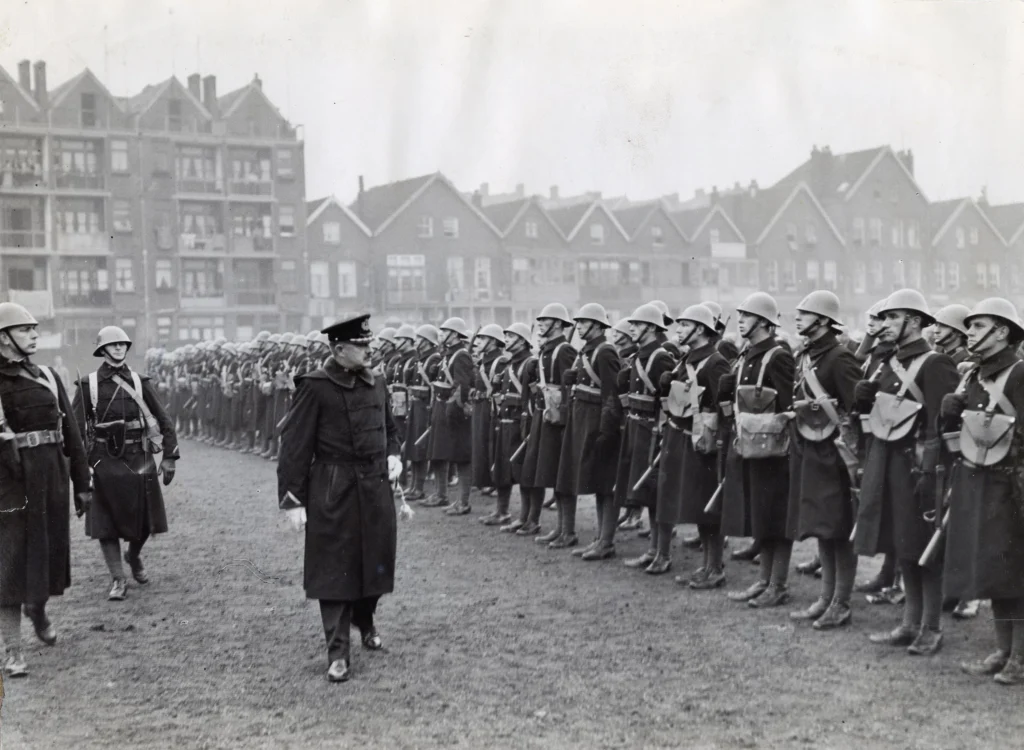
The League of Nations also had to appoint a commander for this force. This role went to British Major General John Brind. He was given operational command of these troops. Their main task was to patrol the Saar region. An important distinction is that they did not exercise oversight; they were only permitted to intervene when requested by local authorities or in the event of an emergency.
The peacekeeping mission was ultimately considered a success, as there was little to no violence during the period of the plebiscite.
The political battle
Most political parties in the Saar region initially supported the region’s return to Germany. However, the plebiscite took place during a particularly turbulent period in German politics. In August 1934, Hitler had consolidated his total and absolute power as Führer and Chancellor following the death of President von Hindenburg. The political offices of president and chancellor were merged into a single position. This was precisely what caused the opponents of Nazism in the Saar region to begin having doubts, partly driven by the distrust they harbored toward Hitler. The communists and socialists, however, supported continued administration by the League of Nations and a postponement of the plebiscite until the Nazis had been driven out of Germany. This was motivated by Hitler’s oppression of their German counterparts.
As for the Roman Catholics in the region, they were particularly divided on the question of whether the region should return to German administration.
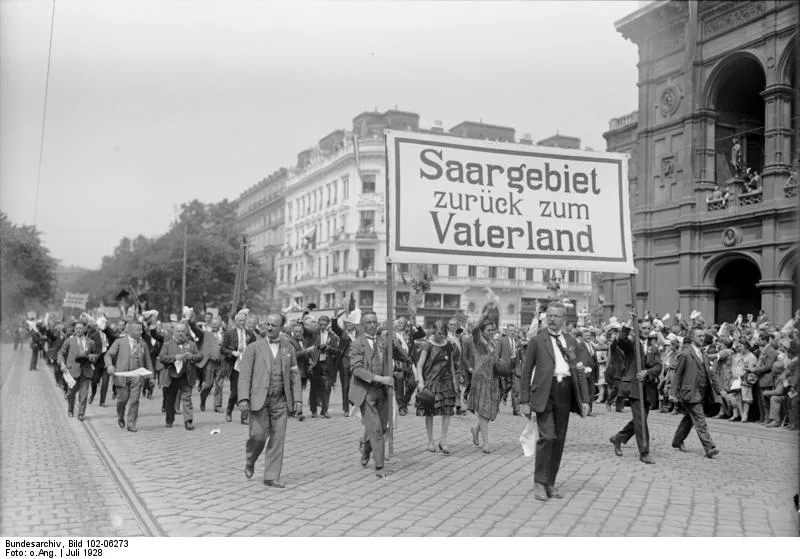
The Nazis, however, had a tried-and-true method of campaigning. To secure victory in the plebiscite, they resorted to a mix of flattery and brute force. As early as 1933, Sarah Wambaugh (one of the members of the Plebiscite Commission) stated that complaints had been received regarding a Nazi reign of terror. These complaints had been filed by the foreign press and by non-Nazi Saarlanders. The accusations were numerous and wide-ranging. For instance, the Nazis were alleged to have engaged in espionage, treason, kidnappings, and other forms of intimidation. The espionage primarily involved intercepting letters and telegrams, as well as eavesdropping on telephone conversations. The government commission, appointed by the League of Nations, therefore felt compelled to issue various restrictive decrees to maintain public order.
The unrest also brought with it a fear from an unexpected quarter. This is reflected in the events that began in November 1934. Fears arose of an armed intervention by France. At that time, the German armed forces were not yet capable of repelling or successfully halting a potential armed intervention by France. The German government was forced to change its campaign strategy. Bellicose rhetoric was toned down. But more importantly, Josef Bürckel (Hitler’s commissioner for the Saar) banned the wearing of uniforms within a 40-kilometer zone. This applied to the area along the Saar border between January 10, 1935, and February 10, 1935. Bürckel also banned gatherings, parades, and processions in this area. At the same time, the Nazi leader in the Saar, Jakob Pirro, ensured that his followers maintained strict discipline. Any violations of the discipline he imposed would result in severe punishments.
This reveals that the German government did everything in its power to secure a victory in the plebiscite. A prime example of this was Germany’s establishment of the so-called Deutsche Front in July 1933. The Deutsche Front grew to become one of the most powerful forces in the Saar region. This was partly due to the substantial financial contributions it received from Germany. The Deutsche Front was primarily active in threatening and intimidating voters. But support also came from an unexpected quarter. The Catholic Center Party of the Saar region was also incorporated into the new pro-German front. They preached about yielding to the threats regarding what would happen after Judgment Day in 1935.
However, just as with the establishment of the Domanialschule, the effect was the opposite. The suppression and intimidation of the Catholic Church by Germany, along with the intimidation by the Deutsche Front, led more and more residents of the Saar region to prefer living in the Saar region under French rule.
But it was not only the founding of the Deutsche Front in July 1933 and the efforts beginning in November 1934 to defuse the situation that played a role in the long campaign leading up to the plebiscite. Amid all this, from June 30 through July 2, 1934, a significant event took place that nearly caused Germany to lose the Saar region to France forever. It was the Night of the Long Knives.
The Night of the Long Knives and the Campaign
Without going into detail about all the events of the Night of the Long Knives, we must focus here on one significant event that directly influenced the campaign for the plebiscite on the Saar region.
During the Night of the Long Knives, a significant event took place in this context. During this purge, two prominent Catholic leaders were murdered. The Catholic leaders were Erich Klausener and Adalbert Probst. Their requiem mass, the Roman Catholic funeral mass, drew a great deal of attention and a large crowd. The Catholic newspaper, Neue Saar Post, also gained many new readers following these events. This newspaper focused primarily on opposition to the return of the Saar region to Germany. Commission member Sarah Wambaugh noted after the events that the odds were even for both France and Germany in the plebiscite. She saw only one path to victory for Hitler. Namely, Hitler had to rehabilitate himself and appease the Catholic Church. Or the Nazi regime had to be overthrown before January 1935, because the plebiscite was scheduled for January 13, 1935. If Hitler failed to do so, the Saar region could be lost to Germany indefinitely.
Shift in the campaign
France and Germany focused their campaigns on appealing to the political Catholicism of voters in the region. On November 30, 1934, for example, the organization Deutscher Volksbund für Christlich-soziale Gemeinschaft was founded. More than 70 members of the Catholic Church had initiated this organization. They held a meeting every Sunday. Their motto was, “Return to Germany, but not to Hitler’s Germany.” But they also proclaimed, in religious terms, “Christ is our leader, not Hitler.”
The League of Nations concluded that a large majority of the clergy in the Saar region supported the status quo. That is, the continuation of the current situation under the administration of the League of Nations and France. In this regard, the League of Nations also became actively involved in the campaign surrounding the plebiscite. It urged voters to block the return of the Saar region to Germany. According to the League of Nations, this would be the best way to serve Germany, by blocking the so-called un-German National Socialist dictatorship.
At the height of the campaign, all parties involved, particularly Germany, the League of Nations, and France, played a highly tactical game. The public was concerned about the Nazis’ anticlericalism. Their opposition to the political and social influence of the clergy or organized religion. The Nazis, in turn, tried to allay these concerns by making an urgent appeal to the voters’ anti-communism. Thus, the NSDAP’s propaganda machine was once again put into action. Photos of atrocities within the Soviet Union circulated, distributed by pro-German newspapers. These photos were then contrasted with the peace and prosperity that would prevail in the Third Reich.
This propaganda strategy did not last long. The Nazis soon resorted to their tried-and-true method of winning an election: intimidation. The Nazis’ paramilitary forces threatened revenge against anyone who voted against the reunification of the Saar region with the Fatherland. In this way, an indirect appeal was also made to the voters’ patriotism, if it existed at all. If it did not yet exist, it was evoked through violence and intimidation.
The plebiscite
The plebiscite gave the residents of the Saar region only three options. The options were: keeping the Saar region under the administration of the League of Nations, reunification with Germany, or annexation of the region by France.
The result was overwhelming. The campaign efforts of all parties yielded the following result. A staggering 90.73% of voters voted for the reunification of the Saar region with Germany. In every electoral district, at least 83% of voters supported the return of the Saar region to Germany. It was also Georges Clemenceau, who died in 1929, who claimed that 150,000 French people lived in the Saar region. However, this did not translate into votes for the French side. Less than 0.5% of voters chose the annexation of the Saar region by France.
| Choice | Votes | % | |
| Reunification with Germany | 477,089 | 90.73 | |
| Status quo | 46,613 | 8.86 | |
| Unification with France | 2,124 | 0.40 | |
| Total | 525,826 | 100.00 | |
| Valid votes | 525,826 | 99.59 | |
| Invalid/blank votes | 2,161 | 0.41 | |
| Total votes | 527,987 | 100.00 | |
| Registered voters/turnout | 539,542 | 97.86 | |
This result surprised not only neutral observers but also Nazi Germany itself. However, the legitimacy of the plebiscite was called into question, particularly by foreign observers. These doubts arose due to the widespread intimidation of voters carried out by the Deutsche Front. The intimidation was exposed by The Sunday Mail of Adelaide. They reported that opponents of the Saar region’s return to Germany were being chased off the streets and even confined to their homes. Jewish shops were reportedly boycotted, and Nazis allegedly visited Jewish homes to demand their voting cards in exchange for protection.
But further signs of intimidation from Nazi Germany emerged from the report by Marinus van der Goes van Naters. In his report, he stated that the Deutsche Front had infiltrated public services, such as the municipal government and the police. This allowed them to force voters, under threat of dismissal or the loss of their pensions, to vote for the return of the Saar region to Germany. The Bulletin of International News also reported that Nazi militias went door to door asking people to sign a statement. The statement required them to pledge to do everything in their power to bring about the return of the Saar region to Germany.
Pro-Nazi police officials maintained so-called blacklists. These lists included people who opposed the reunification of the Saar region with Germany. In this way, the NSDAP sought to prevent these people from voting. The efforts of the Deutsche Front did not stop there. Socialist and separatist newspapers, such as the Volkstimme and the Volkszeitung, were also removed, and there were reports of illegal confiscation of documents by the Deutsche Front.
As a result, Guenter Lewy (a German-born American author and political scientist who is professor emeritus of political science at the University of Massachusetts Amherst) was of the opinion that the outcome of the plebiscite could have been very different had there been better control in the region. He grounds this view to the hostility of Catholics toward the Nazi regime.
But whatever the case may be, and no matter how many new insights we may have 90 years later, there was only one fact. That fact was the reintegration of the Saar region into Germany.
The period following the plebiscite
Following the results of the plebiscite, the League of Nations had no choice but to decide that the Saar region must be returned to Germany. This took place on March 1, 1935. On that date, the Saarland was reintegrated into Germany, with none other than Josef Bürckel serving as Reich Commissioner.
As a result of the plebiscite, the Gau Pfalz-Saar was established in this area in 1936. This occurred because the Saar region was incorporated into the Gau Rheinpfalz. The area was renamed twice: initially to Gau Saarpfalz, and in December 1940 it became the Gau Westmark. Josef Bürckel, however, remained the so-called Gauleiter of this area, and as of March 11, 1941, he even became the Reichsstatthalter. He held this position until his death in September 1944, after which he was succeeded by Willi Stöhr until the end of the war.
It was clear that the NSDAP and the Nazi authorities harbored a grudge against the Catholic Church over what had transpired during the campaign. Immediately after the plebiscite, the NSDAP and its authorities set about curtailing the Catholic Church’s influence in public life. Catholic organizations were suppressed and forcibly dissolved. Guenter Lewy reported that the persecution of the Catholic Church in the Saar region was even worse than elsewhere in the Third Reich, because the Reichskonkordat did not apply there. This was significant because the Reichskonkordat was a treaty concluded between the Vatican and the emerging Nazi Germany. The treaty was intended to guarantee the rights of the Catholic Church in Germany. One should not underestimate the amount of power the Catholic Church held during that period in Germany and elsewhere. It was deeply rooted in society and the institutions that held power over the country.
Through Article 16 of this treaty, Germany imposed restrictions on the power of the Catholic Church. This article stipulated that bishops must take an oath of allegiance to the constitutional government of the Third Reich upon assuming office, as laid out in the constitution. All clergy were also required to refrain from engaging in activities for political parties. As expected, Nazi Germany began violating this treaty immediately after its signing. Hitler, however, had only one goal in mind: to eliminate the Church’s influence within Germany by restricting its organizations to purely religious activities.
Since the Reichskonkordat did not apply to the Saar region, the NSDAP had a completely free hand there in its actions against the Catholic Church. The lawlessness in this context meant that even those members of the Catholic clergy who had campaigned for the return of the Saar region to Germany were now forced to flee.
But after all that was said and done, one fact remained: the Saar region once again became part of Germany. It was a bitter loss for France, which thereby lost its control over the coal mines in the Saar region. For the Third Reich, however, this was a diplomatic and political victory. It bolstered Hitler’s credibility as a political leader. It boosted his popularity at home, but also confirmed his foreign policy as effective and well-thought-out. This victory was also a goldmine for his propaganda. It was framed as definitive proof that Hitler could reclaim a territory without military intervention or war, thereby also lifting a significant restriction of the Treaty of Versailles.
It was a diplomatic and political victory. It gave Hitler credibility. It gave Hitler momentum. But it also marked the beginning of Hitler’s delusions of grandeur and a distorted self-image as a brilliant strategist on the world stage. Yet the general public fell for it as well. They rallied behind Hitler’s leadership.
The story of the 1935 plebiscite was therefore not merely the story of a region returning to Germany, nor was it simply the story of how more than 90% of the inhabitants of the Saar region wished to rejoin Germany. It is a story that serves as a cornerstone in the run-up to World War II. A small region, now part of Germany once again, served as a springboard to World War II. Hitler’s success regarding the Saar region gave him the confidence to proceed with more aggressive actions, such as the rearmament of Germany and the military reoccupation of the Rhineland.
After all, the European powers and the rest of the Allies had no desire for another war. It marked the beginning of the policy of appeasement.
WarCommons publishes long-form, source-driven analysis without ads or click incentives. If you found this feature valuable, consider supporting our research by subscribing to help fund future investigations.
By Nick Ravenshade — Author
Header image: Berlin, arrival of the Saarland voters. January 1935. Source: Wikimedia Commons / Bundesarchiv, Bild 102-04299A. CC BY-SA 3.0.