WARCOMMONS IS NOW ON ANDROID
Explore WWII history and stay connected with the community on the go. GET THE APP →

The focus is often on Hitler, the Japanese Empire, the United States, or the Soviet Union. But there was another key player during World War II. One who also waged his own wars in the run-up to the conflict. An important turning point, because it is also linked to the failure of the League of Nations, which in turn gave Hitler further opportunities to move ever closer to the outbreak of World War II. While the Italians’ battles during World War II were largely unremarkable and they repeatedly required military assistance from Hitler, they also had their own successes that have been forgotten. It was the Second Italo-Abyssinian War.
How This War Came to Be
October 3, 1935. Two hundred thousand Italian soldiers of the Royal Army, or Regio Esercito, attacked Ethiopia. Without a prior declaration of war and under the command of Field Marshal Emilio De Bono. The Italian troops launched their offensive from Italian Eritrea. At the same time, another offensive was launched against Ethiopia. From Italian Somaliland, a smaller force began the offensive under the command of General Rodolfo Graziani. The Second Italo-Abyssinian War had begun. The war was both preventable and, in hindsight, inevitable.
The First Italo-Abyssinian War took place from January 13, 1895, to October 23, 1896. Among other events, it was the scene of the so-called “Disgrace” of Adwa. In 1896, Italian forces were crushed by Ethiopian troops. It was a highly unique but also deeply humiliating defeat for a country that was already regarded at the time as a modern European power. It all took place within the context of the broader Scramble for Africa.
What followed this extraordinary defeat was the nurturing of a grudge that had been harbored for generations among Italian nationalists and military leaders. The conquest of Ethiopia was viewed as a necessary act. The Second Italo-Abyssinian War was therefore not solely about conquering territory. It was also an effort to restore Italian national honor.
In 1922, Benito Mussolini came to power in Italy. Like Hitler, he suffered somewhat from delusions of grandeur. For while Hitler sought to establish the colossal world capital Germania within the larger Third Reich, Mussolini’s regime centered on the reconstruction of the Roman Empire. Ethiopia, as a sovereign and independent African nation, lay precisely between the two Italian colonies of Somaliland and Eritrea. For geographical, ideological, and vindictive reasons, Ethiopia was the ultimate target for demonstrating Italian fascist power and achieving autarky.
During the interwar period, appeasement was indeed the most commonly chosen diplomatic strategy. However, Hitler was not the only one to benefit from such treatment. In the 1930s, the international community was already highly unstable. But Mussolini rightly gambled that the League of Nations would be too powerless to do anything against a possible invasion of Ethiopia. Yet the key players on the European continent, the United Kingdom and France, were already desperate even then. Desperate to keep Italy as their ally. For what was unfolding closer to home on the European mainland was the rapid rise of Nazi Germany under Hitler. To win or keep Italy on their side, the French and British opted for appeasement. In effect, they had simply given Mussolini the green light to invade Ethiopia.
In fact, a secret pact had been signed between the United Kingdom and Italy years earlier. On December 14, 1925, it was signed between what was already fascist Italy and the United Kingdom, aimed at strengthening Italian dominance in the region. The British recognized that the areas in question were in Italy’s interest. They even agreed to an Italian request to build a railway line between Somalia and Eritrea. It was supposed to be a pact of total secrecy, but details soon leaked out. The French and Ethiopian governments were, to put it mildly, outraged by this pact. Ethiopia was even more pointed in its wording. According to them, it would be an act of betrayal against a country that had, in effect, been virtually a member of the League of Nations. Despite all this, the stage for the Wawal Incident had already been set.
Ual-Ual Incident
Italy and Ethiopia had also signed a treaty in 1928. That treaty established the border between Ethiopia and Italian Somaliland. This border ran twenty-one leagues, or approximately 118.3 kilometers, parallel to the coast of Benadir. But in 1930, Italy deemed it necessary to challenge the borders, or at least to ignore them. That year, Italy built a fort near the Walwal oasis, known as Ual-Ual in Italian, in the Ogaden. This fort was manned by Somali dubats. These were irregular troops stationed along the border who were under the command of Italian officers.
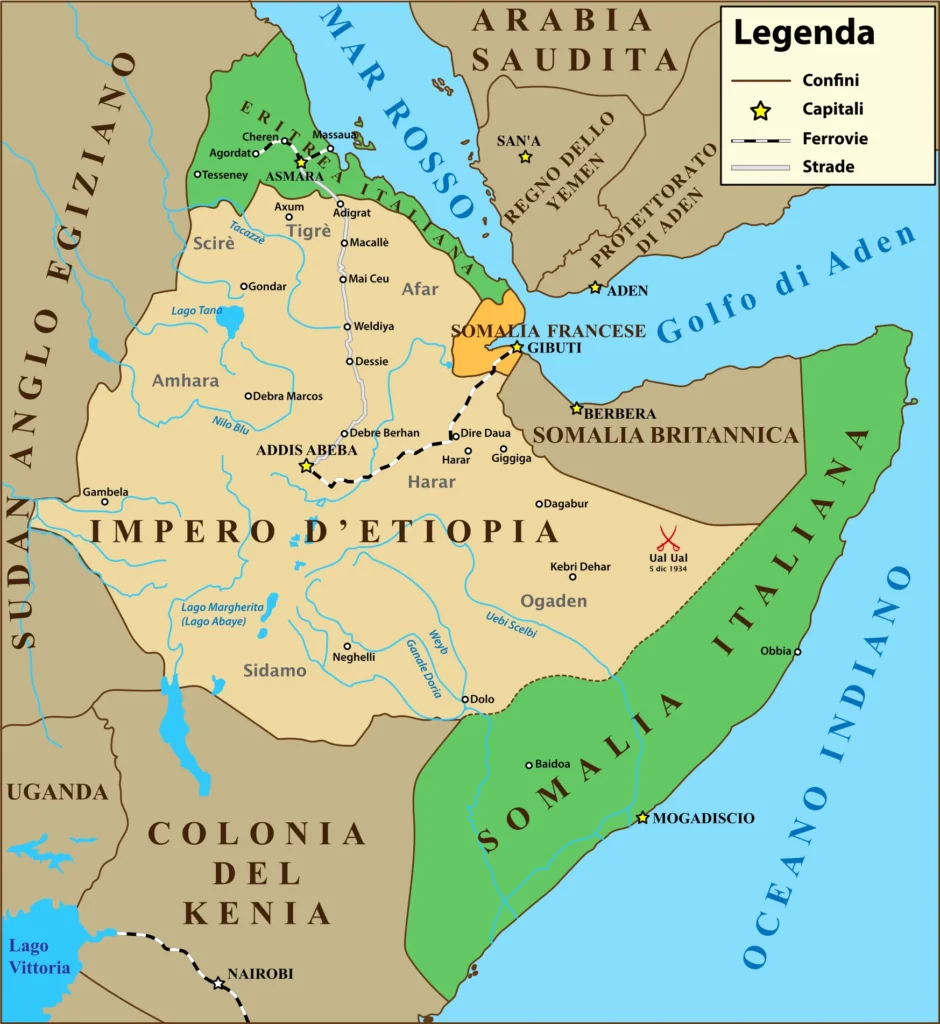
What is also clear from the photograph is that the fort had been built well beyond the 21 leagues border into Ethiopian territory. A British-Ethiopian border commission even arrived on site at Walwal on November 23, 1934. This border commission was tasked with determining where the final border between British Somaliland and Ethiopia should be drawn.
The group within which this border commission operated consisted of British and Ethiopian technicians and an escort of approximately 600 Ethiopian soldiers. They all knew that the Italians had established a military post in Walwal. So when they saw the Italian flag at the wells, they were not surprised. The Italian authorities had, in fact, already been informed that a border commission would be passing through. The Ethiopian government had even extended an olive branch to cooperate with the Italians on this matter. But when Lieutenant Colonel Esmond Clifford, the British commissioner, asked the Italians for permission to camp near Walwal, the Italians rejected his request through the intervention of Captain Roberto Cimmaruta.
Tensions thus remained high. The commander of the Ethiopian escort, Fitawrari Shiferra, paid no heed to the 150 Somali and Italian soldiers and set up camp anyway. Nevertheless, they wanted to prevent an incident between Italy and Ethiopia. So Clifford did withdraw with the British contingent to Ado. Meanwhile, Italian aircraft had already begun flying over Walwal. The Ethiopian commissioners also withdrew to Ado along with the British. But the escort remained behind.
What followed was a ten-day exchange of threats, which at times took place at a distance of just 2 meters from one another. Ethiopia subsequently sent military reinforcements, which eventually grew to 1,500 troops. Italy, on the other hand, increased its garrison at Walwal to 500 troops. At that point, it was practically inevitable that things would go wrong. On December 5, 1934, the first shots were fired. The Italian soldiers were supported by an armored car and a bomber. Although the bomber missed its targets, the machine-gun fire from the Italian armored car hit its mark. There were approximately 110 deaths on the Ethiopian side, and Italy suffered approximately 30 to 50 Italian and Somali casualties. It was the event that marked the beginning of the Abyssinian crisis for the League of Nations. However, in early September 1935, the League of Nations cleared both parties of blame for this specific incident.
High-Stakes Diplomacy
So while the British had already concluded a secret pact in 1925, a move that greatly outraged the French, it was the French who ultimately compromised their principles. On January 7, 1935, a Franco-Italian agreement was also signed. With this, France effectively gave Italy carte blanche in Africa. In return, Italy pledged to cooperate with France in Europe. France and the United Kingdom increasingly viewed Italy as an ally against Hitler. For this reason, the European great powers took no measures whatsoever to stop Italy from building up its forces along the borders of Italian Somaliland and Italian Eritrea. Mussolini, in turn, was tasked with ensuring that Hitler was stopped in his attempt to annex Austria. King Victor Emmanuel III of Italy would also give his approval for the war with Ethiopia, provided that Mussolini did not provoke the United Kingdom. The king, too, had great respect for the British navy. In essence, this meant that British appeasement toward Italy actually ensured that Mussolini’s efforts to secure the king’s support were, in fact, being supported.
Italy was thus given a “free hand” in Ethiopia, as Pierre Laval, the French Minister of Foreign Affairs, informed Mussolini, with the hope of forming a Franco-Italian alliance against Hitler. The new friendship between Italy, France, and the United Kingdom culminated in what we now know as the Stresa Front. It was an agreement between these three countries aimed at limiting further violations of the Treaty of Versailles by Nazi Germany. Sir John Simon, the British Foreign Secretary, stated in a communiqué from the first Stresa summit that the final version was to stipulate that the United Kingdom, France, and Italy would commit to maintaining stability in Europe. Mussolini’s interpretation was that, with such a declaration, the British were thereby accepting an Italian invasion of Ethiopia.
But just as quickly as the Stresa Front was formed, it fell apart. After all, the United Kingdom had secretly concluded the Anglo-German Naval Agreement behind France and Italy’s backs. France and Italy viewed this as an act of betrayal. But the final straw came after Italy’s invasion of Ethiopia. Mussolini had misjudged the European great powers. Following the invasion, France and the United Kingdom sided with the League of Nations, including the imposition of economic sanctions against Italy. That was reason enough for Italy to leave the Stresa Front coalition.
But this was not the end of diplomatic relations between the two countries. In the spring and summer of 1935, approximately 300,000 Italian troops were deployed to Italian Somaliland and Italian Eritrea. The newspapers were full of speculation that Italy was about to launch an offensive against Ethiopia. Anthony Eden, then still the Minister for League of Nations Affairs, arrived in Rome in June 1935. He stated that the United Kingdom opposed an Italian invasion and that they had made a compromise proposal to Mussolini. The compromise involved granting Italy an Ethiopian corridor, allowing Italy to connect its two colonies in the Horn of Africa. But Mussolini would have none of it and resolutely rejected this proposal. And the Italians had another trump card up their sleeve. The British naval codes had, in fact, been cracked by Italy. Mussolini was therefore aware that the British Mediterranean Fleet was in trouble. He therefore assumed that the British, although opposed to an Italian invasion, would not intervene militarily in the impending conflict between Ethiopia and Italy. The United Kingdom, as Mussolini believed, would never go to war over Ethiopia.
But another statesman, or, if you will, a dictator, was also watching closely. Adolf Hitler. He saw his chance in the crumbling alliance between the United Kingdom and Italy. What Hitler did next was a masterclass in covert statecraft. He began by supplying some weapons to Ethiopia. Not because he wanted Emperor Haile Selassie to win the war against Italy, but to ensure that the war between Ethiopia and Italy would drag on for a long time. According to Hitler, this was the way to ensure that the United Kingdom would urge the League of Nations to impose sanctions on Italy. He also thought ahead, reasoning that France would not, after all, veto such sanctions. The French did want to maintain good relations with the United Kingdom, despite a number of diplomatic betrayals that had taken place. Such a crisis in relations between the United Kingdom and Italy would give Hitler the opportunity to offer Germany’s “good services” to Italy.
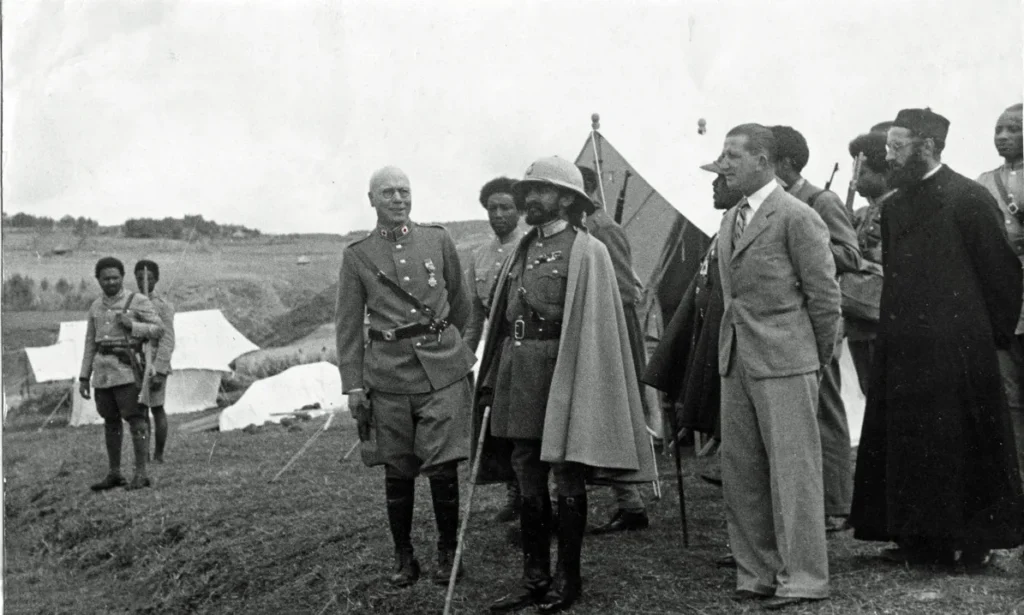
Hitler played this high-stakes game to ensure that Mussolini would become an ally. The Ethiopian Emperor Haile Selassie I, however, had not received the memo regarding this strategy. He thanked Hitler for Germany’s support and was reportedly grateful. In December 1934, he received a personal letter from Hitler. From that moment on, Selassie regarded Nazi Germany as Ethiopia’s only “sincere friend.” Who could have told him the truth?
The Outbreak of War
October 3, 1935, early Thursday morning at 5:00 a.m. Field Marshal Emilio De Bono crossed the Mareb River with his forces. Without any (formal) declaration of war, Italian troops entered Ethiopia from Italian Eritrea. Field Marshal De Bono led the attacking force, which consisted of the I Corpo d’Armata (I Army Corps) led by General Ruggero Santini on the left flank, the II Corpo d’Armata under the command of Lieutenant General Pietro Maravigna on the right flank, and the Corpo d’Armata Indigeni (Eritrean Army Corps) under the command of General Alessandro Pirzio Biroli on the center flank. On the other flanks of Field Marshal De Bono’s attacking force were the 13th and 26th Colonial Battalions in the eastern lowlands, the northern Danakil, and the southern Danakil. In the western lowlands, the 27th and 28th Colonial Battalions were present. They were joined by a unit of irregular fighters and volunteers from Libya, supported by the 17th Colonial Battalion.
But the Italian offensive campaign was plagued with problems from the start. The main obstacle was the lack of proper roads, which made the Italian crossing into Ethiopia difficult. On Italian-controlled Eritrean territory, the roads were well-constructed, all the way to the border. But as soon as they entered Ethiopian territory, the roads turned into virtually undefined trails. The Italian high command was therefore forced to use aerial photographs to plan the advance into Ethiopia. Field Marshal De Bono was well aware that the Italian lines had already stretched too far. The Italian troops would no longer be able to hold a front 480 kilometers long. The front area was also filled with steep mountains and deep gorges. Mother Nature also had a say in the Italian advance. The early onset of the rainy season had caused a number of recently constructed mountain roads to be washed away. Italy thus lost virtually an important supply route for resupplying the frontline troops.
On the other hand, during the first days of the Italian invasion, the Italian troops encountered virtually no resistance at all, apart from a few isolated firefights that took place along the main routes. Within three days, Italy had already captured the villages of Adigrat and Adwa, which, incidentally, had been left undefended on the orders of Emperor Haile Selassie. His son-in-law, Dejazmach Haile Selassie Gugsa, along with Ras Seyoum Mengesha, received orders from him to retreat to the south of Tembien, in Gheralta. There they were to wait for reinforcements from the southern armies, which still had to be mobilized. And what followed is easy to guess. The Ethiopian mobilization actually proceeded extremely slowly overall. The armed columns had to cover hundreds of kilometers on foot. Troops from various regions of the Ethiopian Empire had to assemble in Tigray.
Due to the slow mobilization, a significant (counter)offensive by the Ethiopians could not take place before December 1935. Field Marshal De Bono was well aware of this. He therefore stuck to the tactics he had planned in advance. He therefore consolidated the positions he had already captured and established his defensive line. His goal was to destroy the Ethiopian army in one fell swoop by waiting for the impending Ethiopian offensive and then striking it down.
The First Surrender and Continuation of Offensives
But what followed Field Marshal De Bono’s strategy was initially something else. At least, Haile Selassie Gugsa, the Emperor’s son-in-law, saw it differently. On October 11, 1935, he committed the ultimate act of treason, if you were to ask Emperor Haile Selassie I. On this day, Haile Selassie Gugsa defected to the Italians, along with his 1,200 followers. The surrender took place at the Italian outpost in Idaga Hamus. It was heaven on earth for Italian propaganda, which naturally spread this news far and wide. But in reality, Haile Selassie Gugsa surrendered to the Italian side with less than about 10% of his troops.
Shortly thereafter, on October 14, 1935, Field Marshal De Bono declared an end to slavery in Ethiopia. The Italian army reported the immediate emancipation of 16,000 slaves in the two weeks that followed. This, of course, helped improve international public opinion.
On October 15, 1935, the holy city of Axum was occupied by Lieutenant General Maravigna’s II Corpo d’Armata. It was then that Field Marshal De Bono began to put his strategy into action. He halted the further advance into Ethiopia. But Mussolini was not pleased with this and continued to press for a new advance. Ultimately, the Field Marshal had to comply, so on November 3, 1935, the advance resumed, this time toward Mekelle with two army corps. The II Corpo d’Armata was left south of Axum to provide cover for the I Corpo d’Armata and the Corpo d’Armata Indigeni as they advanced toward Mekelle. A number of detachments of Italian troops were directed toward the Tekezé River, after which the town of Shire was captured without any significant battles. In fact, all Italian troops encountered little resistance at that time. There were only a few isolated skirmishes with the enemy, along with some minor disturbances. Incidentally, the village of Mekelle had already been abandoned on October 27, 1935, after which Italian troops entered the village on November 8, 1935.
At the same time, the southern campaign led by General Graziani began in early October 1935. He set out with a column of motorized troops supported by the Regia Aeronautica and tanks. While the campaign had encountered little resistance from the Ethiopian army up to that point, that changed in the Fanfan Valley near Gorahai. There, the Italian troops faced fierce Ethiopian military resistance. These Ethiopian troops were led by Afawarq Wada Samayat. Only after Samayat was mortally wounded were the Italians able to break through the defenses and capture Gorahai on November 7, 1935. From there, they advanced approximately 193 kilometers, or 120 miles, up the Fanfan Valley toward Degehabur. Nevertheless, the Italian troops were again met by Ethiopian defenses, which they initially could not penetrate. The Italian troops were even forced back to Gorahai as a result of Ethiopian attacks led by Nasibu Zeamanuel. The other Italian attack force within the southern campaign, led by Pietro Maletti, also reached Degehabur. Nevertheless, Maletti was also forced to retreat north of Gorahai after his forces were caught in a deadly ambush. In fact, by the end of 1935, Graziani had made little to no further progress in the southern campaign. He had been halted by Nasibu in Hararghe and Desta Damtew in Sidamo, and the heavy rainfall made any further advance even more difficult.
On November 11, 1935, Mussolini issued a new order to Field Marshal De Bono. He was to have Lieutenant General Maravigna’s II Corpo d’Armata advance across the Tekezé. General Biroli’s Corpo d’Armata Indigeni was to move toward Amba Alagi. However, Field Marshal De Bono disagreed with Mussolini and made his views known. The Field Marshal realized that these orders would cause major logistical problems. Multiple positions would have to be reinforced simultaneously, and areas spanning hundreds of kilometers would need to be secured. In addition to the fact that the Italians would actually have to build new roads for a further advance. Mussolini actually agreed with the Field Marshal, but dismissed him nonetheless on November 14, 1935. From that moment on, the campaign was led by Field Marshal Pietro Badoglio as commander in East Africa. But the Ethiopian army also remained on the move. November 17, 1935, was the day when another 20,000 troops under Ras Kassa Haile Darge joined the 15,000 Tigrayans under Ras Seyoum in the Mai Mescic Valley. When the Regia Aeronautica spotted these reinforcements, they launched an attack the following day. But to no avail, as many Ethiopian troops were moving quickly and were protected by the Oerlikon cannons.
Sanctions and Escalation of the War
On November 18, 1935, 50 member states of the League of Nations voted in favor of economic sanctions against Italy. Only Austria, Hungary, and Albania abstained, and Italy, of course, voted against them. The sanctions were weak, but they were sanctions nonetheless. For example, the Suez Canal was not closed, and Italy maintained a steady supply of oil, steel, and coal. Within Italy itself, the war enjoyed growing support from the population. Mussolini told citizens that his open defiance of the League of Nations should be seen as proof of Italy’s greatness. A direct result of this was the Oro alla Patria, a campaign in which Italians donated their gold to the state to finance the war. As a result, hundreds of thousands of rings and other pieces of jewelry were turned in in Rome and Milan.
In December 1935, the United Kingdom and France were still attempting to resolve their issues with Italy through diplomatic channels. The final attempt at reconciliation was the Hoare-Laval Pact. Italy was promised the best parts of Tigray and Ogaden, along with economic influence in southern Ethiopia. The only problem was that Ethiopia strongly disagreed. But Mussolini also demanded more. As is often the case, this secret plan was leaked on December 13, 1935. It forced Sir Samuel Hoare, the British Foreign Secretary, to resign.
At the same time, the Ethiopian army was continuing its mobilization, and the Christmas Offensive was also in the planning stages. The Italian troops in the north were to be split up, and Ethiopia intended to use this route to invade neighboring Eritrea. On December 15, 1935, the Ethiopian offensive began. 20,000 soldiers under Ras Imru Haile Selassie attacked the thin Italian line along the Tekezé. On the defensive were four Blackshirt battalions under General Filippo Diamanti. Heavy fighting ensued, with heavy casualties on both sides. The Ethiopian troops subsequently broke through the Italian lines. This prompted Captain Carlo Emanuele Basile to order an immediate retreat from Shire to Selekleka. But that was not far enough. The retreat continued to Axum, where Italian reinforcements were waiting. An Ethiopian attack also took place in Tembien. Ras Seyoum Mengesha led the offensive at Abiy Addi. Colonel Ruggero Tracchia’s troops initially held their ground but were ultimately forced to withdraw from Abiy Addi on December 27, 1935.
In fact, Mussolini was not doing very well at all in his campaign in Ethiopia at that time. This led to drastic measures being taken. On December 28, 1935, Mussolini authorized Maresciallo d’Italia (Field Marshal) Badoglio to use chemical weapons, primarily mustard gas. But to make matters worse, the military directive also included an order for a “no prisoners” policy and the complete destruction of the Abyssinian armies. On January 1, 1936, the use of chemical weapons was approved by Colonial Minister Alessandro Lessona; it was a “highly justified retaliation,” referring to the brutal murder of pilot Tito Minniti, who was captured behind enemy lines on December 26, 1935, tortured, mutilated, and killed. During the advance of Ethiopian troops between December 22, 1935, and January 18, 1936, more than 2,000 quintals of gas were dropped over Tigray. No distinction was made between Ethiopian civilians and military personnel.
Hitler Becomes Invisible
This is indeed not the whole story of the Second Italo-Abyssinian War. But this is what I wanted to include in the article. Because much more happened. The reason all of this is important is to illustrate just how deeply the League of Nations, but especially the United Kingdom and France, were drawn into the conflict, at least on a diplomatic level. Italy’s loyalty was essential to any coalition against Nazi Germany, and that demand consumed their diplomatic energy. And that very person, Hitler, became, as it were, invisible during that specific period. In this article, you have read about what the European great powers had to deal with, right up to the use of chemical weapons. Hitler saw this at the time as well and took full advantage of it. The chaos emboldened him to attempt to remilitarize the Rhineland. He sent German troops into the Rhineland. The European powers did not intervene.
The fact that the European great powers did not intervene and that the League of Nations had, in fact, taken no meaningful action against Hitler began to embolden him in his own drive for expansion. What further bolstered his confidence, moreover, was that he saw the League of Nations was also completely powerless against Mussolini and his imperialist war in Ethiopia. Neither the European great powers nor the League of Nations could stop Italy. Amid these international incidents, Hitler maneuvered to achieve his ultimate goals. This situation ultimately culminated in the alliance between Nazi Germany and Mussolini. Italy faced sanctions and became, as it were, isolated. The Stresa Pact had already fallen apart, and virtually all League of Nations countries were opposed to Mussolini’s war in Ethiopia. The only European country still open to a rapprochement was Nazi Germany. And Mussolini sought it out, which is where their alliance was born. Since Italy was no longer expected to oppose the annexation of Austria by Nazi Germany, all of this also served as a prelude to the eventual Anschluss in 1938.
While the world’s attention was on Italy and Ethiopia, Hitler was quietly advancing his own agenda. Although the European powers were concerned about Hitler, he managed to slip under the radar for a brief moment. Just enough time to forge his plans and set his first moves in motion, without reprisals and amid a policy of appeasement.
Field Command members: the Author’s Note for this article is available in the Field Command area.
WarCommons publishes long-form, source-driven World War II analysis without ads or sponsored content. If you found this article valuable, consider supporting independent research by joining Field Command.
By Nick Ravenshade — Founder & Editorial Director, WarCommons
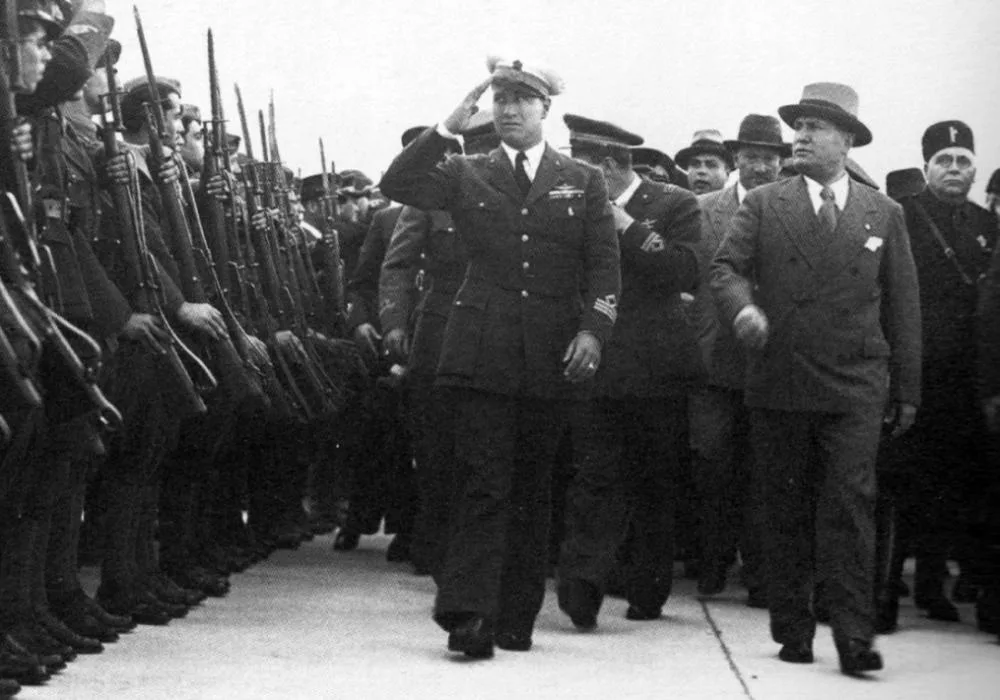
Header image: Galeazzo Ciano and Benito Mussolini inspecting troops returned from Italian East Africa. May 17, 1936. Source: Wikimedia Commons. Public domain.