WARCOMMONS IS NOW ON ANDROID
Explore WWII history and stay connected with the community on the go. GET THE APP →
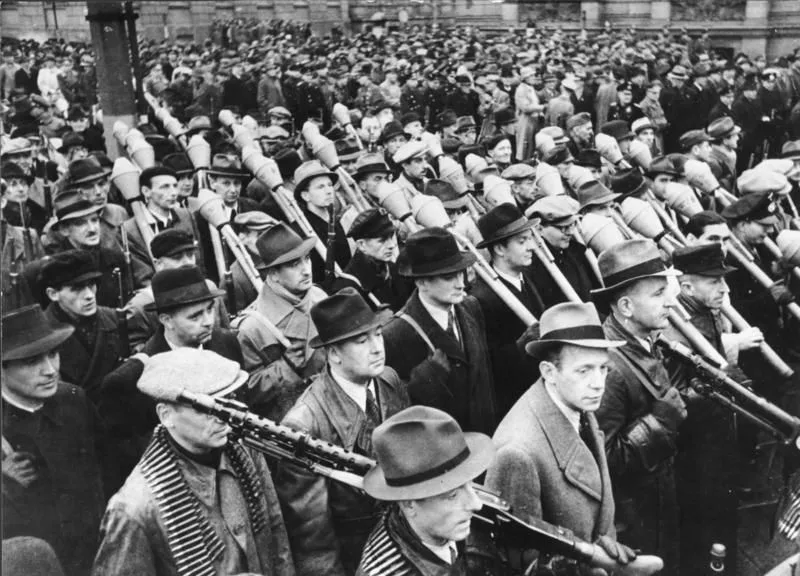

After the horrors of Stalingrad, the collapse of the Eastern Front, Operation Bagration, and the aftermath of the Allied landings on the Western Front during D-Day, Hitler was ready to make his final desperate move: the Volkssturm.
The Volkssturm was officially announced by Heinrich Himmler on October 18, 1944. On Hitler’s orders, the Volkssturm was established by a secret decree that he had already signed on September 25, 1944. Recruitment was to be carried out among men between the ages of 16 and 60 who were not yet serving in the military.
In 1944, the Red Army was on the verge of advancing into Germany and had already advanced as far as Poland and East Prussia. On the other hand, Germany had suffered heavy losses. The Wehrmacht was therefore facing a severe shortage of manpower, in addition to shortages of equipment, logistical resources, and fuel.
After nearly five years of war, the Wehrmacht’s reserves needed to be replenished. However, nearly all the boys and men who were fit for military service were already serving in the Wehrmacht. As a result, the Volkssturm had to consist primarily of boys and men who had initially been deemed unfit for military service. They were now called up to defend their homeland against the Red Army.
By the end of World War II, women and girls were also expected to play an active and supportive role within the Volkssturm. However, they were not officially part of the Volkssturm itself; that dubious honor was reserved for the men. The women and girls were primarily deployed for logistical support, guard duty, and defensive tasks, such as digging tank ditches, trenches, and erecting barricades. Many women were also assigned to nursing duties to care for wounded soldiers and Volkssturm members.
Girls from the Bund Deutscher Mädel (BDM) were also deployed as so-called Flakhelferinnen (anti-aircraft assistants). In that capacity, they operated searchlights and tracking equipment and provided support to the anti-aircraft artillery batteries.
The Formation of the Volkssturm and Internal Power Struggles
The Volkssturm was established in October 1944 at Hitler’s initiative. The true architect of the Volkssturm is sometimes overlooked. The real architect of the Volkssturm was Martin Bormann. Bormann was the head of the Party Chancellery and the primary driving force behind the idea of the Volkssturm. His idea was to place the Volkssturm under the control of the Nazi Party in order to strengthen the Volksgemeinschaft and maintain total control. His vision for the Volkssturm was a political party army.
But Bormann wasn’t the only driving force behind the Volkssturm. It was also a joint effort. The leading roles were played, of course, by Hitler, but also by Himmler.
The de facto formal command of the Volkssturm fell to Himmler. At that time, he was Reichsführer-SS and commander of the reserve army, the so-called Ersatzheer. He was therefore responsible for its military organization, armament, and training. While Hitler signed the secret decree establishing the Volkssturm on September 25, 1944, Himmler officially announced the formation of the Volkssturm on the radio on October 18, 1944.
Despite the joint efforts of Hitler, Bormann, and Himmler to establish the Volkssturm, the process was not entirely without tension. In 1944, the Volkssturm can also be viewed within the context of the ever-intensifying internal power struggle within the Third Reich. Its establishment, in fact, took place against the backdrop of a fierce power struggle between Bormann and Himmler. In the final days of World War II, they were two of the most powerful figures in Nazi Germany
While Bormann viewed the establishment of the Volkssturm as a political party army, Himmler regarded the Volkssturm as a legitimate part of his military authority. He therefore sought to assume control over its armament and training.
Ultimately, it fell to Hitler to settle this internal power struggle over the Volkssturm. Hitler entrusted the political leadership and organization of the Volkssturm to Bormann. Himmler, however, did not come away empty-handed. He remained responsible for the military training and arming of the Volkssturm. Hitler’s decision, however, was more of a shifting of the power struggle than a resolution of it. The shared responsibility between Bormann and Himmler constantly caused friction and inefficiency, as they often worked at cross-purposes.
The Army of Despair
There is broad consensus among historians that the Volkssturm had approximately 6 million members. This does not mean that there were 6 million deployable, trained, or armed men within the Volkssturm. This figure refers to the number of registrations or enlistments in the Volkssturm. The actual size of the Volkssturm in terms of truly deployable personnel is virtually impossible to determine with certainty. Estimates suggest that at its peak, the Volkssturm consisted of around 450,000 personnel. However, this cannot be established with certainty.
The Volkssturm can be seen as an army of desperation, because by the time it was formed, it was already clear to everyone that Nazi Germany would not win the war. With surrender inevitable, Hitler believed this move would ensure the defense of the Third Reich. This leaves a bitter aftertaste for every victim within the Volkssturm. After all, every casualty could have been prevented at that point.
It is a product born of despair, fanaticism, and the doctrine of total war. Total war, conceived in the wake of the disastrous defeat at Stalingrad in 1943.
The army of desperation was doomed to fail. There was a severe lack of training and leadership. Many Volkssturm units received only brief basic training and instructions. A true hierarchy was absent, due to a lack of experienced officers and non-commissioned officers. The fact that nearly the entire Volkssturm was poorly or non-standardly armed also contributed to the total fiasco of the Volkssturm. They had access only to outdated weapons, such as those from World War I and the Panzerfaust. There was no machine gun or artillery support whatsoever. There were also significant regional differences in effectiveness and deployment. This was because the Volkssturm was organized locally through party and municipal structures.
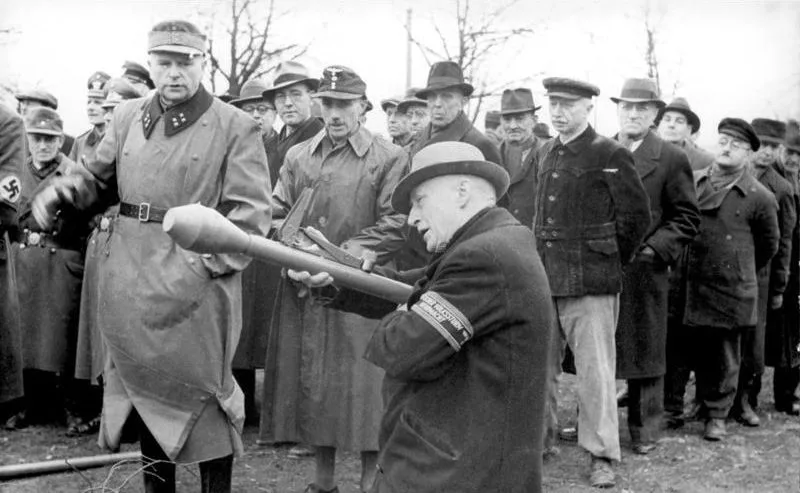
It will never be possible to determine exactly how many casualties the Volkssturm actually suffered. This is due to incomplete casualty records within the Volkssturm and the fact that funerals were organized locally. What can be concluded, however, is that the Volkssturm suffered significant casualties. Simply comparing the Volkssturm’s poor training, armament, and organization against the total advance of the Allies on the Western, Southern, and Eastern Fronts leads to a conclusion that can be drawn cautiously, yet with conviction. We can, however, rely on the conclusion reached by the prominent German military historian Rüdiger Overmans. Approximately 1.23 million German military personnel were killed in the last four months of the war. During that period, the Volkssturm suffered very heavy losses within the total German casualties.
Desertion within the Volkssturm
However, the losses suffered, poor armament, and poor organization were not the Volkssturm’s only problems. Desertion was also very common. Recording desertions was extremely difficult in 1944 and 1945, as Nazi Germany was already in a state of administrative chaos and facing rapid military collapse. Systematic registration was therefore also difficult to organize. It is likely that cases of desertion, when noticed, were dealt with summarily, with the deserter paying with his life. It is not unreasonable to assume that these cases were therefore not reported or recorded.
Desertion was often dealt with by the so-called “fliegende Standgerichte” (mobile courts-martial). These were established not only for the Wehrmacht but also for the Volkssturm. In the final phase of the war, documented cases of the fliegende Standgerichte came to light, particularly from March 1945 onwards. This was primarily used by the Nazi leadership (the SS and the NSDAP) against traitors. Those they called traitors were mainly deserters and civilians who refused to fight. Appearing before the flying Standgerichte (always) meant summary execution. The flying Standgerichte was intended to prevent desertion, prevent collective surrender, and maintain the total war. In some cases, summary execution meant being hanged from lampposts or trees, often with a sign around the neck. The sign would bear texts such as “I am a traitor” or “I am too cowardly to fight.”
It is therefore impossible to determine with certainty the extent to which desertion occurred. However, it can be argued that it did occur, and perhaps more frequently than we currently realize. After all, the Volkssturm consisted of men between the ages of 16 and 60 who had not previously been drafted into the Wehrmacht. These were primarily men who were also unfit for military service, for example, due to their physical condition, their age, or because they were doing something for Nazi Germany that they considered even more important than serving in the army.
It can be argued that the vast majority lacked any form of intrinsic motivation to fight. Under a specific provision, Volkssturm members were classified as part of the Wehrmacht and were therefore regarded as full-fledged soldiers. In the final months of the war, the means to prevent desertion on a large scale were virtually nonexistent. By 1944, many had already realized that Germany could not win the war. Consequently, there was little faith in victory.
These are key factors that contribute to desertion. However, in most cases, surrendering on either side would also mean certain death.
The main reasons the Volkssturm continued to fight to the bitter end were largely driven by Nazi propaganda. Through this propaganda, people were instilled with fear of what would happen if the Red Army defeated Nazi Germany. Posters, pamphlets, and newspaper articles emphasized duty, patriotism, and the threat of the “Bolshevik” enemy. They used visually heroic and patriotic imagery on the posters and printed materials. But radio broadcasts and mass rallies led by Goebbels and Himmler were also employed. At this stage, the war was portrayed in propaganda as an existential struggle against communism and the Western Allies. The Red Army was said to rape all German girls and women as it advanced further into Germany; it was partly up to the Volkssturm to prevent this. The latter is one of the examples used in Nazi propaganda to instill a collective sense of fear and thereby motivate the Volkssturm to fight to the bitter end. A salient detail that is sometimes overlooked is that the Volkssturm had to take an oath. This was intended to reinforce a sense of duty and prevent desertion. The oath was mandatory, in which the Volkssturm pledged total loyalty to Hitler. This personal devotion to Hitler was also intended to prevent desertion and boost morale. Under no circumstances was the Volkssturm allowed to surrender; it had to defend the German fatherland to the bitter end.
However, none of this made any difference. The Volkssturm proved to be ineffective, poorly organized, poorly trained, poorly armed, and weak. Despite all the oath-taking, parades, speeches, Nazi propaganda, and fear.
In the end, the Volkssturm was nothing less than an army of desperation.
WarCommons publishes long-form, source-driven analysis without ads or click incentives. If you found this feature valuable, consider supporting our research by subscribing to help fund future investigations.
By Nick Ravenshade — Author
Header image: Volkssturm march past Goebbels, Berlin, 1944. Source: Wikimedia Commons / Bundesarchiv, Bild 146-1971-033-15 / CC-BY-SA 3.0 DE