
WARCOMMONS IS NOW ON ANDROID
Explore WWII history and stay connected with the community on the go. GET THE APP →

It is September 3, 1939. The United Kingdom officially declared war on Hitler’s Germany, the Third Reich. It was only two days after the German invasion of Poland.
That same day, the Kriegsmarine was preparing for its upcoming operation in the Atlantic Ocean. The start of the longest military campaign of World War II. The U-boats were ready for the so-called Battle of the Atlantic. The goal? To destroy the maritime supply lines to the United Kingdom and thereby disrupt the United Kingdom and its war efforts to such an extent that it would be forced to surrender.
The Battle of the Atlantic
The main reason for British rationing was the Battle of the Atlantic, which began immediately after the United Kingdom declared war on Germany.
Even before the war, the United Kingdom depended on imports via maritime supply lines for a number of raw materials, such as iron ore, bauxite, and petroleum. But that was not all. The United Kingdom also depended on imports across the Atlantic for a large number of foodstuffs. They imported as much as 20 million tons of food per year in the 10 years leading up to World War II. This amounted to nearly two-thirds of the total British food supply. Imports also accounted for 80% of all fruit, 70% of all cheese, 70% of all grains and fats, and more than 50% of all meat.
Adolf Hitler therefore saw his chance through the Kriegsmarine, led by Grand Admiral Erich Raeder. Yet it would not be Grand Admiral Raeder who would play a significant role. That role was reserved for the man they called “Der Löwe.” Admiral Karl Dönitz, who was in charge of the entire U-boat fleet.
In the Battle of the Atlantic, early 1940 marked the time for Hitler to implement his next strategy: starving the British Isles. The U-boats were deployed to attack and sink convoys carrying food and other supplies. The result was intended to be that the British would no longer have access to food supplies and would cease the fight against Germany. During the war and the Battle of the Atlantic, British food imports fell by nearly half, from 22 million tons to 11.5 million tons per year.
Rationing in everyday life
As a result of the German blockade in the Atlantic, nearly one-third of Britain’s food supply was cut off. This led to unreliable imports, and some essential foodstuffs became scarce. There was only one solution: the introduction of a rationing system. This was implemented by the Ministry of Food from 1940 onward. In 1939, only one commodity was rationed: fuel.
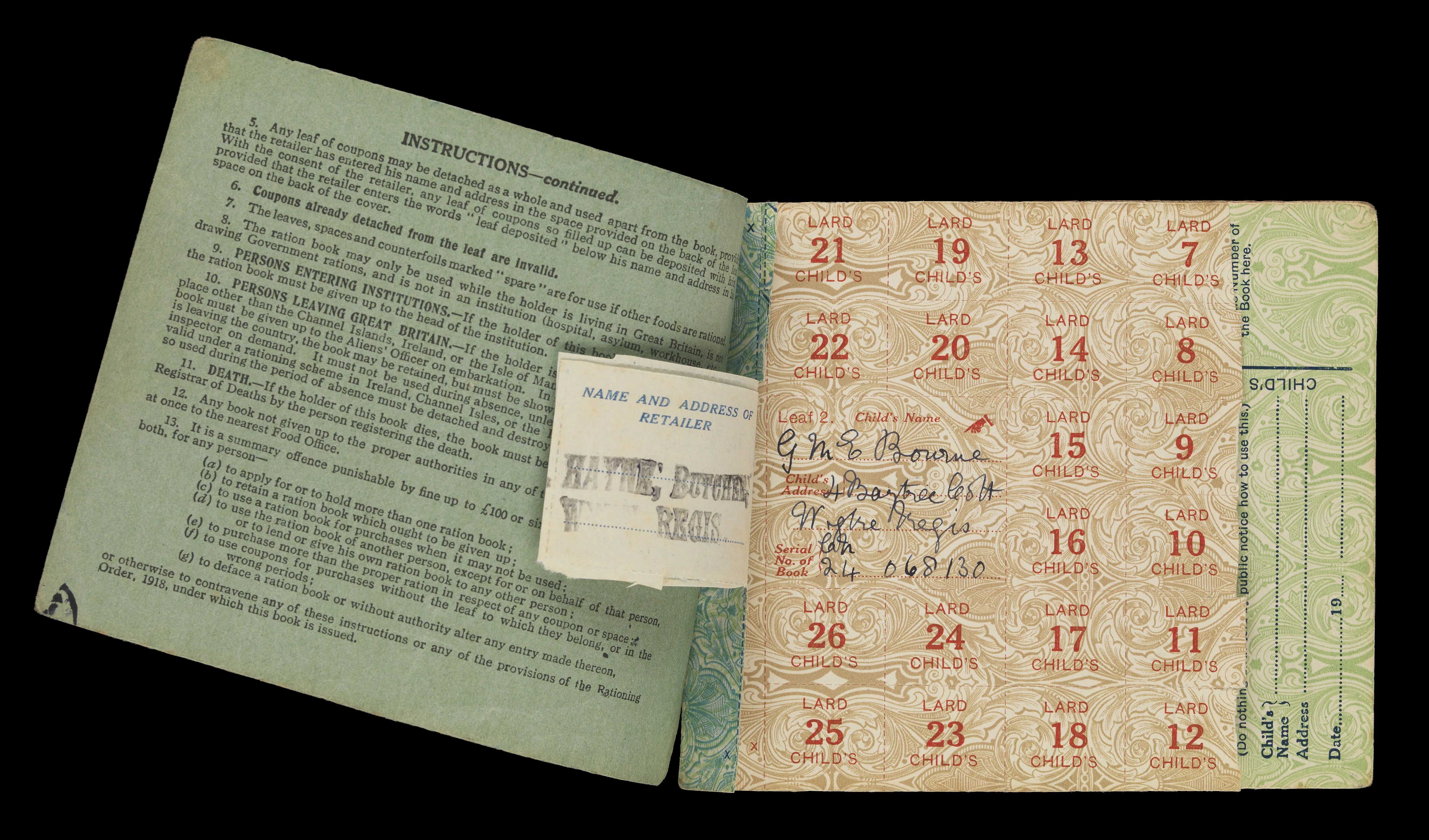
People had to register at designated stores in order to purchase rationed goods. After registering, they received a ration booklet containing ration coupons. The shopkeepers were then supplied with sufficient food for their registered customers. Customers had to show their ration book in the stores so that the coupons for the specific rationed product could be stamped. However, this was not a substitute for payment. The ration book merely indicated whether you were still entitled to a certain product and whether it had not already been stamped in your book. The products still had to be purchased and paid for. However, the British government did control the prices. That is why many food items, which were labeled as essential, were subsidized by the government. Rationing thus limited the types and quantities of products people could buy, as well as their costs.
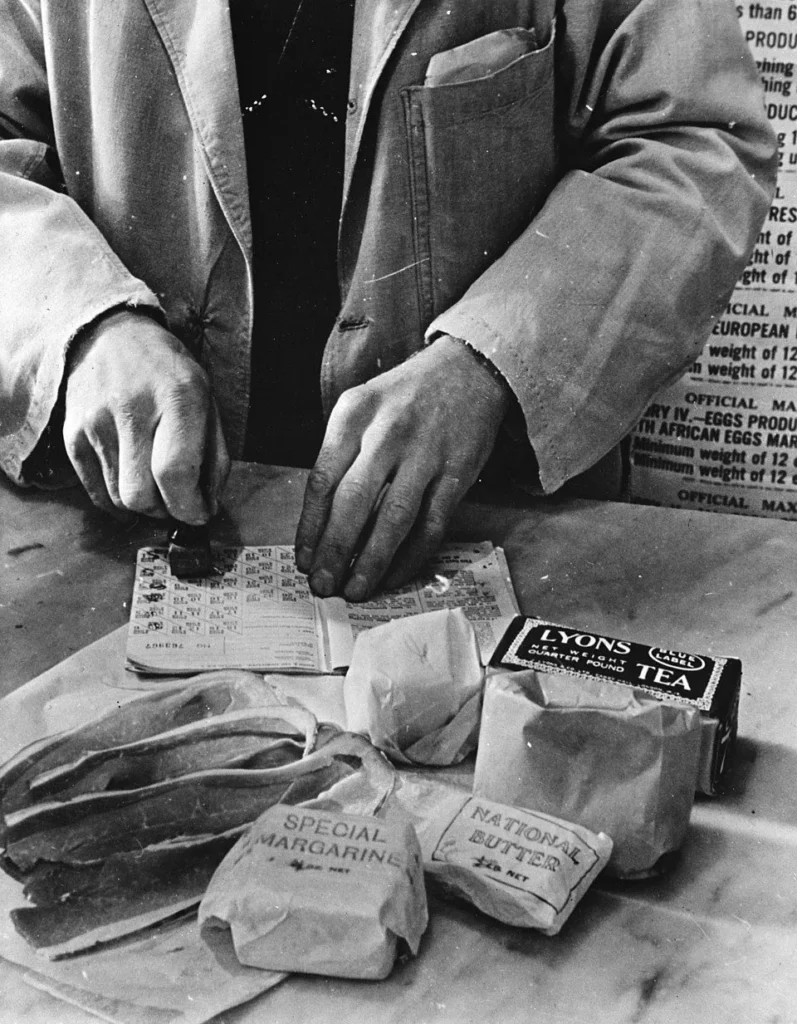
However, even non-rationed products were subject to government control, including price controls. Many of these products could be in short supply, as people were still able to stockpile them. As a result, the prices of many such non-rationed products were very high; unaffordable for many.
The rationing strategy included price controls, subsidies, and government-mandated standards. The government set maximum prices for essential goods and resources, such as food, fuel, and clothing. This was done primarily to combat inflation and to ensure that products remained affordable for the entire population. An unregulated market in those times of scarcity would have meant that prices would skyrocket to unaffordable levels, which would have fueled inflation.
To ensure that these price caps could be maintained without depriving the producers of these goods, the British government utilized subsidies. These subsidies were provided to support the production and distribution of food and raw materials. The standards imposed by the government pertained to the distribution of goods and food. By using ration books and ration coupons, the maximum amount a person was allowed to purchase was guaranteed. This prevented people from hoarding goods and food and ensured an equitable distribution.
The purpose of rationing was not merely to manage the scarcity of certain foodstuffs. It also ensured that the British Army and other essential British services were given priority. Sufficient food and other goods were vital to the British war effort. Rationing thus ensured that everyone had access to sufficient and affordable goods and food, which also had to be of acceptable quality.
Fraud in rationing
Measures such as rationing are inherently prone to fraud and the emergence of a black market. After all, in such situations there are always people who want more or believe they are entitled to more. On the other hand, there are also people who are happy to facilitate this. This is exactly what happened during World War II. The black market that emerged was not all-encompassing, but it was significant. There is broad consensus among researchers on this subject.
There were several prominent ways in which the black market operated during rationing. The main forms of fraud involved forging or reselling ration coupons, and shopkeepers setting aside extra food for regular customers. Fraudsters also did not shy away from selling stolen food and goods or counterfeit ration books.
Fraud also had a significant impact on communities. If someone was suspected of fraud, it heightened feelings of injustice, distrust, and inequality. Another key factor contributed to this: enforcement was inconsistent, with local investigations and criminal prosecutions occurring, but with capacity too limited to maintain adequate enforcement.
However, rationing did not bring only misery.
The surprising effects
Within the United Kingdom, serious consideration was given to a scenario in which all imports would be cut off by the Kriegsmarine’s U-boats. Consequently, a study was conducted in December 1939 by Elsie Widdowson and Robert McCance of the University of Cambridge. They investigated whether the British could survive on domestic food production alone if imports were completely disrupted.
Based on food production levels in 1938, the researchers provided themselves and other volunteers with one egg, 450 grams of meat, and 110 grams of fish per week; and 140 ml of milk, 110 grams of margarine, and unlimited amounts of potatoes, vegetables, and whole-grain bread daily. This was combined with two weeks of intensive outdoor exercise. The intensive exercise was designed to simulate the heavy physical labor that the British were expected to perform during the war.
The researchers concluded that the subjects’ health and performance remained good after three months. This gave the British government confidence that, in the event of a food shortage, it could distribute food evenly among the population without causing widespread health problems. In practice, however, British rationing was not as strict as in the Cambridge study. This was partly because food supplies imported from the United States managed to evade German U-boats. As a result, everyone ultimately had access to a varied diet with sufficient vitamins under the rationing system. And children under 5 and pregnant women received subsidized milk. Consumption of fat and sugar decreased, while consumption of milk and fiber increased.
Researchers agree on the consequences of rationing during World War II. The health of the British population improved, infant mortality declined, and life expectancy rose. This, then, is precisely the irony of British rationing. A doctrine of the Third Reich, intended to starve the British, only made them healthier.
WarCommons publishes long-form, source-driven analysis without ads or click incentives. If you found this feature valuable, consider supporting our research by subscribing to help fund future investigations.
By Nick Ravenshade — Author
Image: Child’s ration book (A), Ministry of Food | Source: Wikimedia Commons. CC-BY 4.0.





,_Ministry_of_Food_Wellcome_L0072437.jpg)