WARCOMMONS IS NOW ON ANDROID
Explore WWII history and stay connected with the community on the go. GET THE APP →
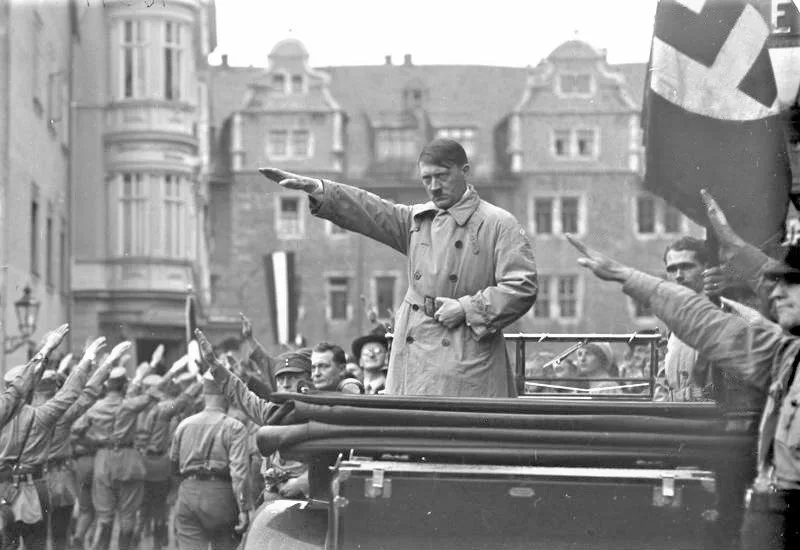

The Kingdom of Bavaria, the scene of the culmination of German collective discontent and crises during the interwar period in the run-up to World War II. There was, however, one city where the NSDAP had already secured a political majority in the city council in 1929 and where the swastika flag was already flying as early as January 1931. It was not the capital, Berlin, nor was it Hitler’s beloved Munich. It was Coburg.
This is the story of Bavaria in 1930. The turning point in the history of World War II.
Core role in Bavarian politics
Beer halls had been at the center of Bavarian politics since 1920. Both radical left-wing and radical right-wing political parties used beer halls for a variety of purposes. They served as party offices, as well as meeting places and recruitment centers. Beer halls were ideally suited for these purposes because, at the time, they were inexpensive, spacious, and easily accessible venues.
The beer halls were already deeply embedded in everyday life. As a result, they were easily accessible and naturally drew large crowds. Political parties, paramilitary groups, and activists saw the beer halls as an excellent opportunity to reach the masses in an effective and inexpensive way. Consequently, a number of small political parties used them as party offices. But they also became propaganda centers and recruitment centers where people gathered to give speeches, network, and mobilize the masses.
Bürgerbräukeller and the Bierkellerputsch
One such beer hall was the Bürgerbräukeller, the site of the Beer Hall Putsch. During the Weimar Republic, it was the go-to venue for political gatherings.
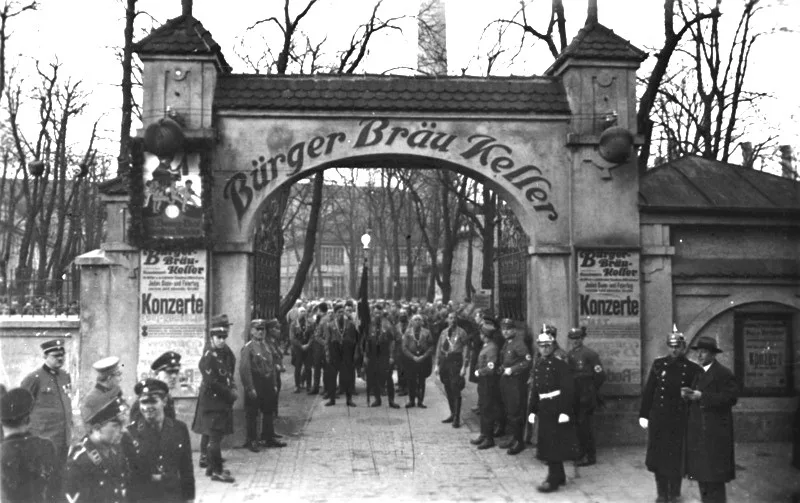
The Bürgerbräukeller gained international fame on November 8, 1923. Gustav von Kahr, a German right-wing conservative politician, was speaking on the stage of the Bürgerbräukeller. His political speech was abruptly interrupted by the arrival of three men. They were the National Socialists Erich Ludendorff, the prominent military figure and the legitimizing force behind the Beer Hall Putsch; the then World War I war hero Hermann Göring; and none other than Adolf Hitler, the corporal from World War I.
Gustav von Kahr was driven off the stage. The National Socialists delivered a speech and called on those present to stage a coup. Gustav von Kahr was also asked for his support. He declared his support for Hitler, and the very next day, on November 9, 1923, Hitler and his followers marched on the Feldherrnhalle at Odeonsplatz. This resulted in a firefight and the failure of the coup. And Gustav von Kahr? He withdrew his support just before the march and did not participate in the Beer Hall Putsch. Historians attribute part of the coup’s failure to Gustav von Kahr’s withdrawal of support. He therefore had to pay the price for this high treason in Hitler’s eyes on June 30, 1934, during the Night of the Long Knives. He was ultimately executed at the Dachau concentration camp.
However, the Bürgerbräukeller was not merely the scene of the Beer Hall Putsch or the November 8, 1939, assassination attempt on Hitler. This beer hall was not just one of the major beer halls that became the focal point of Hitler and the NSDAP’s rise to power.
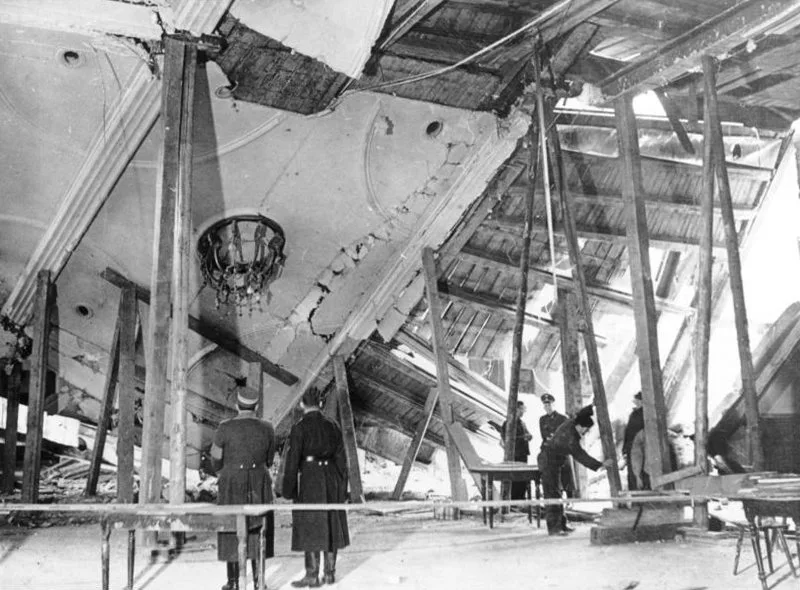
The Bürgerbräukeller is the epitome of how beer halls effectively became town halls.
The Beer Hall Putsch is the most obvious example of this. It was precisely this kind of place, a beer hall, that lent itself to finding the right audience and made political agitation possible. It was not merely a place for politicians or citizens to voice their discontent over the dire economic conditions, unemployment, and hatred toward the Treaty of Versailles. They were breeding grounds for extremist rhetoric that tapped into the mood of society. They were such important places that they could even lead to a coup d’état, and indeed did.
A natural playing field
However, there was another important factor at play. The mass media as we know it today did not yet exist. Radio was still in its infancy, and not every political party had access to newspapers and the press, let alone to photography and film. It was therefore important to find your audience, a place where your views could be presented to a public receptive to them. That is why beer halls became the primary arena for radical left-wing and radical right-wing political parties. The audience receptive to radical left-wing and radical right-wing rhetoric consisted mainly of people who harbored deep dissatisfaction with the state of the country. And beer halls happened to be precisely the place where these groups of people were already gathering.
Many men, including the unemployed and blue-collar workers, spent a great deal of time in these beer halls. As a result, political parties recognized early on that this was an effective channel for establishing direct contact with the public. In the early 1930s, unemployment rose to double digits as a result of the Great Depression. This led to social unrest and discontent, thereby increasing receptiveness to radical political messages. The NSDAP capitalized on this in particular, delivering speeches and radical views in the beer halls. They sought to appeal to a broad audience, not just the unemployed and workers, but anyone who felt any dissatisfaction with the economic situation and experienced shame and anger over the consequences of the Treaty of Versailles. The KPD and SPD, on the other hand, focused primarily on workers and the unemployed, which is why the beer halls were also an obvious choice for them.
Although the beer halls played a central role in Bavarian politics, they were only the beginning.
Julius Streicher’s Nuremberg
A prime example of how beer halls were transformed into so-called community centers is Streicher’s work in Nuremberg. Streicher was Gauleiter of Franconia and the publisher of the newspaper Der Stürmer. He had been involved in National Socialist circles since 1919 and eventually joined the NSDAP after its reestablishment. He was an early follower of Hitler and also took part in the failed Beer Hall Putsch.
As early as the 1920s, Streicher was active as a local organizer. In that capacity, he used large public halls and beer halls in and around Nuremberg as venues for speeches. These were large public halls similar in scale to the Bürgerbräukeller. He relied on regularity and routine to expand the reach of his speeches. Thanks to his fixed dates and regular speakers, people knew when and who would be speaking at the beer hall. Under Streicher, the beer halls ceased to be occasional venues for radical left-wing and radical right-wing parties. They became permanent meeting places.
To support this organization, Streicher used his own newspaper, Der Stürmer, to announce and promote meetings and to normalize certain themes. In this way, Streicher ensured that he could not only address the audience already present in the beer hall, but also increased attendance by attracting people who might otherwise not have been there. This, in turn, strengthened the ideological bond. However, this was not the only factor driving the transformation. Streicher also linked the local meetings to the so-called Gau structure. The Gau can be viewed as the local NSDAP branch. Each Gau had its own administration. By linking the meetings to the Gau structure, Streicher effectively linked the local NSDAP administration to the gatherings in the beer halls. Attendees who were receptive to the radical Nazi rhetoric could then register as members on the spot.
Streicher ensured that SA units were deployed at the beer halls for security purposes, although they were also present to intimidate. This made the gatherings more effective as recruitment venues, as the SA deterred political opponents and maintained order.
Streicher operated within a broader National Socialist apparatus. But it was Streicher who professionalized and centralized the use of the beer halls. Through the use of media promotion, the deployment of administrative structures, standardization, and paramilitary support, the beer halls were transformed into veritable community centers that served as the epicenter of radicalization and the prelude to the rise to power of Hitler and the NSDAP.
Coburg, 1929
It was on June 23, 1929, that the NSDAP won 13 of the 25 seats in the municipal elections, having received 43.1% of the vote. This constituted an absolute majority on the city council. However, Germany’s so-called first National Socialist city did not simply emerge overnight. Germany’s first National Socialist city was the result of how political agitation in beer halls served as a direct prelude to administrative power. The symbolism that emerged from this was already visible on January 18, 1931, when the swastika flag was hoisted for the first time on a public building, the Coburg City Hall.
Following Streicher’s example, the NSDAP used the beer halls in and around Coburg as organized recruitment centers. Local meetings were structured and conducted routinely in the run-up to the Coburg municipal elections.
The beer halls served as permanent meeting places for the local NSDAP branch, where it also registered new members, raised funds, and mobilized SA units. The foundation that Streicher had laid for the use of the beer halls made rapid electoral expansion possible in Coburg. After all, the foundation and structure for the beer halls had been established and tailored for this very purpose.
In support of this, the party press and local announcements promoted the rallies in the beer halls and the planned marches. This increased the visibility of the NSDAP and led to higher attendance at the rallies.
The systematic and tactical use of beer halls to recruit members and secure votes paid off in the case of the Coburg municipal elections. The actual seats won on the Coburg City Council provided the NSDAP with its first institutional foothold. There, it now had the power to influence appointments, budgets, and permits. It also marked the beginning of the power that the NSDAP abused to marginalize political opponents and place party loyalists in key positions.
How Beer Halls Became Town Halls
The preceding events effectively illustrate how the NSDAP began to use the beer halls to rise to political power. After the failed Beer Hall Putsch and Streicher’s actions, the NSDAP charted a new course. The sporadic and impulsive gatherings and speeches within the beer halls became organized meetings, with a more electoral structure, proper membership administration, and SA units ensuring order and intimidation.
Thanks to this organized approach, the individual beer halls became a tightly knit network of local NSDAP hubs. They evolved into party meetings with a set agenda, a membership roster, and well-established coordination between the party press and the local branches.
It was Bavaria’s cultural and institutional tradition that made this possible. Bavaria had a strong tradition of public gatherings and public speeches. The tolerant and conservative local elites within Bavarian politics made the radical rhetoric of the NSDAP and others possible. This is where the foundation lies for the NSDAP’s consolidation of power, from its first local victory in Coburg to its electoral conquest of the Reichstag beginning in 1930.
Although it was not solely the beer halls that paved the way for Hitler’s dictatorship, history does point us to these very beer halls, without which Hitler’s dictatorship would most likely not have been possible. It was here that the NSDAP laid its foundation and gained its reputation and following. The NSDAP sought out its audience in the very places where people were most receptive to its radical rhetoric. This venue, refined and professionalized by the party, was indeed the true foundation for the march toward Hitler’s dictatorship.
WarCommons publishes long-form, source-driven analysis without ads or click incentives. If you found this feature valuable, consider supporting our research by subscribing to help fund future investigations.
By Nick Ravenshade — Author
Image: NSDAP supporters march through Munich, c. 1930. Source: Wikimedia Commons / Bundesarchiv, Bild 102-10541 / Georg Pahl. CC-BY-SA 3.0 DE.