WARCOMMONS IS NOW ON ANDROID
Explore WWII history and stay connected with the community on the go.
GET THE APP →
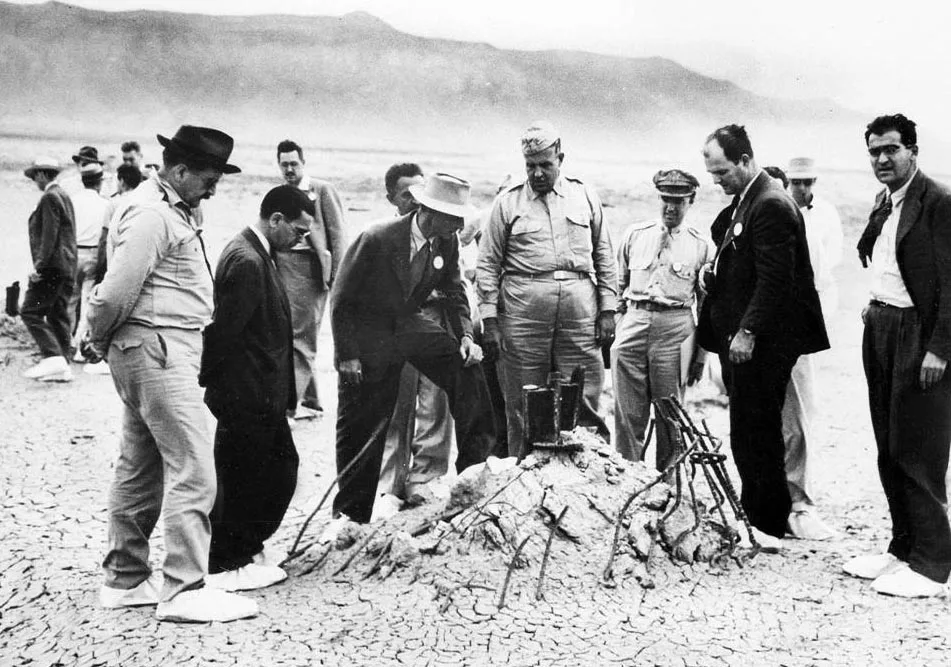

The Manhattan Project began as a race against a Nazi bomb that never existed. By the time it was ready, the target had already changed.
Central to post-World War II discussions is the question of whether dropping the atomic bomb on Japan was necessary. Some historians argue that using the atomic bomb was not imperative to achieve Japan’s surrender. After the first atomic bomb was dropped on Hiroshima, Japan’s leadership didn’t even flinch. Only when the Red Army started its offensive on Japanese occupied territories did Japan’s leadership call a meeting. But many people tend to forget: the United States never even started developing the atomic bomb to use on Japan.
An Irreversible Discovery
The Manhattan Project has become deeply embedded in popular culture in recent years, and for good reason. It’s an intriguing and important story because it’s also responsible for creating the post-World War II world that we are currently living in.
In December 1938, German chemists, Otto Hahn and Fritz Strassmann, discovered nuclear fission by bombarding uranium with neutrons and finding the lighter element barium in the residue. This was actually a surprise, as the scientists expected to create heavier elements. Otto Hahn wrote about this discovery to his former colleague, physicist Lise Meitner, who had fled Nazi Germany for Sweden. Lise Meitner and her nephew Otto Frisch analyzed the results, and they realized the uranium atom had split in half. It was Frisch who named this process ‘nuclear fission’.
By looking at the timeline we know that almost immediately after this discovery, around December 1938, the physicists realized that splitting uranium atoms could release massive amounts of energy. Meitner and Frisch calculated that splitting a heavy uranium nucleus into smaller parts would lose a small amount of mass. Using Albert Einstein’s famous equation, they figured out this lost mass would transform into a massive amount of energy; about 200 million electron volts per atom.
Before you start thinking I’ve transitioned into teaching physics, bear with me.
In January 1939, Frisch confirmed this experimentally in Copenhagen and he shared the news with Niels Bohr. Bohr brought this concept to the United States. It was almost as if a ball started rolling, and the realization spread quickly through the global physics community. As a new war was starting to become inevitable, more and more German scientists decided to flee Germany to the United States. With them, they brought a warning about the unprecedented weapons Nazi Germany might be capable of developing.
Among these physicists and scientists were Leo Szilard and Albert Einstein. Szilard drafted a letter and Einstein signed it. It was a two-page warning dated August 2, 1939, in which the physicists explained that the recent physics research showed a single uranium atom could trigger a large-scale nuclear chain reaction. They also warned that this could create extremely powerful bombs capable of destroying an entire port and its surrounding territory. As for Nazi Germany, they concluded that Germany had already stopped selling uranium from the occupied Czechoslovakian mines and was actively backing secret nuclear research in Berlin. This letter was personally delivered to the President of the United States of America, Franklin D. Roosevelt, by economist Alexander Sachs on October 11, 1939.
However, President Franklin D. Roosevelt’s initial response was cautious. Keep in mind that the United States was still neutral at this point. He only formed the Advisory Committee on Uranium, as well as giving scientists a tiny budget of just $6,000 to be used strictly for small lab experiments. So it wasn’t until December 1941 that some action was finally being taken, as the United States was also thrown into World War II. Not only that, but by 1941, Britain had also confirmed that an atomic bomb was feasible, through the ‘1941 British MAUD Report.’ President Roosevelt therefore rushed to place the uranium research under the newly formed, and more powerful, Office of Scientific Research and Development (OSRD). The research was about to be sped up.
The Intended Target
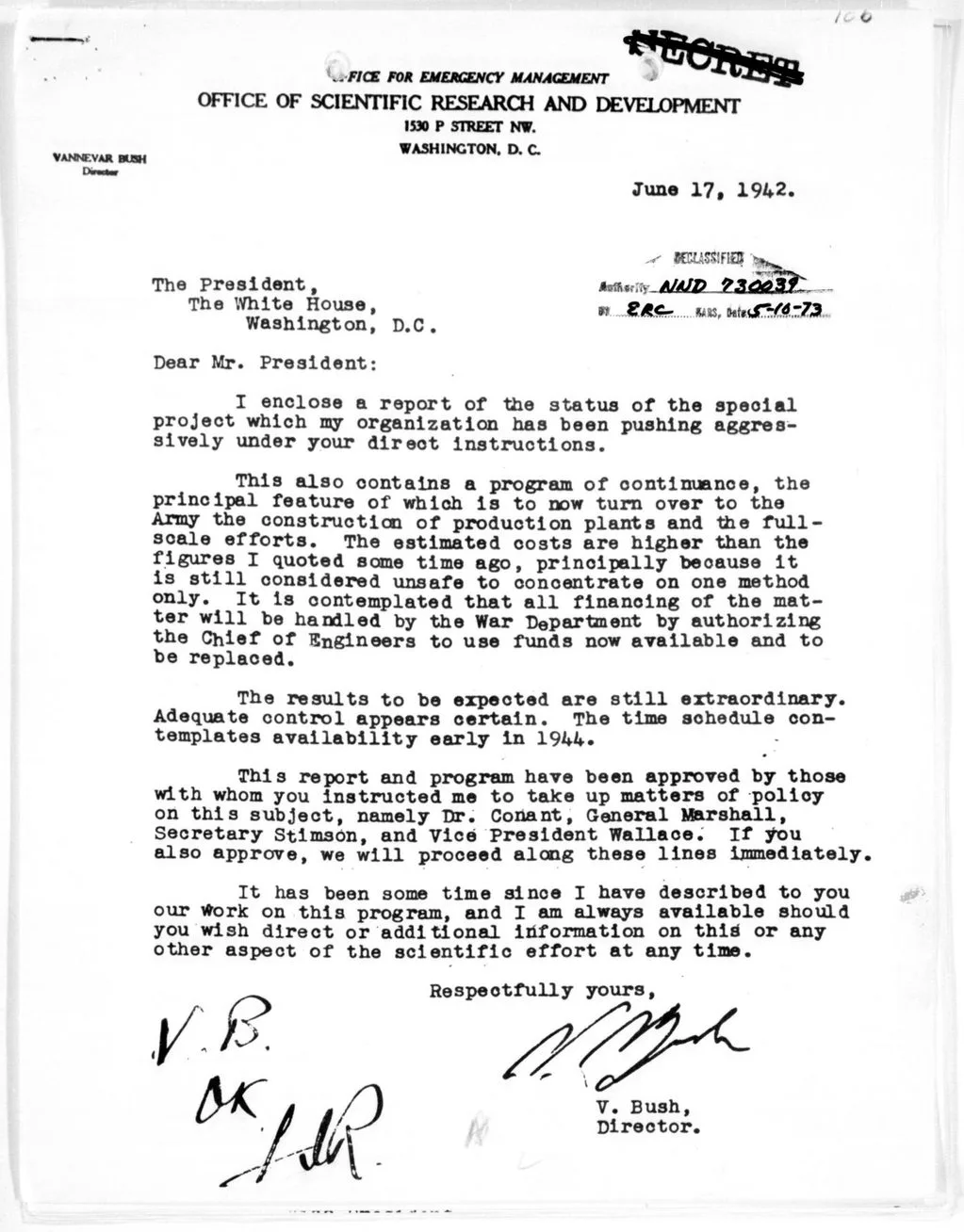
By the summer of 1942, the United States’ leadership realized that building an atomic bomb required massive, industrial-scale factories rather than just university labs. They took military control over the project on June 17, 1942. Brigadier General Leslie Groves was put in charge in September 1942, and he appointed J. Robert Oppenheimer to lead the project’s scientific work. Groves also created the Alsos Mission in late 1943. The Alsos Mission was a specialized unit of scientists and counterintelligence officers who advanced right behind the front lines in Europe to seize German labs and interrogate scientists.
Even though the United States had virtually no concrete military intelligence about the actual status of the German nuclear program between 1939 and 1943, it went full steam ahead in the development of the bomb. The United States was building an atomic bomb with just one intended target: Nazi Germany.
Still, developing the bomb took time. It wasn’t until July 16, 1945, that the first American atomic bomb test was performed. The test was codenamed ‘Trinity.’ There was actually just one small issue. Nazi Germany had already capitulated on May 8, 1945. The intended target was no more. It also turned out that the United States had built the bomb out of a terrifying phantom threat. In late 1944 and early 1945, the Alsos Mission uncovered multiple German documents proving the so-called ‘Nazi bomb’ was a failure. The German atomic bomb program had essentially set itself up to fail. It was crippled by bad resource allocations and bureaucratic infighting. In the end it turned out that the German scientists and physicists had never even achieved a self-sustaining nuclear chain reaction.
But there was an issue. By the time the United States had actually verified that Germany was nowhere near to building an atomic bomb, its own atomic bomb program was already too massive in scale to stop.
New Designated Target
Although it is true that Nazi Germany was the first intended target, it’s a misconception that it kept being the designated target until May 1945.
On May 5, 1943, the Manhattan Project’s Military Policy Committee officially met to discuss the first wartime use of the weapon. You might think that by 1943 Nazi Germany was still unanimously the designated target for the new bomb. But nothing was further from the truth.
During the meeting it didn’t take long before Nazi Germany was ruled out as the single target. That may seem contradictory, since at the time the United States had no definitive proof that Germany didn’t already have an atomic bomb. It’s because the strategy was two-fold. It was deterrence versus the first use of the bomb. On May 5, 1943, these two different strategies were essentially split. Nazi Germany was ruled out as the ‘first use’ target, but it remained within the deterrence strategy. Nazi Germany was ruled out for a highly practical and maybe even highly cynical reason: in case the bomb was dropped on Germany and it turned out to be a dud, the Americans deemed German scientists, such as Werner Heisenberg, advanced enough to reverse-engineer it. The committee quickly came to the conclusion that Japan was less likely to understand the technology if it failed to explode. And so the initial theoretical target was set: the Japanese fleet at the Pacific island of Truk.
That’s how the United States set its sights on Japan to test its newly developed weapon. It left a legacy of destruction. It left an era of mutually assured destruction. And it also left many people wondering. Was dropping the atomic bombs on Japan genuinely necessary? Or was it perhaps the only chance to test the new bomb in a live combat situation?
After all, the official narratives we are given are sometimes curated for political convenience.
Continue the discussion
What do you make of the decision to redirect the atomic bomb’s first-use target from Germany to Japan? Was it simply military necessity, or does the evidence suggest something more complicated?
Join Field Reserve for free and make your case inside the WarCommons community at our Field Headquarters.
WarCommons publishes long-form, source-driven World War II analysis without ads or sponsored content. If you found this article valuable, consider supporting independent research by joining Field Command.
By Nick Ravenshade — Founder & Editorial Director, WarCommons
Header image: J. Robert Oppenheimer and General Leslie Groves at the ground zero site of the Trinity test. September 9, 1945. Source: Wikimedia Commons. Public domain.