WARCOMMONS IS NOW ON ANDROID
Explore WWII history and stay connected with the community on the go. GET THE APP →

The story of World War II does not end with the surrender of Nazi Germany. Nor does it end with the surrender of the Japanese Empire. For some, however, it is clear: after Japan’s surrender, World War II was over, and the world was left with the Cold War in its place. But I see it differently. The immediate aftermath of of World War II is, in my view, still part of its history. This includes some events that occurred after Japan’s surrender, such as the Marshall Plan.
Europe after World War II
The destruction of Europe after World War II was immense. The physical destruction of buildings and infrastructure, however, was caused primarily by Allied bombing campaigns in the west and Soviet operations in the east, through artillery bombardments and aerial bombings by bombers. Buildings that were important before the war were the main targets. These included industrial areas, infrastructure, ports, and other buildings and complexes that were vital to the Axis powers’ war efforts. The advantage of this was that it slowed down the Axis powers’ war machine. It ensured that the Allies’ advance toward Berlin would proceed more smoothly, for both the Americans and British, as well as for the Soviet Union. The downside was that once the war was over, those same buildings, complexes, and infrastructure were still heavily damaged or even completely destroyed. As a result, European countries, not just Germany, could no longer rely on these vital buildings and facilities, even for their own reconstruction.
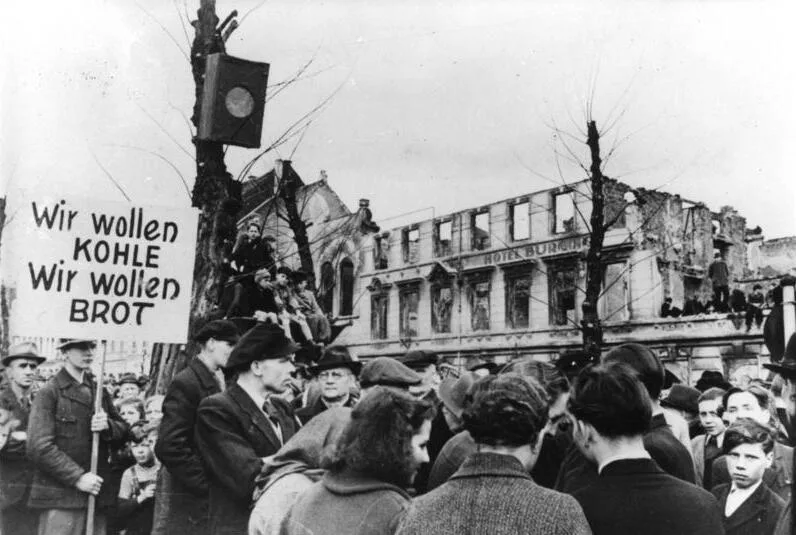
But the damage went beyond buildings, complexes, and infrastructure. There were millions of refugees across Europe. Trade with other countries had ceased, and there were severe food shortages across the population. The food shortage peaked precisely when food was needed most, during the winter of 1946–1947. Despite American efforts, it was not enough to prevent serious hardship that winter. From July 1945 through June 1946, America did a great deal to prevent mass starvation. A total of approximately 22 million tons of food was shipped from the United States to Japan and Europe. Yet it was not enough. It was clear what needed to be done in Europe. Vital infrastructure, industry, food supply, and foreign trade had to be restored. And not just restored, but restored on a sustainable basis.
The top priorities were transportation infrastructure, such as bridges, railways, and ports. This is essential for ensuring a continuous and adequate food supply and maintaining trade relations. In theory, it was quite simple: European countries just had to start investing again in the necessary infrastructure and facilities, and the problem would resolve itself. But there was a problem. Most European countries didn’t even have any money left, because their treasuries were completely emptied by the war.
The only major powers that could still invest and didn’t really need to rebuild anything at home were the United States and Canada. While the war had nearly bankrupted most of the countries involved, the United States and Canada were actually wealthier than before the war. But American and Canadian exports were limited. A way had to be found to expand their exports. Europe had to start importing raw materials and industrial goods from the United States and Canada again. But how?
European Recovery Program, ERP
The Marshall Plan was the nickname for the European Recovery Program, or ERP. It originated from the U.S. Foreign Assistance Act of 1948. Don’t hold your breath, because the Foreign Assistance Act of 1948 also had a long title: “An act to promote world peace and the general welfare, national interest, and foreign policy of the United States through economic, financial, and other measures necessary to the maintenance of conditions abroad in which free institutions may survive and consistent with the maintenance of the strength and stability of the United States.”.
The Marshall Plan was a replacement for the Morgenthau Plan, a plan that was drawn up in detail but never implemented. To anyone with any interest in World War II, it is clear that this plan was essentially a repetition of the mistake made after World War I. In fact, the Morgenthau Plan was the Treaty of Versailles taken to the extreme. It would have punished Germany even more severely for World War II than it had ever been punished for World War I. History had already taught what such harsh measures could entail. Extremism in its worst forms. The Morgenthau Plan would in all likelihood have driven Germany directly into the arms of the Soviet Union. After all, the Soviet Union already controlled nearly half of Germany. A people punished again, and more severely, would once more turn to extremism for a way out.
The Morgenthau Plan proposed completely demilitarizing Germany and dividing it into several smaller states, destroying all industry in the Ruhr region and the Saarland, and creating a decentralized agricultural economy.
Reading it, one can only be glad the plan was never put into practice. Not because Germany should not have been punished for its role in World War II, but mainly because it would likely have had even more extreme consequences. No, this time the Allies would take a different approach. Not creating enemies, but turning former enemies into partners.
The name “Marshall Plan” didn’t come out of nowhere. It was named after U.S. Secretary of State George C. Marshall, who took the initiative to create it. However, the plan was not born entirely from American charity. After the Americans had defeated their enemies, primarily Japan and Nazi Germany, their World War II allies became their new enemies: the Soviet Union. Europe was weakened after the war. Germany was split in two. Europe’s eastern border, running through the middle of Germany itself, lay closer to the North Sea and the Atlantic Ocean than we can easily imagine today. Europe’s eastern border ran through the middle of Germany. Above all, America feared a Soviet Union with an insatiable drive for expansion, a threat that hung directly over Western Europe. Relations among the former allies grew increasingly strained. And this, in turn, paved the way for the emergence of the Truman Doctrine. Named after U.S. President Harry Truman, this doctrine was a component of American foreign policy with a single, self-declared goal: to counter the geopolitical expansion of the Soviet Union during the Cold War.
The plan was intended to ensure that the devastated parts of Europe were rebuilt and that trade barriers were removed. Industry also needed to be modernized, and Europe’s overall prosperity needed to be boosted. In other words, people in Europe had to be kept satisfied. Because any resentment or discontent could push more European countries toward the Soviet Union; according to the United States, the spread of communism had already gone far enough.
Development and Implementation
The plan was officially drawn up on June 5, 1947. A number of the Soviet Union’s allies were also given the opportunity to benefit from the plan, including Finland. But under pressure from the Soviet Union, these countries refused to accept the plan. The Soviet Union, in turn, feared that the Americans would gain a a measure of control over the economies of the communist countries.
But with or without the Soviet Union, the Marshall Plan would go ahead. And so it came to pass: on April 3, 1948, the Marshall Plan was officially signed by U.S. President Harry Truman. The fortunate recipients of $5 billion in aid were 16 European countries. But that was not all. The plan ultimately remained in effect for four years. And during that time, the United States provided an approximate total of $17 billion in economic and technical assistance. It was intended to bolster the economies of the European countries that had joined the Organization for European Economic Co-operation (OEEC).
Europe’s postwar recovery was far from straightforward, involving many different dimensions. It was not merely a matter of rebuilding destroyed areas. The aid was intended to build a sustainable foundation and promote Europe’s self-reliance. Public satisfaction was paramount, as it was clear what extreme dissatisfaction could lead to. Industry therefore had to be modernized, and the business relationship between Europe and America had to be strengthened and maintained.
At that time, America was still primarily known for its isolationism. This was especially true in the run-up to World War II, evident in America’s neutral stance when war broke out on the European continent. In fact, the Marshall Plan cameto be seen as a milestone for American ideology. Americans became more outward-looking, embracing a more globalist, internationalist worldview.
Germany was the top priority
Before General George Marshall was appointed Secretary of State in January 1947, the only policy regarding postwar Europe was Directive 1067 issued by the Joint Chiefs of Staff. This directive was based on the Morgenthau Plan and stipulated that no measures should be taken to support Germany’s economic recovery or to maintain or strengthen the German economy.
But even before the Marshall Plan, a shift was already evident. Directive 1067 was replaced by Directive 1779 of the Joint Chiefs of Staff. This ended the prohibition against intervening in the German economy to promote prosperity. This new directive stated that an orderly and prosperous Europe required Germany’s economic contributions. Germany was seen as a central pillar in maintaining Europe’s prosperity. That is why the focus shifted to Germany. A stable and productive Germany, that was to be the future of Europe, according to Directive 1779. Gradually, The first signs were emerging that America was committing to Europe’s reconstruction. he most concrete early sign: permitted steel production was raised from 25% to 50%.
In fact, as of March 12, 1947, the American isolationist stance was officially over. On that day, President Truman announced his so-called Truman Doctrine. Read between the lines, it was a technical declaration of war on communism: “to support free peoples who are resisting attempted subjugation by armed minorities or by outside pressures.” This doctrine was born out of necessity. A communist uprising had taken place in Greece, and the United Kingdom was unable to help Greece or continue its assistance. After World War II, the United Kingdom’s national treasury were in dire straits. Truman not only articulated his doctrine but also requested aid for Greece and Turkey.
It was by no means a foregone conclusion that Germany would become the focal point of Europe’s reconstruction. World War II was still fresh in people’s minds in 1947, and everyone still remembered what Germany had done. But it was Herbert Hoover who was able to look past this sentiment and see the underlying truth. He wrote: “The whole economy of Europe is interlinked with the German economy through the exchange of raw materials and manufactured goods. The productivity of Europe cannot be restored without the restoration of Germany as a contributor to that productivity.” In any case, the Joint Chiefs of Staff were convinced and decided that the recovery of German industry, and in particular coal mining, was now of primary importance to American security.
Even before the Marshall Plan was officially launched, the Americans had already spent a great deal of money to support Europe’s recovery. More than $14 billion was spent on Europe by the end of 1947. This figure is not included in the total aid that America provided to Europe under the Marshall Plan. A large portion of this money was used to rebuild infrastructure and assist refugees. Notably, the United Kingdom also received an emergency loan of $3.75 billion. It was clear that the United Kingdom had virtually no money left. But it was also clear that these early postwar aid measures were primarily aimed at short-term repairs to things like infrastructure. It was not yet aid intended to ensure lasting peace and prosperity in Europe.
A large number of reconstruction and humanitarian aid programs were also established through the United Nations. These aid and reconstruction programs, too, were almost entirely funded by the United States. Although it was a good thing that these programs were created, they were not always sufficient. The aid often lacked central organization and planning and frequently failed to meet the fundamental needs that Europe had after the war.
Industry and Technology
As established earlier, Europe’s prosperity was to be restored with industry as the foundation. As mentioned earlier, this included increasing steel production, for example. American planners truly saw Germany as the central hub of European industrial prosperity. It is therefore not surprising that one of the most successful aspects of the Marshall Plan was the increase in industrial productivity within Europe. This aspect is best known as the Technical Assistance Program.
The U.S. Bureau of Labor Statistics (BLS) played a major role in this. Starting on June 7, 1940, the BLS was authorized to conduct ongoing studies on labor productivity. A division was established that focused on productivity and technological development. Through this division, the BLS was able to use its expertise to ensure that a productivity initiative was implemented in every Western European country that received Marshall Plan aid. At that time, the disparity in prosperity between America and Western European countries was stark. For instance, France sent approximately 500 missions of businesspeople to the United States to visit factories, stores, offices, and farms. This was intended to strengthen trade relations. But the businesspeople were particularly impressed by how prosperous the average American worker was. After nine months of work, an American worker could buy a new car. To put that in perspective, in France, the average worker could only do so after 30 months.
When the Technical Assistance Program was launched, it became apparent that the Americans were using technologies that were roughly a generation ahead of European technology. As a result, the U.S. government felt compelled to send hundreds of technical advisors to Europe. Their goal was simply to observe the workers on the job. Their analyses fed directly into practical recommendations for manufacturers. Engineers and workers were sent on study tours to America to learn from American industry, including mines, manufacturing companies, and other workshops. Once back on the European mainland, these engineers and workers were able to implement the technologies from America. America saw technology and industry as the engine of European prosperity.
Industry was modernized and professionalized. Modernizing European industry was the Americans’ intention, but it benefited Europe immensely. Given the billions that European countries received through the Marshall Plan, the question arises: at what cost was all this achieved? The most efficient and impactful component of the Marshall Plan was the Technical Assistance Program. The cost was a mere $300 million. A third of that was paid by the Americans. It was a lot of money, but compared to the other aid initiatives within the Marshall Plan, which involved billions, this was one of the most financially efficient measures. And it had a lasting effect.
CIA?
This may well still be the case today. Deep within the international flow of American money, one beneficiary is always present: the CIA. “Follow the money,” as the saying goes.
The Marshall Plan was no exception. The CIA also became a beneficiary of no less than 5% of the total funds allocated to the Marshall Plan. That amounted to a staggering 685 million dollars, spread over a six-year period. The CIA, of course, used this to finance covert foreign operations.
Through the Office of Policy Coordination, funds were allocated to support newspapers, student organizations, artists, intellectuals, and labor unions. All united by a common goal. This goal was primarily to oppose anti-American groups, which in turn were funded by communists.
The End of the Marshall Plan
The postwar period was turbulent not only for Europe. World War II gave way, almost imperceptibly, to the Cold War, which lasted for more than 40 years. It could be argued that the Cold War never actually ended and is still ongoing today. Be that as it may, the Marshall Plan was set to come to an end in 1953. For America, it was also a turbulent time. Every attempt to extend the Marshall Plan was rejected, with the main reason being the American war in Korea. The costs of that war were only rising, so the American government did not want to lose money on the Marshall Plan as well. But American conservative Republicans had also steadily regained power. They were fundamentally opposed to aid for Europe or other countries. It was another small step toward classic American isolationism. Not only did this ensure that the Marshall Plan would not be extended after 1953, but it also led to the plan being terminated prematurely, as early as 1951.
Europe, however, had no reason to despair. From 1948 to around 1952, Europe experienced the fastest growth in its history. Industrial production rose by 35%, and agricultural production also exceeded all pre-war records. While famine in Europe had seemed to be becoming increasingly common, as was the case in Germany in 1946–1947, this period of hardship came to a complete end following the Marshall Plan. Western Europe was poised for an unprecedented period of massive growth that would last for about 20 years. Incomes rose, living standards improved, and discontent declined. To this day, some historians wonder how much of this economic growth should be attributed to the Marshall Plan. The central challenge for historians is the evidence that a general recovery was already underway in Europe regardless of the plan. But whether the people who had to endure a severe famine in 1946–1947 would agree with that is another question entirely.
It seems to be primarily a matter of debate regarding the extent to which the Marshall Plan contributed to an increase in European prosperity and to what degree it initiated this economic growth. According to this school of thought, it served merely as a catalyst for economic growth that was already underway. What can be said with confidence is that the structural adjustments the Marshall Plan brought to Europe were of lasting importance. It was cited by economic historians such as J. Bradford DeLong and Barry Eichengreen as “history’s most successful structural adjustment program.”
European countries that received aid under the Marshall Plan were, broadly speaking, effectively “Americanized.” This happened through exposure to American popular culture, music, cinema, and consumer goods. It led to a growing influence of, for example, rock and roll in Western European countries, but also of Hollywood films.
Political Consequences of the Marshall Plan
The Marshall Plan had more than just economic consequences. One of its primary goals, of course, was also to prevent communism from spreading further throughout Europe. After Nazi Germany was defeated, communism became the arch-enemy of the United States. A major goal within that context was therefore to maintain high levels of social satisfaction, as well as prosperity, which in turn would ensure general satisfaction.
For many Western European countries, the Marshall Plan meant they had the leeway to ease rationing and scale back austerity measures. Consequently, public dissatisfaction naturally subsided. As the economy stabilized in a positive way and prosperity and economic growth increased, this automatically led to political stability as well. Citizens were satisfied with how things were going, and in such cases, they often want to maintain the status quo. This meant simply continuing what worked, including in politics.
Communism was not given a chance in Western Europe. The influence of communist parties was reduced, and the popularity of such parties also declined, even in the years after the Marshall Plan ended. When the public is satisfied, a decline in the popularity of political parties advocating for (radical) change is virtually inevitable. People were satisfied, so the status quo had to be preserved.
Trade relations, both transatlantic and within Europe, also grew and were fostered. It was a harbinger of what would soon be formed: the North Atlantic Alliance, NATO. Although communism never gained a foothold in Western Europe and the prosperity of these countries was greatly enhanced, the divide between Eastern and Western Europe had never been so great. The continent was geographically, geopolitically, and ideologically completely divided into two halves: Eastern Europe and Western Europe. Two worlds on a single continent.
However, the Marshall Plan was not successful in every respect. The Western European countries participating in the Marshall Plan and the Americans both believed that European integration was necessary. This would not only promote prosperity and peace, but also maintain and ensure them. Guidelines from the Marshall Plan were used to promote this European integration. But it was not very successful. After all, the OEEC was the ideal instrument for ensuring that this European integration would be promoted. But the OEEC had ultimately become nothing more than an organization for economic cooperation, rather than an instrument for achieving European integration.
Europe was already turning inward a bit back then. A new organization was formed, one in which the Americans did not participate: the European Coal and Steel Community, the precursor to the European Union. The United Kingdom was not part of it either. Yet there were also aspects in the early European Union that stemmed from the Marshall Plan, and which remain relevant to this day. For example, free trade throughout the region, which stems from the Bretton Woods system. It is something that still applies within Europe: the free movement of goods, services, and people.
The Legacy of the Marshall Plan
The debate among historians continues to this day. The ongoing debate itself suggests that the so-called legacy of the Marshall Plan is not entirely flawless. In fact, some contemporary historians in this field believe that the praise for the plan is often exaggerated. However, there is broad consensus regarding the assessment of the plan. It was simply a good plan that served its purpose well. As a result, there is also still broad consensus on the assumption that such a plan could benefit other parts of the world as well.
The Marshall Plan should in its essence be viewed as an essential link in the history of postwar Europe. It demonstrates the goodwill of an ally willing to help another continent rebuild its society, despite the fact that American self-interest certainly played a role as well.
Despite the controversy, one thing is certain. The Marshall Plan became a metaphor that is still used today as a synonym for a grand plan. Major and far-reaching economic plans, large-scale reconstruction projects, and investment programs are often referred to as the “Marshall Plan.”
Although its actual impact remains a matter of debate, the term continues to be used around the world.
Field Command members: the Author’s Note for this article is available in the Field Command area.
WarCommons publishes long-form, source-driven analysis without ads or click incentives. If you found this feature valuable, consider supporting our research by subscribing to help fund future investigations.
By Nick Ravenshade — Author
Header image: Krefeld, Hunger Winter, Demonstration. March 31, 1947. Source: Wikimedia Commons / Bild 183-B0527-0001-753. CC-BY-SA 3.0.