WARCOMMONS IS NOW ON ANDROID
Explore WWII history and stay connected with the community on the go. GET THE APP →

The collective memory of World War II is dominated primarily by the European theater of war, Nazi Germany, Operation Barbarossa, and D-Day, to name just a few well-known examples. But in the Far East, the war raged just as fiercely. Although Japan did not actively participate in the Holocaust, war crimes and human rights violations certainly took place. But that fact did not apply only to the Axis powers. The Allies were not innocent of these crimes either. Nevertheless, it was exclusively the Axis powers that were required to appear before the tribunal. A fact that remains relevant and applicable to this day. For Japan, however, this meant The Tokyo Trials.
The Tribunal
The Tokyo Trials is the name given to the military criminal trial of the leaders of the Japanese Empire. It is also sometimes referred to as the Tokyo War Crimes Tribunal. However, its official name was the International Military Tribunal for the Far East (IMTFE).
The Japanese Empire was held accountable for its conventional war crimes, crimes against peace, and crimes against humanity. Japan had committed these crimes in the lead-up to and during World War II. The tribunal did not emerge from nowhere. It was modeled after the International Military Tribunal (IMT) in Nuremberg, the famous tribunal where Nazi leaders from Nazi Germany were prosecuted for their war crimes. After Japan was forced to surrender unconditionally following the use of two atomic bombs, the Allies, particularly the Americans, were in control of Japan. The renowned American general and Supreme Commander of the Allied Forces, Douglas MacArthur, issued a proclamation. The immediate result was the establishment of the IMTFE. But the laws actually still had to be written. What should the Japanese leaders be convicted of?
A charter was drawn up. This charter set forth the composition of the tribunal, its jurisdiction, and its procedures. The crimes committed by the Japanese defendants were defined in accordance with the Nuremberg Charter. The tribunal was composed of representatives from eleven countries, including judges, staff members, and prosecutors. However, the eleven countries were not chosen at random; they were all countries with which Japan had been at war. These were: Australia, Canada, China, France, India, the Netherlands, New Zealand, the Philippines, the Soviet Union, the United Kingdom, and the United States. You might wonder why the Netherlands was included, since that country was at war in Europe and occupied by Nazi Germany. But the Netherlands also had overseas territory, namely the Dutch East Indies. That was part of the Kingdom of the Netherlands.
The defense for the Japanese defendants was handled by lawyers from the United States and Japan. However, there was one notable difference from the Nuremberg trials. The temporal jurisdiction extended much further back, all the way to 1931. That was, in fact, the starting point of the Japanese invasion of Manchuria.
The defendants
The dubious honor of appearing before the tribunal fell to 28 Japanese political leaders and high-ranking military officers. Cabinet members, prime ministers, and military commanders, they all stood trial on 55 separate charges. The most significant were waging wars of aggression, war crimes, murder, and crimes against humanity committed against prisoners of war and civilian internees. And, moreover, crimes against humanity committed against their own citizens within the Japanese colonial empire. It was determined that a number of the charges were not authorized or were redundant under the Charter of the IMTFE. “A number of” should perhaps be taken with a grain of salt, as it actually concerned 45 of the 55 charges.
While the Allies quickly concluded the trials of Nazi leaders during the Nuremberg Trials, the trial of the Japanese defendants lasted no less than twice as long. However, this particular tribunal also had a significant impact on international law and its development in the immediate aftermath of World War II.
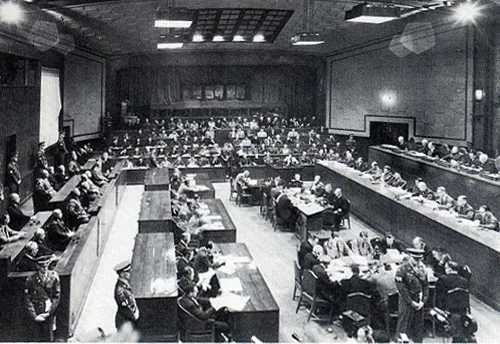
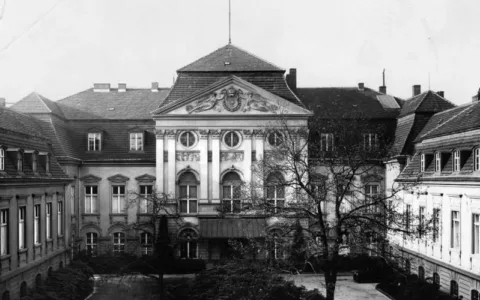
And there they stood, all the defendants. Preparations for the trial had been underway for months. The IMTFE convened on April 29, 1946, and the trials took place at the Ministry of War offices in Tokyo.
For the prosecutors, May 3, 1946, marked the starting point. It was the day the prosecutors had to present and build their case. The charges against the defendants were thus formally stated for the first time. The defendants faced charges of crimes against humanity, crimes against peace, and conventional war crimes. The trial lasted more than 2.5 years. During that time, 419 witnesses were heard, statements and sworn affidavits from 779 people were submitted, and no fewer than 4,336 pieces of evidence were introduced and admitted for use during the court proceedings.
The proof
As with any legal proceeding in a functioning constitutional state, there must be evidence to support the allegations against the accused. But not just any evidence. Especially when it comes to such serious allegations and accusations, there should be absolutely no room for doubt or ambiguity. Given that 4,336 pieces of evidence were submitted by all parties, this at least shows that there was sufficient documentation to substantiate the allegations, but the defense against these allegations was also included among them.
It took the prosecutor 192 days to present the case against the defendants. It lasted until as late as January 24, 1947, and by then the defense had not even had a chance to present its case. The prosecutor presented the evidence in fifteen phases. But how can you accuse someone of such grave crimes when they were simply soldiers who were obligated to obey their superiors on pain of punishment for, say, insubordination, refusal of orders, or desertion?
This is where the doctrine of command responsibility comes into play. Under this doctrine, it was not necessary to prove that the alleged atrocities were carried out as a result of illegal orders issued by the defendants. It was up to the prosecution to prove three things: that the war crimes were widespread or systematic; that the defendants knew or should have known that their troops were committing atrocities; and that, in their roles or ranks, the defendants had the authority and power to stop these crimes.
The conditions were clear and well explained. It looked very much as though the proceedings would go smoothly. However, there did seem to be a small problem. The standards of proof turned out to be very low. In fact, we can draw on Article 13 of the Charter to explain why this should have been a major cause for concern. According to this article, standards were not required for technical rules of evidence. Any evidence deemed relevant could be admitted, provided it had probative value. However, this could be quickly determined, regardless of which party you asked. The prosecutor likely found much or all of it relevant and of probative value, while the defense might have more readily recognized that some pieces of evidence, in all reasonableness, should never have been admitted as evidence. Even diaries or letters that lacked a signature or proof of issuance could be admitted. his directly opens the door to manipulation and injustice. Given these indications, can one still speak of a fair trial for the defendants? After all, on April 4, 1946, one could have quickly written a letter or a diary entry about one or more defendants and presented it on April 5, 1946.
It is plausible that, given the circumstances described, the trial may not have been fair. However, it is also clear that the trial did in fact take place. Among other things, the prosecutor presented evidence to argue that a conspiracy had taken place within the Japanese government: a document from 1927 known as the Tanaka Memorandum. For the prosecutor, it was evident, because the Tanaka Memorandum stated in black and white what the Japanese government’s plans were, namely: to conquer the world.
Shocking evidence, or was it? The Tanaka Memorandum later turned out to be a forgery produced in China. But at the time, few of those involved ever questioned the memorandum. However, what applies to one side also applies to the other. The defense was also bound by the rule of best evidence. Only incriminating evidence regarding Emperor Hirohito and his family was excluded from the trials, at the behest of the United States. According to the United States, the emperor was still needed to maintain order in Japan and to ensure that the United States could still achieve its postwar objectives in Japan.
The defense
One hundred lawyers, about a quarter of whom were American and three-quarters Japanese, and support staff stood by the defendants’ side. After the prosecution had presented, explained, and argued its case, it was the defense’s turn to present its case on January 27, 1947. The defense’s presentation of the case lasted 225 days, until September 9, 1947.
The defense arguments raised at the Tokyo Trials had clear parallels with those raised at Nuremberg. The defense argued that the trial, as structured, could not be free from substantial doubt regarding its legality, fairness, and impartiality. The laws under which they were to be convicted did not even exist at the time of World War II. There were some rules and guidelines, but they were not explicit or codified enough to establish that their conduct, though horrific, was prohibited at the time.
The principle that no one may be convicted on the basis of new laws enacted after an act was committed falls under the principle of legality. It is nothing less than a cornerstone of the rule of law. But after World War II, many of these cornerstones were lost in the quest for revenge and vindication.
In addition to the argument that the laws did not even exist at the time of World War II and therefore could not serve as a basis for conviction. There was another crucial point of defense raised by the defendants. They took the position that they could not be held individually responsible for acts that were in fact committed by a state, namely the Japanese Empire. And they argued that they could not be tried or held accountable for failing to prevent others from committing or having committed war crimes. According to the defendants, the violations of international law should, in any case, have been investigated by the Allies.
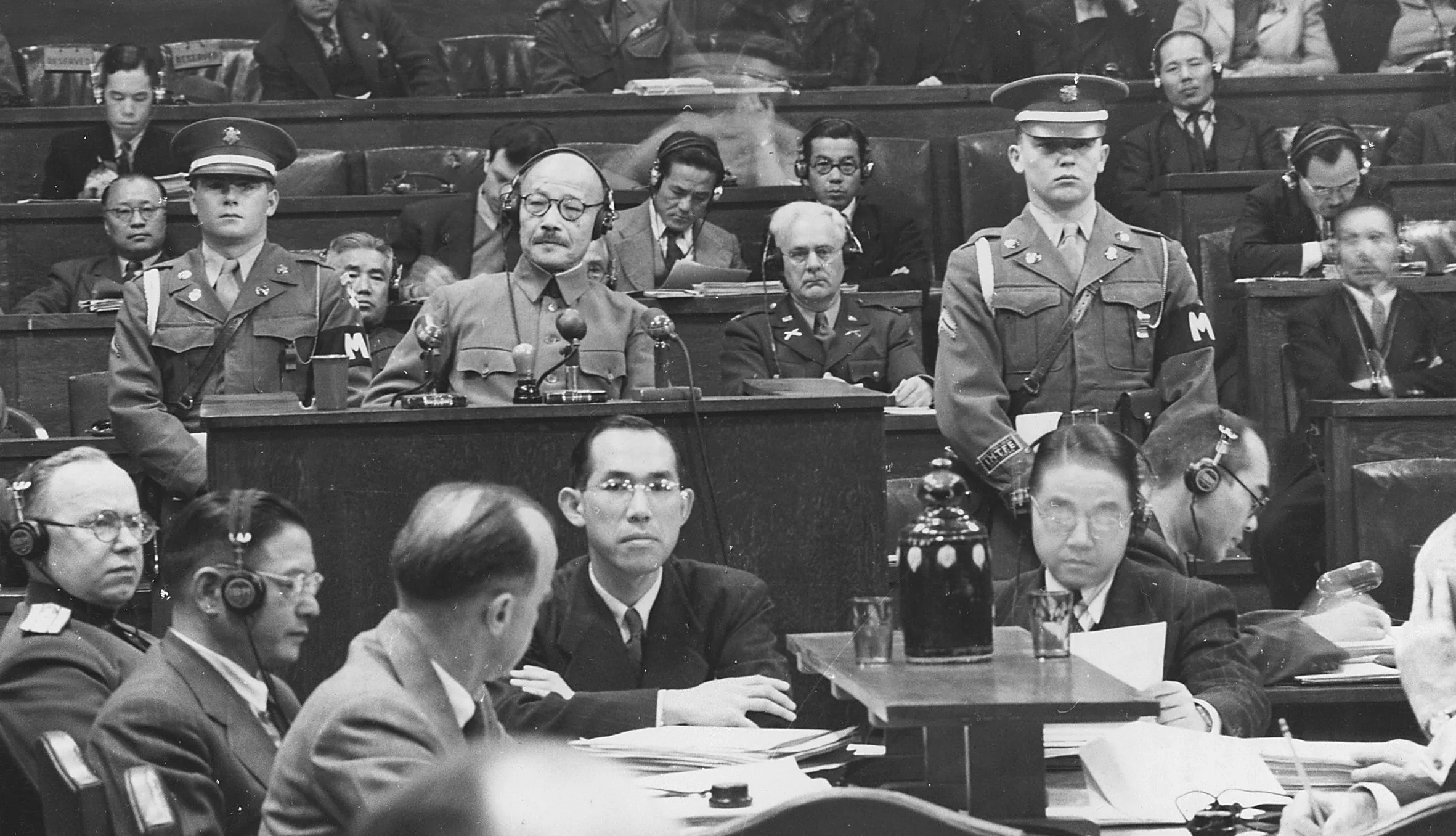
Hideki Tojo, Japan’s wartime Prime Minister, maintained throughout the entire trial that he had acted in self-defense. His statement is often quoted: “We felt at the time that Japan was being driven either to war or suicide.” He based his claim of self-defense on the Hull Note. According to him, this note forced the Japanese Empire into war and therefore it could not be viewed as an aggressor at all. It was intended to be a direct rebuttal to the accusation of crimes against peace.
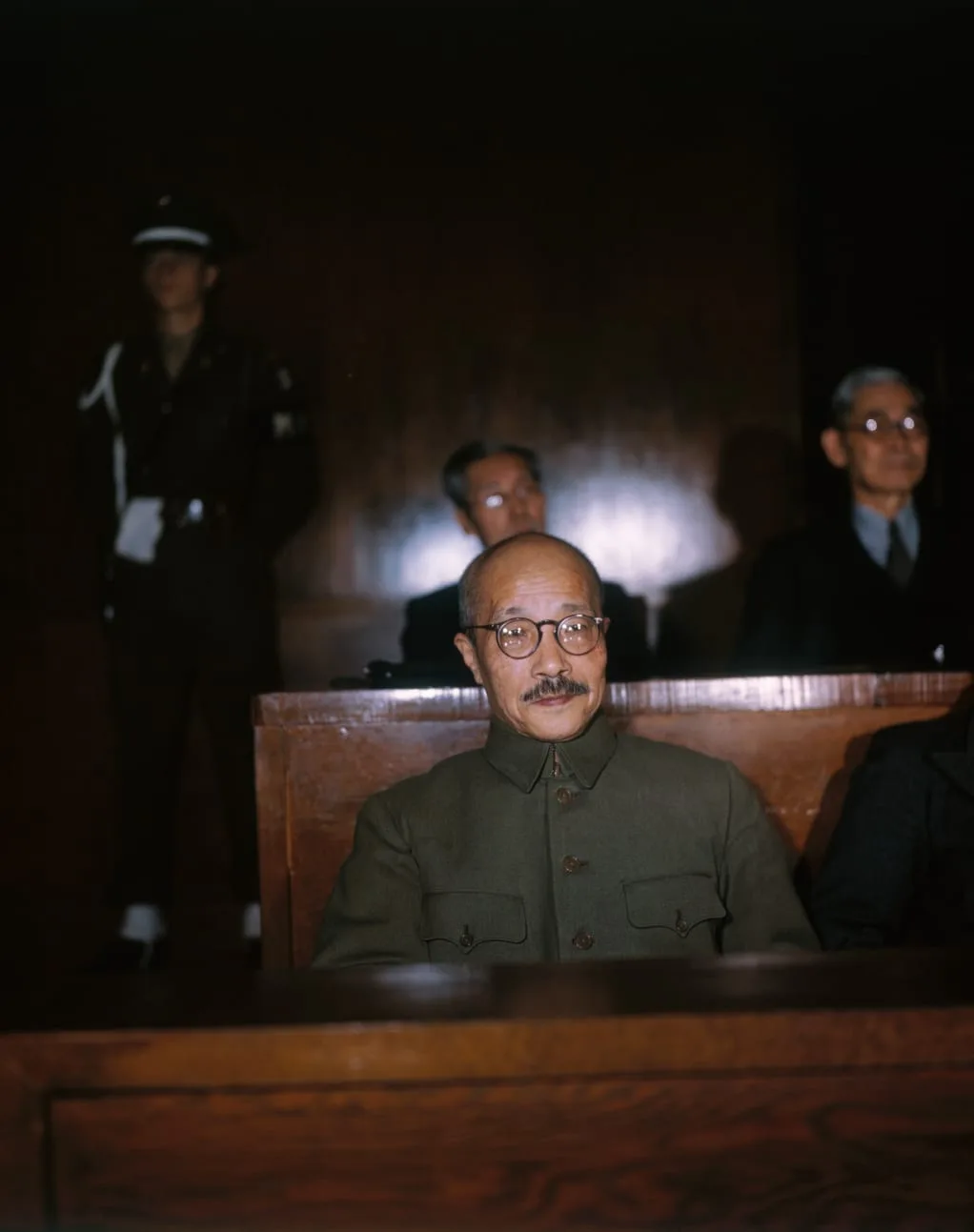
However, the defense’s broader trial strategy was that even if the criminal acts alleged by the prosecution were true, that did not immediately prove guilt beyond a reasonable doubt.
Convictions and Sentences
After both the prosecution and the defense had presented their arguments before the tribunal, the time had come for the verdict and the potential sentencing of the defendants. But it didn’t happen right away. It took a full 15 months before the final verdict was issued. Work was underway not only on drafting the verdict but also on finalizing it. The end result was nothing short of shocking, not so much in terms of content, but in terms of length. The verdict totaled 1,781 pages. It took from November 4 through November 12, 1948, for the verdict to be read in its entirety, as required in legal proceedings. After the Tokyo Trials, five of the eleven judges who had handed down the verdict separately put their respective opinions in writing, outside the tribunal and entirely in a personal capacity.
In any case, the consequences for the defendants were determined by the verdict and set in writing. No opinion expressed after the trials would change anything for the defendants. The harshest punishment that could be imposed by the tribunal was, of course, the death penalty by hanging, a practice that was frequently employed in the quest for justice following World War II. That dubious honor was meted out to seven of the convicted. Six of these defendants were convicted of committing war crimes, crimes against humanity, and crimes against peace. One defendant was also sentenced to death by hanging, but with one discrepancy. General Iwane Matsui, commander of the Shanghai Expeditionary Force and the Central China Area Army, was convicted of committing war crimes and crimes against humanity. He was spared the charge of crimes against peace.
These seven men were executed by hanging on December 23, 1948, at Sugamo Prison in Ikebukuro.
Sixteen convicts were sentenced to life imprisonment. Three of the sixteen died in prison, while the other thirteen were eventually released, despite their life sentences. Between 1952 and 1958, these thirteen men were released on parole.
Two defendants received a fixed-term prison sentence, and three suspects were not sentenced to prison. Not because they might have been innocent, but because two of the suspects died prematurely and one suspect was declared mentally unfit. That was Shūmei Ōkawa, and all charges against him were dropped.
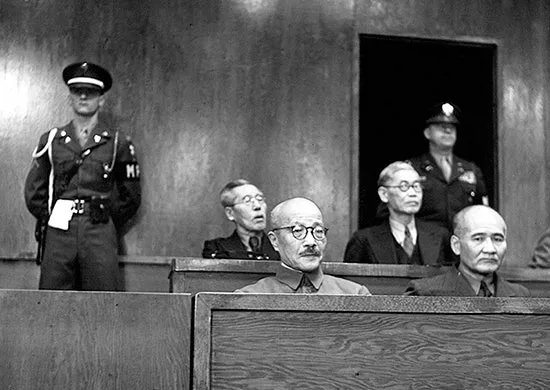
Opinions of the judges of the tribunal
In the context of this article, it is important to also consider what the five judges of the tribunal said about the trials in later years, what their true opinions were. Not to see whether this might have been of any use to the convicted and the accused, but to analyze whether justice truly prevailed between November 4 and 12, 1948.
In his opinion, Australian judge William Webb focused on the Japanese Emperor Hirohito. He disputed the emperor’s legal status and could not see that the emperor would be obligated to act on advice. According to Webb, it was precisely the Emperor who bore the responsibility of the country as a constitutional monarch who accepted ministerial and other advice regarding war. He wrote: “No ruler can commit the crime of launching an aggressive war and then validly claim to be excused for doing so because his life would otherwise have been in danger … It remains that the men who advised the commission of a crime, if it is one, are in no worse position than the man who directs the crime to be committed.”
The fact that one judge disagreed with the verdict might be to be expected in such a lengthy and extensive trial, but perhaps not in the way one might think. It was Judge Delfin Jaranilla, representing the Philippines, who actually felt that the sentences were too lenient. In this way, the sentences would not be sufficiently deterrent and would not be proportionate to the seriousness of the offenses or crimes committed.
There was also one judge who directed his criticism not only at the Japanese emperor, but also at the judges themselves, of whom he was a member. The French judge Henri Bernard believed that the tribunal’s proceedings were flawed because there had not been sufficient deliberation among the judges and because the emperor himself had not stood trial. He wrote regarding Japan’s declaration of war: “…had a principal author who escaped all prosecution and of whom, in any case, the present Defendants could only be considered as accomplices” and that: “a verdict reached by a Tribunal after a defective procedure cannot be a valid one.”
The Netherlands has traditionally had a strong sense of duty regarding the administration of justice and its neutrality. The same was expected of Dutch judges: complete neutrality, knowledge and expertise, and fairness. It is therefore not surprising that a Dutch judge also voiced his opinion after the Tokyo Trials. This was the Dutch judge Bert Röling. He focused primarily on the criminal charges and crimes which, as noted, were essentially flawed. He wrote: “It is well-nigh impossible to define the concept of initiating or waging a war of aggression both accurately and comprehensively,” Röling also had an opinion regarding the composition of the judges. He believed that the judges should not only be neutral but that judges from Japan itself should have been included. His own caveat was that the Japanese judges would have been in the minority and might not have had much influence. But they could have exerted a different kind of influence on the judges’ judgment: “they could have convincingly argued issues of government policy which were unfamiliar to the Allied justices.” In doing so, he did offer some insight into the issues that the judges struggled with in reaching their verdict. The judges faced difficulties and constraints in holding individuals accountable for acts of state and in criminalizing the failure to fulfill responsibilities. He was the only judge who argued for the acquittal of all of the defendants on all charges.
The Indian judge, Radhabinod Pal, held that the evidence of the atrocities committed against the civilian population, the population in occupied territories, and prisoners of war was clear and overwhelming. However, he did voice fundamental criticism of the proceedings. He wrote: “I would hold that each and every one of the accused must be found not guilty of each and every one of the charges in the indictment and should be acquitted on all those charges.”
Victors’ justice?
It is not without reason that the opinions of the five judges must still be examined. After all, there is a direct link to the frequently cited argument that this was a case of “victors’ justice.” This argument was also often used in the trials at the Nuremberg Tribunal. The victors of the war pass judgment on the vanquished. The victor is the one who determines what is just and what is punishable. The loser is punished, while the victor’s crimes go unpunished.
Victors’ justice is a delicate principle. If one takes the position that victors’ justice was at play, for example, during the Tokyo Trials and the Nuremberg trials, the rest of society immediately dismisses them as deniers of the war crimes committed and of the atrocities that took place throughout World War II. But this conclusion is often unjustified. It can also be factually established, which is why this topic is addressed in this article. Precisely because victors’ justice was indeed at play during the Tokyo Trials. No, it is not a denial that the convicted and accused were guilty of war crimes. And no, it is not a matter of sympathizing with the aggressors of World War II. Yes, the war crimes committed by all the countries involved were grave and should never have taken place, regardless of their scale. Every war crime or crime of this nature is one too many.
The fact is that the Tokyo Tribunal, like the Nuremberg Tribunal, focused solely on crimes committed by the Axis powers and not on the actions of the Allies.
The United States had provided both the financial resources and the personnel necessary for the Tribunal’s operations and also served as the chief prosecutor. It was argued that it was difficult, if not impossible, to meet the requirement of impartiality that should be expected of such a body. This apparent conflict gave the impression that the tribunal was merely an instrument for enforcing the victors’ justice. Solis Horowitz argues that the IMTFE exhibited an American bias: unlike the Nuremberg trials, there was only one team of prosecutors, led by an American, while the members of the tribunal represented eleven different Allied nations.
Judge Jaranilla was also a member of the IMTFE. As it happened, he had been captured by the Japanese. He had survived the massacre in Manila and the Bataan Death March. The defense, of course, made a big issue of this, arguing that this judge would be unable to maintain his objectivity. The request to remove this judge from the tribunal was denied. However, Jaranilla did recuse himself from presenting evidence regarding the atrocities that had taken place in his native country, the Philippines.
Judge Radhabinod Pal argued that the exclusion of Western colonialism and the atomic bombings of Hiroshima and Nagasaki from the list of crimes, as well as the lack of judges from the defeated nations on the bench, pointed to the “failure of the Tribunal to offer anything other than an opportunity for the victors to take revenge.” Pal was not alone in his views. A well-known lawyer from Kolkata argued that the Tribunal was nothing more than “a sword in a [judge’s] wig.”.
It should be noted that Pal’s dissent has subsequently been embraced by Japanese nationalist movements, a fact Pal himself reportedly found uncomfortable.
It is a recurring theme in every tribunal where only the loser is brought to justice for crimes committed during wartime. The victors, or the Allies, also committed war crimes, but were not tried for them. A common argument against this is that the tribunals established after World War II were only authorized to try the war crimes of the Axis powers. But where, then, were the tribunals that did have the authority to try the war crimes of the Allies? To this day, this issue causes friction whenever the proceedings of the tribunals are described. But none of this changes the fact that war crimes, crimes against humanity, and other atrocities such as the Holocaust did indeed take place, and that this was the horrific and unimaginable reality for millions of people.
Allied war crimes
Nevertheless, in this context, we must also consider the crimes that were committed by the Allies, for which no convictions were handed down. The fact that the tribunals were established solely to try the Axis powers directly reinforces the perception of “victors’ justice.” This does not, however, absolve countries seeking justice from also establishing tribunals for war crimes committed by nations other than the Axis powers. The absence of such tribunals subsequently reinforces the sense of “victors’ justice.” One might then argue that the Allies should have tried the war crimes they committed themselves at the national or national military level. But was this actually the case?
The Soviet Union is responsible for the Katyn massacre. The National Archives describe how Polish officers, police, and the intelligentsia were arrested and imprisoned by the Soviet Union in 1939 and later executed in 1940.
But that is not the whole story. Later, mass graves containing thousands of Polish officers were discovered. This was immediately exploited by the German propaganda machine in 1943. The Red Army also committed mass rapes during its advance on Berlin. All of this was later dismissed by the Soviet Union as Western propaganda. And indeed, at the national and military levels, no convictions were ever handed down for the war crimes committed.
The Western Allies were not entirely blameless either. There are documented cases of individual crimes, some of which were prosecuted internally. This applies to the so-called Biscari murder in Sicily. American soldiers shot and killed Italian and German prisoners of war. A war crime, in other words. One of the perpetrators was actually found guilty of the murder of 37 prisoners of war and sentenced to life in prison. His name was Sergeant Horace West. Justice had prevailed for the Allies as well and was not selective based on whether you were a winner or a loser. Or was it? West was later released through a pardon. Captain John T. Compton was acquitted in the same case
Justice?
So were the Tokyo Trials an act of justice after all? Or was it just the victor’s justice? Or was it something in between?
So many people, so many opinions. And in fact, this question will likely never be settled, because for each of these three questions, one can argue for a particular conclusion. It’s important not to accept everything as true, even when looking at history. Curiosity is part of human nature. It also ensures that mistakes are still being discovered today that perhaps should never have been made. It is also essential to shed light on these aspects so that history does not repeat itself in the most serious contexts. As mentioned, there are many examples of this kind that mean we are dealing with delicate principles. One flawed line of reasoning, and you’re already dealing with disinformation or the distortion of facts. It’s also important to scrutinize legal proceedings and even question them where applicable. However, the atrocities that actually and factually took place, all over the world, during World War II, before and after, committed by both the Axis powers and the Allies, or other parties, must never, under any circumstances, be questioned or denied.
So, did justice prevail at the Tokyo Trials? Judge for yourself.
WarCommons publishes long-form, source-driven analysis without ads or click incentives. If you found this feature valuable, consider supporting our research by subscribing to help fund future investigations.
By Nick Ravenshade — Author
Header image: Hideki Tojo, former Japanese General Premier and War Minister, from December 2, 1941 to July 1944, takes the stand for the first time during the International Tribunal trials, Tokyo, Japan. He is testifying in his own behalf during the defense phase of the trials. Tojo is surrounded by the Tribunal’s staff. Between circa 1945 and circa 1948. Source: Wikimedia Commons. Public domain.