WARCOMMONS IS NOW ON ANDROID
Explore WWII history and stay connected with the community on the go. GET THE APP →
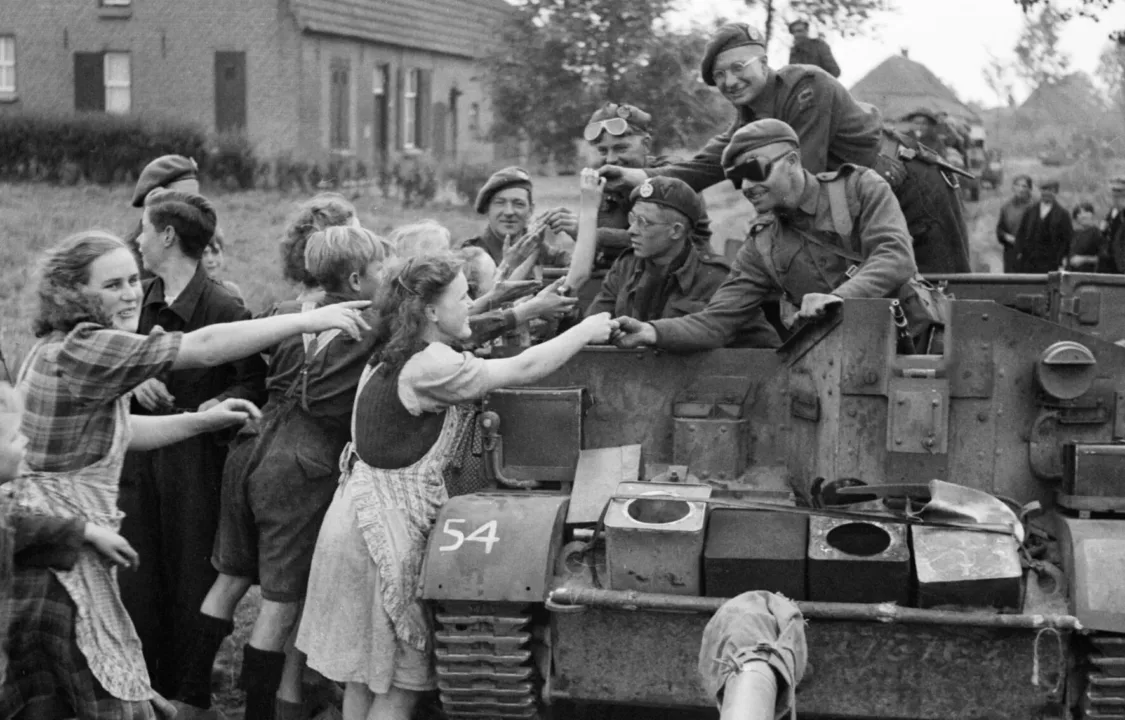

Today is May 5, 2026. You’re probably wondering what this could possibly have to do with World War II, unless you’re Dutch. May 8, 1945 marked the official end of World War II in Europe. Sometimes better known as VE Day. France had already been liberated from Nazi German occupation in September 1944; Paris was liberated on August 25, 1944. Even Belgium had been liberated as a whole by February 1945. For the Netherlands, the freedom that had been denied its people for five years would have to wait even longer, no less than three days before the war ended across all of Europe. This is the story of the liberation of the Netherlands. This is why.
Attack, surrender and occupation
On May 10, 1940, the Netherlands, too, was forced to yield to the violence and expansionist ambitions of Nazi Germany. Hitler viewed the Dutch people as Germanic brothers, or as a brother nation. Yet this could not prevent Germany from attacking the Netherlands as well. Despite fierce resistance from the Dutch and even a successful defense against the German airborne invasion, the Netherlands surrendered unconditionally on the night of May 14–15, 1940. The words of General Henri Winkelman resonated throughout the country: “Our soldiers fought with a courage that will remain unforgettable. But the battle was too unequal; our troops faced technical means against which even the greatest human courage is powerless. By the thousands, they fell for the freedom of the Netherlands.”. He continued: “Relying almost entirely on our own strength, we were unable to protect our country and our civilian population from this violence. It was these harsh realities that compelled me to make my most serious decision: we have ceased the fight.”
Because the Netherlands wanted to remain independent during World War II, it was on its own from the very beginning. Neither France nor the United Kingdom was able to come to the Netherlands’ aid.
Contrary to what many people still believe today, Germany’s attack on the Netherlands was not without reason and was not solely driven by Hitler’s desire for expansion. It was primarily based on tactical considerations. Hitler had to protect his western flank, because the ports and west coast of the Netherlands were a perfect location for the Allies to bring reinforcements onto European soil. By forcing the Netherlands to capitulate, Hitler could control the Dutch west coast and its ports himself, preventing the Allies from gaining a foothold there.
The Netherlands therefore wanted to remain neutral, just as it had during World War I. The Netherlands fought fiercely to maintain its neutrality, but only briefly. The Netherlands surrendered on May 15, 1940. The Netherlands was defeated, but did not give up over the next five years.
Occupation
As mentioned, Hitler viewed the Dutch as a brother nation. Consequently, the occupation of the Netherlands was initially carried out with a light touch. After all, they were Germany’s brothers. The Nazis also regarded them as racially pure Aryans. The Netherlands was to be incorporated into the Third Reich, just as Austria had been. Some of the Dutch people saw it this way too, especially the supporters of the NSB, the National Socialist Movement, or the Dutch Nazi party. The political leader of the NSB was Anton Mussert, a great admirer of Hitler, but more of an opportunist. The scale of Dutch collaboration, however controversial, speaks for itself. Approximately 25,000 Dutch people voluntarily joined the Waffen-SS during World War II. They were recruited as Germanic brothers for the fight on the Eastern Front.
At first, the Dutch were spared the kind of treatment meted out to the people in other occupied territories, such as Poland and France. But this did not last long. Despite the “Germanic brotherhood” touted by Nazi Germany, the Netherlands became nothing more than a police state where oppression was a daily reality. By far the majority of the Dutch population had no appetite for life under German occupation. This is evident, among other things, from the widespread, extensive, and significant resistance movement in the Netherlands. Ultimately, the SS and Nazi Germany would also have their hands full in the Netherlands trying to crush the resistance movement.
Liberation in stages
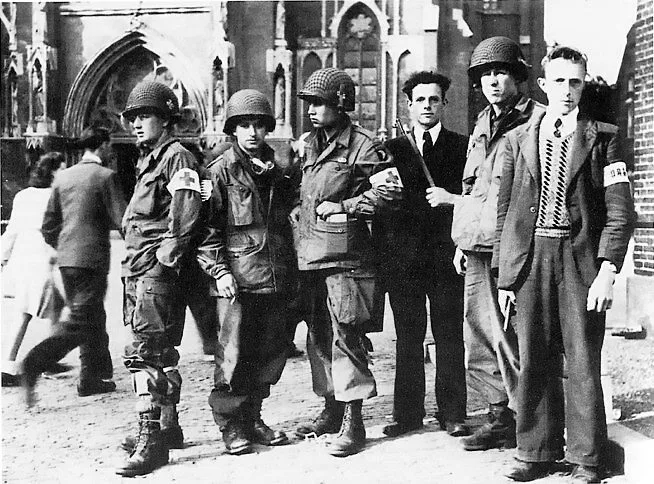
Liberation Day in the Netherlands is officially celebrated on May 5. This date was officially established by the Dutch government in 1946. It marks the day in 1945 when the Netherlands was fully liberated. However, part of the Netherlands had already been liberated earlier by the Allies, consisting of American, British, Canadian, and Polish troops. For a small country like the Netherlands, the complete liberation of the country took no less than 8 months. While one part of the Netherlands was able to taste absolute freedom for the first time in nearly 5 years, the other part still had to endure daily oppression.
The liberation of the southern part of the Netherlands had already been achieved as early as September 1944. The Allies were making their way through Belgium and the Netherlands. There was only one ultimate goal for the Allies. No, not the liberation of the Netherlands. To capture Berlin before the Red Army got there first. Operation Market Garden was intended to make that happen. The bridgeheads across the Dutch rivers, the Meuse, Waal, and Rhine, had to be secured, with the bridge at Arnhem as the ultimate objective. The Allies wanted to use this route to bypass the German Siegfried Line, also known as the Westwall. By capturing these key positions in the Netherlands, German troops in the western part of the country would be isolated. And of no small importance, the Netherlands would thereby be liberated in its entirety before Christmas 1944.
Operation Market Garden failed in that the bridge at Arnhem proved to be a bridge too far. The immediate consequence was that the front in the Netherlands came to a complete standstill. The Allies did not advance beyond Arnhem, and the three major rivers in the Netherlands formed a natural barrier against further advance, a situation that worked to the advantage of the German defenses. As a result, the northern Netherlands fell far down on the Allies’ list of priorities. While the southern Netherlands could once again taste freedom after more than 4.5 years, the northern Netherlands remained trapped under the oppression and occupation of Nazi Germany. The Allies bypassed the northern Netherlands and moved eastward toward Berlin, their newest and highest priority, because the Red Army was already dangerously close to the German capital.
The Netherlands was divided into two parts: an occupied part and a liberated part. This, combined with the major Dutch railway strike, led to the Hunger Winter of 1944.
Liberation of the Northern Netherlands
Winter gave way to spring in 1945. The Allies had their sights set solely on Berlin. But hope was not entirely lost. The 1st Canadian Army was preparing for the upcoming operation. It was primarily Canadian troops who had liberated the northern Netherlands, with the support of British troops, Polish troops, and the Dutch resistance, also known as the Internal Forces. The Canadian troops entered occupied Netherlands from Germany via the Achterhoek region. They crossed the IJssel River and continued their rapid advance through eastern Netherlands northward toward the provinces of Groningen and Friesland. Although the German army had already been defeated throughout virtually all of Europe, the fighting in the northern Netherlands remained fierce, particularly during the Battle of Groningen from April 14–16, 1945. It was one of the largest urban battles, in which Canadian tanks and infantry had to face the still fanatical German Waffen-SS and even Dutch SS troops. But a German defeat was all but certain and imminent. In the days that followed, more and more towns and villages in the northern Netherlands were liberated.
On May 4, 1945, German troops in the Netherlands signed the surrender at Lüneburgerheide. This marked the official surrender of German troops in the Netherlands on May 5, 1945, although many hostilities had already ceased by 8:00 a.m. that morning. As with any surrender, a number of incidents still occurred after May 5, 1945, but the entire Netherlands was officially liberated. Or was it?
On the Wadden Islands, particularly Schiermonnikoog and Terschelling, liberation was already in sight, but had not yet become a reality by May 5, 1945. A fanatical group of Waffen-SS soldiers had gathered there, some of whom were from the northern Netherlands. Some of these SS members had fled from the Scholtenhuis in Groningen, among other places. This group of fanatics, especially on Schiermonnikoog, initially refused to acknowledge the surrender and hoped to continue fighting or flee via the islands. On Terschelling, the German troops surrendered on May 29, 1945, and the last troops departed on June 5, 1945. The occupation lasted the longest on Schiermonnikoog. There, the last German troops did not leave the island until June 11, 1945.
The Netherlands was, in fact, liberated in stages, partly due to a delayed Allied operation that contributed to the Hunger Winter. The northern part of the country had to wait more than eight months longer for liberation than the southern part of the Netherlands. But on Schiermonnikoog, it took another month beyond that.
On May 5, the Netherlands once again celebrates its freedom. But let us also remember June 5, 1945, and June 11, 1945, for all those who had to live under occupation longer than others.
Would you like to learn more about the Netherlands and the resistance during World War II? Then be sure to check out this in-depth feature: A Nation That Never Yielded.
WarCommons publishes long-form, source-driven analysis without ads or click incentives. If you found this feature valuable, consider supporting our research by subscribing to help fund future investigations.
By Nick Ravenshade — Author
Header image: A carrier crew of 8th Rifle Brigade hands out chocolate to Dutch civilians during the advance of 11th Armoured Division in Holland, 22 September 1944. Source: Wikimedia Commons. Public domain.