WARCOMMONS IS NOW ON ANDROID
Explore WWII history and stay connected with the community on the go. GET THE APP →

Throughout its brief history, the Weimar Republic was often plagued by instability. But among these periods of instability, the hyperinflation of 1923 stands out as the most significant. And especially what resulted from that hyperinflation. A culmination of this was that in 1923, you could buy a single loaf of bread in Berlin for 200,000,000,000 German marks, whereas at the end of 1922 it cost only 160 German marks. The response to this hyperinflation and the political chaos that fwollowed was the Dawes Plan.
The Origins of Hyperinflation
History has taught us that the Weimar Republic (Germany at the time) was primarily a scene of instability and extremism. But the main cause of this was the Treaty of Versailles and the resulting obligations that Germany was required to fulfill at that time. This was established on June 28, 1919, the day the Treaty of Versailles was signed. The infamous “guilt clause” stems from Article 231 of the Treaty of Versailles and is of great significance. It effectively attributed full responsibility for World War I to Germany. Articles 232–247 of the Treaty mandated reparations. However, the amount was still undetermined at that time and would later be set by a Reparations Commission.
However, the commission’s first report was not long in coming. On May 5, 1921, the Schedule of Payments was published. It established Germany’s debt at a nominal value of 132 billion gold marks. Based on the gold price in 2026, this would amount to approximately 7,000,000,000,000 U.S. dollars in 2026. About 50 billion gold marks was the portion of the total amount to which the repayments and guarantees were practically directed. Quite reasonably, according to the Allies, Germany was allowed to pay off this debt over a period of 42 years at an interest rate of 5% per year. Germany also received a clear repayment schedule at no cost: 2 billion gold marks per year for the first two years, and starting in the 37th year, that amount was to be 5 billion gold marks per year. There was, however, one problem. The debt was so high and unrealistic that Germany simply could not pay it.
They immediately informed the Commission of this. But the Commission was not convinced. August 1921 was therefore the month in which the so-called London Schedule, the repayment plan for Germany, came into effect. The plan provided for the payment of 50 billion gold marks over 30 years. The payments were made partly in kind, including coal, steel, timber, ships, livestock, and more, and partly in cash. Germany met the first installment of 1 billion gold marks, but it soon became clear that the plan was unsustainable. Germany fell behind on the agreed-upon London Schedule as early as after the first installment. Not only did the payments fall behind, but the agreed-upon payments in kind also began to lag. In the spring of 1922, the crucial coal deliveries also began to fall behind. This was the result of technical problems as well as strikes in the Ruhr region. By the summer, the situation had deteriorated to such an extent that no steel and/or timber was being delivered at all. In addition, Germany delivered only 25% of the intended ships.
The picture was clear to the commission. In November 1922, the commission determined that Germany was officially two months behind schedule in its deliveries of wood and coal, amounting to 400,000 metric tons of undelivered coal. Germany attempted to explain the coal shortage to the Allies, attributing it to the harsh winter of 1921–1922. France, however, would have none of it and viewed Germany’s failure to fulfill its obligations as deliberate sabotage of the Treaty of Versailles. Diplomatic tensions ran high, and payments from Germany ceased entirely.
The London Conference
The Allies did not leave Germany’s failures unaddressed for long. The culmination of Germany’s default was reflected in the first conference between Germany and the Allies regarding reparations. The London Conference, held in response to Germany’s failure to meet its obligations, took place from December 1922 through January 1923. Germany showed itself willing to fulfill its obligations as set forth in the Treaty of Versailles. Consequently, Germany offered to pay 50 billion gold marks, as the London Schedule had also stipulated, but emphasized that more was truly not possible. The major victor of World War I, France, felt shortchanged and emboldened by the injustice it believed had been done to it. Consequently, France no longer demanded payment of 132 billion gold marks, but double that amount, namely 269 billion gold marks. Approximately, and considering the price of gold in 2026, this would amount to around 15,000,000,000,000 U.S. dollars. According to the French, this was a reasonable amount, representing the original sum plus compensation for overdue payments and inflation-related losses.
Where a solution should have been reached at the London Conference, the parties only reached an impasse. Even more remarkable was that the Allies themselves became divided. For the British, restoring trade within Europe and with Germany was a central priority. The Americans were primarily seeking stability within Europe, but remained as neutral as possible in the process. France was still primarily focused on revenge and demanded maximum reparations and control over Germany. Neither financial proposals nor threats had any effect on this deadlock.
Occupation of the Ruhr region
However, the impasse was merely the prelude to a larger crisis that threatened to spiral out of control. On January 9, 1923, the commission officially determined that Germany had failed to meet its obligations to the coal suppliers. The commission did not mince words. It formally concluded that the Weimar Republic, under Wilhelm Cuno, had deliberately withheld deliveries. France seized this moment with both hands. It was the perfect justification for invading the Ruhr region. However, the other Allies were not united on this point either. The Americans and British disapproved of a French occupation of the Ruhr region, and Belgian politicians also argued against the occupation. However, it was not Belgian politicians who made the decision for Belgium. The Belgian military leadership, still filled with a desire for revenge over World War I, saw this as the moment to occupy the Ruhr region. Under French pressure and out of fear of missing out on much-needed reparations, the Belgian Theunis government decided to go along with the occupation of the Ruhr region.
And so it came to pass. Belgium and France got their way and thought they were getting their revenge. It was January 11, 1923, when France and Belgium crossed the border and occupied the Ruhr region with an initial force of no fewer than 60,000 troops, later increased to 100,000. The goal? To enforce reparations by taking control of coal and steel production within the Ruhr region and to protect a commission of engineers who could ensure production.
Germany’s response came almost immediately. A campaign of passive resistance and civil disobedience was called for. But demonstrations and some attempts at sabotage were also encouraged. In part by Chancellor Cuno. He encouraged passive resistance immediately after the occupation. The Reichstag therefore approved passive resistance as official policy as early as January 13, 1923. The German population could now, with the support of their country, lawfully engage in passive resistance against the Franco-Belgian occupation of the Ruhr region.
The acts of sabotage were carried out primarily by members of the former Freikorps. As a result, sabotage was limited to small-scale operations. For example, a number of bridges were blown up and some railway lines rendered unusable. German collaborators who had assisted the French and Belgians during the occupation of the Ruhr region were executed by these groups.
Germany chose to continue paying the wages of strikers and those refusing to work. However, this led to budget deficits. The Cuno cabinet thought it could solve this by simply printing extra money to pay the wages. The massive money creation by the Cuno cabinet was the final catalyst for hyperinflation, which just needed that little push. As a result, by November 1923, 4,210,500,000,000 German marks were worth only one U.S. dollar.
This hyperinflation ultimately led not only to economic collapse but also to political chaos. The end of 1923 alone, due to hyperinflation, was the scene of three historically significant events: the Cuno government fell, Gustav Stresemann became the new Chancellor, and Adolf Hitler carried out his failed Beer Hall Putsch.
A salient and sensitive detail is also often overlooked in this context. The occupation of the Ruhr region by France and Belgium garnered Germany significant international sympathy. However, this was not publicly acknowledged. The League of Nations therefore took no action against this clear violation of its own rules, because the action was, in fact, justified under the Treaty of Versailles.
A New Beginning
In November 1923, Gustav Stresemann became the new chancellor of the Weimar Republic. He envisioned a different solution than his predecessor, Cuno. Immediately after taking office, he abolished passive resistance. This was a risky gamble, as the Ruhr region was still occupied. However, it did mean that Germany no longer had to pay the wages of strikers and those refusing to work. It was one of the most important conditions for beginning the economic stabilization of the country. It immediately reduced the pressure on the budget and meant that less money had to be printed. A large number of civil servants were also laid off as a result of strict austerity measures and reorganizations. He had only one immediate goal in mind: stabilizing the state finances.
But even before he took the opportunity to resume negotiations with the Allies, he implemented a number of economic measures intended to stabilize the economy. He introduced the Rentenmark in November 1923. This was a new currency, strictly controlled by the state. It was intended to replace the now worthless Reichsmark. This brought the spiral of hyperinflation to a halt within weeks. The Rentenmark was backed by mortgages on industry and land. A fixed amount of Rentenmark was in circulation, namely 3.2 billion.
In this way, confidence among the German population was gradually restored. But what had not yet been resolved were the reparations under the Treaty of Versailles. Nor had the divisions among the Allies been resolved. After the end of German hyperinflation, the Americans and British were at the forefront of efforts to restore trade with Germany and withdraw from the Ruhr region. But France remained firm in its initial position: maximum reparations and maximum control over Germany.
It was a fresh start, but the result remained the same. A deadlock.
The Dawes Plan
In January 1924, all parties were at an impasse. This applied not only to the Allies against Germany, but also to the Allies among themselves and within German politics.
Despite the stabilization of its domestic economy through the Rentenmark, Germany could not afford to make monetary reparations. After all, the Rentenmark was merely a domestic stabilization measure. Germany still lacked (foreign) currency, such as the dollar, pound, franc, and gold. The reparations had to be converted into foreign currency. But because Germany did not yet have enough hard currency, it could not yet make stable and sustainable payments, even though it did have a stable domestic currency at that time. Another hindering factor was the political right in Germany. They viewed the reparations as high treason.
France, on the other hand, remained mired in its desire for revenge and short-sightedness. It saw retaining the Ruhr region as the only solution until Germany could once again guarantee maximum payments on its own.
The United Kingdom and the United States of America adopted a more neutral stance and were more solution-oriented. The UK wanted to restore trade and feared the spread of Bolshevism in Germany if the untenable situation continued in this manner. The US also favored restoring trade, remained neutral, but now also advocated for a technical solution.
It was therefore the Americans who took the lead in breaking the deadlock. President Coolidge supported a so-called committee of experts consisting of non-political financiers and bankers. On January 9, 1924, the London Reparations Conference decided to establish the First Committee of Experts, also known as the Dawes Committee.
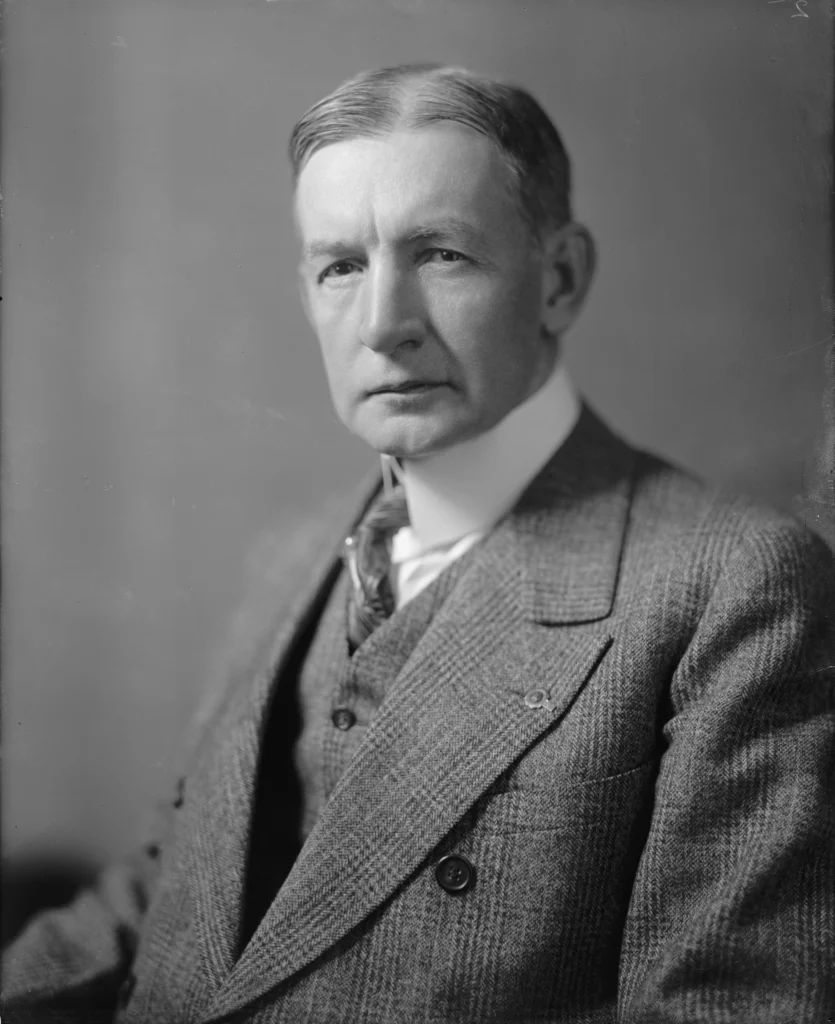
This work is from the Harris & Ewing collection at the Library of Congress. According to the library, there are no known copyright restrictions on the use of this work.
The chairman of this committee was none other than the banker Charles G. Dawes. The committee consisted of 10 financial experts and no politicians. They were tasked with developing a practical payment plan, independent of the total amount of reparations. And they were to remain impartial, as the plan had to be free from political ideology, which had already driven the entire solution into a deadlock.
It did not take long. In April 1924, the committee presented its report, and the Dawes Plan was adopted later that same year. The Dawes Plan had several objectives and was intended as a temporary restructuring measure. The primary goal was to restore trust among all parties. Against France’s strong wishes, it also provided for the end of the Franco-Belgian occupation of the Ruhr region. Regular reparations payments were ensured, as they were tailored to Germany’s exports and financial capacity. After all, the reparations were not to result in Germany once again facing an immediate economic collapse.
The reparations payments were linked to Germany’s economic capacity and exports. The payment schedule was revised and now appeared reasonable for Germany. Starting in 1924, they were required to pay 1 billion gold marks per year, rising to 2.5 billion gold marks beginning in 1929. The Reichsbank, which was to become independent under the plan, was placed under Allied supervision with Hjalmar Schacht as president of the Reichsbank. The German railways were to be privatized in accordance with the Railway Executive outlined in the plan, so that the railways could be managed more efficiently with mortgages as collateral. Germany was also granted loans, and the Ruhr region was to be returned to Germany, marking the end of the Franco-Belgian occupation of the area.
Weimar’s golden years
On August 16, 1924, the Reichstag ratified the plan, despite opposition from the NSDAP, which was still a small party at the time, and the Communists. But the plan did achieve what it was designed to do: it marked the beginning of the so-called Goldenen Zwanziger, The Golden Twenties.
American banks and American investors were the direct sponsors of the Golden Twenties. While the Dawes Plan was a short-term solution for Germany’s economic collapse, for American banks and investors, among others, it was nothing short of a gold mine.
It was therefore J.P. Morgan & Co. that, in a consortium with American banks such as National City Bank and First National Bank, organized the first and largest Dawes loan of 800 million gold marks. Between 1924 and 1929, they provided a direct cash injection into the German economy by channeling tens of billions of Reichsmarks in foreign loans into the country. The Golden Twenties were therefore not just for Germany. The banks profited in three distinct ways. These banks and investors earned most of their profits from commissions they received for assuming the risks involved in issuing new bonds, securities, or loans. The first Dawes loan of 800 million gold marks thus generated tens of millions of gold marks in pure profit. The financial institutions also profited from the so-called interest spread. In the capital market, they borrowed money themselves at a low interest rate and then issued bonds to Germany that paid a higher interest rate. The difference between the interest rates was also pure profit for the banks and investors. But the banks and investors also had the fundamental economic conditions in place to generate profits. Buy low and sell high. The banks bought bonds themselves and then sold them to other investors at a higher price.
These pure profits ensured that American financial institutions benefited enormously from the Dawes Plan and the massive cash flows involved. But in practical terms, Germany actually benefited the most, as the country was saved from total financial ruin. The loans also enabled Germany to begin reparations payments immediately and stimulated investment. Industrial production rose by as much as 40% between 1924 and 1927. Unemployment fell and payments proceeded smoothly; a total of 8.9 billion gold marks was paid over four years. Germany was propelled into a period of economic prosperity, and diplomatic tensions, especially between Germany and France, were eased by the reparations and the gradual lifting of the occupation of the Ruhr region.
The funds from the Dawes Plan were thus to flow to three sectors in Germany that were most essential: industry, the government, and the municipalities. Because industrial factories could once again borrow money cheaply, there was ample capital available for new investments that spurred economic growth and an increase in exports. Expanding industrial capacity and exports was of crucial importance. After all, it generated revenue through export earnings, which could be used to pay reparations and cover imports. Industry was often viewed as the top priority. Production was on the rise, unemployment was falling, and wages were regaining their purchasing power. Workers were finally able to spend money on things other than just food again.
The German government used the financial injection to shore up its budget and cover civil servants’ salaries. This quickly addressed acute budget deficits. The reparations payments also consisted mainly of borrowed funds, but they did help ease diplomatic pressure. Municipalities put the borrowed money to work to repair roads, bridges, water and energy infrastructure, and housing. This not only improved municipal infrastructure; the repair work also created jobs. Railways were also upgraded as part of railway reforms, which improved logistics and trade.
As purchasing power rose again, nightlife and the avant-garde began to flourish. Consumers were finally able to spend again. And that need was quickly met. There was a surge in cabaret and jazz, with performers like Josephine Baker in Berlin and Marlene Dietrich taking the stage. The films Metropolis and Der Blaue Engel appeared on the silver screen. And elsewhere in the cities, the elites lived in a frenzy of freedom and experimentation. Berlin became a city of sin. The decadent heart of Europe.
The economic recovery also brought political stability and paved the way for the 1925 Locarno Treaties, also known as the Geist von Locarno. The Geist von Locarno ushered in a period of political reconciliation in Europe and, with it, stability. Germany, France, Belgium, the United Kingdom, and Italy recognized Germany’s western borders, as established in the Treaty of Versailles, and guaranteed the demilitarization of the Rhineland. As a result, Germany had to accept the loss of Alsace-Lorraine to France. Germany, France, and Belgium also signed a non-aggression pact with one another and pledged to resolve any disputes peacefully.
And so it was to be. The Rhineland remained free of German troops, making France feel safer. Ultimately, these Golden Twenties paved the way for Germany’s admission to the League of Nations in 1926. Germany’s eastern border with Poland and Czechoslovakia remained uncertain, however. But the Germans promised not to use force. The investments were made with borrowed money. The reforms were carried out with borrowed money. The reparations were paid with borrowed money. The principal and interest that Germany had to pay on these loans? Paid with borrowed money.
Germany also earned more money, thanks to its newly acquired prosperity, growing industry, and exports. But this was not enough to meet all its financial obligations. The economy, the Golden Twenties, could only continue as long as borrowed money, primarily from America, continued to flow into Germany.
But in the meantime, life was bustling in major German cities like Berlin. Under the neon lights, the new elite were shaping their newly acquired prosperity. In the nightlife scene, amid cabaret and avant-garde culture, they were completely oblivious to the bubble they were living in and just how close it was to bursting.
Inevitable end
However, the Dawes Plan also specified an end date for the financial arrangement. After all, it was intended only as a short-term emergency solution. Technically, the plan expired in 1928, although the agreed reparations payments were to continue. It did, however, mark the end of the U.S. loan arrangement as implemented under the plan. The Dawes Plan could not simply be extended either. Not only because the plan technically expired in 1928, but also because German politicians resisted it, particularly the NSDAP, which called the Dawes Plan “chains of slavery.” However, 1929 also marked the point at which the reparations payments were set to increase. The problem was that Germany could not continue to meet those deadlines in the long term without structural reforms. Owen Young therefore believed he was the one with the solution to the problem that had now arisen following the expiration of the Dawes Plan. It became the Young Plan of 1929.
The Young Plan provided for a structural reduction in the total amount of Germany’s reparations debt, from 132 billion gold marks to 112 billion gold marks. Allied supervision of the Reichsbank came to an end, and the reparations were given an end date: 1988. The Dawes Plan was the stopgap solution, and the Young Plan was intended to provide for post-war recovery within Germany. Despite fierce protests from the NSDAP, the Young Plan was ratified by the Reichstag in November 1929. But even before the Young Plan could have any meaningful impact on the Allies and Germany, The Great Depression was looming.
The Great Depression
The summer of 1929 was just like any other during the Roaring Twenties. The cabarets in the cities were packed, and the middle class was enjoying champagne and jazz. The Dawes loans had been serving their purpose since 1924, and everything seemed to be going smoothly.
But then came October 24, 1929. The stock market on Wall Street was abruptly plunged into crisis. In the days that followed, between October 24 and October 29, 1929, tens of billions of dollars in market value evaporated. These days were the scene of Black Thursday and Black Tuesday. The Great Depression was a reality.
Whereas American banks, including J.P. Morgan & Co., had already pumped tens of billions of Reichsmarks into the German economy between 1924 and 1929, the entire flow of money from America to Germany came to a complete standstill. In 1929, the banks still tried to sell Dawes bonds, but there were no buyers to be found. Foreign capital was no longer reaching Germany. As a result, Germany could no longer pay for investments and expenses, as it was largely dependent on foreign loans. Germany, too, fell into a recession, and export revenues plummeted by roughly 40%. This led to deflation in Germany, with prices falling by roughly 25% and wages by about 40%. Businesses went bankrupt and prosperity crumbled, contributing to rising unemployment. While unemployment stood at just around 4.5% in 1929, it rose to over 6 million unemployed people, around 30%, by 1932 during the crisis. The Great Depression also led to the bankruptcy of around 2000 banks, including the Danatbank in July 1931. Savings vanished and the middle class was ruined. The cabarets closed and the silver screen remained empty.
The Golden Twenties were no more.
Lausanne Conference
The financial system had collapsed, and Germany was no longer able to meet its reparations payments. Consequently, the Hoover Moratorium was issued on June 20, 1931, the year in which Germany officially defaulted on its reparations payments once again. The Hoover Moratorium suspended German reparations for a period of one year. The aim was to provide Germany with a cooling-off period to cope with the financial crisis and to maintain trust between Germany and the Allies.
One year after the Hoover Moratorium, the Lausanne Conference was scheduled. The conference took place from June 16 to July 9, 1932. The United Kingdom, France, Italy, Belgium, Japan, and Germany were represented at this conference. It was already clear to all parties that it was effectively impossible for Germany to continue meeting its reparations payments as a result of The Great Depression. But Belgium and France, in particular, were still partly saddled with debts from the war against Germany in World War I, as well as the damage caused. According to the Entente, reparations could only cease if an agreement were reached with the United States regarding the debts the Entente owed to the United States. The Americans did not agree with this, and the U.S. Congress rejected the plan in December 1932.
The Treaty of Lausanne required Germany to make one final payment of three billion gold marks, which it was to settle in the form of 5% interest-bearing bonds to the Bank for International Settlements in Basel, Switzerland. For Germany, this also entailed a three-year suspension of payments, during which the interest income would accrue to the creditors. The bonds were to be placed on the market within 15 years, once economic stability had been restored.
The Young Plan, which was not being followed anyway, remained in effect. Despite all this, Germany still stopped making reparations payments. These payments were never resumed. All of this meant that Germany paid only about one-eighth of the original debt amount, according to some historians.
The bonds were ceremonially burned in 1948.
The beginning of the end
Adolf Hitler rose from this economic ruin. Capitalizing on widespread social discontent and Germany’s economic collapse, he promised stability and jobs. Society was vulnerable, dissatisfied, angry, and receptive to extremist rhetoric. Six million citizens were unemployed, and Germany’s economic collapse was evident. The middle class, which had lost everything, the unemployed, and industrialists saw the NSDAP as the alternative and as the solution to their problems. In 1930, the NSDAP received 18.3% of the vote, securing 107 seats, whereas during the economic boom of 1928, it had received only 2.6% (12 seats). The ongoing crisis ultimately resulted in 230 seats for the NSDAP in July 1932, representing 37.4% of the vote. It is widely accepted among historians that Germany’s economic and social collapse directly led to the NSDAP’s rise to power. The Dawes Plan also played a central role in this.
The Dawes Plan is often viewed as a political lifeline that single-handedly restored stability to Europe. However, it was also the Dawes Plan that served as a key link in the chain of events leading to a new crisis, which paved the way for the rise of Hitler’s dictatorship and Nazi Germany.
WarCommons publishes long-form, source-driven analysis without ads or click incentives. If you found this feature valuable, consider supporting our research by subscribing to help fund future investigations.
By Nick Ravenshade — Author
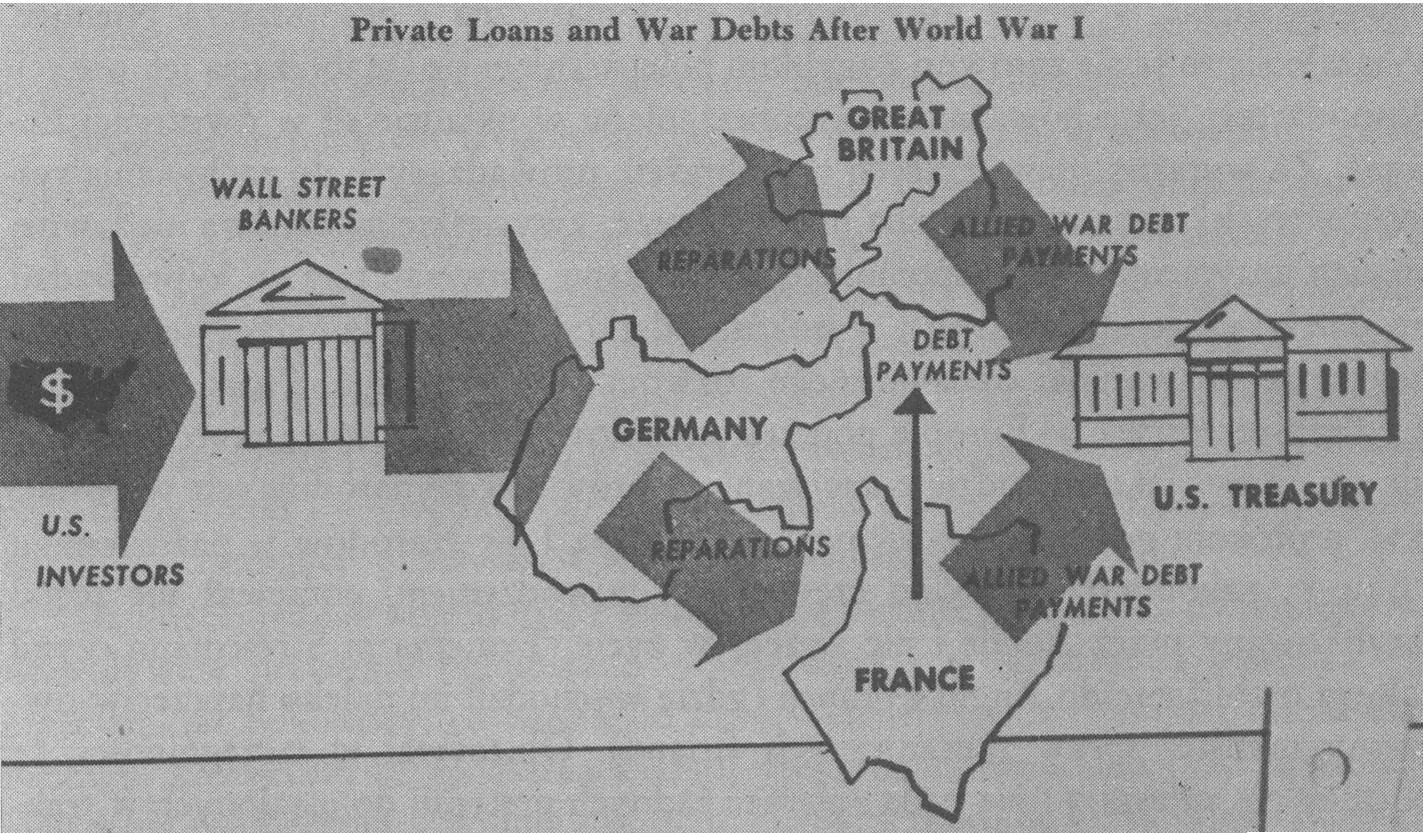
Header image: English: Flow chart of loans and repayments of war debts after the adoption of the Dawes Plan in 1924 from American banks through Germany, England, France back to America. Source: Wikimedia Commons. Public Domain.

.jpg)