WARCOMMONS IS NOW ON ANDROID
Explore WWII history and stay connected with the community on the go. GET THE APP →

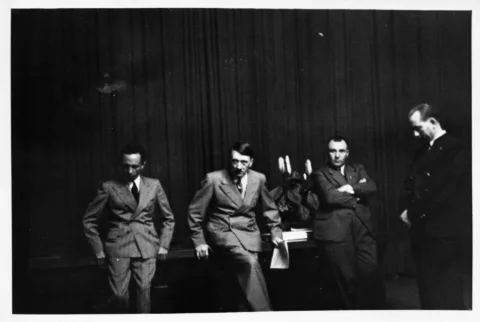
April 30, 1945. At that exact moment, Hitler had already been in hiding since January 16, 1945. He had hardly ever come out into the open. Only on March 20, 1945. That was when the last images of Hitler were recorded. The now iconic video showing a line of Hitler Youth receiving a handshake, a pat on the shoulder, an Iron Cross medal, and a pinch on the cheek from Hitler.
The last defenders of Berlin. Children and the elderly.
April 30, 1945. Berlin is on the verge of falling. Germany has fallen. World War II is as good as over. The end of the war is now merely a formality. But the fighting was no less intense. Death and destruction continued for a few more days.
April 30, 1945. It is clear to Hitler as well: Germany is lost, the war is lost. And he gives up. He has led Germany into the abyss. And he takes the so-called coward’s way out. Together with his wife Eva Braun, he committed suicide. On April 30, 1945.
The scene of the suicide was a small room inside the famous Führerbunker. The setting for Hitler’s final days alive. Isolated, without daylight, and with a constant stream of people, generals, and Hitler’s confidants coming and going.
The Führerbunker
The bunker where Hitler took his own life has always been notorious. It was the setting for Hitler’s final months and his increasing isolation from the outside world. But it was also the scene of horrors, such as the murder of the Goebbels children by their mother, Magda Goebbels. It is difficult to imagine such an act. It is depicted in the film Downfall, and all one can do is be left speechless. But that is precisely what WWII was like. So many horrors had taken place that sometimes one can only be left speechless.
After WWII, the general trend was that anything related to National Socialism or with Nazi connotations had to be destroyed. This often leads to the question: what actually happened to the Führerbunker? The iconic underground structure where Hitler spent his final days. It could have been a time capsule for historians.
The Origin of the Bunker
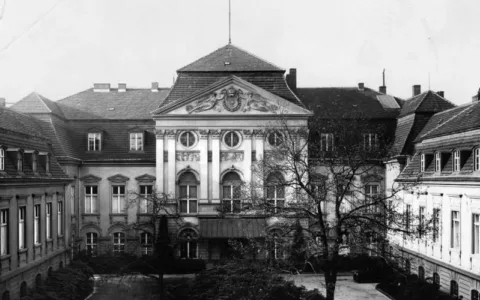
Between 1935 and 1936, the first bomb shelter was constructed beneath the banquet hall and winter garden of the Reich Chancellery. The floor of this bomb shelter lay a full 6.40 meters below ground. But this was not the Führerbunker. Hitler likely saw what was coming well before 1945. In 1943, he ordered the construction of a second bunker. This second bunker was to be deeper and offer better protection. Hitler’s fear of air raids was immense, and previous bombings had made it clear that the Allies could penetrate to considerable depths with their bombs. Certain types of bombs could explode up to several meters underground. The second bunker therefore had to be built even deeper underground; the floor of this second bunker was 8.50 meters below ground level. But nothing was left to chance. Not only was the bunker located so deep underground, but the ceiling was made to be approximately 3 to 4 meters thick, with another meter of earth above it.
The older bunker, which was shallower, became known at that time as the so-called Vorbunker. The deeper second bunker is the one widely known as the so-called Führerbunker.
What stands out in the films and series that claim to faithfully reconstruct Hitler’s final moments in detail is the deafening sound and the vibrations of the bombings. The question is how realistic this depiction was compared to reality. But there is no room for doubt that it is accurate. The bunkers were located below the water table of the city of Berlin. The bomb impacts, especially in the final weeks of the war, could be heard very clearly inside the bunker. Groundwater also constantly seeped into the bunker due to the bombings, which then had to be pumped out.
But otherwise, every detail had been considered. There was a special system for supplying filtered, fresh air, which also protected the bunker against chemical attacks. Diesel generators also supplied the bunker with electricity. The choice of a diesel generator did, however, result in significant vibration and noise inside the bunker. And if you wanted to reach the Führerbunker, you first had to pass through the Vorbunker and a number of security checkpoints. Every entrance was sealed with armored doors. All visitors were checked by SS guards, and weapons had to handed in at the guardroom. The only people allowed to carry a weapon inside the bunker were Hitler, the SS guards, and the telephone operator, Rochus Misch. This essentially reflects the degree of trust Hitler had in Misch.
On the other side of the bunker was a staircase. This special staircase led to the above-ground exit in the garden, which is also frequently seen in *Der Untergang*, for example. However, it was intended as an emergency exit from the bunker.
Daily Life in the Bunker
Before Hitler moved into the Führerbunker permanently on January 16, 1945, he was not often to be found there. Only very occasionally. He spent most of his time at his official residence within the Reich Chancellery. The Allied bombings of Berlin, which were drawing ever closer, forced him to take up residence in the Führerbunker almost permanently. Nevertheless, the meetings, which took place daily, were still held in the Reich Chancellery itself at the beginning of this period. After a few weeks, the bombings intensified dramatically. Even the ordinary rooms and offices of the Reich Chancellery itself were no longer safe enough. From that moment on, all meetings took place exclusively in the bunker.
Confidants, generals, and other staff members came and went constantly. Daily life went on, insofar as it could still be considered normal amid the bombings from above. People were safe inside the bunker. But there must certainly have been an atmosphere of impending doom. Blondi was always there, Hitler’s dog. And Eva Braun, who had previously hardly ever come to Berlin, moved into the bunker with Hitler around April, 1945. She would never emerge alive. But another of Hitler’s confidants also came to live with him in the bunker. The man who, to this day, is known to have had an enormous admiration for Hitler: Joseph Goebbels. He moved into the bunker with his family. None of them survive the final days of the Reich.
It was precisely here that Hitler directed divisions and regiments that either did not exist or had already been destroyed across the map of Germany. For example, Steiner’s Army Detachment was ordered to attack the Red Army’s northern flank near Berlin. But Steiner’s army was virtually nonexistent by then, as he did not have enough troops. In addition, there were also the now ever-present 9th Army and Wenck’s 12th Army. According to Hitler, Theodor Busse’s 9th Army was supposed to create a pincer movement in the northern sector together with Steiner. The problem, however, was that this maneuver was effectively impossible. And the great rescue was to come from Wenck’s 12th Army. Hitler demanded that he focus entirely on the east against the Red Army. Wenck was, in fact, still fighting in the west against the Allies, especially the Americans. During military briefings, the generals heard about nonexistent and small units that were supposed to carry out counterattacks. Everything was coordinated by Hitler, based on a map that no longer reflected reality at all. And his generals simply said “Jawohl.”
After Hitler was told that the attack Steiner was supposed to carry out had never taken place, Hitler suffered a nervous breakdown. As far as we know, this was the first time Hitler had stated in the presence of others that the war was lost for Germany. It was April 22, 1945.
The Fate of the Führerbunker
After World War II, there was a broad consensus among the Allied nations regarding the preservation of the history of that war. Namely, no preservation of history at all. A great many historic Nazi buildings, works of art, and structures were demolished or destroyed after the end of World War II. The Nazi architecture and monumental grandeur associated with Hitler meant that every piece of Nazi architecture was equated with propaganda and ideology. The buildings themselves were intended to demonstrate and radiate the greatness of the Third Reich. After the war, democracy was to prevail, and the prevailing view was that such buildings had no place in a democracy. The Allies and the new German government had only one goal: to eliminate the symbols of Nazism and enable the reconstruction of a democratic society.
In addition to the fact that a significant portion had already been destroyed by Allied bombing raids on Germany, the remaining buildings also had to be demolished. This was a consequence of denazification. Nazi symbols, monuments, works of art, and structures were systematically and without exception removed from public spaces.
However, it was also intended to ensure that these types of Nazi sites would not become gathering places or memorials for neo-Nazis in the future. This is also one of the reasons why there is no grave for Hitler, aside from the fact that his body was likely never recovered.
This was the fate that awaited the Führerbunker and the Vorbunker. The Red Army had already attempted to blow up the bunker in 1947. But as mentioned, the ceiling alone was made of 4-meter-thick concrete. That might seem abstract when you think of the number of meters. But in architectural terms, this is truly an enormous thickness. The Red Army’s attempt in 1947 therefore had little lasting effect, as might actually have been expected. Only a few walls and partitions were damaged. In 1959, a second attempt was made. This time, the East German government took the lead. The bunker was located in the East German sector of Berlin. Once again, brute force was used in an attempt to simply blow up the bunker. Naturally, this too failed to achieve the desired result. The bunker simply remained underground.
It wasn’t until the 1980s, around 1987-1989, that another attempt was made. At that time, the bunker’s ceiling was removed. An apartment complex was built nearby on Wilhelmstraße. The remains of the bunker were eventually removed with great difficulty. Only the floor slab and a few walls remain deep underground. A parking lot has been built directly above the remains of the bunker. The only reminder of the impressive underground complex, the Führerbunker and the Vorbunker, is an information sign at the spot where the bunker once stood.
The necessity of the far-reaching measures
It is unclear what impact the continued existence of the Führerbunker and the Vorbunker actually had between 1945 and 1989. Had it truly become a sort of pilgrimage site for neo-Nazis? Was it a place where neo-Nazis gathered to glorify violence and the Holocaust? This is what people should have asked themselves at the time. After two failed attempts, is this really what we should be doing? Or should this instead be a place that must be preserved, so that people have something tangible from history? A solemn reminder of what we want to prevent to this very day.
It is legitimate that the level of violence and extermination perpetrated by the Nazis should not be glorified. It is also right that there is no place of pilgrimage where neo-Nazis can gather and which could become the birthplace of a new world war involving the same kind of extermination as in WWII. Denazification was also truly legitimate and had to happen. No one ever wants to see a repeat of WWII.
But if people were to start destroying every historical building, complex, structure, or other site simply to ensure that something isn’t misinterpreted, not a single historical structure would remain standing anywhere in the world.
History, in all its forms, must be preserved. Not to idolize it, but to learn from it. To understand why something happened and, above all, how it can be prevented.
Just imagine for a moment: wouldn’t you have wanted to visit the Führerbunker to see how it all happened, the final days of a maniacal leader? The culmination of a history that began in the early 1930s and ended in May 1945. It doesn’t mean you’re a Nazi yourself or that you’re glorifying violence or extermination. It means you’re interested in history and want to understand what happened and why it happened.
It would be good to break with this approach. No matter how terrible a particular regime may have been, the history behind it must also be preserved in physical form. It is not glorification, but a lesson. And a constant reminder of the events about which everyone feels the same way. Never again.
Field Command members: the Author’s Note for this article is available in the Field Command area.
WarCommons publishes long-form, source-driven analysis without ads or click incentives. If you found this feature valuable, consider supporting our research by subscribing to help fund future investigations.
By Nick Ravenshade — Author
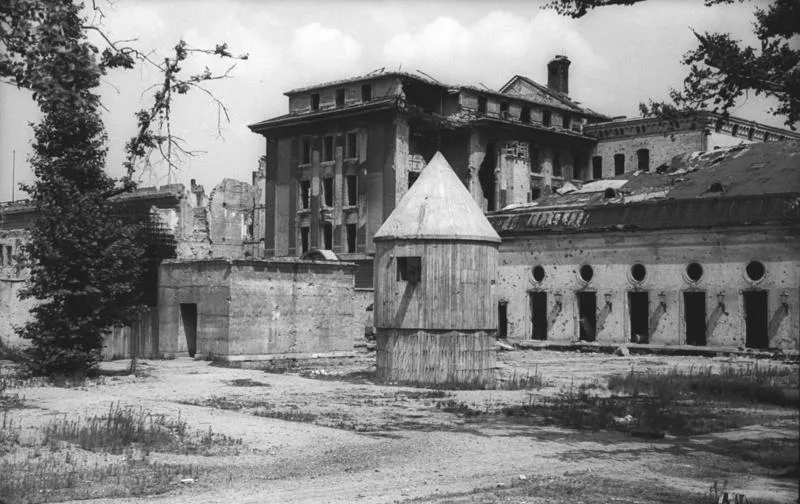
Header image: Rear entrance to the Führerbunker in the garden of the Reich Chancellery, Berlin. July, 1947. Source: Wikimedia Commons / Bundesarchiv, Bild 183-V04744. CC-BY-SA 3.0.