WARCOMMONS IS NOW ON ANDROID
Explore WWII history and stay connected with the community on the go. GET THE APP →
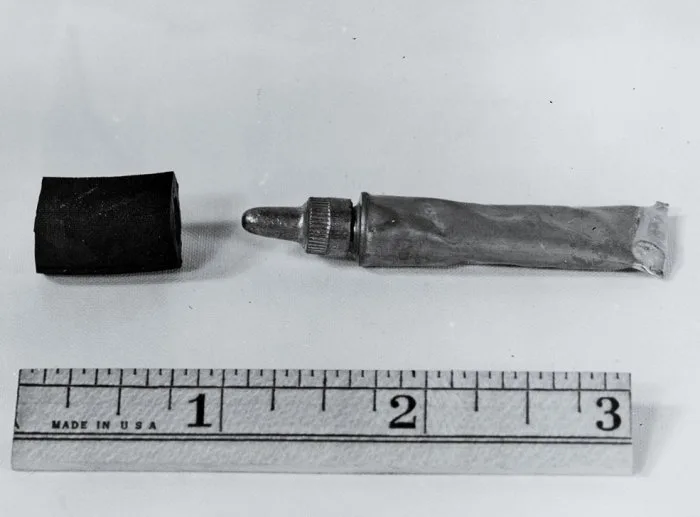

The OSS built a weapon with only one purpose: making German officers smell like they’d soiled themselves.
During World War II, not only were many bombs dropped, but many new bombs were also developed. Some were truly revolutionary. Nazi Germany’s V-2 rocket, unmistakable and, for its time, a massive technological advancement. And, of course, the atomic bomb. The only weapon that continued to hold the world in its grip for decades after World War II, throughout the Cold War. Unlike World War I, chemical weapons saw little battlefield use in World War II. Though the Nazis used Zyklon B as a mass murder weapon in the extermination camps, a horror of a different category entirely. And in the war in Asia, where the Imperial Japanese Army repeatedly used mustard gas and lewisite against Chinese soldiers and civilians in China. Yet, in addition to the atomic bomb, the United States also developed another peculiar “chemical” weapon.
Humiliating the Nazis
During World War II, the U.S. Office of Strategic Services maintained close contact with various European resistance groups, including those in France. The Americans supplied items such as radios, weapons, ammunition, and sometimes explosives, all of which the resistance could put to good use. In return, the resistance provided the Americans with intelligence, photographs, observations, and maps. But one day, the U.S. Office of Strategic Services had developed a new weapon. Or rather, a new bomb. It was a bomb developed specifically for the French resistance, with the aim of humiliating the Nazis and thereby undermining their morale.
The bomb was named “Who, Me?” and consisted of a small glass vial containing what was known as “skatole.” That’s right, it was nothing less than a stink bomb!
The Resistance was supposed to deploy these stink bombs and use them as a kind of psychological weapon against the occupying forces. The chemical substance skatole was an organic compound that smelled like feces. But anyway, what was the Resistance supposed to do with it? It almost seems like a joke. But it actually served a purpose.
The French Resistance was supposed to crush the ampoule containing skatole near German officers. This caused the stench to permeate the target’s clothing and pores. The intention was to cause immense embarrassment among the officers in question, which, in turn, would lower their morale. But it also had to serve a practical purpose. The ampoule was also crushed near French collaborators. This was intended to help expose the French collaborators.
But regardless of who the target was, to the average citizen, it looked very much as if the person in question had soiled their pants.
The Problem Bomb
But no matter how well thought out it was, the stink bomb had a major weakness.
Of course, it could not replace the weapons and explosives that the resistance urgently needed. But the purpose of the stink bomb was to provoke ridicule and shame. That was supposed to weaken German morale and make German soldiers more vulnerable to other attacks. But the bomb had an obvious flaw: it couldn’t ensure that only the intended target was hit. If the smell caught an innocent bystander instead, that person might now be wrongly suspected of collaboration, condemned by nothing more than bad luck and a bad smell.
Of course, an inherent problem with the stink bomb was that the direction of the odor could not be controlled at all. As a result, the stink bomb could affect not only the suspected collaborator but also the resistance fighter who broke the ampoule.
Fortunately, the French Resistance discovered this during the experiments they conducted with “Who, Me?”. Furthermore, it remains unclear to this day whether the French Resistance ever carried out an actual attack using the stink bomb. Be that as it may, “Who, Me?” could certainly have helped ridicule the enemy as a supplementary tactic. It would have provided that little bit of satisfaction if the occupiers suddenly started to smell like feces.
Most likely, however, the Resistance stuck to other, tried-and-true tactics for carrying out acts of resistance. These included spray-painting graffiti featuring texts and caricatures that mocked the occupiers, a tactic that was particularly effective for boosting the morale of the citizens of the occupied country.
Continue the discussion
Could the French resistance actually use this bomb as a new sabotage tactic? Or was the risk of exposing yourself too high to ever use it safely?
Join Field Reserve for free and make your case inside the WarCommons Field Headquarters!
WarCommons publishes long-form, source-driven World War II analysis without ads or sponsored content. If you found this article valuable, consider supporting independent research by joining Field Command.
By Nick Ravenshade — Founder & Editorial Director, WarCommons
Header image: “Who, Me?” was deployed in a small squeezable container. 1944. Source: Wikimedia Commons. Public domain.