WARCOMMONS IS NOW ON ANDROID
Explore WWII history and stay connected with the community on the go. GET THE APP →

The Luftwaffe had numbers, firepower, and momentum. Then Göring made one decision that saved Britain.
You’re probably familiar with Operation Seelöwe. Hitler’s so-called master plan to invade the United Kingdom. Fresh from the Blitzkrieg’s successes in Poland and France, Hitler immediately turned his attention to Britain. The “problem,” however, was that this operation was never carried out. The reason it never happened? The Battle of Britain.
Hitlers Orders
After Hitler had conquered Poland and France using the new Blitzkrieg doctrine and tactics, he set his sights on England. There was no stopping the power of Nazi Germany, and thus no stopping Hitler’s delusions of grandeur. After all, the British had already been driven back from Dunkirk and were as good as defeated. Time was of the essence, and Operation Seelöwe had to be carried out as quickly as possible.
That is why, as early as 1940, Hitler issued all his orders to the Luftwaffe through Hermann Göring. Göring had assured Hitler that, with his Luftwaffe, he could destroy the entire RAF within a few weeks. This would establish absolute air superiority over England, allowing the coastal defenses and ports to be neutralized. All of this would guarantee a safe German crossing.
According to Göring, the Luftwaffe would eliminate absolutely all RAF fighters and bombers. Airfields, radar stations, and aircraft factories within England would not be spared either. As a result, the Luftwaffe would not only establish absolute air superiority but also be able to keep the Royal Navy at bay and prevent it from taking action in the event of an invasion of England. Apparently, this was music to Hitler’s ears, as he had been impressed by the Luftwaffe’s performance during the Blitzkrieg in Poland and France.
The ultimate goal was not to actually occupy all of England. Now that the British were virtually the only ones left in Europe standing against Hitler, Hitler wanted to force the British to surrender.
Battle of Britain
The Battle of Britain (also known as the Luftschlacht um England) officially began on July 10, 1940, and lasted until October 31, 1940. It was the prelude to Nazi Germany’s invasion of England, and the Luftwaffe was ready for the task. At least, that’s what Göring had promised and assured. Göring, who may have already been succumbing to delusions of grandeur, was on his way to squandering another opportunity to finish Britain, much as the halt order at Dunkirk had done. But not in the way you might think.
It was primarily southern England that became the scene of the Battle of Britain. The Germans’ top priority was the British convoys transporting supplies to England and the port cities along the English Channel. Only after that did the focus shift to the radar stations and the British Air Force, the RAF.
Contrary to what one might think, things were actually going quite well for Nazi Germany and the Luftwaffe. But it wasn’t long before a crucial mistake was made. Just as at Dunkirk, the Germans halted their advance at a crucial and critical moment. In August 1940, several British RAF squadrons were on the verge of collapse. They had been plagued by heavy losses and troop fatigue. Despite all this, the Luftwaffe failed to deliver the final blow that would have brought the RAF to its knees. Who was to blame? None other than Hermann Göring himself. He committed a massive blunder by deciding that additional attacks on the RAF’s air bases were unnecessary. The RAF was already broken, according to Göring. From that point on, his aircraft would focus primarily on carpet bombing London. Although London suffered heavily, the pressure on the RAF bases was actually greatly relieved, just when collapse was imminent.
The climax of this battle took place on September 15, 1940. The Luftwaffe launched a major attack on London. However, this attack was repelled, resulting in the loss of 58 German aircraft.
Just two days later, Operation Seelöwe was postponed indefinitely by Hitler himself. The Luftwaffe had failed. Hermann Göring had failed. The Luftwaffe had not achieved air superiority, not even to a small degree. The Blitz, however, continued, and nightly bombings of London and other British cities still took place. But England was, in effect, saved and dealt Nazi Germany its first real major defeat of World War II.
What Else Went Wrong
It is clear that Göring played a crucial role in Germany’s first major defeat of World War II. Yet he was not the only factor. The British had something that, at the time, could also be seen as a sort of superweapon: radar.
Britain’s air defense consisted of much more than just the RAF pilots, who, incidentally, were also extremely skilled. The British had also set up radar stations along the coast. Even before the German planes reached British soil, the radars had already detected their approach. This information was further supplemented by a vast network of approximately 30,000 civilian observers. The RAF then dispatched the appropriate number of squadrons into the air to repel the impending German attack. This ensured that the RAF only had to take action when it was truly necessary, as opposed to conducting random patrols. As a result, not only was fuel saved, but the pilots themselves were able to rest better and more frequently.
The so-called home-field advantage also played a major role for the British. Most of the Battle of Britain took place right over England. If an RAF pilot was hit, he had a better chance of bringing the plane down safely and thus surviving the attack. In other similar air battles, pilots were as good as dead, even if the plane could still fly a short distance. That’s because the plane would most likely crash into the sea, somewhere on unknown land, or even behind enemy lines. That significantly reduced their chances of survival. RAF pilots who were hit over England but still managed to land were always back on their own territory, with all the necessary assistance. There was a good chance they could join the next sortie.
For the Germans, the situation was very different. They almost always ended up in enemy territory, and if they survived a crash, captivity followed. Those who flew back to Germany in a damaged aircraft were also not immediately ready for duty again, unlike the RAF pilots. They first had to survive the long journey home, after which the trip back to England would be just as long.
But even if everything had gone the Germans’ way, there was one shortcoming they would never have been able to overcome within the duration of the war. That shortcoming was the aircraft themselves. Although it is absolutely true that the Luftwaffe had powerful aircraft, the truth is also that these aircraft had a shortcoming. They were simply not suited for the prolonged battles that took place during the Battle of Britain. The Messerschmitt Bf 109, as iconic as the aircraft is today, operated during this battle at the very limits of its range and capabilities. The Messerschmitt’s operational time over England was very short and limited; pilots soon had to return to refuel. In terms of numbers as well, the Luftwaffe ultimately could not match the RAF; German factories simply could not replace losses fast enough to sustain the campaign. In the summer of 1940, for example, the RAF was producing about 500 fighter aircraft per month, that was significantly more than the Germans.
The Real Winner
And you’re probably already thinking, “The British had the Spitfire fighter plane.” That, too, was an iconic aircraft that certainly made a difference in this battle. But the aircraft that truly won the battle was the Hawker Hurricane, the so-called humble “workhorse” of the RAF. The Hawker Hurricane was responsible for shooting down more German aircraft than the Spitfire and British anti-aircraft artillery combined.
Although Göring played a major role in the defeat, it was not solely due to his actions. Nazi Germany’s first major defeat in World War II was more complex and went beyond any single individual. The structural shortcomings in production and equipment were, in fact, already very evident. This would prove to be an ongoing problem for Nazi Germany.
WarCommons publishes long-form, source-driven World War II analysis without ads or sponsored content. If you found this article valuable, consider supporting independent research by joining Field Command.
By Nick Ravenshade — Founder & Editorial Director, WarCommons
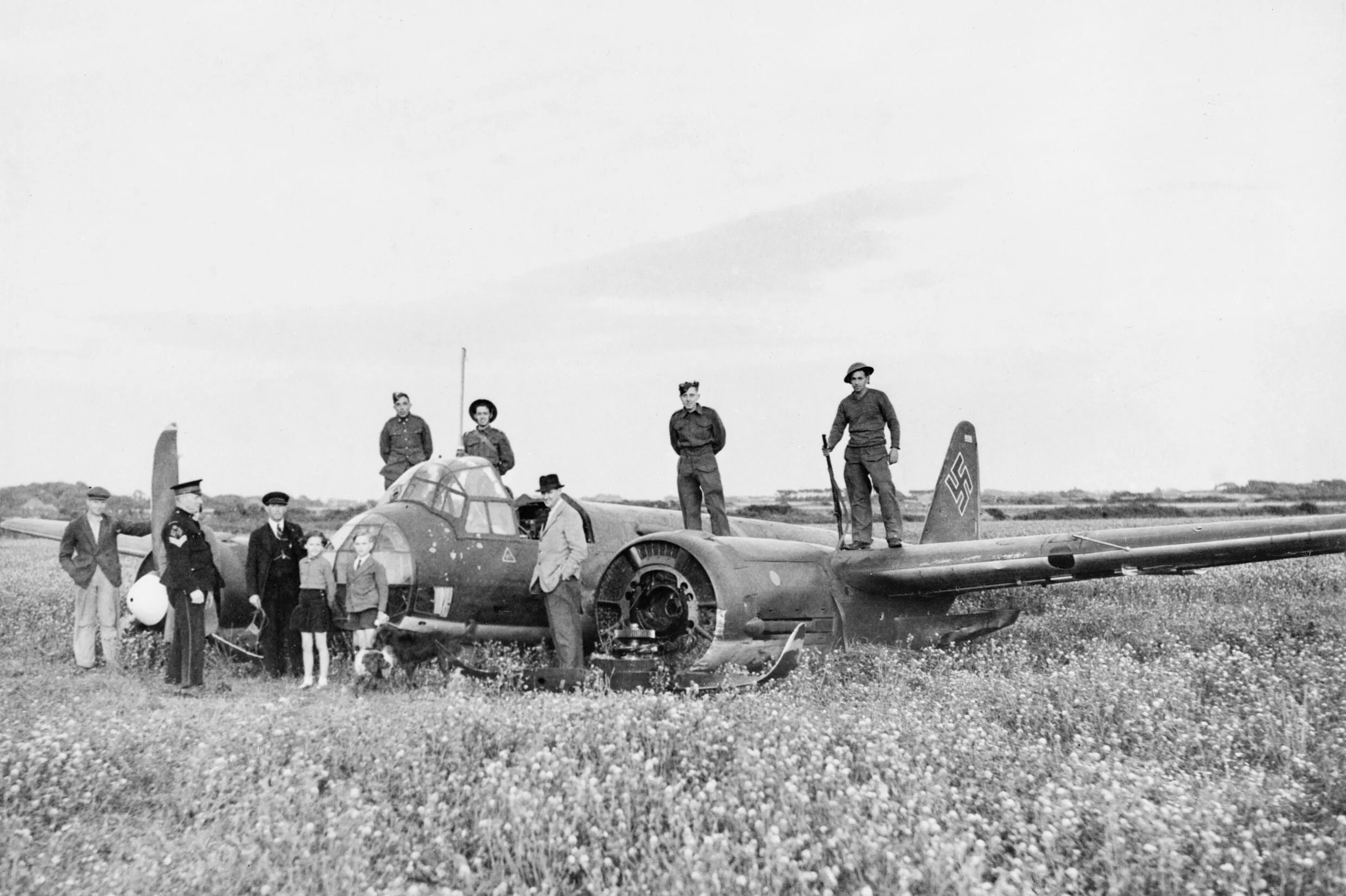
Header image: Troops and civilians pose with Junkers Ju 88A-1 (B3+BM) of 4./KG 54, which belly-landed on Marsh Farm, Earnley, Sussex, on the evening of 21 August 1940. It had been intercepted by No. 17 Squadron Hurricanes during an attack on RAF Brize Norton. August 1940. Source: Wikimedia Commons. Public domain.