
WARCOMMONS IS NOW ON ANDROID
Explore WWII history and stay connected with the community on the go. GET THE APP →
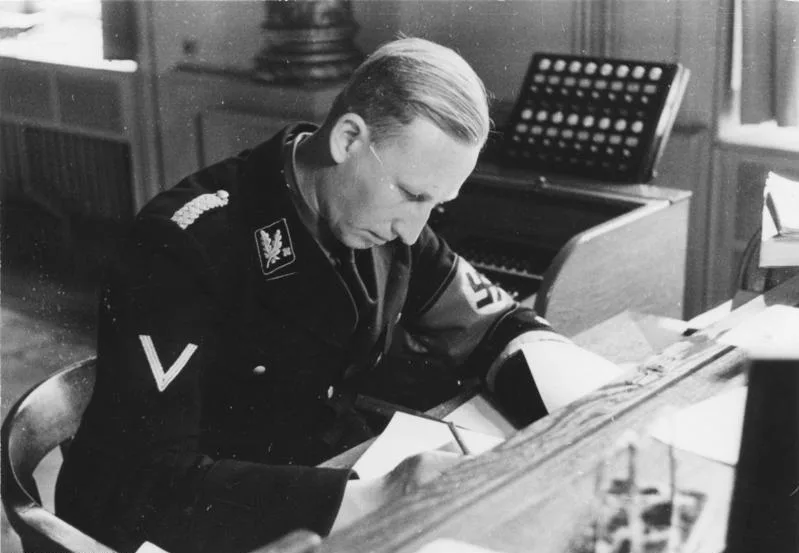

The Holocaust was one of the greatest tragedies that humanity has inflicted upon itself. However, it did not happen overnight. The evil within the Nazis was laid bare before the world. But not before they first calmly discussed and deliberated on it. The Wannsee Conference. Where one person was then, and still is today, regarded as one of the chief architects of the Holocaust: “The Man with the Iron Heart,” Reinhard Tristan Eugen Heydrich. This is his story.
The Man Before His Crimes
March 7, 1904, is the day Reinhard was born in Halle an der Saale. His father, a convert to the Roman Catholic faith, was an opera singer and composer, Richard Bruno Heydrich. And his mother was Elisabeth Anna Maria Amalia Heydrich. A striking detail is that rumors later circulated about Richard Heydrich suggesting he was of Jewish descent. This was fueled by the fact that his stepfather, Robert Gustav Süss, allegedly had a surname that sounded Jewish.
Reinhard may not have always been the embodiment of evil, but who knows? In any case, he was an altar boy during his youth. Every week, he faithfully attended evening prayers and Mass with his mother. He was part of the Catholic minority in Halle. Nevertheless, his family enjoyed high social status. Nor did they know hunger or financial worries. In that respect, survival was not a struggle for Reinhard. Put simply, his family was simply wealthy.
How could the life of an up-and-coming musician take such a drastic turn?
Music was one of the most important things in Reinhard’s family. Day in and day out. His father had founded the Halle Conservatory of Music, Theater, and Education, and his mother taught piano there. Reinhard was the second child, and there were always certain expectations of this particular second child. He was supposed to inherit and carry on his father’s music conservatory. That is why his father gave him a musical education, teaching him to play the piano and violin as early as age six. But Reinhard’s passion lay more in playing the violin. This passion did not end in his childhood; he carried it with him into his adult years. He truly had musical talent and also impressed his listeners.
With such a social status, involvement in politics, whether at the national or local level, was often inevitable. Reinhard’s father was, in fact, a German nationalist who pledged his complete loyalty to the emperor. Richard passed on this patriotism and these patriotic ideals to his children, including Reinhard. It was not until after World War I, however, that Richard joined a nationalist political party.
It is therefore no surprise that both Richard and Elisabeth were strict in their parenting and in running the household. When he was young, Reinhard was a frail boy. His parents encouraged him to take up sports to build his strength. This, too, had the desired effect, as Reinhard became a talented swimmer and fencer. But he also excelled in his schoolwork, particularly in the sciences. Despite this hard work, Reinhard was often bullied at school. He was insecure and shy. He also had a high-pitched voice and was rumored to be of Jewish descent. The rumors that he was of Jewish descent were later reinforced. His maternal uncle married a Hungarian Jewish woman named Iza Jarmy. It is sometimes hard to believe how well some of the Nazi leaders, including Hitler, got along with Jews in their early years. This was also true for Reinhard and his family. The Heydrich family maintained good relations with the Jewish community. Many Jewish students also attended the Halle Conservatory, and the basement of the building was even rented to a Jewish merchant. Reinhard himself was also friends with Abraham Lichtenstein, the son of the conservatory’s cantor.
After World War I
In Reinhard’s hometown of Halle, too, there was considerable civil unrest following World War I. There were clashes between communists and anti-communists, as well as strikes. The unstable situation was precarious by late February 1919. But under the leadership of Defense Minister Gustav Noske, Halle was recaptured by the paramilitary Freikorps units. This apparently made an impression on Reinhard. He was 15 years old at the time and decided to join the Freikorps Maercher’s Volunteer Rifles, or Freiwillige Landesjägerkorps.
It was most likely only a symbolic gesture on Reinhard’s part. After all, he was too young for military service, and there are no primary sources indicating that he actually participated in battles with the Freiwillige Landesjägerkorps. Once calm had somewhat returned and the skirmishes were over, Reinhard became part of the Freikorps unit assigned to protect private property.
It was precisely at this point in his life that he began to form his views on the Völkisch movements and anti-communism. He also personally shared the strong collective social aversion to the Treaty of Versailles. It also seemed that the position of the Polish-German border was an even greater thorn in his side. Reinhard stated that he was a member of the Deutschvölkischer Schutz- und Trutzbund (German Nationalist Protection and Defiance League). It was an anti-Semitic organization. But to this day, it remains a matter of debate whether Reinhard was ever a member of this organization.
But for the Heydrich family, the worst was yet to come. And that was in 1921. Germany was reeling from hyperinflation. Many people lost their savings, and the money they did have was virtually worthless. The city of Halle was not spared either. As a result, very few people in the city could afford a music education at the conservatory. The Heydrich family also found themselves in a financial crisis, which only increased their discontent.
In the Navy
To guarantee a stable income for himself and secure a good pension, Reinhard joined the German Navy, the Reichsmarine, in 1922. He ended up at Germany’s main naval base, Kiel, where he began working as a naval cadet.
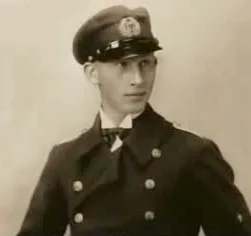
Even as he reached adulthood, the rumors about Reinhard persisted. His fellow naval cadets still mistakenly believed him to be Jewish. Reinhard was determined to put an end to these rumors. He therefore informed his colleagues that he had been a member of various anti-Semitic and nationalist organizations. He specifically mentioned the Deutschvölkischer Schutz- und Trutzbund. His colleagues believed him, and as far as we can tell, the rumors stopped there. This is all the more an indication that Reinhard may never have been a member of such an organization, which means there is still debate over whether he was actually a member.
Be that as it may, it certainly had the desired effect for him. Not as a joke, but in all seriousness, Reinhard was promoted to senior midshipman, officially Oberfähnrich zur See, on April 1, 1924. This paved the way for him to enter the Navy’s officer training program. And so it came to pass that Reinhard began his officer training at the Naval Academy in Mürwick (Marineschule Mürwik). This ultimately earned him the rank of ensign (Leutnant zur See). He was assigned to the battleship SMS Schleswig-Holstein as a signal officer. It was the flagship of the German North Sea Fleet. His promotion also brought him personal recognition. His superiors always rated him highly, and there were virtually never any problems between him and the crew members. This smooth military career was sealed with a promotion on July 1, 1928, to Oberleutnant zur See, which is essentially the equivalent of a first lieutenant, for comparison.
Things were looking good for Reinhard, from cadet to a full-fledged Oberleutnant zur See in just six years. But the “feel-good story” was about to take a bitter turn. In December 1930, Reinhard met Lina van Osten. Lina was a supporter of the Nazi Party and an anti-Semite. She had already attended her first Nazi rally in 1929.
April 1931. From officer to dishonorable discharge. April 1931 marked the end of Reinhard’s promising career in the Reichsmarine. Primary sources indicate that in early 1931, Reinhard was accused of “conduct unbecoming an officer and a gentleman.” He was alleged to have broken his promise, as he had been engaged to one woman and subsequently became engaged to Lina von Osten. It was Admiral Erich Raeder who ultimately dismissed Reinhard from the Reichsmarine in April 1931.
Reinhard did eventually marry Lina in December 1931.
The Road to a Nazi Career
Reinhard wasn’t unemployed for long, so to speak. On May 30, 1931, Reinhard’s discharge from the Reichsmarine was finalized. Historians agree that just a day or two later, on May 31, 1931, or June 1, 1931, Reinhard had already joined the Nazi Party in Hamburg. What is certain is that Reinhard joined the Schutzstaffel (SS) on July 14, 1931. But he almost fell victim to new rumors. The Alte Kämpfer, or Old Fighters, the first party members, viewed the new recruits with suspicion. In particular, the men who had joined after January 1933, following Hitler’s seizure of power. The Alte Kämpfer suspected these men of having joined solely to advance their careers, rather than out of intrinsic and sincere devotion to Nazi ideology.
The fact that Reinhard had joined the SS and the Nazi Party as early as 1931 largely dispelled the Alte Kämpfer’s reservations. However, his enrollment was not early enough for him to be truly regarded as an Old Warrior. That “prestige” eluded him.
And although his career in the Reichsmarine was, in principle, successful, he would have gone down in history as almost completely insignificant. In 1931, Heinrich Himmler made preparations to establish a counterintelligence division within the SS. Karl von Eberstein was an associate of Himmler’s and a friend of both Lina and Reinhard. Karl arranged for Himmler to agree to a meeting with Reinhard, whom Karl believed was certainly suited to work for the new division under Himmler. Himmler agreed, but canceled the meeting at the last minute.
This could have been the moment when Reinhard Heydrich’s life took a drastic turn. Perhaps his name would never have been so inextricably linked to the Wannsee Conference and the Holocaust. But fate had other plans.
Lina completely ignored Himmler’s cancellation and told Reinhard nothing. She packed his suitcase and sent him to Munich for the meeting. Karl was waiting for Reinhard at the Munich train station and personally took him to Himmler. The meeting took place after all. What followed was a discussion of Reinhard’s ideas for the development of an intelligence division within the SS. Himmler was apparently very impressed by Reinhard. In fact, he was immediately hired by Himmler following this meeting.
Career Within the SD, Gestapo, and a Troubled Past
His military career seemed to be back on track. On August 1, 1931, Reinhard began his new job as chief of the new Sicherheitsdienst des Reichsführers-SS, better known as the SD. By October of that same year, Reinhard had already built up a network of spies and informants to gather intelligence and information. Often this involved political opponents, and in particular information that could be used for blackmail for political purposes. This information was recorded on index cards and stored in the so-called Brown House in Munich, the name for the Nazi Party headquarters. It demonstrates how systematically the service was already operating after his appointment.
Its success was unstoppable. In December 1931, Reinhard was promoted to SS-Sturmbannführer, that is, he became a major, on the occasion of Reinhard’s wedding anniversary.
But his past was not far behind, ready to come back and haunt him. As was often the case with rising figures in the Nazi Party, he had his share of opponents. Reinhard, too, had his opponents, who resorted to spreading rumors about his alleged Jewish ancestry. One of these opponents was Wilhelm Canaris. He was said to have copies of documents that would prove Reinhard had Jewish ancestry. And the Nazi Gauleiter Rudolf Jordan was also adamant; he was certain that Reinhard was not a pure Aryan.
One could indeed argue that this might not have meant all that much and that statements by enemies should not be taken too seriously. But it was also Himmler himself who is said to have made a remarkable remark about Reinhard: “an unhappy man, completely divided against himself, as often happened with those of mixed race.”
Within the Nazi Party and its organization, such rumors and insinuations were damaging and sometimes fatal. The fact that Reinhard was one of the most powerful figures in the Nazi security apparatus did nothing to change this. Such rumors were extremely damaging to him as well. The matter even reached the top of the Nazi Party. Gregor Strasser, Reichsorganisationsleiter, or head of the national organization, also took up the matter. He passed on the accusations or rumors about Reinhard to the Nazi Party’s racial expert, Achim Gercke. He thoroughly investigated Reinhard’s genealogy and reported: “… [Reinhard was] of German origin and free from any colored or Jewish blood.” Reinhard consistently maintained that these rumors about him were false and did not accept Achim Gercke’s findings. He also secretly commissioned Ernst Hoffmann, an SD member, to investigate the rumors further and, above all, to continue refuting them.
However, it didn’t matter much anymore, as the rumors seemed to have lost their impact after being debunked. In mid-1932, Reinhard was appointed head of the SD by Himmler. His new task was to bring every state in Germany under the control of the SD. The Gestapo was founded in 1933 by Hermann Göring, initially from the Prussian political police. But in April 1934, Göring transferred full authority over the Gestapo to Himmler, who immediately began using it as a new instrument of terror. The Gestapo was placed under the supervision of the SS, and Reinhard was appointed head of the Gestapo on April 22, 1934.
That same month, Reinhard was also appointed by Göring as an advisor to the Prussian government, including a seat on the Prussian State Council. The SD was subsequently declared the official Nazi intelligence service by Rudolf Hess on June 9, 1934.
The Night of the Long Knives
Given the positions Reinhard began to hold within the Nazi regime, it is not surprising that he also played a role in the Night of the Long Knives. Hitler asked Himmler and Reinhard to compile a dossier on Ernst Röhm, the leader of the Sturmabteilung (SA), who, in Hitler’s eyes, was increasingly becoming a threat to his power. Röhm was essentially Hitler’s greatest rival for the leadership of the Nazi Party. At that time, however, the SA and the SS were still inextricably linked, with the SA already numbering more than three million members within the paramilitary organization. Reinhard, together with Himmler, Göring, and Viktor Lutze, was tasked with compiling lists of the people who were to be killed. High-ranking SA officials, in particular, were to pay with their lives. On June 30, 1934, the time had come. The list had to be carried out, and what followed were mass arrests that lasted two days. The SS and the Gestapo carried out the arrests and executions together. It later became known as the Night of the Long Knives, which claimed the lives of approximately 85 people, with some estimates reaching up to 200 people. Lutze subsequently became the new head of the SA, which was transformed into a sports and training organization.
Now that the SA was no longer a problem, Reinhard saw his chance to further develop the Gestapo into a true instrument of fear and oppression. The index card system was still in use, but it was also expanded and improved. Categories of offenders were introduced, along with color-coded cards. The Gestapo was authorized to arrest citizens suspected of committing a crime. And what constituted a crime was left entirely to the Gestapo’s own discretion.
The Gestapo essentially became a loose cannon that could, at any moment, simply take anyone away, interrogate, abuse, torture, and kill them. The Gestapo Act of 1936 made this all the more possible. It gave the Gestapo the right to act outside the law. The judiciary was no longer allowed to intervene; courts were barred from investigating or interfering in the Gestapo’s actions. According to its own rules, the Gestapo always acted legally, provided it acted in accordance with the will of its leadership. This was the basis for the arbitrary arrest and killing of people. The rest were often sent to concentration camps.
Religious Conversion and a New Police Force
In March 1936, Reinhard was elected to the Reichstag following that year’s parliamentary elections. He was re-elected in 1938. He held his seat in the Reichstag until his death. But 1936 also marked another personal turning point for Reinhard. Himmler developed the idea of a Germanic religion. SS members were therefore required to leave the church if they were believers. Reinhard was Catholic, but he too succumbed to this requirement. He left his church in early 1936 and converted to the so-called Gottgläubig movement. Lina had already done so a year before him, but Reinhard actually took it a step further. He not only left the church but also decided that the church’s political power and influence were a threat to the state.
Himmler was appointed head of the German police, and as a result, all police forces throughout Germany were centralized on June 19, 1936. Because Reinhard was very close to Himmler, he became Himmler’s de facto deputy in his new role. They were the two most powerful men in Germany’s domestic administration.
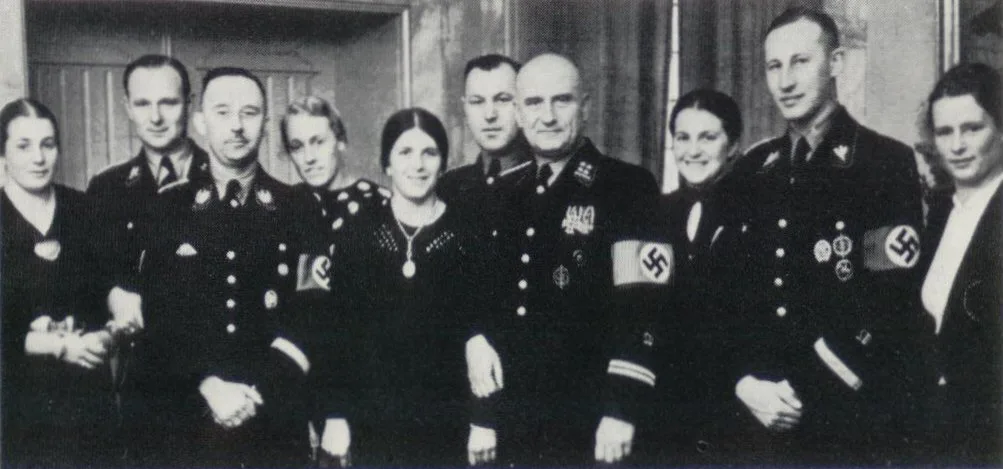
Himmler immediately reorganized the police. Two groups were formed: the first was the Ordnungspolizei (Order Police; Orpo), which included the national uniformed police and the municipal police. The second group was the Sicherheitspolizei (Security Police; SiPo), which comprised the Geheime Staatspolizei (Gestapo) and the Kriminalpolizei (Criminal Police; Kripo). At that time, Reinhard was the head of the SiPo and the SD. The head of operational affairs within the Gestapo was Heinrich Müller. In his new capacity, Reinhard published a strategy outlining how the enemies of the German state were to be destroyed.
It soon became clear just how ruthless Reinhard was becoming. He also played a role in the Anschluss. In January 1937, he ordered the SD to secretly gather information on public opinion. The Gestapo was then ordered to conduct house searches, make arrests, and carry out interrogations, thereby effectively allowing him to control public opinion. When Austrian Chancellor Kurt Schuschnigg began to resist a merger with Germany in February 1938, it was Reinhard who began to ramp up the pressure in Austria. He organized Nazi demonstrations in Vienna, and propaganda was also distributed, emphasizing in particular the Germanic origins of both countries.
New Promotions
For Reinhard, however, there was only one path, and that was the path to the top. When the SD and the SiPo were merged into the new Reichssicherheitshauptamt (RSHA), the Reich Security Main Office, Reinhard became the head of this organization with a new title: Chef der Sicherheitspolizei und des SD, or simply Chief of Security Police and SD. But that wasn’t all. On August 24, 1940, Reinhard also became president of the precursor to Interpol, namely the International Criminal Police Commission. And he even received a promotion from Himmler himself within the SS. Starting September 24, 1941, he was also permitted to call himself SS-Obergruppenführer und General der Polizei. At that time, the rank of SS-Obergruppenführer was still the second-highest rank within the SS, comparable to a three-star general, such as a lieutenant general.
But that was not all. His next step came as early as September 27, 1941, when he became the Deputy Reich Protector of the Protectorate of Bohemia and Moravia. However, the intention was already clear: Reinhard was eventually supposed to replace Reich Protector Konstantin von Neurath. Hitler considered him too soft and sent him on leave. Reinhard, however, was not so soft. Reportedly, upon his appointment, he told his assistants: “We will Germanize the Czech vermin.”
To give just one example: Reinhard declared martial law within five days of arriving in Prague, and 142 people were subsequently arrested and executed. The Czech prime minister was not safe either; Alois Eliáš was also arrested and sentenced to death, but kept alive for a time as a sort of hostage. He would not be executed until later, as revenge for Reinhard’s murder. More on that later. Reinhard did not endear himself to the people and ruled solely through terror and oppression. Murder, torture, arrests, and sending people off to concentration camps. That is what Reinhard had become in the Protectorate of Bohemia and Moravia. He was nicknamed “the Butcher of Prague.”
Reinhard was never promoted to full Protector of Bohemia and Moravia, however, but remained the deputy. De facto, though, he was the full Protector of Bohemia and Moravia, because Konstantin von Neurath had been all but sidelined.
Holocaust and the Ending
It was especially during Reinhard’s reign of terror within the Protectorate of Bohemia and Moravia that it became clear just how devoted Reinhard was to Nazi ideology. He is said to have remarked about the Czech population: “Czech territory must never be left in such a state that would allow the Czechs to claim it as their own. The final solution is to Germanize them or simply kill them against a wall.”
Historians widely agree that this is the man we must still regard as the most feared member of the Nazi elite. Even Hitler called him “The man with the iron heart.” He is therefore regarded as the principal architect, or one of the principal architects, of the Holocaust in its early years. He tolerated no one above him, except Hitler, Himmler, and Göring, in matters concerning Jews. He also played a prominent role in Kristallennacht. Reinhard sent a telegram to several SD and Gestapo offices. In doing so, he ensured effective coordination between the SS, SD, Orpo, SA, and Gestapo, as well as Nazi Party officials all the way down to the fire department. In the telegram, Reinhard indicated that he authorized arson and the destruction of Jewish businesses and synagogues. He also ordered the confiscation of all archival material from Jewish community centers and synagogues. Furthermore, he gave the order for arrests, with most of those arrested to be transported to concentration camps. As many as 20,000 Jews were shipped off to concentration camps in the days following the telegram. Reinhard thus played a direct and significant role in what is considered the beginning of the Holocaust.
By 1939, Reinhard seemed to be everywhere at once. He was even involved in the pretext for the invasion of Poland. In fact, he, Himmler, and Heinrich Müller devised the false-flag operation themselves. It was the staged attack on the German radio station in Gleiwitz on August 31, 1939. Reinhard was the mastermind behind this operation and even visited the site before the plan was put into action.
The Einsatzgruppen were also Reinhard’s creation. Although he had formed this unit on Himmler’s orders, it was still he who had formed it.
Reinhard’s career and hatred of the Jews effectively culminated in his role at the Wannsee Conference on January 20, 1942. He played a central role at this conference as head of the Reich Security Main Office. He was the leader of the conference, but he also personally presented the genocide plan. He informed the senior officials present that Hitler had ordered him to take charge of coordinating the so-called Final Solution (the plan to exterminate all Jews in Europe). But he also expanded the scale of the actions against the Jews. It was no longer just a matter of emigration or expulsion of Jews. From that moment on, it was solely about the systematic physical extermination of approximately 11 million Jews. He distributed a detailed list, broken down by country.
It didn’t stop there. During this conference, he also demanded cooperation from the civil service. The purpose of the conference was actually very specific: to compel the civil service to ensure overall coordination among various ministries, such as those of Justice, the Interior, and Foreign Affairs. All of this was necessary for the deportations to the extermination camps. To establish his own legitimacy within the conference, he presented a document dated July 31, 1941. In this document, Hermann Göring formally tasked him with devising a “final solution” to the “Jewish question.” And to try to conceal it all, he used veiled language during the conference. Precisely to try to mask what his actual actions were to entail. The cruelty of the impending mass murders had to be made acceptable to the bureaucracy. So Reinhard spoke, for example, about labor deployment in the East. But everyone present at the conference knew that this was about the death and execution of Jews.
Reinhard’s Fate
In a way, it is quite remarkable. A figure who played such a significant role during World War II never lived to see the end of the war. It is also not surprising that the Allies wanted to eliminate him early on. His cruelty was widely known. He seemed to be the embodiment of evil.
The Czechoslovak authorities in exile were, in any case, clear about their desire. They wanted Reinhard dead. On December 28, 1941, Jan Kubiš and Jozef Gabčík parachuted into the Protectorate. For the time being, they lived virtually in hiding as they prepared for their upcoming mission.
It took a while, but the date finally arrived: May 27, 1942. Reinhard had an appointment to meet Hitler in Berlin. Reportedly, Hitler wanted Reinhard transferred to the occupied part of France, where the resistance was causing increasing problems. Reinhard had to travel from his home to the airport. He took the road where the Dresden-Prague highway meets a junction leading to the Troja Bridge. This intersection was ideal for an attack, as drivers had to slow down significantly before a hairpin curve. Reinhard’s car slowed down, and Gabčík was waiting for him. But Gabčík’s Sten gun jammed and refused to fire. Reinhard ordered his driver to stop and even tried to confront Gabčík instead of driving away. But what Reinhard and his driver Klein didn’t see was that Kubiš was also present. Kubiš threw a converted anti-tank mine at Reinhard’s car once it had come to a complete stop. The grenade exploded and tore through the car’s right rear fender. Reinhard was wounded by metal fragments and fibers from the upholstery. The left side of his body was seriously injured. He sustained injuries to his diaphragm, spleen, and lung. The explosion also caused him to break a rib. But he did not give up. Kubiš fled, and Reinhard ordered Klein to pursue Gabčík on foot. But Gabčík managed to escape, though not before shooting and wounding Klein.
Reinhard was not dead after all this. A Czech woman came to Reinhard’s aid. She managed to flag down a van, and Reinhard was placed face-down inside it. They made their way to Bulovka Hospital. Reinhard underwent emergency surgery. Karl Gebhardt was even sent to Prague to take charge of Reinhard’s care. In principle, his recovery also seemed to be going well. Even Hitler’s personal physician, Theodor Morell, suggested administering a new antibacterial agent, sulfonamide, to Reinhard to ensure his wounds would heal properly without infection. But Gebhardt believed that Reinhard would recover well anyway, even without the new antibacterial agent.
But Reinhard’s fate had already been sealed. On June 3, 1942, Reinhard fell into a coma. By June 4, 1942, he had already passed away. The cause of death was sepsis, something that might have been prevented with the new antibacterial agent. Who knows what suffering humanity was spared by Reinhard’s untimely death. Be that as it may, the further course of the Holocaust is well known to us. And it was all made possible in part by Reinhard.
Reinhard was 38 years old.
Field Command members: the Author’s Note for this article is available in the Field Command area.
WarCommons publishes long-form, source-driven World War II analysis without ads or sponsored content. If you found this article valuable, consider supporting independent research by joining Field Command.
By Nick Ravenshade — Founder & Editorial Director, WarCommons
Header image: München, Reinhard Heydrich. April 11, 1934. Source: Wikimedia Commons / Bundesarchiv, Bild 152-50-10 / Friedrich Franz Bauer. CC-BY-SA 3.0.


.jpg)

