WARCOMMONS IS NOW ON ANDROID
Explore WWII history and stay connected with the community on the go. GET THE APP →

During World War II, people in the Pacific countries and islands heard a radio broadcast. In fact, it was immediately clear who these broadcasts were aimed at. For approximately 75 minutes a day from around 1943 through 1945, American soldiers and sailors “had” to listen to Tokyo Rose. But what, or who, was Tokyo Rose? Was it a group or a woman, and did she call herself Tokyo Rose?
The Radio Broadcasts
The full story of Tokyo Rose is still largely unknown. Perhaps that’s because Tokyo Rose didn’t even call herself that. And perhaps it’s also because she wasn’t even a single person. What historians now know is that Tokyo Rose was not just one person. When we talk about Tokyo Rose’s broadcasts in this context, we are essentially referring only to the daily radio program The Zero Hour. That was where the secret lay. Radio Tokyo broadcast it, the Japanese army was behind it, and American soldiers and sailors were forced to listen. In perfect English, the broadcasts directly appealed to the emotions of the American soldiers and sailors. With only one goal: to influence and undermine the morale of the American forces in the Pacific. Japan hoped this would lead more Americans to desert or break their morale.
It was a regular program. Every day, for approximately 75 minutes. If we think about it a little more, this was actually a pretty advanced and extremely sophisticated form of psychological warfare. Hard-hitting propaganda, with a touch of entertainment thrown in to spice things up a bit.
They made heavy use of fake news and played on the personal emotions of the American forces. Stories were told, by Tokyo Rose, for example: about unfaithful wives on the home front. But there was also other fake news, such as heavy Allied losses and the sinking of Allied warships. Events that had never actually taken place. But also that fighting was pointless and that American troops, once home, wouldn’t even have jobs anymore. They had lost not only their wives but also their jobs. Someone else had already filled that gap. If you have to listen to such messages every day, who can you still believe?
Back then, the way information was shared was simply very different from today. You couldn’t pull out your phone to fact-check what you had just heard. People were completely dependent on information provided via the radio or during operational briefings. That’s why even a moment of doubt about what was actually true was enough to cause a shift in morale or mindset. This made The Zero Hour, in principle, a very dangerous and effective psychological weapon.
The same was true of personal messages from American and Allied prisoners of war. They were meant to strike their Brothers in Arms where it hurt the most. And just then, Tokyo Rose would lighten the mood for a moment with pleasant Western music, such as jazz and swing. American troops could send in requests and messages, so it felt personal.
Tokyo Rose?
But where did that term actually come from? Not a single one of the female announcers on these broadcasts ever called herself “Tokyo Rose” or even uttered those words. It was a term coined by the American troops themselves.
The American troops actually began to see it as a regular routine and enjoyed listening to Tokyo Rose’s broadcasts. If you simply look up Tokyo Rose and who she was, the answer is, in principle, clear: she was not a single person, but a group of people. The question, then, is: who exactly were these people? And one name remains inextricably linked to her to this day. Even though she was once wrongly identified as the one and only Tokyo Rose. That was Ann the Orphan, as she called herself in the radio broadcasts. But her real name was Iva Toguri D’Aquino. A Japanese-American woman who had traveled to Japan just before the outbreak of the war between Japan and the United States to care for her sick aunt. But as fate would have it, just as she arrived in Japan, the world was shaken by the attacks on Pearl Harbor. She could no longer return and, whether or not forced by the circumstances of her situation, began working for Radio Tokyo. It was therefore no coincidence that she was given a role on the daily program The Zero Hour, as an American woman who spoke English well.
But things didn’t go entirely smoothly. Toguri refused to broadcast anti-American propaganda on The Zero Hour. But the program’s producer, Australian Major Charles Cousens, who was himself a prisoner of war at that time, was clear: she didn’t need to worry about that. The producers wouldn’t write scripts that would force her to say anything against the Americans. And so it was, in principle. The broadcasts began in November 1943, and Toguri and Cousens initially tried to turn the broadcasts into a farce. But on the Japanese side, in particular, humor was hard to find. The Japanese propaganda officials, in particular, had very little sense of the double meanings and nuances being broadcast.
It had become clear what role Toguri had ultimately played in the radio broadcasts of The Zero Hour. She introduced recorded music and often appeared in comedy sketches. She actually never participated in the news broadcasts, which were primarily used for propaganda. Her speaking time, incidentally, was only about 2 to 3 minutes a day. She earned about 150 yen a month from this work. She used part of the money to buy food for prisoners of war. She would then smuggle this food into the prisoner-of-war camp. And this was not a one-time act.
In the brief segment during which she actually used her 2 to 3 minutes of airtime, she addressed her fellow Americans above all. Or, as she herself put it: “My fellow orphans.” She used American slang and played American music for the American troops. She never called herself Tokyo Rose. It also turned out that this term was already in use by American troops as early as the summer of 1943. This was, therefore, months before Toguri herself made her debut as one of the broadcasters.
Advanced Psychological Warfare
It was only briefly mentioned, but the broadcast of The Zero Hour, and Tokyo Rose within it, represented a highly sophisticated and advanced form of psychological warfare. At least, in theory, given the state of information available at the time. People couldn’t quickly verify whether what was said during a broadcast of The Zero Hour was true. One could have a hunch, but how could you get that confirmed?
It is therefore not surprising that studies were conducted after the war into the impact that The Zero Hour and Tokyo Rose had on American troops. If something is effective, the U.S. Army naturally did not want to miss out on a new tool for psychological warfare.
In 1968, a number of additional studies were conducted on the effect that The Zero Hour had on American troops. Although the sample size was small, especially considering the number of American troops actually deployed in that specific region. The studies report on 94 men who were interviewed and who, at the very least, could recall having listened to the radio broadcasts of The Zero Hour. 89% of these men indicated that they had perceived or recognized the radio broadcasts as propaganda. However, less than 10% felt demoralized by the radio broadcasts. So it did have some effect. On the other hand, however, about 84% of these men actually enjoyed listening to The Zero Hour. The main reason was that they felt the program simply provided good entertainment for the troops.
But, based on the respondents’ answers, it can be subtly inferred that it was, in fact, a more sophisticated form of psychological warfare. One American soldier also noted that many of them believed the enemy had been on their side all along. And this is precisely the key element that makes psychological warfare possible: deception and trust.
A Myth
The myth of Tokyo Rose is exactly that, a myth built around the wrong person. To this day, it remains a half-truth and, in fact, a half-myth. For who were the so-called Tokyo Rose really? Only one person, Iva Toguri D’Aquino, had to pay the price for the propaganda spread by the Tokyo Rose. The fact that she ultimately received a presidential pardon also tells us something. In any case, it was more than just a shift in the spirit of the times. Actively working for a foreign power with which your country is at war is, in principle, a criminal offense in every country. It was also no secret that The Zero Hour was controlled by the Japanese army. That may have been treason, but she was not the Tokyo Rose. She refrained from making propaganda statements against the Americans. She did her best to navigate a situation she had not chosen. Who were the rest of the women who spoke perfect English? Iva Toguri D’Aquino was indeed one of the Tokyo Roses, but she was not the mastermind behind the propaganda. In the search for the real Tokyo Rose, America completely missed the mark, as American justice has done before and since. Justice had not prevailed with Toguri’s conviction. Justice had prevailed with the presidential pardon granted to Toguri.
And so, more than 81 years later, the Myth of the Tokyo Rose lives on.
When people say “Tokyo Rose,” they think of Iva Toguri D’Aquino, also known as Ann the Orphan.
Field Command members: the Author’s Note for this article is available in the Field Command area.
WarCommons publishes long-form, source-driven World War II analysis without ads or sponsored content. If you found this article valuable, consider supporting independent research by joining Field Command.
By Nick Ravenshade — Founder & Editorial Director, WarCommons
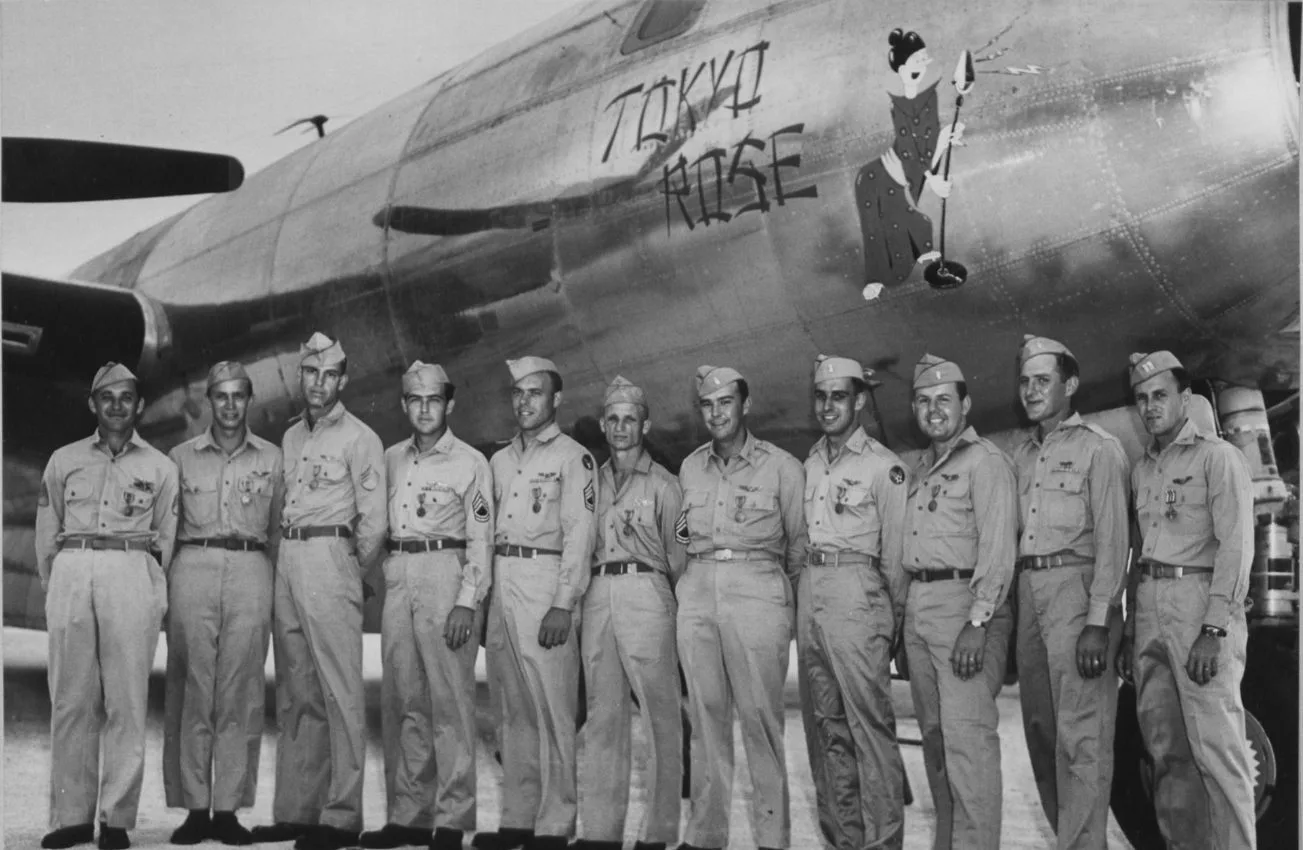
Header image: U.S. Air Force crew in front of the B-29 “Tokyo Rose,” Saipan, Mariana Islands, 1944. U.S. Air Force photograph. National Archives and Records Administration, NAID 204972152, Local ID 342-FH-3A38963-A55539AC. Public domain.